Software Development
Domain-Specific Language Models for Enterprise Software: Architecture, Fine-Tuning & Use Cases
October 7, 2026
October 7, 2026
Key Takeaways:
Domain-specific language models help enterprise software handle specialized terminology, business tasks, and industry workflows.
Use RAG for current company knowledge and fine-tuning for consistent, task-specific behavior.
Reliable data, clear permissions, and strong governance are essential for accurate, secure enterprise AI.
Build a focused prototype, test it against real business needs, and monitor performance after deployment.
Plan for the full cost of data preparation, model access, integrations, hosting, security, and maintenance.
What happens when your enterprise AI gives a confident answer but misses a critical company rule or uses the wrong technical term? That’s more than a small mistake. It can slow down teams, frustrate customers, and put business decisions at risk.
Domain-specific language models (DSLMs) help address this problem by adapting AI to specialized business needs. But do you need fine-tuning, RAG, or both? Choosing the wrong approach can waste time and money.
In this guide, we’ll explain enterprise DSLM architecture, fine-tuning methods, RAG vs. fine-tuning, data governance, deployment, security, and real-world business use cases so you can plan an AI system that fits your workflow.
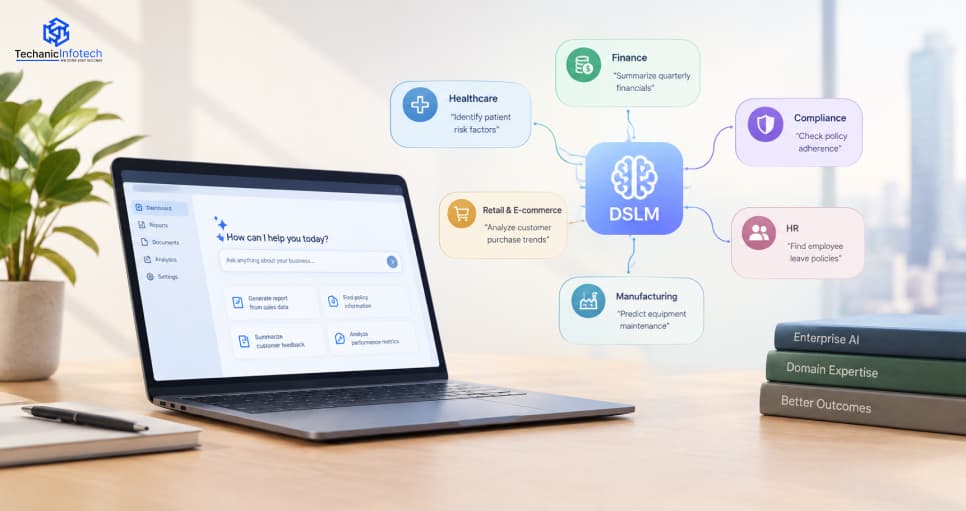
A domain-specific language model is a language model adapted to understand and perform tasks within a particular field. That field could be healthcare, finance, legal services, manufacturing, or enterprise IT.
The domain-specific language models market is projected to grow significantly, with the LLM platforms market reaching $15.54 billion by 2033
The language models market is reaching $18.25 billion by 2031, at CAGRs of 30.3% and 30.73%, respectively.
In enterprise software, DSLMs can support applications such as:
Internal knowledge assistants
Customer support copilots
Contract review systems
Financial document analysis
Technical support tools
Software development assistants
Manufacturing operations platforms
These three terms describe different things, although they are sometimes used interchangeably.
|
Type |
What it means |
Enterprise example |
|
General-purpose LLM |
A model designed to handle many kinds of tasks |
Drafting emails, summarizing text, and answering general questions |
|
Domain-specific language model |
A model adapted for a particular domain or task |
An LLM fine-tuned to classify insurance claims |
|
Domain-specific language (DSL) |
A programming language designed for a specific problem area |
A language for defining business rules or database queries |
A domain-specific approach can help address these needs.
Industries use terms that have precise meanings in their own context. A term in healthcare may mean something different from the same term in finance or manufacturing.
Domain-focused training and reliable context can help a model interpret these terms more accurately. This is especially useful when employees ask questions using abbreviations, technical language, or industry-specific phrases.
Enterprises rely on information stored across internal systems, including documents, knowledge bases, CRM platforms, ERP software, and support tools.
A model does not automatically know this information. RAG can retrieve relevant content from approved sources and provide it to the model when answering a question.
Many business processes involve similar tasks performed at scale. Examples include classifying support tickets, extracting information from contracts, summarizing incident reports, and drafting structured responses.
Fine-tuning may help a model perform these tasks in a more consistent way, particularly when the required behavior is difficult to achieve through prompting alone.
Enterprise applications often need responses in a specific format. A support system may require a ticket category, priority, summary, and suggested next step.
Structured output schemas, validation, and task-specific prompts can help enforce these formats. Fine-tuning may further improve consistency for recurring tasks.
Enterprise AI systems must work within access policies, data-handling rules, and business requirements. A domain-specific solution can be designed around approved data sources, permission checks, audit logs, and human review.
These decisions should also align with your generative AI business strategy, including how AI supports business goals, manages risk, and fits into existing workflows.
Specialization alone does not provide these controls. They must be implemented as part of the overall system.
An enterprise DSLM is usually one part of a larger software system. The complete application may include data pipelines, a retrieval layer, a language model, business logic, APIs, security controls, and monitoring.
A typical architecture looks like this:
Enterprise data → Ingestion → Processing and indexing → Retrieval → Model and orchestration → Validation → Enterprise application
Fine-tuning can be added to the model development process when the task requires it.
The system begins with information the business is allowed to use. Sources may include:
Internal documents and knowledge bases
CRM and ERP records
Product manuals and technical documentation
Support tickets and approved conversation data
Databases and business APIs
Policies, procedures, and reference materials
The ingestion layer collects information from approved systems. Depending on the source, it may use connectors, scheduled imports, event-driven updates, or API requests.
Raw data usually needs cleaning before the system can use it. Processing may include removing duplicate records, extracting text from files, correcting encoding issues, and preserving document metadata.
Metadata such as document owner, version, department, and access permissions can help the application retrieve the right information later.
For RAG, long documents are often divided into smaller sections called chunks. The system converts these chunks into numerical representations called embeddings.
An embedding captures aspects of a text's meaning, allowing the system to find content that is semantically related to a user's question.
Chunk size matters. Very large chunks may contain irrelevant information, while very small chunks can lose important context. The right approach depends on the document structure and the types of questions users ask.
Some systems also use keyword search, metadata filters, or hybrid search alongside vector search.
When a user asks a question, the retrieval layer searches the indexed content for relevant information. It may filter results based on the user's permissions, document status, department, or other conditions.
The application then selects and organizes the retrieved content into context for the model.
Retrieval quality has a direct effect on answer quality. If the system retrieves outdated, incomplete, or irrelevant information, the model may produce a weak answer even if the model itself is capable.
The model layer generates or transforms content. It may use a general-purpose foundation model, a fine-tuned model, or a smaller domain-focused model.
RAG supplies relevant information at runtime. Fine-tuning changes model parameters using training examples. These methods address different needs and can work together.
An orchestration layer manages the steps required to complete a request. It may decide when to retrieve information, call a business API, request clarification, or send an answer for review.
The application should validate important outputs before using them. For example, a generated JSON response may need schema validation, while a proposed financial action may require approval from an authorized employee.
The final layer connects the AI system to business applications. APIs can expose AI features to web applications, internal dashboards, CRM platforms, or workflow tools.
For actions that change business records, the application should verify permissions and validate the requested operation before executing it.
Production systems need monitoring for latency, errors, retrieval quality, model behavior, and user feedback.
These signals help teams identify problems and improve the system over time. Monitoring should also account for privacy and avoid collecting sensitive information unnecessarily.
The right choice depends on what the application needs to improve.
|
Enterprise requirement |
Approach to consider |
|
Answer questions about current company policies. |
RAG |
|
Retrieve information from private documents. |
RAG with access controls |
|
Use recently updated product information |
RAG |
|
Follow a consistent response format. |
Structured outputs and prompting |
|
Classify specialized requests. |
Prompting or fine-tuning |
|
Follow a domain-specific writing style. |
Prompting or fine-tuning |
|
Perform a recurring specialized task. |
Fine-tuning may help |
|
Combine current knowledge with task-specific behaviour. |
RAG + fine-tuning |
Fine-tuning adapts a pretrained model using a dataset designed for a specific task or domain. The process teaches the model patterns found in the examples, such as how to classify requests, follow instructions, or produce structured responses.
It does not guarantee that the model will learn every fact in the dataset correctly.
Supervised fine-tuning uses examples that pair an input with a desired output.
A training example for a support system might contain a customer message and the correct category, priority, and response. The model learns from many such examples.
The quality of the examples is critical. If the training data contains inconsistent labels, outdated rules, or low-quality responses, fine-tuning can reinforce those problems.
LoRA is a parameter-efficient fine-tuning method. Instead of updating all the model's parameters, it trains a smaller set of additional parameters.
This can reduce training costs and make it easier to maintain task-specific adaptations. LoRA is useful when a team wants to adapt a model without managing a full fine-tuning process.
QLoRA combines quantization with LoRA. It allows a quantized base model to be adapted using trainable low-rank components, reducing memory requirements during training.
It can make fine-tuning more accessible when GPU memory is limited. However, hardware needs still depend on the model size, sequence length, batch size, and training setup.
Before training, teams should:
Define the exact task and expected output.
Collect approved, relevant examples.
Remove duplicates and incorrect records.
Standardize labels and response formats.
Separate training, validation, and test data.
Check for sensitive information and data leakage.
The test set should remain separate from the training process. Otherwise, evaluation results may look better than real-world performance.
Fine-tuning can weaken some capabilities the model had before training. This is known as catastrophic forgetting.
The risk depends on the model, dataset, training method, and training settings. Teams can reduce it by using suitable training data, limiting training intensity, and testing both the target task and important general capabilities.
Avoid fine-tuning when the main requirement is to provide current facts, retrieve private documents, or follow a simple output format that prompting can already handle.
Start with a baseline model and test it on representative tasks. Add fine-tuning only when evaluation shows a meaningful gap that training is likely to address.
The quality of a domain-specific AI system depends heavily on its data. This applies to both retrieval and fine-tuning, although the data requirements differ.
RAG data and fine-tuning data need separate preparation processes.
|
RAG data |
Fine-tuning data |
|
Supplies information at runtime |
Teaches task behavior |
|
Often includes current documents |
Uses curated input-output examples |
|
Needs indexing and metadata |
Needs consistent examples and labels |
|
Must reflect access permissions |
Must be approved for model training |
|
Requires updates when sources change |
Requires controlled dataset revisions |
For RAG, teams should focus on document quality, version control, metadata, access permissions, and update frequency. Outdated or conflicting documents can lead to unreliable answers.
For fine-tuning, teams should focus on representative examples, consistent labels, task coverage, and clean evaluation splits.
Data governance should also define who owns each dataset, who can approve its use, how sensitive information is handled, and when data must be removed.
These practices help teams maintain a clear record of where their AI system's information and training examples came from.
A focused implementation process helps enterprises avoid unnecessary model complexity.
Start with one specific business problem. Examples include answering internal policy questions, classifying support tickets, or summarizing technical incidents.
This focused approach also supports AI native software development, where AI capabilities are built into software workflows to solve specific business needs.
Define the intended users, expected outputs, risk level, and success criteria.
Identify the data sources required for the task. Check their quality, freshness, ownership, access restrictions, and suitability for AI use.
Do not assume that every document available to the company should be accessible to the model.
Test an existing model with representative prompts and real-world examples. Record its accuracy, output quality, latency, and failure cases.
This baseline provides a way to measure whether RAG, fine-tuning, or other changes actually improve the result.
Use RAG when the task depends on current or private information. Use prompting and structured outputs for clear instructions and formatting requirements. Consider fine-tuning for repeated specialized behavior.
Choose a combined approach only when the use case benefits from both retrieved knowledge and adapted behavior. This decision also helps clarify custom AI vs off the shelf solutions, based on your data needs, workflow requirements, and the level of customization your business needs.
Connect the model to a small, approved dataset or a limited set of business workflows. Add the retrieval, validation, and permission checks required for the task.
Keep the prototype narrow enough to test and troubleshoot.
Test the system against representative questions, edge cases, incorrect inputs, and unauthorized requests.
Compare results with the baseline. Fix data, retrieval, prompts, or model behavior based on the errors you find.
Integrate the system into the relevant enterprise application. Monitor performance, security events, user feedback, and changes in data quality.
Use the results to guide updates rather than retraining or changing the system without evidence.
Enterprises can deploy DSLM-based applications through managed model APIs, private cloud environments, or self-hosted infrastructure.
The choice depends on data sensitivity, latency requirements, operational capacity, cost, and control requirements.
For smaller businesses, custom software development for SMBs can help connect AI features with existing workflows while keeping the solution aligned with their operational needs and budget.
Managed APIs can reduce infrastructure work, while self-hosting may offer greater control over the serving environment. Private and hybrid deployments can support specific security or data-location needs, but they still require careful configuration.
Enterprise integration is equally important. The AI system may need to connect with:
CRM platforms for customer and sales workflows
ERP systems for business operations
Ticketing tools for support and incident management
Document repositories for internal knowledge
Identity systems for authentication and access control
For production use, teams should plan for scaling, rate limits, timeouts, retries, logging, and model version changes. They should also define what happens when the model or a connected service is unavailable.
A useful deployment design keeps business rules and permission checks outside the model wherever possible. The model can recommend an action, but the application should decide whether that action is allowed.
Enterprise DSLMs may process confidential documents, customer records, financial information, or proprietary technical data. Security must cover the entire application, not just the model.
Users should only retrieve information they are authorized to see. Permissions must be enforced during retrieval and before any connected tool or business API performs an action.
Filtering results after the model has already received unauthorized content is too late.
Teams should identify sensitive data, minimize unnecessary collection, and define how prompts, retrieved documents, outputs, and logs are stored.
They should also review the data handling practices of any external model provider, including retention, training use, and processing arrangements.
Prompt injection occurs when malicious or untrusted content attempts to manipulate the model's behavior. Such content may appear in user prompts, retrieved documents, or other inputs.
Retrieved text should be treated as data, not as trusted instructions. The application should restrict tool access, validate outputs, and require approval for sensitive actions.
Audit logs can record relevant events, such as model versions, retrieval sources, access decisions, and tool calls. Logs should be designed to support investigation without unnecessarily exposing sensitive information.
Applicable compliance requirements depend on the industry, data, jurisdiction, and intended use. A model's domain specialization does not automatically make the application compliant.
RAG is not a security boundary. It can provide relevant context, but identity checks, authorization, data protection, and application-level controls must be implemented separately.
Domain-specific language models can support a range of enterprise workflows. The exact design depends on the task, data, and level of risk.
|
Industry |
Example use case |
Potential role of a DSLM |
|
Healthcare |
Clinical document assistance |
Summarize approved records or organize clinical text for review |
|
Finance |
Financial document analysis |
Extract information and classify financial documents |
|
Legal |
Contract review support |
Identify clauses and summarize contract sections |
|
Manufacturing |
Technical operations assistant |
Retrieve equipment guidance and summarize maintenance reports |
|
SaaS and IT |
Support and engineering copilot |
Classify tickets, summarize incidents, and retrieve technical documentation |
A model that produces fluent answers is not necessarily suitable for enterprise use. Evaluation should measure whether it completes the intended task accurately, safely, and consistently.
Start by creating a test set that reflects real user requests, common edge cases, and known failure modes.
|
Metric |
What it measures |
|
Task accuracy |
Whether the model completes the requested task correctly |
|
Retrieval relevance |
Whether retrieved content is useful for the question |
|
Groundedness |
Whether answers are supported by the provided evidence |
|
Format validity |
Whether outputs follow the required structure |
|
Latency |
How long the system takes to respond |
|
Cost per task |
The model and infrastructure cost of processing a request |
|
Safety and access control |
Whether the system respects policies and permissions |
The evaluation method should match the use case. A classification model may need precision, recall, and F1 scores. A RAG application may need retrieval and groundedness checks. A structured-output system should also test schema validity.
Human review remains useful for tasks where errors have meaningful business consequences. Reviewers should use clear criteria rather than relying only on whether an answer sounds convincing.
Test the full application, not just the model. Retrieval failures, permission errors, API issues, and poor context assembly can all affect the final result.
After deployment, monitor real-world performance for changes in user behavior, source data, model versions, and task requirements. Evaluation should continue as the system evolves.
The cost of an enterprise DSLM depends on the model, data pipeline, deployment setup, and amount of usage. Model training is only one part of the total cost.
Key cost drivers include:
Model access or hosting: API usage, GPU resources, and inference capacity.
Data preparation: Cleaning documents, building connectors, labelling examples, and maintaining indexes.
Fine-tuning: Training compute, dataset preparation, experimentation, and evaluation.
RAG infrastructure: Embedding generation, vector storage, retrieval, and document updates.
Integration: Connecting the model to enterprise applications and workflows.
Maintenance: Monitoring, security reviews, model updates, and ongoing evaluation.
A successful implementation depends on more than selecting a model. These practices help keep the project focused and manageable.
Start with a defined task: Solve a clear business problem before expanding to more workflows.
Build a baseline: Measure an existing model before investing in fine-tuning.
Use trusted data: Keep source documents current, relevant, and properly governed.
Choose the simplest effective approach: use RAG, prompting, or fine-tuning based on measured needs.
Protect data and actions: Enforce permissions, validate outputs, and restrict tool access.
Test continuously: Evaluate quality, security, latency, and cost before and after deployment.
Domain-specific language models (DSLMs) can help enterprise software handle specialized tasks, technical terms, and business workflows. But success depends on more than choosing a model. Start with reliable enterprise data, then decide if RAG, fine-tuning, or both fit your needs.
A solid DSLM architecture also requires data governance, secure deployment, access controls, and ongoing evaluation.
From healthcare to manufacturing, the goal is simple: build an AI system that solves real business problems, protects sensitive information, and delivers useful results without adding needless complexity.
A domain-specific language model (DSLM) is adapted for a specific field or task. It helps enterprise software handle industry terms, specialized workflows, and domain-related requests.
General-purpose LLMs handle many topics, while DSLMs focus on specific industries or tasks. This can help them follow specialized terminology and workflows.
RAG retrieves relevant information at runtime. Fine-tuning trains a model on examples to adapt its behavior. Enterprises can use both when needed.
No. You can use prompting or RAG with an existing model. Fine-tuning is useful when testing shows that the model needs better task-specific behavior.
RAG retrieves relevant information from approved sources, such as company documents or databases, and gives it to the model to help answer a user's question.
Costs depend on model access, data preparation, fine-tuning, RAG infrastructure, integrations, hosting, and maintenance. The total varies by project and usage.
They use access controls, data protection, permission checks, audit logs, and output validation. Security must cover the full application, not just the model.
Test task accuracy, groundedness, retrieval quality, output format, latency, cost, and security. Use real business examples and keep testing after deployment.


Abhishek Jangid is the CEO of Techanic Infotech, with extensive experience in mobile app and web development. He specializes in helping businesses turn innovative ideas into scalable digital solutions through strategic planning and modern technology.