Mobile App Development
How AI Is Making Mobile Apps More Context Aware and Personalized?
September 7, 2026
September 7, 2026
Most mobile apps already collect signals about how people use them. They know what users search for, which screens they visit, what they buy, what they ignore, and when they return.
The difference today is that artificial intelligence can make much better use of that information.
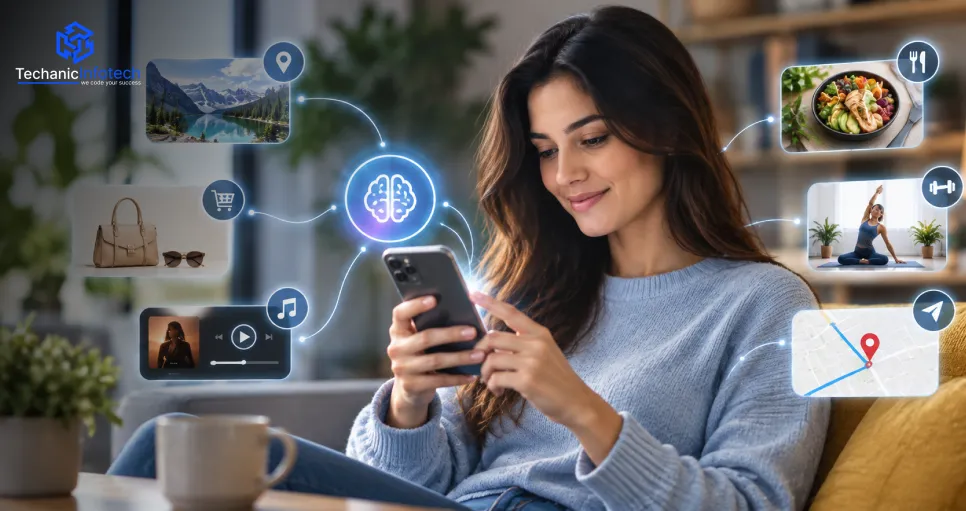
Instead of giving every user the same interface, recommendations, notifications, and search results, AI can help an app respond to the context of each individual user.
That context may include previous activity, preferences, location, time, current behavior, purchase history, device activity, and even the intent behind a search or conversation.
The result is a more relevant mobile experience.
For businesses, this matters because personalization is no longer limited to showing a user's name or recommending a few popular products. Modern applications can adapt continuously as the user interacts with them.
Building this kind of experience requires more than an AI model. It requires strong mobile architecture, user data, backend systems, APIs, privacy controls, and carefully designed product logic. Businesses planning such products can combine AI capabilities with professional mobile app development services.
A context aware mobile app changes its behavior according to information about the user and the situation in which the app is being used.
A normal application may respond only to direct actions.
If the user taps a category, the app opens that category.
If the user searches for a product, the app returns matching results.
A context aware application can consider more information before deciding what to show.
For example, a food delivery app may know that a user usually orders vegetarian food in the evening. Instead of displaying the same restaurant list shown to everyone, the application can prioritize relevant options at the time the user is most likely to order.
A travel app may recognize that a user frequently searches for short weekend trips and begin recommending destinations that match previous budgets and travel preferences.
A fitness application may adjust suggested workouts depending on past activity and progress.
The application becomes more useful because it responds to the user's situation rather than treating every interaction as an isolated event.
Personalization itself is not new.
Apps have used recommendation systems, user profiles, and behavioral data for years.
What has changed is the amount of context AI can understand and how quickly it can turn that context into an action.
Older personalization systems often depended heavily on predefined rules.
For example:
A user who purchased running shoes may be shown running accessories.
A user who watched several comedy films may receive more comedy recommendations.
These rules can still be useful, but AI allows personalization to become more flexible.
A modern system can evaluate multiple signals at the same time and identify patterns that would be difficult to define manually.
This is one of the areas covered in Techanic Infotech's broader guide to AI mobile app development, where personalization, recommendation systems, predictive analytics, and intelligent automation are treated as part of the wider app architecture.
AI powered personalization begins with data.
The application needs enough useful information to understand what the user is doing and what may be relevant at that moment.
The exact data depends on the product.
An ecommerce app may use browsing activity, previous purchases, search queries, saved products, and cart behavior.
A streaming app may focus on viewing history, session duration, skipped content, and category preferences.
A travel app may use destination searches, booking history, trip dates, location preferences, and budget patterns.
AI models analyze these signals and look for relationships between them.
This allows the application to answer questions such as:
What is this user likely to want next?
Which content is most relevant right now?
Is the user's current behavior different from normal?
What information should appear first?
Which notification is likely to be useful?
The application can then adjust what the user sees.
Recommendation engines are one of the clearest examples of AI driven personalization.
They help applications decide which products, services, content, or actions should be presented to a specific user.
An ecommerce app may recommend items based on previous browsing and purchasing behavior.
A streaming platform may suggest content according to viewing patterns.
An education app may recommend lessons based on progress and previous performance.
The important difference is that recommendations can change continuously.
If user behavior changes, the recommendation system can respond.
A customer who previously bought budget products may start viewing premium alternatives. The system can recognize that change instead of continuing to treat the user according to an old profile.
This makes recommendations more responsive to actual behavior.
Search is becoming another important part of context aware app experiences.
Traditional search depends heavily on keywords.
Users need to type terms that closely match the information stored inside the application.
AI can make search more flexible by understanding meaning and intent.
Imagine a user enters:
I need a lightweight laptop for travel and occasional video editing.
A conventional search system may struggle because the query contains several different requirements.
An AI powered system can understand that the user cares about portability, performance, and a particular use case.
It can then return results that match the overall intent rather than simply matching individual words.
This is especially valuable in mobile apps where users often want to reach a result quickly rather than navigate several filters.
AI can also change the content displayed inside an application.
The app may adjust information according to time, location, previous activity, or current intent.
For example, a travel application could show local activities once the user reaches a destination instead of continuing to promote booking options.
A retail application could surface recently viewed items when the user returns after several days.
A financial application could highlight unusual spending activity instead of showing the same dashboard information every time.
This does not mean redesigning the entire interface for every user.
Small changes in ordering, recommendations, content visibility, and messaging can make the app feel significantly more relevant.
Some of the most useful personalization happens before the user explicitly asks for something.
Predictive models use historical behavior to estimate what a user may need next.
A grocery app could predict frequently purchased products.
A fitness app could recommend a lighter workout after a period of reduced activity.
A subscription platform could identify users who appear likely to cancel and offer more relevant support or content.
A fintech app could detect spending patterns and surface insights before the user manually reviews transactions.
This turns the application from a passive tool into something that can anticipate needs.
Prediction still needs to be used carefully. A recommendation that is consistently wrong quickly becomes annoying rather than useful.
The quality of the data and the model behind it therefore matters as much as the feature itself.
Conversational interfaces allow users to provide context directly.
Instead of forcing users through menus and filters, the app can let them explain what they want in natural language.
For example, a travel user might ask:
Find me a quiet beach destination for four days with hotels within my budget.
The application can combine the request with available profile information and previous preferences.
An ecommerce user could ask for a gift recommendation based on a recipient, occasion, and price range.
A financial app could allow a user to ask questions about spending patterns in ordinary language.
These experiences rely on natural language understanding, user context, business data, and application logic working together.
Techanic Infotech provides AI development services for businesses that want to integrate these capabilities into mobile and software products rather than adding a disconnected chatbot that has little access to the actual application.
User preferences are rarely fixed.
Someone may use a shopping app differently during the holiday season than during the rest of the year. A fitness user may change goals after several months. A traveler who once searched for budget trips may later begin looking at premium experiences.
Static personalization can miss these changes.
Adaptive AI allows an application to update its understanding as new behavior appears. Instead of relying only on an old profile, the system continues learning from recent interactions and outcomes.
This can improve recommendations, content ordering, search results, and other personalized experiences.
For applications where customer behavior changes frequently, Techanic Infotech provides adaptive AI development services that can support recommendation systems and intelligent experiences that evolve with real usage.
Location can provide useful context when it directly affects what the user needs.
A travel application may recommend nearby attractions after a user reaches a destination. A food delivery app may prioritize restaurants that can deliver to the current area. A retail app could show the nearest store with a product in stock.
Location should not be used simply because a device can provide it.
The information needs to improve the experience.
Time can also add useful context. A restaurant application may show breakfast options in the morning and dinner options later in the day. A productivity app may organize suggestions according to the user's work routine.
When location, time, activity, and previous behavior are analyzed together, the application can make much more relevant decisions.
Notifications are useful when they arrive at the right moment.
They become irritating when they are repetitive or irrelevant.
AI can improve notification strategies by analyzing how users respond to previous messages and what they are currently doing inside the application.
Instead of sending the same notification to the entire user base, an app can decide whether a particular user is likely to find the message useful.
Consider an ecommerce application.
One customer may respond well to price drop alerts. Another may be more interested in reminders about saved products. A third user may rarely interact with notifications at all.
Treating these users differently can create a better experience than applying one notification strategy to everyone.
Context aware notifications should aim to reduce unnecessary interruptions rather than simply increase the number of messages sent.
There is a temptation to add personalization everywhere once a business has access to AI.
That is usually the wrong approach.
Context awareness is useful when it removes effort from the user.
If personalization creates unpredictable interfaces, irrelevant recommendations, or constant notifications, it can make the experience worse.
Businesses should identify the areas where understanding context genuinely improves the user journey.
For many apps, those areas are search, recommendations, onboarding, content discovery, customer support, and notifications.
The goal is not to make every screen intelligent.
It is to make the application better at recognizing what the user is trying to accomplish.
The underlying personalization logic may be similar across platforms, but implementation still needs to respect the mobile environment.
Android and iOS applications have different development frameworks, device capabilities, permission models, and platform requirements.
AI features also need to work with the rest of the app rather than slowing it down or introducing unnecessary complexity.
For businesses targeting Apple users, Techanic Infotech provides dedicated iOS app development services that can incorporate intelligent features while maintaining the performance and usability expected from native applications.
The same principle applies across mobile platforms.
AI should support the experience rather than becoming the experience itself.
The technology behind context aware apps can be sophisticated, but the product decision is often straightforward.
Businesses need to decide what information the app should understand and how that information should improve the user's next interaction.
An ecommerce business may prioritize better discovery and recommendations.
A healthcare platform may focus on easier access to relevant information.
A travel platform may prioritize personalized planning.
A content application may focus on discovery and retention.
There is no universal personalization model that works for every app.
The architecture needs to reflect the product, its users, and the type of data available.
This is where experienced mobile and AI development becomes important. Techanic Infotech can help businesses define the right personalization use cases, connect AI with existing data and backend systems, and build the mobile experience around those requirements rather than forcing generic AI features into the product.
The value of AI personalization depends heavily on the type of application being built.
Ecommerce applications can personalize search results, product recommendations, promotions, home screens, and notifications according to browsing and buying behavior.
The application can also respond to immediate intent. Someone searching repeatedly for laptops should not continue seeing unrelated recommendations simply because they purchased a phone several months earlier.
Healthcare and fitness applications can personalize reminders, educational content, wellness suggestions, and user journeys according to relevant activity and preferences.
These applications need stronger privacy controls because the information they process may be sensitive.
Travel apps can adapt recommendations according to destination, budget, previous trips, travel dates, location, and current stage of the journey.
What a user needs while planning a trip is different from what they need after arriving.
Financial apps can personalize insights around spending patterns, account activity, savings goals, and relevant services.
In this category, personalization should be particularly transparent. Recommendations need to be useful without making users feel that financial behavior is being analyzed unnecessarily.
The wider range of products that can benefit from these capabilities can also be seen across Techanic Infotech's app and software solutions, which cover industries including healthcare, finance, retail, travel, logistics, education, and entertainment.
A context aware app usually needs more information than a basic application.
That creates an obvious responsibility.
Businesses need to decide what data is genuinely necessary and avoid collecting information simply because it may be useful later.
Users should understand why permissions are requested and how information improves their experience.
A location based feature, for example, should have a clear reason for requesting location access.
Businesses should also consider where personalization data is stored, who can access it, how long it is retained, and whether sensitive information is being shared with external AI systems.
Good personalization should feel helpful rather than intrusive.
That distinction will become more important as mobile apps gain access to increasingly capable AI models.
The difficulty is not usually adding a recommendation model or connecting an AI API.
The harder part is making the feature reliable inside a real application.
Developers need to connect user activity, backend data, AI models, APIs, and application logic without affecting performance.
Poor data can also create poor personalization.
If the application misunderstands user behavior, it may repeatedly surface irrelevant content. The result can be worse than showing a general experience.
Mobile performance is another consideration.
AI requests can add latency, cloud costs, and additional backend processing. Development teams need to decide which intelligence should run through cloud services and which operations can be handled more efficiently inside the application.
Platform specific engineering matters as well. Businesses targeting Android users can work with Techanic Infotech's Android app development team to integrate intelligent capabilities while maintaining app performance, usability, security, and compatibility across devices.
Building a personalized mobile experience begins with understanding the product rather than selecting an AI model.
Techanic Infotech can help businesses identify where context awareness would actually improve the app, then design the architecture required to support it.
Depending on the product, implementation may involve user behavior analysis, recommendation engines, predictive models, intelligent search, conversational interfaces, location based experiences, personalized notifications, or adaptive AI systems.
The AI layer also needs to work with the rest of the product.
That means connecting mobile interfaces with backend systems, databases, APIs, cloud services, analytics, and business logic.
For an existing application, the work may involve integrating new AI capabilities rather than rebuilding the entire product.
For a new app, personalization can be planned into the architecture from the beginning.
The objective is not to make every part of the application intelligent. It is to use AI where understanding the user can make the product genuinely easier or more useful.
AI is changing mobile personalization from a collection of simple rules into a much more responsive experience.
Apps can now understand intent, recognize changing preferences, improve search, adjust recommendations, and use real time context to decide what information matters most.
But successful personalization depends on restraint.
Businesses need good data, clear product goals, thoughtful privacy decisions, and an application architecture that can support AI without making the experience slower or more complicated.
When those pieces are handled well, context awareness can make an app feel less generic and much more useful to the person using it.
A context aware mobile app adjusts content, recommendations, search results, or other experiences according to information such as user behavior, preferences, location, time, and current activity.
AI analyzes user signals and identifies patterns that can help the app provide more relevant recommendations, content, notifications, and experiences.
Ecommerce, travel, healthcare, fitness, finance, entertainment, education, and content platforms can all benefit when personalization solves a clear user need.
Yes. Existing apps can often add recommendation systems, intelligent search, personalized notifications, predictive features, and other AI capabilities through backend and application updates.
Yes. Techanic Infotech can design and develop mobile applications with AI based personalization, adaptive recommendations, contextual search, intelligent notifications, and other custom AI capabilities.


Bharat Sharma is the CTO of Techanic Infotech, bringing deep technical expertise in software architecture, mobile app development, and scalable system design. He leads the engineering team with a strong focus on innovation, performance, and security.