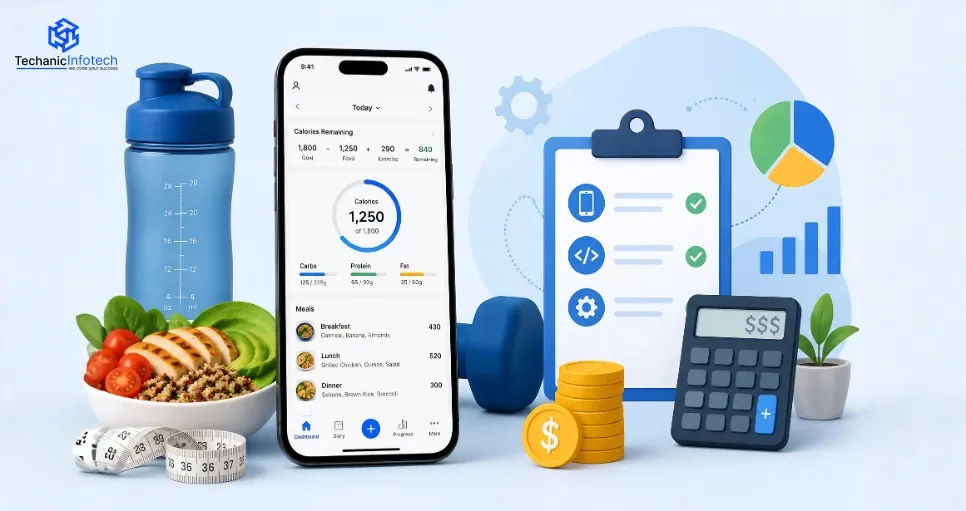
Key Takeaways
The MyFitnessPal-like app development cost typically starts around $8,000 and increases based on features, integrations, and overall complexity.
Core features like nutrition tracking, workout logging, and user profiles play a major role in both user engagement and development pricing.
Hidden costs such as APIs, cloud hosting, maintenance, and marketing can significantly impact your overall budget if not planned early.
Choosing the right monetisation strategy, like subscriptions, partnerships, or content marketplaces, helps recover costs and drive long-term revenue.
A scalable, user-focused approach with the right tech stack and development team is essential to building a competitive and sustainable fitness app.
Building a fitness tracking app like MyFitnessPal is a smart move in today’s health-focused market.
But how much does it really cost to develop a feature-rich app that users rely on daily?
In the middle of this discussion, the MyFitnessPal-like app development cost depends on several factors, such as features, integrations, design complexity, and the technology stack you choose.
From calorie tracking and workout logging to AI-driven insights, each element impacts the overall budget.
In this guide, we’ll break down key cost factors, explore essential features, compare development approaches, and share practical tips to help you plan your fitness app investment effectively.
Understanding market trends is essential before estimating development costs. In 2026, evolving user behaviour, AI adoption, and rapid growth in digital fitness are directly shaping how apps like MyFitnessPal are built and priced.
The global fitness app market is projected to reach $13.92 billion in 2026 and grow to $33.58 billion by 2033, showing strong demand for health-focused apps and long-term investment potential.
AI-driven fitness experiences are becoming standard. Over 60% of US users already rely on health apps, and demand for personalised workouts, nutrition tracking, and smart recommendations continues to grow rapidly.
Modern apps now integrate with wearables and IoT devices for real-time tracking. This trend increases development complexity but enhances user engagement, making connected fitness ecosystems a key cost-driving factor in 2026.
Estimating development costs helps you plan your fitness app budget more effectively. Understanding features in fitness apps is essential, as a MyFitnessPal-like app can start around $8,000, depending on complexity and integrations.
When estimating the MyFitnessPal app development cost in 2026, this module plays a key role. It allows users to set goals, manage profiles, and track progress for a personalised fitness experience.
|
Component |
Description |
Estimated Cost (USD) |
|
Profile Setup |
User data and preferences |
$300 – $380 |
|
Goal Configuration |
Fitness and nutrition targets |
$280 – $350 |
|
Progress Tracking |
Activity and goal monitoring |
$320 – $400 |
The MyFitnessPal clone app development cost increases with a rich food database. Accurate calorie tracking and meal logging require API integration or custom database creation for a better user experience.
|
Component |
Description |
Estimated Cost (USD) |
|
Food Database API |
Third-party integration |
$350 – $420 |
|
Custom Entries |
User-added food tracking |
$300 – $380 |
|
Nutritional Insights |
Calorie and macro breakdown |
$320 – $400 |
In fitness app development, barcode scanning simplifies food tracking. This feature improves usability but requires camera integration and database matching, increasing development effort and cost.
|
Component |
Description |
Estimated Cost (USD) |
|
Camera Integration |
Barcode scanning functionality |
$300 – $380 |
|
Product Lookup |
Database matching |
$320 – $400 |
|
Error Handling |
Scan accuracy improvements |
$280 – $350 |
When building an app like MyFitnessPal, a workout library is essential. It enables users to follow routines, log exercises, and monitor progress, boosting engagement and retention.
|
Component |
Description |
Estimated Cost (USD) |
|
Exercise Database |
Workout content |
$320 – $400 |
|
Activity Tracking |
Exercise logging |
$300 – $380 |
|
Progress Metrics |
Performance insights |
$350 – $420 |
The cost to develop an app like MyFitnessPal includes engagement features like notifications. Reminders for meals, workouts, and hydration improve retention but require backend scheduling and personalisation.
|
Component |
Description |
Estimated Cost (USD) |
|
Notification Setup |
Push system integration |
$280 – $350 |
|
Scheduling Logic |
Timed alerts |
$300 – $380 |
|
Personalization |
User-based reminders |
$320 – $400 |
The cost to develop a fitness app increases with social features. Community interaction, sharing progress, and group challenges boost engagement but require additional backend and moderation systems.
|
Component |
Description |
Estimated Cost (USD) |
|
Social Feed |
Activity sharing |
$350 – $420 |
|
Group Features |
Community interaction |
$320 – $400 |
|
Moderation Tools |
Content control |
$300 – $380 |
The cost to build an app like MyFitnessPal rises with global features like localisation. Supporting multiple languages expands reach but requires UI adjustments, translations, and regional customisation.
|
Component |
Description |
Estimated Cost (USD) |
|
Language Integration |
Multi-language support |
$300 – $380 |
|
Content Translation |
Regional text adaptation |
$280 – $350 |
|
UI Adjustments |
Layout localization |
$320 – $400 |
The MyFitnessPal-style app development cost includes monetisation systems. Secure payment gateways, subscriptions, and billing logic add complexity but are essential for generating consistent revenue.
|
Component |
Description |
Estimated Cost (USD) |
|
Payment Gateway |
Secure transactions |
$350 – $420 |
|
Subscription Logic |
Plan management |
$320 – $400 |
|
Billing System |
Payment tracking |
$300 – $380 |
Diet and nutrition app development requires admin tools for managing users and tracking performance. Analytics dashboards provide insights but increase backend complexity and overall development cost.
|
Component |
Description |
Estimated Cost (USD) |
|
Admin Panel |
User and system control |
$350 – $420 |
|
Data Analytics |
Performance tracking |
$320 – $400 |
|
Reporting Tools |
Insights and reports |
$300 – $380 |
App maintenance cost is influenced by cloud storage and data handling. Secure infrastructure, backups, and scalable storage ensure performance but add to long-term operational expenses.
|
Component |
Description |
Estimated Cost (USD) |
|
Cloud Setup |
Infrastructure configuration |
$400 – $500 |
|
Data Storage |
User data management |
$350 – $420 |
|
Backup Systems |
Data security and recovery |
$320 – $400 |
Hidden costs in fitness app development can quickly impact your overall budget if not planned properly. Working with a reliable fitness app development company helps identify these expenses early and ensures better financial control throughout the project lifecycle.
|
Hidden Cost Element |
Description |
Estimated Cost (USD) |
|
Third-Party API Integrations |
Costs for nutrition databases, payment gateways, or analytics tools |
$200 – $500/month |
|
App Store Fees |
Charges for publishing on the Apple App Store and Google Play |
$25 – $99/year |
|
Cloud Hosting & Storage |
Ongoing server, storage, and bandwidth expenses |
$100 – $400/month |
|
Maintenance & Updates |
Regular bug fixes, feature updates, and performance improvements |
$300 – $800/month |
|
Security Enhancements |
Data encryption, compliance, and protection upgrades |
$200 – $600 |
|
UI/UX Revisions |
Design changes based on user feedback or testing |
$250 – $700 |
|
Marketing & User Acquisition |
Paid ads, influencer marketing, and promotional campaigns |
$500 – $2,000+ |
|
Device & OS Compatibility |
Testing across devices and operating systems |
$200 – $600 |
|
Customer Support Systems |
Chatbots, helpdesk tools, and support team setup |
$150 – $500/month |
|
Scaling Infrastructure |
Additional resources as the user base grows |
$300 – $1,000+ |
Monetising a MyFitnessPal-like app in 2026 requires creative strategies beyond traditional models. The MyFitnessPal-like app development cost can be recovered faster by focusing on scalable and user-driven revenue streams.
When evaluating MyFitnessPal app development cost in 2026, white-label solutions offer strong ROI. Businesses like gyms and trainers can rebrand your app, creating a consistent B2B revenue stream.
Many fitness app development companies partner with organisations to offer employee wellness solutions. Companies pay for access, creating stable, high-value revenue while improving workforce health and engagement.
The MyFitnessPal clone app development cost increases with wearable integrations, but it unlocks premium partnerships. Exclusive features for smartwatch users can generate additional revenue and improve user retention.
Investing in UI/UX design services helps create engaging fitness challenges. Charging entry fees for competitions boosts user interaction while opening up recurring monetization opportunities within the app.
A content marketplace can offset MyFitnessPal-like app development cost by allowing trainers and nutritionists to sell plans. Taking a commission on each transaction creates a scalable and content-driven revenue model.
When building an app like MyFitnessPal, offering paid API access allows other platforms to use your features. This creates an additional revenue stream without directly depending on end-users.
Collaborating with healthcare providers and insurance companies for sponsored programmes adds credibility and generates revenue while delivering value-driven fitness initiatives to users.
Partnering with on-demand app development services helps implement premium syncing and backup features. Users pay for seamless cross-device access, creating a steady and subscription-like revenue stream.
Building a MyFitnessPal-like app in 2026 requires a thoughtful balance between features, user experience, and cost planning.
From understanding market trends to estimating development expenses and hidden costs, every step plays a critical role in shaping your app’s success.
Choosing the right monetisation model ensures you can recover investment while delivering real value to users. It’s also important to focus on scalability, performance, and long-term engagement rather than just the initial launch.
By aligning your strategy with user needs and industry trends, you can create a competitive fitness app that stands out in a crowded market.
With the right approach, your app can drive growth, retain users, and generate sustainable revenue over time.
The MyFitnessPal-like app development cost typically starts around $8,000 for a basic version and increases based on features, integrations, and overall app complexity.
Key factors include app features, UI/UX design, third-party integrations, tech stack, development team location, and scalability requirements.
Development usually takes 3 to 6 months, depending on the app’s complexity, features, and whether you start with an MVP or a full-scale solution
Important features include user profiles, calorie tracking, workout logs, notifications, analytics, and integrations with wearables or third-party tools.
Yes, hidden costs may include API subscriptions, cloud hosting, maintenance, app store fees, marketing, and ongoing updates.
You can reduce costs by building an MVP first, using open-source tools, reusing APIs, outsourcing development, and prioritising essential features.
Effective models include subscriptions, in-app purchases, affiliate marketing, corporate partnerships, and content marketplaces for trainers and nutritionists.
Yes, with the right strategy, user engagement, and monetisation model, fitness apps can generate consistent revenue and long-term profitability.
Custom development offers flexibility and scalability, while ready-made solutions are quicker and more affordable initially but may limit future growth.
Look for experience, portfolio, technical expertise, and the ability to deliver scalable, user-friendly solutions aligned with your business goals.


Bharat Sharma is the CTO of Techanic Infotech, bringing deep technical expertise in software architecture, mobile app development, and scalable system design. He leads the engineering team with a strong focus on innovation, performance, and security.