Mobile App Development
Native vs Cross-Platform App Development: Key Differences, Benefits, Cost and Full Guide
September 19, 2026
September 19, 2026
Key Takeaways:
Native development offers superior performance and immediate access to platform specific features, making it ideal for graphics-intensive apps, games, and complex hardware integrations.
Cross-platform frameworks like Flutter and React Native reduce development time and cost significantly through a single shared codebase serving both iOS and Android.
Common challenges differ by approach: native development faces higher maintenance burden and talent costs, while cross-platform deals with bridge overhead and delayed OS feature support.
Choosing the right approach depends on evaluating performance needs, budget constraints, timeline, and long-term scalability rather than following industry trends.
Most business apps, MVPs, and content-driven platforms perform well with cross-platform development, while performance-critical apps benefit more from native development investment.
Every mobile app project eventually hits the same fork in the road: build natively for iOS and Android separately, or use a cross-platform framework to build once and deploy everywhere.
It's one of the earliest, highest-stakes decisions in the entire development process, and getting it wrong can mean expensive rewrites down the line.
The native vs. cross-platform app development debate isn't about which approach is objectively better; it's about which one actually fits your specific app's performance needs, budget, timeline, and long-term goals.
This guide breaks down the real technical differences between the two, comparing performance, development speed, cost, and use cases in detail, so you can make an informed decision instead of just following whatever's trending.
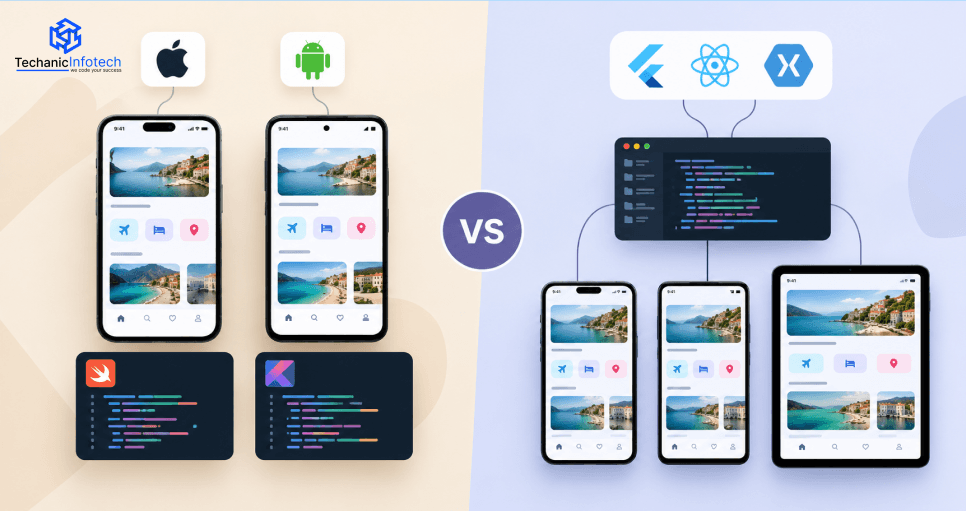
Native app development means building separate apps for iOS and Android using each platform's dedicated language and tools: Swift for iOS and Kotlin for Android.
Cross-platform development uses a single codebase to deploy across both operating systems simultaneously, trading some platform-specific optimization for speed and cost efficiency.
iOS apps get built with Swift (or Objective-C) using Apple's Xcode, while Android apps use Kotlin (or Java) through Android Studio.
Each platform has its own design guidelines, APIs, and tooling, meaning native development essentially requires building and maintaining two entirely separate applications.
This shift has become mainstream, not experimental.
Over 80% of developers now use or plan to use cross-platform frameworks, with the market projected to grow at roughly 15% CAGR, reflecting how thoroughly cross-platform tools have moved into standard industry practice.
Flutter and React Native dominate this category specifically.
Flutter holds approximately 46% developer market share compared to React Native's 35%, together accounting for over 80% of the cross-platform development conversation among professional mobile developers worldwide.
Native and cross-platform development both aim to deliver functional, reliable apps to users; they simply take fundamentally different paths to get there.
Native prioritizes platform-specific optimization, while cross-platform prioritizes development efficiency and shared codebase maintenance across both operating systems.
Neither approach wins universally; the right choice depends heavily on your specific app type and priorities.
Understanding where cross-platform app development genuinely shines, and where native still holds the advantage, helps you make a confident, informed decision.
Apps like news platforms, blogs, or social media feeds benefit significantly from cross-platform app development, since teams can push feature updates once and deploy them across both iOS and Android simultaneously, rather than duplicating work across two separate codebases.
Apps needing extensive access to device-specific features, advanced camera controls, specialized sensors, or AR/VR capabilities generally perform best with native mobile app development, since it provides direct, unrestricted access to every platform-specific API without requiring custom bridging workarounds.
Startups validating a new idea often lean toward hybrid app development or standard cross-platform frameworks, since building once and deploying to both platforms significantly reduces initial development cost and time-to-market during the critical, uncertain early validation phase.
Apps with complex animations, real-time rendering, or resource-intensive graphics processing typically favor native development, since direct access to platform-specific graphics APIs delivers smoother performance than cross-platform frameworks can reliably match for the most demanding use cases.
Businesses wanting identical functionality and visual consistency across both platforms, without maintaining two separate codebases, often choose cross-platform frameworks like Flutter, which renders its own UI components independently of platform-specific defaults for guaranteed uniformity.
Apps that need immediate access to newly released iOS or Android features, before cross-platform frameworks catch up with official support, generally benefit from native development, since built-in platform SDKs typically support new OS capabilities faster than third-party frameworks.
Choosing between native and cross-platform development shapes your app's performance, cost, and long-term scalability.
The react native vs. native development decision, alongside comparisons with Flutter, depends on factors like target platforms, budget, team expertise, and how performance-critical your application truly needs to be.
|
Technical Factor |
Native Development |
Cross-Platform Development |
|
Programming Languages |
Swift/Objective-C for iOS, Kotlin/Java for Android, requiring separate codebases and language expertise for each platform |
JavaScript (React Native), Dart (Flutter), or C# (Xamarin), using a single shared codebase across both platforms |
|
Performance |
Direct access to native APIs and hardware delivers maximum speed, smoother animations, and lower latency for resource-intensive tasks |
Near native performance for most apps, though heavy graphics, complex animations, or intensive computations may show slight lag via a JavaScript bridge or compiled rendering engine |
|
UI Rendering |
Uses platform-specific native UI components directly, ensuring pixel-perfect adherence to iOS Human Interface Guidelines and Android Material Design |
Renders custom widgets (Flutter) or maps to native components at runtime (React Native), which can occasionally cause subtle visual inconsistencies across-platforms |
|
Access to Device Hardware |
Full, immediate access to camera, GPS, Bluetooth, sensors, and biometric APIs the moment a new OS feature releases |
Requires third-party plugins or custom native modules to bridge hardware access, sometimes causing delays in supporting the newest OS level features |
|
Development Time |
Requires building and maintaining two separate codebases, roughly doubling development effort and calendar time for feature parity across-platforms |
Single codebase deployment cuts development time significantly, often by 30 to 50 percent, since one team builds for both platforms simultaneously |
|
Cost of Development |
Higher overall cost due to needing two specialized teams (iOS and Android developers) working in parallel on separate codebases |
Lower overall cost since one team with shared skills handles both platforms, reducing hiring, coordination, and long-term maintenance overhead |
|
Code Maintenance and Updates |
Bug fixes and feature updates must be implemented and tested twice, once per platform, increasing long-term maintenance workload |
A single fix or update applies across both platforms simultaneously, streamlining long term maintenance, though platform-specific bugs can still surface occasionally |
|
App Size and Resource Usage |
Typically smaller app size and more efficient memory usage since the app compiles directly to native machine code |
Slightly larger app size due to bundled frameworks or engines (like Flutter's Skia renderer), and marginally higher memory footprint on lower-end devices |
|
Third Party Library Support |
Full access to the complete native ecosystem of platform specific libraries, SDKs, and tools without compatibility concerns |
Depends on community-maintained bridges or plugins; less common native features may lack a ready-made cross-platform equivalent, requiring custom native modules |
|
Best Suited Use Cases |
Ideal for graphics-intensive apps, AR/VR experiences, gaming, or apps requiring cutting-edge OS features immediately upon release |
Ideal for MVPs, business apps, ecommerce platforms, and content-driven apps where faster time to market and lower cost outweigh marginal performance tradeoffs |
Understanding how native app development actually executes code versus cross-platform alternatives reveals why performance differences exist beyond marketing claims.
Examining rendering pipelines, memory management, and execution models clarifies which approach genuinely suits your app's specific technical demands and user expectations.
Native apps compile directly into machine code specific to each platform's processor architecture, executing instructions without translation layers.
This direct compilation in native app development vs. cross-platform frameworks explains why native apps typically achieve faster startup times and lower latency for demanding operations.
React Native historically relied on a JavaScript bridge to communicate between JavaScript code and native modules, introducing serialization overhead during frequent calls.
This cross-platform vs native performance gap has narrowed significantly with newer architectures like React Native's JSI, though heavy workloads still show measurable differences.
Flutter sidesteps the bridge problem entirely by using its own Skia-based rendering engine, drawing every pixel directly rather than mapping to native UI components.
This native vs cross-platform comparison shows Flutter often matches native smoothness for standard UI, though it increases app bundle size.
Native apps benefit from platform-optimized memory management tailored specifically to iOS or Android's operating system.
Cross-platform app development frameworks introduce additional runtime layers or virtual machines, which can increase memory consumption and occasionally trigger more frequent garbage collection pauses on lower-end devices.
Complex animations, particle effects, and custom graphics rendering favor native development due to direct GPU access and platform specific optimization libraries.
Hybrid app development services have improved considerably, but genuinely graphics-intensive apps like games still show a noticeable performance advantage with fully native builds.
Native apps generally consume less battery and CPU resources during sustained, intensive tasks since they avoid the overhead of interpreting or bridging code at runtime.
Cross-platform apps have narrowed this gap substantially, though battery efficiency still tends to favor native for resource-heavy, long-running background processes.
Every technology choice comes with tradeoffs, and mobile app development services must navigate distinct challenges depending on the path chosen.
Understanding these pain points upfront helps businesses set realistic expectations and avoid costly surprises during development, testing, and long-term maintenance.
The native vs. cross-platform app development decision significantly affects hiring difficulty and cost, since each path demands different specialized skill sets that vary widely in availability across regional talent markets.
Native: Requires hiring separate Swift/Objective-C and Kotlin/Java specialists, often doubling recruitment effort and cost, especially in markets with limited platform-specific expertise available.
Cross-Platform: Requires developers skilled in JavaScript or Dart, generally more available, though deep platform-specific troubleshooting knowledge is still occasionally needed for edge cases.
Native app development often struggles to keep iOS and Android versions perfectly synchronized, since features are built and tested independently, creating version drift and inconsistent user experiences between platforms.
Native: Two separate codebases mean features can launch at different times, requiring careful coordination to avoid platform-specific gaps in functionality.
Cross-Platform: A single codebase ensures simultaneous feature releases, though platform-specific bugs still require separate testing and occasional custom code branches.
Cross-platform app development sometimes lags when Apple or Google release new OS features, since framework maintainers need time to add support before developers can access new capabilities.
Native: Immediate access to new APIs and features the moment they're released, since developers work directly with each platform's SDK.
Cross-Platform: Delayed access until the framework's community or maintainers build bridges to new native features, sometimes taking weeks or months.
Custom software development involving specialized SDKs, payment processors, or hardware integrations presents different hurdles depending on whether teams work natively or through cross-platform bridges and plugins.
Native: Direct SDK integration works smoothly since most vendors prioritize native support first, though maintaining two separate integrations doubles ongoing effort.
Cross-Platform: Relies on community-maintained plugins that may be outdated, poorly documented, or require writing custom native modules to bridge gaps.
Hybrid app development can accumulate technical debt differently than native builds, since shared codebases sometimes hide platform-specific issues that only surface after significant user adoption and edge case testing.
Native: Two codebases mean double the long-term maintenance burden, though issues are typically easier to isolate and debug within a single platform.
Cross-Platform: Single codebase simplifies most maintenance, but framework version upgrades occasionally introduce breaking changes affecting both platforms simultaneously.
The react native vs native development debate extends into testing complexity, where each approach requires different strategies to catch platform-specific bugs before they reach production users.
Native: Testing focuses separately on each platform's unique behaviors, requiring duplicate test suites but often catching platform-specific issues more reliably.
Cross-Platform: Shared test suites reduce duplication, though testers must still verify rendering and behavior separately across iOS and Android devices.
Native mobile app development naturally delivers platform-authentic design language, while cross-platform apps sometimes struggle to feel truly native, requiring extra design effort to match iOS and Android conventions.
Native: Automatically inherits platform-specific design patterns and behaviors, ensuring users feel immediately familiar with standard interactions and navigation.
Cross-Platform: Requires deliberate design adjustments to avoid a generic feel, sometimes needing platform-specific UI tweaks to match user expectations.
AI development for on-device machine learning, computer vision, or real-time inference presents different levels of difficulty depending on whether teams build natively or through cross-platform frameworks and bridges.
Native: Direct access to Core ML on iOS and ML Kit on Android allows optimized, hardware-accelerated AI performance without translation overhead.
Cross-Platform: Requires additional plugins or native bridge code to access these AI frameworks, sometimes introducing performance overhead for real-time inference tasks.
Selecting the right development approach requires evaluating your project's specific needs rather than following trends.
Partnering with an experienced software development company helps businesses weigh performance, budget, and timeline factors to make a confident, well-informed technology decision.
The native vs. cross-platform app development decision often comes down to how performance-sensitive your app truly is.
Graphics-intensive apps, games, or AR experiences typically demand native development, while standard business apps perform well with cross-platform frameworks.
Cross-platform development generally costs less upfront since one team builds for both platforms simultaneously.
If budget constraints are significant, especially for startups or MVPs, cross-platform frameworks offer a more cost-effective path to market without sacrificing core functionality.
Projects with tight deadlines benefit from cross-platform development's single codebase efficiency, cutting development time significantly compared to building separate native apps.
Native development suits projects with more flexible timelines where quality and platform optimization take priority over speed.
Businesses with limited engineering resources often prefer cross-platform solutions since one team maintains a single codebase rather than two separate ones.
Organizations with dedicated platform-specific teams may find native development's maintenance burden more manageable long term.
Apps requiring deep hardware integration, cutting-edge camera features, or immediate access to new OS capabilities benefit from native development's direct API access.
Apps with standard functionality needs work well with cross-platform plugins and bridges.
If your audience skews heavily toward one platform, focusing native development resources there first, then expanding later, might make sense.
Balanced audiences across iOS and Android often favor cross-platform development for simultaneous launch efficiency.
Working with experienced react native app development services provides access to a broader talent pool compared to finding specialized native iOS and Android developers separately.
Team availability and existing skill sets should heavily influence your final technology decision.
Consider whether your app will need advanced features, complex animations, or heavy computational tasks as it scales.
Projects anticipating significant future complexity may benefit from native development's performance headroom, while simpler apps scale well with cross-platform architecture.
Choosing between native and cross-platform development ultimately comes down to understanding your project's specific performance needs, budget constraints, and long term goals rather than following industry trends blindly.
Native development delivers unmatched performance and immediate access to platform specific features, making it ideal for graphics intensive apps, games, and complex hardware integrations.
cross-platform frameworks like Flutter and React Native offer faster time to market, lower development costs, and simplified maintenance through a single shared codebase, making them well suited for most business apps, MVPs, and content driven platforms.
Neither approach is universally superior, the right choice depends on weighing performance requirements against budget and timeline constraints.
Carefully evaluating these factors ensures your technology decision supports both immediate launch goals and long term scalability as your app and business continue to grow.
Native development builds separate apps for iOS and Android using platform specific languages, while cross-platform development uses a single shared codebase to deploy across both platforms simultaneously, reducing development time and cost.
Native apps generally deliver superior performance for graphics-intensive tasks, animations, and hardware-heavy operations, since they compile directly to machine code without translation layers or bridges required by cross-platform frameworks.
Yes, cross-platform development typically costs less since one team builds for both platforms using a shared codebase, whereas native development requires two separate specialized teams working independently on iOS and Android.
Flutter uses its own rendering engine for consistent performance across platforms, while React Native offers a larger developer community and JavaScript familiarity. The right choice depends on your team's existing skills and project requirements.
Yes, cross-platform apps access native features through plugins and bridges, though this sometimes introduces delays in supporting brand new OS capabilities compared to native apps with immediate, direct API access.
Cross-platform development typically takes 30 to 50 percent less time since one codebase serves both platforms, while native development requires building and testing two separate applications, extending overall timelines significantly.
Yes, native development provides direct access to Core ML on iOS and ML Kit on Android, enabling optimized, hardware-accelerated AI performance without the overhead cross-platform bridges sometimes introduce.
Cross-platform development generally suits startups and MVPs better, offering faster time to market and lower initial investment, allowing businesses to validate their product before committing to more expensive native development.
Modern cross-platform frameworks like Flutter and React Native have significantly closed this gap, though some design adjustments are often needed to ensure the app feels authentic to each platform's design conventions.
Evaluate your performance requirements, budget, timeline, target audience distribution, and long-term scalability needs. Projects demanding cutting-edge features or intensive graphics favor native, while most business apps perform well with cross-platform.


Bharat Sharma is the CTO of Techanic Infotech, bringing deep technical expertise in software architecture, mobile app development, and scalable system design. He leads the engineering team with a strong focus on innovation, performance, and security.