Key Takeaways
Spatial computing combines AR, VR, mixed reality, AI, and computer vision to create immersive digital experiences that blend the physical and virtual worlds.
Businesses across healthcare, retail, manufacturing, education, and real estate are adopting spatial computing to improve user engagement, training, visualisation, and operational efficiency.
The cost of spatial computing app development typically ranges from $8,000 to $70,000, depending on application complexity, supported platforms, immersive features, and integration requirements.
Successful spatial computing projects require a structured development process, including planning, 3D asset creation, application development, testing, deployment, and ongoing maintenance.
Challenges such as hardware fragmentation, performance optimisation, cross-platform compatibility, and data security can be overcome through the right technology stack, scalable architecture, and experienced development expertise.
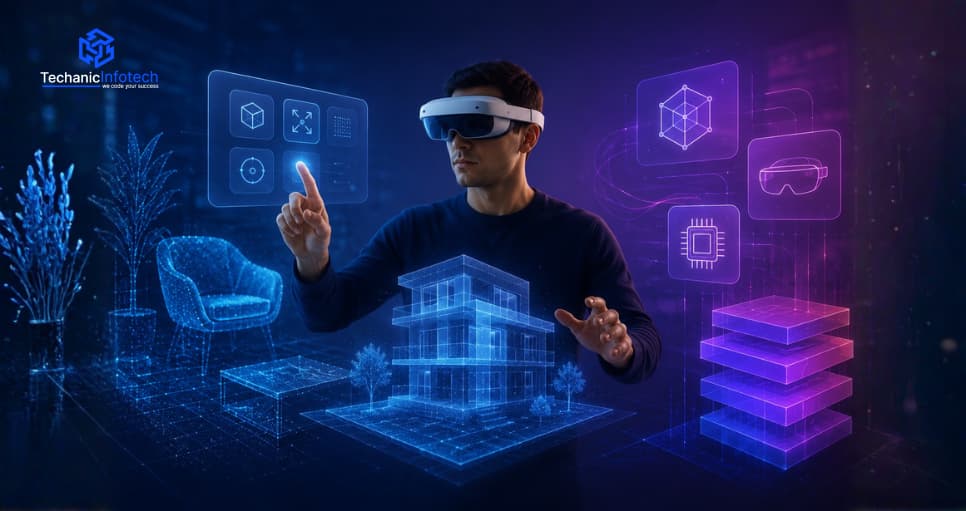
Spatial computing is transforming how users interact with digital environments by merging the physical and virtual worlds. Powered by technologies such as augmented reality (AR), virtual reality (VR), mixed reality (MR), artificial intelligence, and computer vision, spatial computing enables immersive and interactive experiences across industries.
From healthcare and retail to manufacturing and education, businesses are increasingly investing in spatial computing app development and advanced mobile app development services to create innovative customer experiences and improve operational efficiency.
In this guide, we'll explore everything you need to know about spatial computing application development, including features, development process, technology stack, costs, and future opportunities.
Spatial computing refers to technologies that enable computers to understand, interpret, and interact with physical spaces in real time. Unlike traditional mobile applications that operate on flat screens, spatial applications create immersive environments where users can interact with digital objects naturally.
Spatial computing software development combines the following:
Augmented Reality (AR)
Virtual Reality (VR)
Mixed Reality (MR)
Artificial Intelligence
Computer Vision
Spatial Mapping
IoT Connectivity
3D Visualization
The goal is to make digital interactions more intuitive, contextual, and immersive.
Businesses across industries are rapidly embracing enterprise spatial computing solutions to create immersive digital experiences, streamline operations, and gain a competitive edge. By blending physical and virtual environments, spatial computing enables organisations to interact with data, products, and processes in entirely new ways.
Spatial computing delivers highly interactive and immersive experiences that capture user attention more effectively than traditional applications. Whether through AR product visualisation, virtual showrooms, or immersive training environments, businesses can significantly improve customer engagement and retention.
Organisations can create realistic simulations that allow employees to practise complex tasks in a safe and controlled environment. This approach improves learning outcomes, reduces training costs, and minimises operational risks, particularly in industries such as healthcare, manufacturing, and aviation.
Spatial computing transforms complex datasets into interactive 3D visualisations, making information easier to analyse and understand. Teams can explore designs, workflows, and business insights more intuitively, leading to faster and more informed decision-making.
By providing real-time spatial awareness and digital overlays, spatial applications help employees perform tasks more accurately and efficiently. Businesses can reduce errors, optimise workflows, and improve productivity across various operational processes.
Companies that adopt emerging technologies early often differentiate themselves in the marketplace. Spatial computing enables businesses to offer innovative customer experiences, improve internal operations, and position themselves as industry leaders.
Spatial computing is transforming how businesses and consumers interact with digital content by creating immersive, real-world experiences. From healthcare and retail to manufacturing and education, organisations are leveraging spatial computing application development to solve complex challenges and improve user engagement.
Surgical simulations
Medical training
Patient education
Remote assistance
Virtual try-ons
Product visualization
Interactive shopping experiences
Equipment maintenance
Workforce training
Digital twins
Remote inspections
Virtual classrooms
Interactive learning experiences
Immersive simulations
Virtual property tours
Interior design visualization
Architectural walkthroughs
Building a successful spatial computing application requires a strategic development process that combines immersive technologies, user-centric design, and scalable architecture. Whether you're creating an AR, VR, or mixed reality solution, following a structured approach helps reduce risks, optimise development costs, and deliver a seamless user experience.
The process begins with understanding business objectives, target users, industry-specific challenges, and project requirements. Developers also identify supported devices, hardware compatibility, and key use cases to define the project scope.
During this stage, teams create wireframes, user journeys, and interactive prototypes. The focus is on designing intuitive spatial interactions that enhance user engagement while ensuring smooth navigation within immersive environments.
High-quality 3D models, animations, and virtual environments are developed to create realistic and engaging experiences. These assets form the foundation of any spatial computing application.
Developers build the application's core functionality using technologies such as AR, VR, mixed reality, computer vision, and AI. Many businesses also collaborate with experienced AI app development companies to integrate intelligent features such as object recognition, predictive analytics, and voice interactions.
Features like gesture recognition, voice commands, real-time spatial mapping, and object tracking are integrated during this phase.
Third-party APIs, cloud services, AI models, and enterprise systems are connected to ensure seamless functionality. Developers also optimise rendering performance, latency, and device compatibility to deliver a smooth user experience.
Comprehensive testing is conducted across multiple devices and environments to verify functionality, usability, security, and performance. A structured mobile app testing process helps identify bugs early and ensures the application performs reliably under real-world conditions.
Once testing is complete, the application is deployed on the intended platforms, including mobile devices, AR/VR headsets, web platforms, or Apple Vision Pro. A well-pla2nned mobile app launch strategy helps ensure a smooth rollout, user adoption, and long-term success.
Post-launch support includes regular updates, feature enhancements, security patches, and performance improvements. Ongoing mobile app maintenance is essential for keeping the application secure, compatible with new devices, and aligned with evolving user expectations.
The cost of spatial computing app development typically ranges from $8,000 to $70,000+, depending on factors such as application complexity, supported devices, immersive features, 3D asset requirements, AI integrations, and platform compatibility. Similar to the cost to develop a mobile app, the final budget largely depends on project scope and feature requirements.
The final investment largely depends on the type of spatial computing solution you plan to build, as outlined in the table below.
Estimated Spatial Computing Development Cost
|
Project Complexity |
Estimated Cost Range |
Timeline |
|
Basic Spatial Computing App |
$8,000 – $20,000 |
4-8 Weeks |
|
Medium-Complexity AR/VR Application |
$20,000 – $45,000 |
2-4 Months |
|
Advanced Mixed Reality Solution |
$45,000 – $70,000+ |
4-8 Months |
|
Enterprise Spatial Computing Platform |
$35,000 – $90,000+ |
6-12 Months |
The cost of spatial computing app development can vary significantly depending on the project's complexity, features, platform requirements, and technology stack.
The more advanced the features, the higher the development cost. Applications with real-time spatial mapping, AI-powered interactions, multiplayer collaboration, and immersive 3D environments require significantly more development time and expertise.
Developing for a single platform is usually more affordable than supporting multiple devices, such as Apple Vision Pro, Meta Quest, HoloLens, iOS, and Android. Cross-platform compatibility increases testing and optimisation efforts.
High-quality 3D models, animations, textures, and spatial user interfaces can represent a major portion of the project budget. Realistic and interactive visuals require skilled designers and additional production time.
Adding capabilities such as computer vision, object recognition, gesture tracking, voice control, and personalised AI experiences increases development complexity and overall cost.
The cost varies depending on the experience level of the development team, geographic location, and project duration. Specialised AR/VR and mixed reality developers generally command higher rates than standard mobile app developers.
While spatial computing is opening new possibilities for immersive digital experiences, developing robust and scalable applications comes with several technical and business challenges.
The spatial computing ecosystem includes a wide range of devices, from AR-enabled smartphones and tablets to advanced headsets such as Apple Vision Pro, Meta Quest, and Microsoft HoloLens.
Solution: Use cross-platform frameworks like Unity, Unreal Engine, and OpenXR to streamline development across multiple devices. Conduct extensive device testing and prioritise support for platforms most relevant to your target audience.
Spatial applications rely heavily on real-time 3D rendering, environment mapping, object tracking, and interactive visual elements.
Solution: Optimise 3D assets, use efficient rendering techniques, implement Level of Detail (LOD) models, and leverage cloud-based processing where appropriate. Regular performance testing helps maintain smooth experiences across devices.
Traditional app design principles do not always apply to immersive environments. Developers must create intuitive gesture controls, voice interactions, eye-tracking experiences, and spatial navigation systems that feel natural and comfortable for users.
Solution: Adopt a user-centred design approach with frequent usability testing. Follow platform-specific design guidelines and focus on creating simple, intuitive interactions that reduce user fatigue and learning curves.
Building applications that work consistently across AR, VR, and mixed reality devices often requires additional development resources.
Solution: Design modular architectures and use standardised APIs such as OpenXR. A scalable codebase allows developers to support multiple platforms while minimising development and maintenance costs.
Spatial applications frequently collect location data, environmental scans, biometric information, and user behaviour insights.
Solution: Implement end-to-end encryption, role-based access controls, secure cloud storage, and compliance with regulations such as GDPR and CCPA. Transparency about data collection practices also helps build user confidence.
Developing realistic 3D assets, virtual environments, animations, and interactive objects can be time-consuming and resource-intensive.
Solution: Use reusable asset libraries, procedural content generation tools, and AI-assisted 3D modelling solutions to reduce development time. Prioritising essential assets during MVP development can also help control costs.
Although spatial computing is growing rapidly, market adoption is still evolving. Businesses must carefully evaluate target audiences, device availability, and user readiness before making large-scale investments.
Solution: Start with a Minimum Viable Product (MVP) to validate demand and gather user feedback. Focus on solving specific business problems and delivering measurable value before scaling the application to a broader audience.
Spatial computing is redefining digital experiences by bridging the gap between physical and virtual environments. As technologies such as AR, VR, MR, AI, and computer vision continue advancing, businesses have unprecedented opportunities to create immersive and engaging applications.
Whether you're exploring spatial computing app development, building enterprise spatial computing solutions, investing in Apple Vision Pro app development, or launching innovative extended reality app development projects, early adoption can provide a substantial competitive advantage.
The development timeline typically ranges from 3 to 12 months, depending on the application's complexity, features, platform support, and integration requirements.
AR overlays digital content onto the real world, VR creates a fully virtual environment, and mixed reality combines both by allowing digital and physical objects to interact in real time.
Yes. Many spatial computing applications use AR technologies like ARKit and ARCore, enabling immersive experiences on modern iOS and Android devices.
Absolutely. SMBs can leverage spatial computing for product visualisation, employee training, virtual showrooms, and customer engagement without investing in large-scale enterprise systems.
Enterprise spatial computing solutions improve training efficiency, enhance remote collaboration, streamline operations, reduce costs, and support better decision-making through immersive visualisation.
Not always, but AI significantly enhances spatial experiences through object recognition, voice interaction, predictive analytics, personalisation, and real-time environment understanding.


Bharat Sharma is the CTO of Techanic Infotech, bringing deep technical expertise in software architecture, mobile app development, and scalable system design. He leads the engineering team with a strong focus on innovation, performance, and security.