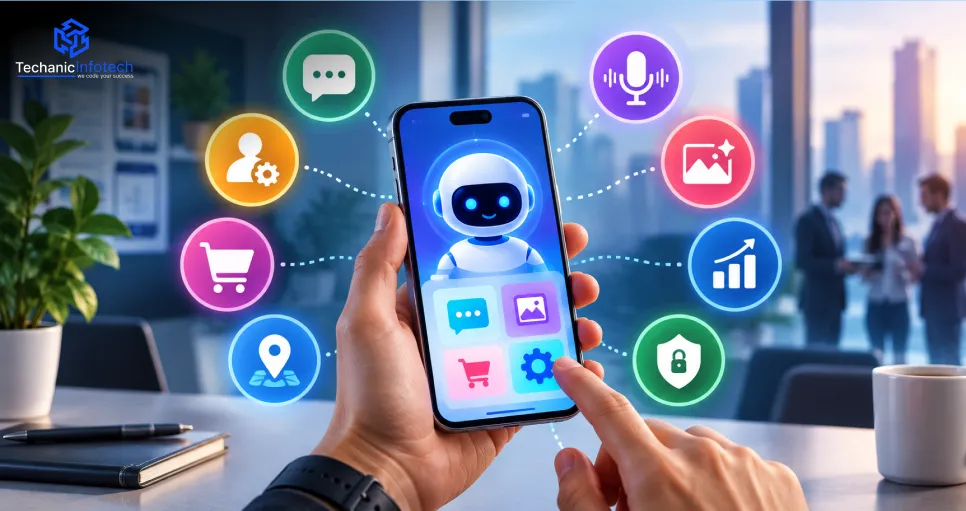
Artificial intelligence is rapidly becoming one of the most valuable additions to modern mobile applications.
Businesses are using AI to make apps more personalized, responsive, efficient, and useful. Instead of offering the same experience to every user, AI powered mobile apps can understand behavior, predict preferences, automate communication, and provide smarter recommendations.
For businesses planning a new app or upgrading an existing one, the question is no longer whether AI can be added. The more important question is which AI features actually create value.
Techanic Infotech provides mobile app development services that combine modern mobile technologies with artificial intelligence, automation, personalization, analytics, and intelligent user experiences. The right AI features can help businesses improve engagement while making their applications more competitive.
Traditional mobile applications mainly respond to user actions through predefined logic.
AI allows applications to become more intelligent.
A mobile app can learn from previous interactions, understand natural language, recognize patterns, and provide recommendations based on individual behavior.
This creates opportunities across many industries, including ecommerce, healthcare, finance, education, travel, fitness, entertainment, and enterprise software.
AI features can help businesses improve:
User personalization
Customer support
Search and discovery
Automation
Decision making
User retention
The key is choosing features that solve real user problems instead of adding AI simply because it is popular.
Techanic Infotech also provides dedicated AI development services for businesses that want to integrate intelligent capabilities into mobile products and software platforms.
Personalization is one of the strongest AI features businesses can add to a mobile application.
Users increasingly expect apps to understand what they are interested in rather than showing identical content to everyone.
AI can analyze information such as browsing behavior, previous purchases, search activity, app usage, preferences, and engagement patterns.
The application can then adjust the experience for each user.
For example, an ecommerce app can recommend products based on shopping behavior, while a fitness app can suggest workouts according to previous activity.
A streaming application can recommend content based on viewing history, and a food delivery app can prioritize restaurants or dishes that match the user's preferences.
This type of personalization can make an application feel more relevant and encourage users to return more frequently.
Generic experiences often require users to search for what they need.
AI personalization reduces that effort.
Instead of expecting users to discover everything manually, the application can bring relevant options closer to them.
For businesses, this can improve engagement, product discovery, conversion opportunities, and customer retention.
Adaptive systems can take this further by continuously changing recommendations as user behavior changes. Techanic Infotech provides adaptive AI development for applications that need to learn from changing user data and outcomes.
AI chatbots are becoming one of the most practical AI features in mobile applications.
Traditional chatbots often rely on predefined responses.
Modern AI chatbots can understand natural language and generate more contextual answers.
Businesses can use them for customer support, onboarding, product guidance, account assistance, booking support, and internal employee applications.
For example, a banking app could allow users to ask questions about recent transactions.
A travel app could help users find booking information.
An ecommerce app could answer questions about products, delivery, or return policies.
The biggest advantage is availability.
An AI chatbot can respond immediately without requiring a human support representative for every routine question.
However, businesses should still provide human escalation for cases the chatbot cannot resolve.
Techanic Infotech offers AI chatbot development services for businesses that want chatbots integrated with mobile apps, websites, CRMs, payment systems, helpdesk tools, and other software platforms.
Search is one area where AI can dramatically improve the mobile experience.
Traditional search often depends on exact keywords.
If the user does not type the expected words, relevant results may not appear.
AI powered search can understand intent and context.
For example, a user could search:
Comfortable running shoes for long walks
The application can understand that the user is looking for products related to comfort, running footwear, and extended walking rather than matching only the exact words.
This is particularly useful for ecommerce apps, travel apps, content platforms, enterprise applications, and large marketplaces.
Natural language processing can also allow users to search through complete questions rather than short keyword phrases.
Techanic Infotech already supports natural language capabilities within its mobile and Android development offerings, including smarter search, language understanding, and conversational functionality.
Recommendation systems are closely related to personalization, but they deserve separate attention because they can directly influence user activity and revenue.
An AI recommendation engine analyzes user behavior and identifies products, content, services, or actions that are likely to be relevant.
These systems are commonly used in:
Ecommerce apps
Streaming apps
Food delivery apps
Travel apps
Social platforms
Online learning apps
Fitness platforms
For example, an online marketplace can recommend complementary products after a purchase.
A music application can create personalized playlists.
A travel app can suggest destinations based on previous searches and booking behavior.
The recommendation system becomes more effective as it learns from larger amounts of user interaction data.
AI does not only react to current behavior.
It can also help businesses predict what may happen next.
Predictive analytics uses historical and real time data to identify patterns and forecast possible outcomes.
Inside a mobile application, this can support many different functions.
A fintech app could identify unusual transaction behavior.
A retail application could predict what products a customer may want next.
A logistics app could estimate potential delivery delays.
A fitness app could analyze previous activity to recommend future goals.
For business owners, predictive analytics can also provide valuable operational insights.
Instead of only reviewing what has already happened, companies can use AI to make more informed decisions about what may happen next.
This is one of the reasons AI powered mobile applications are becoming more valuable as business tools rather than simply customer facing platforms.
Voice is another important AI feature for mobile applications.
Users can speak naturally instead of typing or navigating through multiple screens.
Voice capabilities can be useful when users are driving, exercising, multitasking, or using an application where typing is inconvenient.
For example, a healthcare app could allow a user to ask for appointment information.
A logistics employee could update information through voice commands while working in the field.
A productivity app could create reminders or tasks from spoken instructions.
Modern speech recognition can also convert conversations into text, summarize voice input, and identify important information.
This gives businesses new ways to create faster and more accessible mobile experiences.
Computer vision allows mobile applications to understand images and visual information.
This can turn the smartphone camera into an intelligent input tool.
A user can capture an image and the application can identify objects, extract information, classify content, or trigger a relevant action.
Computer vision is useful in industries such as healthcare, retail, logistics, manufacturing, insurance, and real estate.
For example, a retail app could allow users to search for products using a photo.
An insurance app could analyze images submitted during a claim.
A logistics app could scan packages or documents.
A property app could automatically classify uploaded images.
Techanic Infotech's AI capabilities include computer vision systems for areas such as object detection, visual analysis, and recognition tasks.
Businesses do not need to add every AI capability to their mobile application.
The best approach is to identify where users experience friction and determine whether AI can solve that problem.
For example, a company receiving thousands of repetitive support questions may benefit more from an AI chatbot than computer vision.
An ecommerce business with a large catalog may gain more value from intelligent search and recommendations.
A data heavy business application may need predictive analytics.
The feature should follow the business requirement.
Techanic Infotech can help businesses evaluate which AI capabilities fit their application, design the required architecture, integrate models and APIs, and build the mobile experience around those features.
A detailed overview of how these technologies fit into app development is also available in Techanic Infotech's guide to AI mobile app development.
Security is becoming an important reason for adding AI to mobile applications, especially in fintech, ecommerce, banking, insurance, and payment related platforms.
AI powered fraud detection systems can analyze large amounts of transaction and user behavior data to identify unusual patterns.
For example, the system may detect:
Unusual login behavior
Suspicious payment activity
Abnormal transaction patterns
Unexpected device or location changes
Unlike traditional rule based systems, AI can analyze multiple signals together and identify patterns that may not be obvious through fixed rules alone.
This can help businesses reduce fraudulent activity while improving the security of their mobile applications.
For companies operating in financial technology, Techanic Infotech also provides fintech app development services for building secure mobile platforms with advanced digital capabilities.
Push notifications are useful, but sending the same notification to every user can quickly become ineffective.
AI can make notifications more intelligent by analyzing user behavior and determining what message should be sent, when it should be sent, and whether it is likely to be relevant.
For example, an ecommerce application could notify a user when a product they previously viewed becomes available again.
A food delivery application could recommend a restaurant around the user's usual ordering time.
A fitness application could send reminders according to previous workout habits rather than using a fixed schedule.
The goal is not to send more notifications.
It is to make each notification more useful.
This can improve engagement while reducing the chances of users disabling notifications completely.
Automation is one of the biggest opportunities for AI enabled mobile applications.
Many apps require users or employees to complete repetitive tasks such as reviewing requests, entering information, processing documents, generating reports, or updating records.
AI can reduce some of this manual work.
For example, an enterprise mobile application could automatically classify incoming requests and send them to the correct department.
A field service app could analyze service information and recommend the next action.
A sales application could summarize customer interactions and prepare follow up notes.
The value of AI automation becomes even greater when the application is connected with existing business systems.
Techanic Infotech builds digital solutions across a wide range of industries and business workflows through its custom app and software solutions.
AI agents represent a more advanced form of mobile application intelligence.
A chatbot usually provides information.
An AI agent can potentially perform a sequence of actions.
Consider a travel application.
A user may ask an AI agent to find suitable hotels, compare options, create an itinerary, and save selected information.
In an enterprise application, an agent could retrieve customer information, analyze previous records, prepare a response, and update a business system.
This creates more useful automation because the AI can interact with multiple tools instead of only generating text.
However, businesses need to control what an AI agent is allowed to access and which actions require human approval.
AI agents are most effective when they are designed around clear business workflows rather than added simply as another conversational feature.
Many mobile applications allow users to upload documents, receipts, invoices, forms, photographs, or identity documents.
AI can help process this information automatically.
For example, an expense management application could extract information from receipts.
An insurance app could analyze uploaded claim documents.
A logistics application could capture information from shipping paperwork.
A healthcare app could organize information contained in uploaded medical documents.
This reduces the amount of manual data entry required from users and employees.
Document intelligence can be especially useful when mobile applications are part of larger business workflows.
Sentiment analysis allows an application to understand the general tone or emotional context of written feedback.
Businesses can use this capability to analyze customer reviews, support conversations, survey responses, and other text based interactions.
For example, a support application could identify a frustrated customer and prioritize the conversation for human assistance.
A brand management platform could analyze thousands of customer comments and identify whether feedback is becoming more positive or negative.
Sentiment analysis can also help businesses understand recurring customer concerns instead of manually reviewing every message.
Generative AI can help mobile applications create content directly for users.
The exact use case depends on the industry.
A marketing application may generate captions.
A productivity app may summarize notes.
A learning application may create explanations or practice questions.
A business application may generate reports from operational data.
The most effective use of generative AI is usually not simply giving users an empty text box.
Businesses should connect content generation with the actual purpose of the application.
For example, an ecommerce app could generate useful product descriptions from structured product information rather than asking users to create generic content.
This makes the AI feature feel like part of the product rather than an external tool added to it.
Businesses should not try to include every feature covered in this guide.
The right choice depends on the industry, application purpose, target users, available data, and business goals.
A useful way to prioritize AI features is to identify the biggest problem inside the current user journey.
If customers struggle to find products, intelligent search may provide greater value than an AI chatbot.
If customer support teams receive large volumes of repetitive questions, conversational AI may be the better investment.
If an application generates large amounts of behavioral data, predictive analytics and personalization may create stronger results.
If employees spend significant time processing documents, AI document analysis may have a more direct operational impact.
AI should therefore solve a clear problem.
The feature should not exist only because artificial intelligence is trending.
Adding AI to a mobile application can create additional technical requirements.
Businesses need to think about data availability, privacy, model accuracy, response speed, operating cost, and scalability.
The application may also require changes to its backend architecture so it can communicate with AI models, databases, and third party systems.
Security becomes particularly important when AI handles customer or business information.
Businesses should define exactly what information the AI can access and how that information will be protected.
For Android focused products, Techanic Infotech already integrates capabilities such as AI, analytics, natural language processing, chatbots, cybersecurity, cloud integration, and predictive features into its Android app development services.
Yes.
Businesses do not always need to rebuild an application from the beginning to introduce artificial intelligence.
AI features can often be integrated into an existing app using APIs, AI models, cloud services, new backend components, and updated user interfaces.
For example, an existing ecommerce application could add:
Intelligent product recommendations
AI powered search
Conversational assistance
Personalized offers
Predictive analytics
The complexity depends on the existing architecture.
Older applications may require backend modernization before advanced AI features can be added reliably.
The development team should evaluate the existing application first and determine which parts of the architecture need to change.
Adding AI successfully requires more than connecting a mobile application with an AI model.
The feature must work properly with the frontend, backend, databases, APIs, cloud infrastructure, and existing business systems.
Techanic Infotech can help businesses implement AI capabilities across both new and existing mobile applications.
The development process can include AI feature planning, mobile application development, API integration, model integration, backend development, testing, deployment, and ongoing optimization.
Techanic Infotech's development approach already combines frontend, backend, APIs, databases, cloud systems, mobile integration, and AI integration through its full stack development services.
The goal should always be to implement AI where it improves the actual product experience.
A well integrated AI feature should feel like a natural part of the application rather than a separate technology added only for marketing purposes.
AI is creating new possibilities for mobile applications across almost every industry.
Features such as personalization, intelligent search, AI chatbots, recommendation engines, predictive analytics, computer vision, fraud detection, automation, AI agents, and document intelligence can make applications more useful and efficient.
However, businesses do not need every AI feature.
The strongest mobile products identify where users experience problems and introduce AI where it can create measurable value.
This is where professional mobile and AI development becomes important.
Techanic Infotech can help businesses evaluate, design, develop, and integrate AI features that align with real application requirements and long term business goals.
The future of mobile apps is not about adding AI everywhere.
It is about using AI intelligently to build better digital products.
Some of the most useful features include personalization, AI chatbots, intelligent search, recommendation engines, predictive analytics, voice recognition, computer vision, fraud detection, and AI powered automation.
Yes. Many AI features can be integrated into existing applications using AI APIs, models, cloud services, and backend integrations. The exact approach depends on the current application architecture.
AI can make apps more personalized, improve search results, automate support, provide smarter recommendations, reduce repetitive tasks, and deliver more relevant content.
AI can increase development and operating costs depending on the feature, model, data requirements, integrations, and infrastructure. However, businesses can control costs by selecting AI features that provide clear business value.
Yes. Techanic Infotech can build new AI powered mobile applications and integrate intelligent features into existing apps, including chatbots, recommendations, automation, predictive capabilities, and other custom AI functionality.


Bharat Sharma is the CTO of Techanic Infotech, bringing deep technical expertise in software architecture, mobile app development, and scalable system design. He leads the engineering team with a strong focus on innovation, performance, and security.