AI Agent Development
Vertical AI Agent Development: Creating Industry-Specific Agents for Business Automation
November 14, 2026
November 14, 2026
Key Takeaways
Vertical AI agents combine LLMs, industry data, business rules, and integrations to automate specialized workflows.
Healthcare, banking, retail, insurance, and manufacturing can use AI agents to reduce manual work and improve efficiency.
Strong AI agent architecture includes RAG, API integrations, access controls, human oversight, and continuous monitoring.
Vertical AI agent development costs vary from $8,000 to $90,000+, depending on scope, integrations, and security needs.
Start with one high-value workflow, test performance, and scale only after the agent proves reliable results.
A customer support agent that only answers questions is useful. But what if it could check an order, review the return policy, and prepare a refund request for approval? That is where industry-specific AI agents become valuable.
Vertical AI agent development focuses on building agents for specific industries and business workflows.
These agents combine large language models (LLMs), domain knowledge, business rules, and software integrations to handle tasks that once required several manual steps.
In this blog, we’ll explore vertical AI agent development, including industry use cases, key features, development steps, technology stack, costs, and how to choose the right development partner.
Vertical AI agents combine large language models (LLMs), industry-specific knowledge, business rules, and software integrations to perform specialized tasks.
They can retrieve relevant information, automate workflows, use business tools, and support decisions while following defined security controls and human oversight.
Unlike general-purpose AI assistants, vertical AI agents are designed around the real workflows, data, and requirements of a particular industry.
The vertical AI market was valued at USD 10.3 billion in 2025 and is expected to reach USD 74.5 billion by 2033, growing at a 28.3% CAGR, with software holding 47.1% and North America leading at 36.8%.
The global vertical AI market was worth USD 12.9 billion in 2024 and is projected to reach USD 115.4 billion by 2034 at a 24.5% CAGR, with software holding 42.1% and North America leading at 37.1%.
The AI agents market is projected to grow from USD 7.84 billion in 2025 to USD 52.62 billion by 2030 at a 46.3% CAGR, with North America leading and Asia Pacific growing fastest.
Many businesses still rely on employees to move information between spreadsheets, emails, databases, and internal systems. These repetitive tasks take time and create opportunities for mistakes.
Automate repetitive work: Handle routine tasks like data entry, document processing, customer inquiries, and appointment scheduling.
Improve operational efficiency: Connect CRM, ERP, and business databases to reduce manual handoffs and delays.
Deliver industry-specific insights: Use domain knowledge and company data to provide relevant answers and support better decisions.
Reduce operating costs: Cut time spent on repetitive workflows and free employees to focus on higher-value work.
When evaluating an AI development company, look beyond model expertise. The team should understand your industry, existing systems, data access rules, and business goals.
A vertical AI agent architecture connects the language model to business data, tools, and control systems. Each component has a specific role.
Employees or customers interact with the agent through a website, mobile app, internal portal, or existing business application. This layer collects requests and presents results.
The orchestration layer manages the steps needed to complete a task. It decides when to retrieve information, call a tool, ask for clarification, or request human approval.
The LLM interprets requests, generates responses, and helps select actions. Model selection should consider accuracy, latency, cost, privacy requirements, and performance on real tasks.
Retrieval-augmented generation (RAG) allows an agent to retrieve relevant information from approved sources before answering. Depending on the use case, these sources may include policies, product catalogs, technical manuals, or internal documents.
Tools connect agents to systems such as CRM platforms, ERP software, inventory databases, and claims management applications. Permissions should limit what each tool can read or change.
Authentication, role-based access, input validation, and action limits help protect sensitive information. High-impact actions should require appropriate approval.
Logs and traces help teams understand what the agent did, which tools it used, and where failures occurred. Regular testing helps identify incorrect outputs and performance changes.
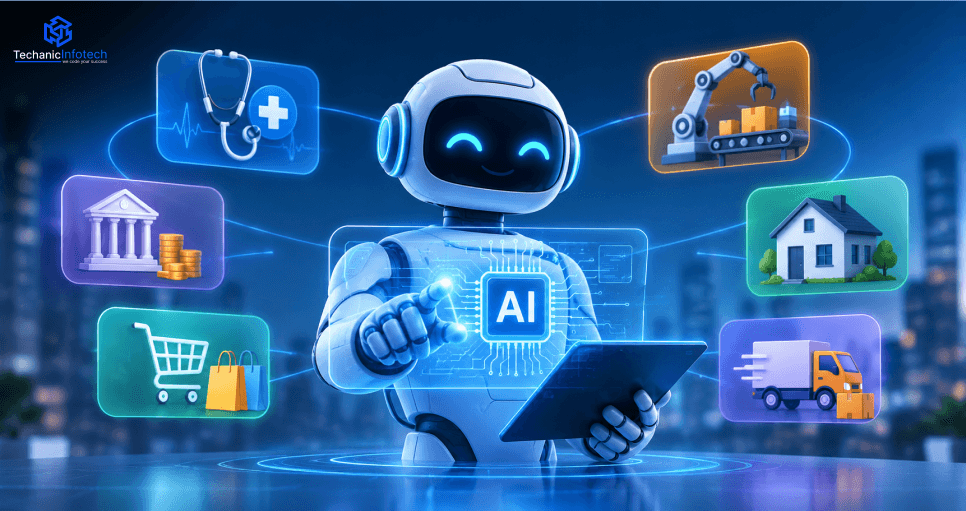
The best use cases solve specific problems, not every problem in a department. Here is how vertical AI agents can support different industries.
Healthcare agents can support administrative work and information retrieval.
Clinical documentation assistance.
Appointment scheduling and patient administration.
Medical-record retrieval for authorized staff.
For example, an agent could gather relevant records for a clinician before an appointment. Access controls and privacy safeguards must protect patient information, and clinical decisions should remain with qualified professionals.
Financial institutions handle large volumes of documents, policies, and transactions.
|
Use case |
Agent's role |
Important control |
|
Document processing |
Extract and organize information. |
Validate extracted data |
|
Compliance research |
Retrieve relevant policies. |
Verify sources. |
|
Fraud investigation |
Summarize suspicious activity. |
Human investigation and review |
Agents can support analysts, but they should not independently make high-impact financial decisions without appropriate controls.
Manufacturing teams often deal with inventory gaps, maintenance requests, and supplier delays.
An agent could detect a low-stock alert, check recent orders, review supplier lead times, and prepare a replenishment request. An authorized employee can approve the purchase before it is submitted.
Other uses include maintenance knowledge retrieval and supplier status updates.
Retail agents can connect customer requests with order and inventory systems.
Check order status and return eligibility.
Retrieve accurate product details.
Coordinate customer support and inventory inquiries.
For example, an agent could explain why an order is delayed using approved order data instead of giving a vague response.
Legal agents can retrieve contract clauses, compare document versions, and summarize case-related materials. They can save research time, but confidentiality, access restrictions, and lawyer review remain essential.
Insurance agents can organize claim documents, retrieve policy information, identify missing paperwork, and route claims for review. Final decisions should follow the insurer's rules and applicable requirements.
The right vertical AI agent features depend on the job it needs to perform.
Industry-specific knowledge retrieval: Finds relevant information from approved sources.
Tool calling and API integrations: Connects the agent to business applications.
Workflow automation: Coordinates tasks and follows defined business rules.
Context and memory management: Maintains relevant information across steps when needed.
Role-based access and human approval: Limits permissions and controls sensitive actions.
Monitoring and evaluation: Tracks errors, task completion, and reliability.
Not every agent needs long-term memory or a multi-agent setup. A simple, well-controlled agent may be easier to test, maintain, and operate.
Building a vertical AI agent starts with a real business problem, not a complex AI model. Follow these steps to create an agent that fits your industry, works with your existing systems, and delivers measurable results.
Start with one repetitive task that takes employees too much time or causes frequent errors. Look for a process with clear inputs, predictable steps, and measurable outcomes.
For example, an insurance company could build an AI agent that reviews claim documents and flags missing information. This is easier to test than automating the entire claims process at once.
Set clear rules for what the agent can do and when it needs human approval. Then choose metrics to measure its performance.
Track key indicators such as
Task completion rate: How often does the agent finish the workflow correctly?
Accuracy: Does it retrieve the right information and follow company policies?
Response time: How quickly does it complete each task?
Cost per task: Does it reduce the cost of manual work?
Escalation rate: How often does it need human help?
These metrics help you decide if the agent is ready for production or needs more testing.
Vertical AI agents depend on reliable, industry-specific data. Review your internal documents, databases, APIs, and business records before development begins.
Check for outdated information, duplicate records, missing fields, and conflicting policies. Set role-based access controls so the agent only retrieves data its users are allowed to see.
For example, a healthcare agent should access patient records only when the user's role and permissions allow it. Better data and clear access rules reduce errors and security risks.
Your architecture should match the workflow's complexity. A simple task may need one AI agent connected to a few tools. A more complex process may require several agents or a controlled sequence of steps.
Consider three common approaches:
Single-agent architecture: Best for focused tasks, such as answering product questions or retrieving policy details.
Workflow-based architecture: Best for tasks that follow fixed steps, such as checking an order and preparing a return request.
Multi-agent architecture: Useful when different agents need separate roles, such as researching a claim, checking policy rules, and preparing a summary.
If your workflow needs several specialized agents, learn how to build multi-agent systems by defining each agent's role, tool access, communication rules, and handoff process. Avoid adding agents unless they solve a real problem.
Choose an LLM based on task accuracy, response speed, operating cost, privacy needs, and tool-calling performance. A larger model is not always the best choice. Test available models against real examples from your industry before deciding.
Next, connect the agent to the systems it needs, such as CRM software, ERP platforms, document repositories, or inventory databases.
For example, a retail agent may use an LLM to understand a customer's question, then call an order-management API to retrieve the latest shipping status.
The model handles language; the connected system provides the actual order data.
Build a small working version that handles one workflow from start to finish. Use a limited set of data, approved tools, and basic security controls.
For instance, a manufacturing POC could retrieve maintenance instructions and suggest troubleshooting steps using approved equipment manuals.
Test whether it can:
Retrieve relevant information.
Follow the correct workflow.
Call tools with valid inputs.
Return useful results.
Escalate requests it cannot safely handle.
A POC helps uncover technical problems before you invest in a full production system.
A successful demo does not prove an agent is ready for real users. Test how it behaves when information is missing, APIs fail, or users provide misleading instructions.
Include test cases such as:
Incomplete or conflicting source data.
Incorrect API responses or service outages.
Prompt injection hidden in documents or user input.
Requests that exceed the agent's permissions.
Tasks that require human judgment.
Measure the results against your original success metrics. Fix critical failures before expanding the agent's access or autonomy.
Launch the agent with limited permissions and a clear process for handling errors.
Require human approval for sensitive actions, such as issuing large refunds, approving payments, or changing important business records.
Set up logging, tracing, alerts, and access controls. These tools help your team see which actions the agent took, which systems it accessed, and where a workflow failed.
Start with a small group of users. Expand access after the agent demonstrates reliable performance in real business conditions.
Vertical AI agent development does not end at launch. Business rules change, data sources evolve, and model behavior can vary over time.
Review task accuracy, completion rates, operating costs, user feedback, and failure reports. Use these findings to improve prompts, retrieval quality, integrations, and approval rules.
Also review the agent's context and memory needs.
A system that must retain information across multiple steps may benefit from a well-designed AI agent memory architecture, with clear rules for what it stores, retrieves, and forgets.
The goal is steady improvement, not unlimited autonomy. Expand the agent's responsibilities only when testing shows that it can handle them safely and consistently.
Your vertical AI agent tech stack should match your team's skills, data requirements, and deployment environment. Avoid choosing tools simply because they are popular.
|
Technology layer |
Options to consider |
Main purpose |
|
LLM |
Hosted or self-hosted models |
Reasoning and text generation |
|
Agent framework |
OpenAI Agents SDK, LangGraph |
Tool use and orchestration |
|
Knowledge retrieval |
RAG, vector search, hybrid search |
Retrieve relevant business information. |
|
Backend |
Python, TypeScript |
Business logic and APIs |
|
Data storage |
Relational databases, object storage, vector databases |
Store records, documents, and embeddings |
|
Infrastructure |
AWS, Azure, Google Cloud |
Hosting, scaling, and access management |
|
Evaluation |
Automated tests, tracing, monitoring tools |
Track reliability and failures |
Vertical AI agent app development cost depends on workflow complexity, data quality, integrations, security needs, and testing depth. The following figures are illustrative U.S. planning estimates, not vendor quotes.
|
Project scope |
Estimated cost |
Estimated timeline |
|
Basic proof of concept |
$10,000–$25,000 |
2–4 weeks |
|
Single-workflow production agent |
$25,000–$75,000 |
4–10 weeks |
|
Multi-integration enterprise agent |
$75,000–$200,000+ |
10–20+ weeks |
|
Complex multi-agent platform |
$200,000–$500,000+ |
4–9+ months |
An agent that can access business systems also creates new risks. Security needs to be part of the design, not something added just before launch.
Restrict access to sensitive records and follow applicable privacy and retention rules. Healthcare, financial services, and other regulated industries may have additional requirements.
Retrieved documents and user inputs can contain malicious instructions. Treat external content as untrusted and validate actions before execution.
Give agents only the access needed for their tasks. Read-only access is a sensible starting point when write access is not required.
Require authorized review before sensitive actions, such as approving payments, issuing refunds above defined limits, or making consequential decisions.
Record important actions, tool calls, errors, and approval decisions. Create a clear process for investigating failures and disabling unsafe behavior.
The NIST AI Risk Management Framework offers guidance for identifying and managing AI risks.
Choose a development partner with industry expertise, proven AI projects, strong security practices, and clear performance goals.
Check industry experience: Look for proven work in your sector, such as healthcare, banking, insurance, or manufacturing.
Review technical expertise: Assess skills in LLMs, RAG, AI agent architecture, API integrations, and workflow automation.
Ask for real project results: Request case studies showing accuracy, time savings, lower costs, or improved task completion.
Evaluate security practices: Confirm data privacy controls, role-based access, audit logs, and human approval for sensitive actions.
Understand the development process: Review the agentic development lifecycle, from workflow discovery and prototyping to testing, deployment, and monitoring.
Compare support and total cost: Check pricing, maintenance, model usage fees, scalability, and post-launch support before signing a contract.
Building before validating the problem: Start with a workflow that has measurable value.
Using generic knowledge for specialized tasks: Ground responses in relevant, approved domain information.
Choosing multi-agent architecture too early: Add multiple agents only when separate roles justify the extra complexity.
Ignoring data quality and permissions: Poor source data and weak access controls can undermine the whole system.
Skipping evaluation: Test realistic scenarios before and after deployment.
Giving agents too much autonomy: Limit tool permissions and add approval checkpoints.
Underestimating maintenance: Budget for monitoring, model usage, integration changes, and ongoing testing.
Vertical AI agents are likely to become more closely connected to industry workflows as tools, models, and enterprise platforms evolve.
Their practical value will depend on reliable execution, useful integrations, and clear controls, not just more capable models.
Human-agent collaboration will remain important for tasks that involve sensitive information or costly mistakes.
Businesses that build around measurable outcomes and regular evaluation will be better placed to judge where greater automation makes sense.
Vertical AI agent development works best when a business starts with a clear problem rather than trying to automate an entire department at once.
Choose one workflow, identify the data and systems it needs, define success metrics, and set clear limits on what the agent can do.
Build a small proof of concept, test it against real scenarios, and expand only when the results justify the investment.
The right agent is not necessarily the most complex one.
It is the one that solves a real business problem reliably, protects sensitive information, and gives people more time for work that needs human judgment
Vertical AI agent development builds AI agents for specific industries using domain knowledge, business rules, and software integrations to automate specialized tasks.
Costs typically range from $8,000 to $90,000+, depending on workflow complexity, integrations, security requirements, and testing needs.
A basic prototype may take 2–4 weeks, while complex enterprise agents can require several months.
Healthcare, banking, insurance, manufacturing, retail, and legal services can use agents to automate workflows and retrieve industry-specific information.
Common technologies include LLMs, RAG, vector databases, agent frameworks, Python, APIs, cloud platforms, and monitoring tools.
Vertical AI agents focus on specific industry workflows, approved business data, specialized tools, and defined operational rules.
They can be secure with strong access controls, data encryption, audit logs, testing, and human approval for sensitive actions.
Review its industry experience, technical skills, security practices, case studies, pricing, and post-launch support before making a decision.


Bharat Sharma is the CTO of Techanic Infotech, bringing deep technical expertise in software architecture, mobile app development, and scalable system design. He leads the engineering team with a strong focus on innovation, performance, and security.