AI Agent Development
AI Agent Evaluation Platform Development: Testing, Monitoring and Performance Optimization
November 12, 2026
November 12, 2026
Key Takeaways
AI agent evaluation platforms test accuracy, tool use, safety, and task completion before failures affect real users.
Core features include automated scoring, test datasets, agent tracing, security checks, and continuous production monitoring.
Development costs range from $8,000 to $90,000+, depending on features, integrations, security, and platform complexity.
Common challenges include inconsistent outputs, biased AI judges, weak test data, rising costs, and privacy risks.
Businesses can monetize evaluation platforms through subscriptions, usage-based pricing, enterprise licenses, and managed evaluation services.
Is your AI agent failing in silence? You launch it. It sounds smart. Then it picks the wrong tool and gives a customer a wrong answer. Trust drops fast.
Most teams catch this too late. Smart AI agent evaluation platform development fixes that. It tests agents, traces every step, and flags problems before users see them.
In this blog, you will learn what an evaluation platform is, why it matters, key features, build steps, cost, challenges, and ways to earn money from it.
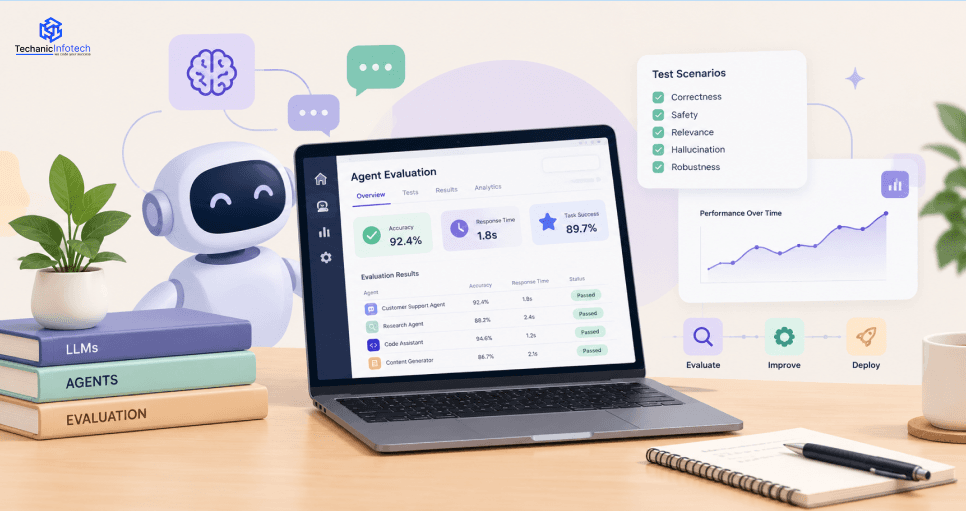
An AI agent evaluation platform is software that tests AI agents, scores their answers and tool use, tracks every step through traces, and monitors them in production.
It helps teams measure task success, catch failures early, and improve agent reliability.
The AI Evaluation Platform Market is projected to grow from $1.20B in 2025 to $16.54B by 2035 at a 30.02% CAGR, with software holding 81.64%, cloud 72.84%, large enterprises 74.63%, and BFSI 26.74%.
Agents act on their own. One bad step can cost money and trust. Here is why testing them now matters for every team.
Evaluation datasets and test cases score answer correctness, factual accuracy, and hallucination rate. You find weak spots in testing, not after a real customer complains.
Every retry, tool call, and long prompt adds token consumption. Tracking cost per task and latency shows where money leaks, so you can fix slow or wasteful agent steps fast.
Adversarial testing checks prompt injection resistance, data leakage, and access control. Guardrails and policy checks reduce risk, though no tool alone makes you compliant.
Clear scoring rubrics and evaluation reports turn gut feelings into proof. Leaders see task success rate trends and approve launches with less fear and more facts.
Production telemetry and error analysis show real failure patterns. Teams turn them into regression tests, and every release gets safer than the last one.
Good AI agent evaluation platform features start simple and grow smart. Here are seven, from basic to advanced.
Store evaluation datasets, benchmark datasets, and ground truth answers in one place. Version them like code.
Good test cases include edge cases and reference outputs, so every run stays fair and repeatable.
Run automated evaluation with a clear scoring rubric. Track task success rate, precision, recall, and answer correctness.
Rules based checks are fast and cheap. They catch obvious errors before any costly review step starts.
Capture agent traces, spans, and execution logs for each run. Built on OpenTelemetry, distributed tracing shows where a step failed.
Root cause analysis gets quick. You see the exact tool call that broke the chain.
Check tool selection, argument validation, and function calling. Measure tool call accuracy and error recovery.
Teams learning how to build multi-agent systems also need to test delegation and coordination.
Pair expert review with LLM as a judge scoring. Use pairwise comparison and annotation to check the judge.
Automated judges can be biased. Human adjudication keeps scores honest and trusted.
Run adversarial testing for prompt injection, jailbreak robustness, and privilege escalation. Test for data exfiltration too.
Map findings to OWASP LLM risks. Add harmful output detection and human oversight rules.
Use regression suites and release gates in every build. Monitor production telemetry, drift detection, and alerts.
When model drift hits, you know fast. Failed live runs become new test cases for tomorrow.
Building a platform takes clear steps. Skip one, and you pay for it later. Here is the full path in plain words.
This step decides everything. Start with one question. What agent are we testing, and what does a good day look like for it?
Say you run a US bank. Your support agent answers card questions. Success means the right answer, the right tool, and no private data leaks.
Write down these basics.
Agent type, such as customer support, coding, or research agents
Who will use the dashboard, like engineers, product managers, or auditors
Key risks, like wrong advice or data leakage
Data rules, such as privacy and access control
Success criteria in numbers, like a 90% task success rate
Common implementation mistake: Teams may choose evaluation metrics before understanding what users consider a successful outcome. This can lead to scores that look good on paper but fail to measure real business needs.
Before defining metrics, consult stakeholders, identify critical failure scenarios, and establish clear success criteria for each agent workflow.
Next, pick the shape of the system. Most platforms have four parts. Ingestion, storage, the evaluation engine, and reporting.
Keep each part separate. That way, you can swap a judge model or a database without a full rewrite. I prefer this setup because change is certain in AI.
Agents with long term memory need special tests. Study AI agent memory architecture so you can check context retention and retrieval accuracy.
Here is a simple AI agent evaluation platform tech stack to start from.
|
Layer |
Common Choices |
Job |
|
Dashboard |
React, Next.js |
Show scores, traces, and reports. |
|
Backend and API |
Python with FastAPI, Node.js |
Run jobs and serve data. |
|
Evaluation engine |
Python, DeepEval, Ragas |
Score test cases and metrics |
|
Tracing |
OpenTelemetry, Arize Phoenix |
Capture traces and spans. |
|
Database |
PostgreSQL, ClickHouse |
Store runs, logs, and results |
|
Queue |
Redis, Celery, Kafka |
Handle many runs at once |
|
Cloud |
AWS, Google Cloud, Azure |
Host and scale the platform |
|
Judge models |
OpenAI, Anthropic Claude |
Power LLM as a judge scoring |
Dashboards are where people decide to trust your platform. If they cannot read it in ten seconds, they will stop using it.
Design for three kinds of users. Engineers want traces. Managers want trends. Auditors want clear evaluation reports.
Include these core screens.
A run list with pass and fail status
A trace timeline that shows each tool call
Score trends over time for task success rate
Failure clusters that group similar errors
A cost and latency view for token consumption
Here is an example. A product manager opens the dashboard on Monday. She sees success dropped from 91% to 84%. One click shows the new prompt broke refund questions.
Dashboard design best practice: Too many charts can make evaluation results harder to interpret. Prioritize the metrics users need most, such as task success rate, failure categories, execution traces, latency, and cost per task.
Keep detailed technical traces available for engineers while giving managers a clear overview of performance trends.
This is the heart of your AI agent evaluation platform development work. The engine runs test cases, collects outputs, and scores them.
Start with simple, clear metrics.
Task success rate and task completion rate
Tool call accuracy and argument validation
Factual accuracy and hallucination rate
Latency, token consumption, and cost per task
Consistency and robustness across repeated runs
Use three scoring methods together. Rules based checks catch format errors. LLM as a judge handles tone and meaning. Human evaluation settles hard calls.
Agents are nondeterministic. The same input can give different answers. So run each test several times and look at the average, not one lucky result.
Here is a quick example. Your agent must book a flight. A rule checks that it called the booking tool with the right dates. A judge scores how polite the reply was.
A word of caution. LLM judges can lean toward longer answers. Check them against human labels often. Watch for benchmark contamination too, when test data leaks into training.
Your platform is only useful if agents can plug in easily. Offer an SDK, a REST API, and OpenTelemetry support.
Cover the popular tools. LangChain with LangGraph, LlamaIndex, and Microsoft AutoGen are common agent frameworks. Support Model Context Protocol for tool calls.
For judge models, connect OpenAI and Anthropic through one clean adapter. If one provider has an outage, you can switch fast.
You may also study LangSmith and Braintrust. Each one already handles tracing, datasets, and experiments well.
My advice is to copy their best ideas, not their weak spots. Read their docs before you design your own flow.
Common integration pitfall: Hardcoding model names throughout an application can make model upgrades and provider changes difficult to manage.
Store model identifiers, provider settings, and evaluation configurations centrally so they can be updated without modifying multiple parts of the codebase.
Also, rerun relevant evaluation tests whenever a model or provider configuration changes.
Yes, you must test the tester. A buggy evaluation platform gives false comfort, and that is worse than no testing at all.
Run unit tests on each metric. Run integration tests on the full pipeline. Run end to end tests with a sample agent that fails on purpose.
Then do a security audit. Check access control, data storage, and logs. Test for prompt injection against your own judge prompts too.
The OWASP GenAI Security Project lists top LLM risks, like prompt injection and excessive agency. The NIST AI Risk Management Framework helps with risk measurement. ISO IEC 42001 covers AI governance.
Using a platform does not make you compliant on its own. Treat these as guides, not magic shields.
Launch day is the start, not the finish. Models change. Prompts change. Users surprise you.
Plan these tasks every month.
Refresh test datasets with new production failures
Retest judge models for bias
Watch for model drift and set alerts
Review storage, latency, and cloud bills
Add new agent frameworks as clients ask
When traffic grows, scale the queue and the database first. Evaluation jobs are heavy. Sampling a share of live traces keeps costs sane.
My rule is simple. Every real failure becomes a test case. After a year, you own a strong regression suite that no vendor can sell you.
A trusted AI agent evaluation platform development company can handle upkeep if your team is small.
Cost depends on scope, team, and depth of testing. Here is a clear range, from a simple MVP to an enterprise build.
|
Platform Level |
Estimated Cost |
Timeline |
Best For |
|
Basic MVP |
$8,000 to $18,000 |
4 to 8 weeks |
Startups testing one agent with core metrics |
|
Mid-level platform |
$18,000 to $35,000 |
2 to 3 months |
Growing teams needing tracing and dashboards |
|
Advanced platform |
$35,000 to $60,000 |
3 to 5 months |
Companies with many agents and human review |
|
Enterprise platform |
$60,000 to $90,000+ |
5 to 8 months |
Large firms needing security, audits, and scale |
Every build hits bumps. Knowing them early saves weeks of rework and a lot of stress.
Challenge: The same prompt can return different results, so one test run proves very little about real quality.
Solution: Run each test several times. Report averages and ranges, and use statistical significance before you trust a change.
Challenge: An LLM judge may favor long answers or its own style, which can hide real errors in your agent.
Solution: Compare judge scores with human labels often. Use clear rubrics and pairwise comparison to cut evaluator bias.
Challenge: Small or old datasets miss edge cases, so agents look great in tests and then fail with real users.
Solution: Add real production failures and synthetic test data. Review ground truth answers on a set schedule.
Challenge: Agents take many steps and call many tools, so finding the one broken step feels like finding a needle.
Solution: Use trace level evaluation with spans and logs. Score each step, then run root cause analysis on failed runs.
Challenge: Judge models and repeated runs burn tokens fast, and the bill can surprise you at month end.
Solution: Use cheap rules first and judges second. Sample live traffic, cache repeated calls, and track cost per task.
Challenge: Traces often hold private data, and attackers may try prompt injection on the judge or the dashboard.
Solution: Mask sensitive fields, set strict access control, and run adversarial testing. A skilled AI development company can help.
An evaluation platform can earn well when you match pricing to the value clients feel. Here are proven ways to do it.
Subscription tiers based on team size, projects, and stored traces for steady monthly income.
Usage-based pricing per trace, test run, or evaluation score for fair, flexible billing.
Enterprise licences with single sign-on, audit logs, and private cloud hosting.
Managed evaluation services, where your experts design rubrics and review agent failures.
Premium safety packs with prompt injection tests and governance reports aligned to NIST and OWASP.
A marketplace for ready-made evaluators, benchmark datasets, and industry test templates.
Onboarding and training packages that help clients set up continuous evaluation fast.
The field moves fast. Here is what I expect to shape the next few years of agent testing.
Trace level evaluation becomes standard, with OpenTelemetry as the shared language for spans and metrics.
Tests grow for Model Context Protocol tools, including MCP servers and clients.
Synthetic testing creates edge cases and adversarial scenarios at scale.
Multi-agent evaluation scores delegation, collaboration, and communication failures.
Continuous evaluation links production feedback directly to release gates.
Governance reports help teams show human oversight and responsible AI practice.
Businesses investing in these capabilities may benefit from AI development services to build custom evaluation pipelines, integrate observability tools, test multi-agent workflows, and establish continuous evaluation processes.
Agents are only as good as the way you test them. Smart AI agent evaluation platform development gives you traces, evaluation datasets, and clear metrics like task success rate and tool call accuracy.
Start small. Define your use case, build the evaluation engine, add human review, and monitor production. Then grow with every real failure you learn from.
Ready to build? Begin with one agent and one clear goal today.
An AI agent evaluation platform tests an agent’s accuracy, reliability, safety, and ability to complete tasks successfully.
Businesses use AI agent evaluation to catch errors, reduce risks, improve performance, and check if agents meet their goals before deployment.
Key features include automated testing, performance metrics, trace analysis, safety checks, benchmarking, reporting, and continuous monitoring.
Costs depend on features, integrations, and complexity. A basic MVP costs less than an enterprise platform with advanced testing and monitoring.
Common metrics include task success rate, answer accuracy, tool-call accuracy, latency, cost per task, and failure rate.
Popular tools include LangSmith, Braintrust, Arize Phoenix, DeepEval, and Ragas. The right choice depends on your testing needs.
LLM evaluation focuses mainly on model outputs. Agent evaluation also tests tool use, multi-step actions, decision-making, and task completion.
Businesses can improve evaluation by using realistic test cases, tracking execution traces, testing edge cases, reviewing failures, and running regression tests regularly.


Bharat Sharma is the CTO of Techanic Infotech, bringing deep technical expertise in software architecture, mobile app development, and scalable system design. He leads the engineering team with a strong focus on innovation, performance, and security.