Software Development
AI-Native Vertical Software: How Industry-Specific AI Apps Are Changing Business Operations
October 14, 2026
October 14, 2026
Key Takeaways
AI-native vertical software combines industry data, domain knowledge, workflows, and automation to solve specialized business problems.
Vertical AI can outperform generic tools by delivering stronger context, workflow automation, security, and measurable business outcomes.
RAG, AI agents, APIs, and proprietary data help vertical AI complete complex tasks beyond basic chatbot responses.
Healthcare, legal, finance, manufacturing, retail, and logistics can use vertical AI for industry-specific workflows and decisions.
Generic AI still works well for writing, research, brainstorming, productivity, and other low-risk everyday tasks.
What if your AI understands words but not your business? Generic AI can write, summarize, and answer questions, but it may miss industry rules, private data, workflows, and compliance needs.
That creates extra checking, manual work, and costly mistakes. AI-native vertical software solves this by combining domain knowledge, proprietary data, AI agents, automation, and industry-specific workflows.
This guide explains how vertical AI works, why it can outperform generic tools, its technology stack, business models, risks, and future.
You’ll also see real industry examples and practical ways to build and adopt vertical AI.
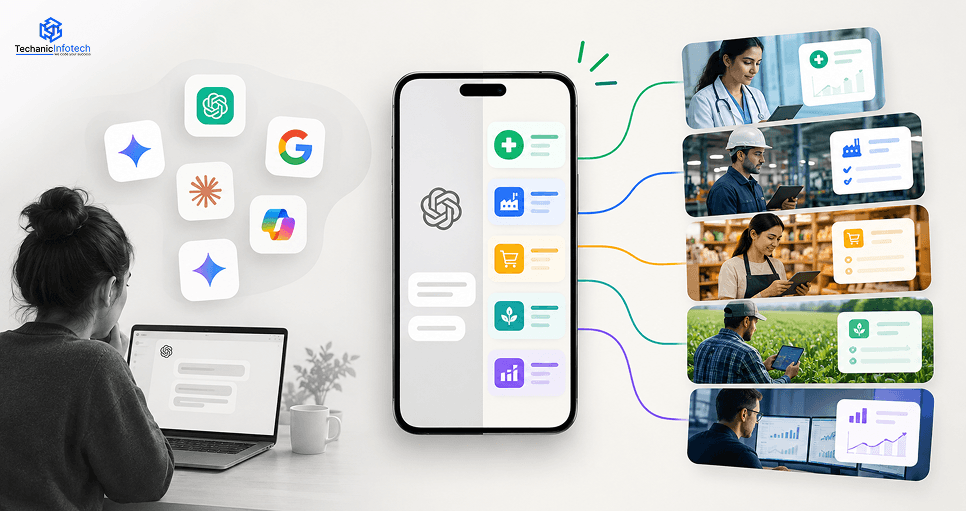
AI-native vertical software is built for a specific industry from the start. It combines AI with industry data, business rules, workflows, and automation. Unlike generic AI tools, it is designed to solve specialized problems and complete real business tasks.
The global vertical AI market was worth about $10.3 billion in 2025 and is projected to reach $74.5 billion by 2033, growing at a 28.3% CAGR from 2026 to 2033, according to Grand View Research. North America held the largest regional share in 2025.
According to data from Mordor Intelligence, the vertical software market is projected to grow from $164.06 billion in 2026 to $282.98 billion by 2031, at a CAGR of 11.52%.
Generic AI tools can answer many questions, but they often lack industry context, workflow knowledge, data controls, and task-specific accuracy.
General AI can understand language, but it may miss industry rules, terms, and workflows. Adaptive AI development can add domain context for more relevant results.
Generic AI may produce confident but wrong answers. NIST calls this "confabulation", making human review, validation, and trusted data important for business use.
Public AI models do not automatically know your internal records, policies, customer history, or operating rules. Without secure data access, useful answers can stay too generic.
Sensitive business data needs strong access controls, privacy safeguards, and AI governance.
A chatbot may give a useful answer, but teams still need to copy, check, and move data between systems. Generative AI development can connect AI to specific workflows.
Generic AI can answer almost anything. That sounds powerful, but businesses usually need something narrower: fewer manual steps, better decisions, faster work, and results they can measure. That is where vertical AI gets its edge.
Vertical AI is built around specific terms, rules, workflows, and user roles. This domain expertise gives the model better context and reduces repeated prompting, especially in complex fields like healthcare, legal services, finance, and insurance.
A generic chatbot mainly answers. Vertical AI can connect that answer to a real business process. It can review a claim, check records, route a task, and request approval. A software development company can build these steps directly into the product.
Vertical AI can use private, permissioned business data to deliver more useful results. Customer records, industry documents, operational data, and feedback can improve the system over time and create a practical data advantage.
Retrieval-augmented generation can pull trusted information from company sources, while AI agents can complete multi-step tasks using tools and APIs. This makes vertical AI more useful for real work than simple question-and-answer systems.
Custom AI vs. off-the-shelf solutions often comes down to control and fit. A vertical product can match company rules, user permissions, integrations, and industry needs instead of forcing teams to change their process around a general tool.
Regulated industries need more than smart answers. Vertical AI can include role-based access, audit logs, data controls, human review, and policy checks from the start. These safeguards matter when AI handles sensitive customer or business data.
A focused AI product can connect its work to clear business metrics, such as claims processed, hours saved, errors reduced, or customer response time. That makes its value easier to track than a general-purpose AI tool.
Vertical AI is not a one-size-fits-all solution. A hospital, law firm, factory, and retailer all work with different data, rules, and daily tasks. That is why the real value of AI often appears when it is built around one industry.
Healthcare is one of the clearest examples of vertical AI in action. Doctors and staff deal with heavy paperwork, medical records, patient messages, and research every day.
Common use cases include:
Clinical documentation
Medical transcription
Patient intake
Medical coding
Clinical decision support
Medical research summaries
Revenue cycle management
Appointment management
Patient communication
The American Medical Association reported in March 2026 that 81% of surveyed physicians use AI professionally. Common uses include research summaries, documentation, and discharge instructions.
There is also a useful real-world example. The Permanente Medical Group used ambient AI scribes across more than 2.5 million patient encounters. The system saved an estimated 15,791 hours of physician documentation time.
Law firms handle contracts, case files, research, emails, and large document sets. Generic AI can help with basic writing, but legal work needs stronger context and source control.
Vertical AI can support:
Contract review
Legal research
Document analysis
Due diligence
E-discovery
Case summaries
Clause comparison
Matter management
The American Bar Association's 2025 Legal Industry Report found growing personal use of generative AI among legal professionals. It also found that 43% prioritized integration with trusted software when considering legal-specific AI tools.
Finance and insurance rely on structured data, strict rules, and decisions that can affect people's money. That makes them strong areas for vertical AI.
Common use cases include:
Loan processing
Underwriting
Claims processing
Fraud detection
Risk analysis
Customer support
Compliance monitoring
Financial document processing
The real advantage comes from connecting AI with financial records, policy rules, customer data, and business systems.
But speed is not enough here. AI systems also need security, testing, human oversight, and clear risk controls.
Construction and real estate teams deal with contracts, property records, plans, schedules, bids, and maintenance data. Much of this information sits in different systems.
Vertical AI can help with:
Document extraction
Property listing analysis
Lease review
Construction scheduling
Bid analysis
Change-order management
Site reporting
Property maintenance
Tenant communication
For example, an AI system could review project documents and flag missing information before it causes a delay. The value comes from connecting documents with projects, properties, contractors, schedules, and costs.
Factories produce large amounts of operational data. That data can help teams spot equipment problems, plan production, and manage inventory.
Common AI use cases include:
Predictive maintenance
Quality inspection
Demand forecasting
Inventory optimization
Supplier risk analysis
Production scheduling
Procurement automation
Root-cause analysis
A generic AI model may know what predictive maintenance means. A vertical manufacturing system needs to understand a plant's machines, maintenance history, production targets, quality limits, and operating conditions.
That deeper context can turn raw data into useful operational intelligence.
Retail and logistics companies deal with changing customer demand, inventory levels, orders, prices, warehouses, and delivery routes. AI becomes more useful when these pieces work together.
Potential use cases include:
Demand forecasting
Inventory planning
Product recommendations
Customer service
Order management
Route optimization
Warehouse operations
Returns processing
Pricing analysis
For example, a retail AI system can look at sales trends and inventory levels before suggesting what needs to be reordered. A logistics system can combine orders, vehicle capacity, traffic data, and delivery windows to improve route planning.
The goal is not simply to add a chatbot. It is to connect AI to the work that keeps the business moving. For complex retail and logistics workflows, an AI development company can help build AI solutions around demand, inventory, orders, and delivery.
Vertical AI is also moving into industries with large amounts of physical and operational data.
Agriculture
Crop monitoring
Yield forecasting
Irrigation planning
Pest detection
Equipment maintenance
Energy
Asset monitoring
Demand forecasting
Predictive maintenance
Grid optimization
Energy trading analysis
Education
Personalized learning
Student support
Administrative automation
Curriculum analysis
Across these industries, the same pattern keeps showing up:
Industry data + domain knowledge + workflow + AI + measurable business outcome
That is the real idea behind vertical AI. The model matters, but the surrounding product often matters more. When AI understands the work, connects to the right systems, and follows the rules of the industry, it can become part of the workflow instead of another tool employees have to manage.
There is no single winner here. Generic AI works well for broad, everyday tasks. Vertical AI makes more sense when a business needs deep industry knowledge, private data, workflow automation, or stronger controls.
|
Factor |
Vertical AI |
Generic AI |
|
Accuracy |
High for specific industry tasks because it uses domain context, rules, and relevant data. |
Good for broad tasks, but results may lack industry-specific context. |
|
Compliance |
Can include role-based access, audit trails, data controls, and industry policies. |
Compliance features vary by provider and may need extra controls. |
|
Adoption |
Can fit existing workflows, reducing manual steps and training needs. |
Easy to start, but teams may need extra steps to fit it into business processes. |
|
Cost |
Higher upfront cost for custom development, integrations, testing, and maintenance. |
Usually cheaper to start with ready-made plans and standard features. |
|
Data |
Can work with private, permissioned, and industry-specific business data. |
Mainly designed for broad use across many users and tasks.a |
|
Best fit |
Regulated industries, complex workflows, and repeatable business processes. |
Writing, brainstorming, research, coding help, and everyday productivity. |
Content creation: Draft blog posts, emails, product descriptions, and social media copy quickly.
Research: Summarize public information, reports, articles, and general business topics.
Brainstorming: Generate ideas for campaigns, products, presentations, and business strategies.
Everyday productivity: Write meeting notes, rewrite documents, create summaries, and organize information.
Basic coding help: Explain code, find simple bugs, and generate common programming examples.
Small teams: Start with low-cost AI tools before investing in custom AI infrastructure.
Low-risk tasks: Use general AI when mistakes have limited business or customer impact.
Early experiments: Test AI workflows before committing to a specialized vertical AI platform.
General customer support: Handle simple FAQs that do not require private customer or industry data.
Creative work: Support ideation, copywriting, image prompts, presentations, and other creative tasks.
A vertical AI product is more than an AI model. The model is only one piece of the puzzle. You also need trusted data, retrieval, integrations, security, and a workflow layer that helps people get real work done.
|
Technology Layer |
What It Does |
Role in Vertical AI |
|
AI Foundation Models |
Understand and generate text, code, images, or other outputs. |
Powers core AI features such as analysis, prediction, content generation, and decision support. |
|
Industry-Specific Data |
Provides domain documents, records, rules, and business knowledge. |
Gives AI the context it needs to produce more relevant industry-specific results. |
|
RAG (Retrieval-Augmented Generation) |
Retrieves trusted information before generating an answer. |
Helps reduce unsupported responses and lets AI work with current company or industry data. |
|
AI Agents |
Break complex tasks into steps and use connected tools or APIs. |
Lets vertical AI move beyond answers and complete tasks inside real business workflows. |
|
Machine Learning & Fine-Tuning |
Adapts AI behavior for specific tasks, data, or patterns. |
Improves performance for specialized use cases where a general model may fall short. |
|
APIs & System Integrations |
Connect AI with CRM, ERP, EHR, payment, cloud, and other systems. |
Allows AI to read data, trigger actions, and fit into existing business processes. |
|
Data Storage & Vector Databases |
Store business data and enable semantic search. |
Helps AI find relevant documents, records, policies, and other knowledge quickly. |
|
Security & Access Control |
Protect data through permissions, encryption, authentication, and monitoring. |
Keeps sensitive business and customer information restricted to authorized users and systems. |
Vertical AI can also change how software companies make money. Traditional SaaS often sells access. AI-native software can increasingly sell work completed or outcomes achieved.
Common models include:
|
Pricing model |
Best suited for |
|
Per-seat |
Employee productivity |
|
Usage-based |
API or AI consumption |
|
Transaction-based |
High-volume workflows |
|
Outcome-based |
Measurable business results |
|
Hybrid |
Enterprise AI platforms |
For example, instead of paying for 20 users, a customer could pay based on:
Claims processed
Documents reviewed
Tickets resolved
Transactions completed
Applications processed
This is sometimes called 'services-as-software' because the product begins to replace part of the labor required to complete a task.
AI-native products can sell completed work, not just software access. Pricing can shift toward tasks, outcomes, time saved, revenue, or errors reduced, making value easier to connect to business results.
Legacy systems, strict rules, and slow procurement can make adoption harder. Vertical AI companies can gain traction by solving one costly workflow first, then expanding across the business.
Trust can make or break a vertical AI sale. Domain experts, security controls, customer references, clear privacy policies, human oversight, and strong support can reduce buyer concerns.
Vertical AI can deliver strong industry value, but it also brings risks around data, accuracy, security, compliance, cost, and adoption.
Challenge: Poor data quality, fragmented records, and biased datasets can weaken AI accuracy and create unreliable business insights.
Solution: Use data governance, validation, RAG, and human review to improve training data and ground outputs in trusted sources.
Challenge: AI hallucinations can produce confident but false answers, creating risks in healthcare, legal, finance, and other sensitive fields.
Solution: An LLM development company can use RAG, evaluation tests, guardrails, citations, and human oversight to reduce errors.
Challenge: Vertical AI may process customer records, financial data, or other sensitive information that attackers could target.
Solution: Use encryption, RBAC, access controls, audit logs, secure APIs, and privacy-by-design practices across the AI stack.
Challenge: Industry rules can limit how AI uses data, makes decisions, stores records, and explains automated outcomes.
Solution: Build compliance checks, audit trails, policy controls, and human review into enterprise software development from the start.
Challenge: Custom models, integrations, cloud infrastructure, data pipelines, and ongoing monitoring can make vertical AI expensive.
Solution: Start with one high-value workflow, use existing foundation models, and scale infrastructure as customer demand grows.
Challenge: Older ERP, CRM, EHR, and internal systems can make AI integration slow, costly, and technically messy.
Solution: Use APIs, middleware, secure connectors, and phased deployment to connect AI with existing business systems without major disruption.
Challenge: Employees may distrust AI outputs or fear job changes, making adoption harder even when the technology works well.
Solution: Provide training, explain AI decisions, keep humans in control, and show clear time savings through real workflow results.
Challenge: Relying heavily on one AI model or cloud provider can create pricing, availability, performance, and lock-in risks.
Solution: Design flexible AI architecture with model options, portable data, API abstraction, monitoring, and clear fallback plans.
Vertical AI is moving past simple chatbots. The next wave will focus on software that understands industry rules, business data, and daily workflows. AI agents, predictive analytics, multimodal AI, and workflow automation will make these systems more useful and more autonomous.
AI agents: AI agents can handle multi-step industry workflows with less manual input, making AI agent development valuable for building more autonomous software.
Proprietary data: Give AI better context through RAG, knowledge bases, and real-time data.
Multimodal AI: Work with text, images, audio, video, and documents together.
AI governance: Bring stronger privacy, audit trails, access controls, and human oversight.
Vertical SaaS: Combine industry software with automation, predictions, and AI-powered decisions.
The bigger shift is simple: businesses will want AI that does more than answer questions. They will want software that helps complete the work, measure results, and fit naturally into existing operations.
Generic AI is useful, but it cannot always understand the rules, data, and workflows behind a real business.
AI-native vertical software goes deeper by combining industry-specific data, AI agents, RAG, automation, security, and domain knowledge.
That makes AI more practical for healthcare, legal, finance, manufacturing, retail, and other complex industries.
The real opportunity is not simply adding AI to software. It is building software that understands the work, connects with existing systems, protects sensitive data, and delivers measurable business outcomes.
Vertical AI focuses on one industry and its workflows, data, and rules. Generic AI handles broader tasks but may lack the context needed for specialized work.
Vertical AI uses domain knowledge, private data, workflow automation, and industry-specific controls. This can improve accuracy, reduce manual work, and boost ROI.
Healthcare, legal, finance, insurance, manufacturing, retail, logistics, construction, real estate, agriculture, energy, and education can all use vertical AI.
Key technologies include foundation models, RAG, AI agents, machine learning, APIs, vector databases, industry data, security controls, and workflow integrations.
Yes. Vertical AI can connect to permissioned business data, internal records, policies, and documents through secure integrations, RAG, and access controls.
Usually, yes. Custom development, integrations, testing, security, and maintenance can cost more upfront than ready-made generic AI tools.
Key risks include poor data, hallucinations, privacy issues, compliance pressure, high costs, legacy integrations, low adoption, and dependence on AI providers.
No. Generic AI remains useful for writing, research, brainstorming, and productivity. Vertical AI is better suited to specialized workflows and industry-specific tasks.


Abhishek Jangid is the CEO of Techanic Infotech, with extensive experience in mobile app and web development. He specializes in helping businesses turn innovative ideas into scalable digital solutions through strategic planning and modern technology.