Milk Delivery App Development
Dairy Farm Management Software Development: From Herd Tracking to Milk Production
August 19, 2026
August 19, 2026
Key Takeaways:
Dairy farm management software can centralize herd, milk production, health, breeding, feed, inventory, and financial records.
The dairy farm software development cost generally ranges from $8,000 to $90,000+, depending on complexity and integrations.
IoT enables real-time monitoring of livestock, equipment, milk production, and farm conditions.
AI can support health monitoring, production forecasting, anomaly detection, and predictive analytics.
A basic solution can be developed in around 2–3 months, while advanced enterprise systems may take 7–10+ months.
Businesses can start with an MVP and gradually add IoT, AI, automation, and multi-farm capabilities as their operations grow.
Modern dairy farming involves much more than managing livestock and collecting milk. Farmers need to monitor herd health, track breeding cycles, manage feed, record milk production, monitor equipment, control expenses, and make timely operational decisions.
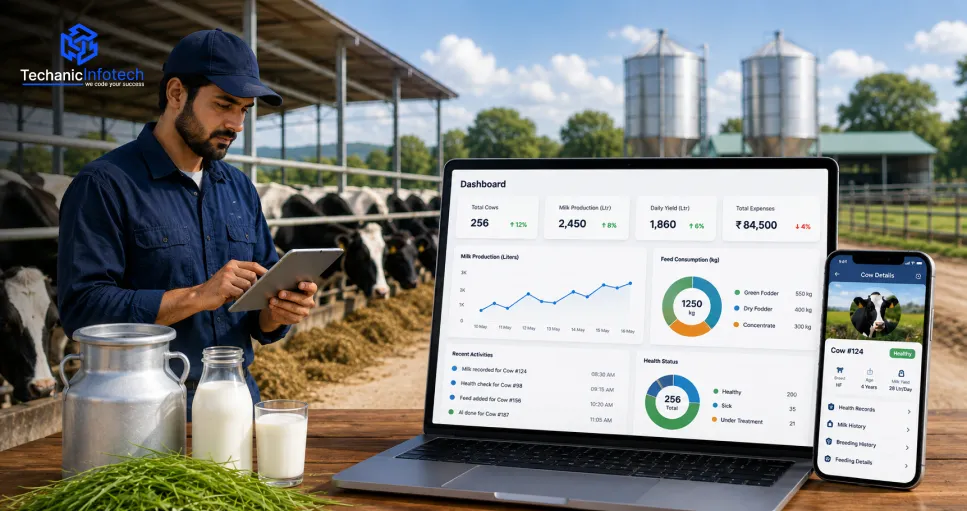
Dairy farm management software brings these activities into a centralized digital platform. Instead of relying on spreadsheets, paper records, or disconnected systems, farmers can use software to monitor livestock, production, resources, and farm performance in real time.
With technologies such as IoT sensors, cloud computing, mobile applications, data analytics, and artificial intelligence, modern dairy farm software development can support more accurate monitoring and data-driven decision-making.
A well-designed solution can help dairy businesses improve operational visibility, reduce manual work, identify potential issues earlier, and manage growing farm operations more efficiently. The overall dairy farm software development cost depends on factors such as features, integrations, IoT devices, AI capabilities, platforms, and software complexity.
The global dairy farm management software market is valued at approximately $3.2 billion and is projected to scale up to around $7.1 billion by 2034, growing at a steady compound annual growth rate (CAGR) of about 9.3%.
According to Dataintelo, in 2025, the average dairy farm that adopted comprehensive farm management software reported a 14.2% improvement in milk yield per cow and a 19.5% reduction in veterinary costs compared to non-adopters, according to industry surveys.
According to Dataintelo, North America held the dominant position in the global dairy farm management software market in 2025, accounting for $1.11 billion, equivalent to 34.7% of total global revenues.
Dairy farm management software is a digital system designed to help farmers manage livestock, milk production, farm resources, financial records, and day-to-day operations from a centralized platform. Instead of maintaining separate records for each activity, farmers can use one system to collect, organise, and analyze operational data.
The software typically works through a combination of mobile or web applications, cloud databases, IoT devices, and analytics tools.
Data Collection: Information about cows, milk production, feeding, health, breeding, and farm activities is recorded manually or collected through connected devices.
Centralized Data Storage: The collected information is stored in a centralized database, making records accessible to authorized users.
Real-Time Monitoring: IoT sensors and connected equipment can provide information about animal activity, environmental conditions, milk production, and equipment performance.
Data Analysis: Analytics tools identify trends, production patterns, health indicators, and operational inefficiencies.
Alerts & Notifications: The system can notify farmers about vaccination schedules, breeding cycles, unusual animal activity, equipment issues, or other important events.
Reports & Decision-Making: Farmers can access dashboards and reports to evaluate milk production, herd performance, expenses, feed usage, and overall farm efficiency.
For larger operations, livestock management software can integrate multiple farms, herds, users, and connected devices into a single management environment. This makes it easier to monitor operations as the business expands. When a mobile application is part of the solution, businesses should also consider mobile app development costs, which can vary based on the number of platforms, features, integrations, and level of customisation required.
Modern dairy management platforms can cover multiple operational areas from a single system. This helps farmers replace scattered records with centralized, actionable data.
|
Management Area |
What the Software Can Track |
|
Herd Management |
Animal profiles, breed, age, identification, ownership, and herd history |
|
Milk Production |
Daily yield, individual animal production, quality records, and production trends |
|
Animal Health |
Vaccinations, treatments, medical history, illnesses, and health alerts |
|
Breeding Management |
Heat cycles, insemination, pregnancy, calving, and breeding history |
|
Feed Management |
Feed types, consumption, inventory, nutritional plans, and costs |
|
Farm Inventory |
Medicines, feed, equipment, supplies, and stock levels |
|
Employee Management |
Staff records, assignments, schedules, and farm activities |
|
Financial Management |
Expenses, revenue, milk sales, purchases, and profitability |
|
Equipment Monitoring |
Equipment usage, maintenance schedules, faults, and service history |
|
Farm Analytics |
Production trends, herd performance, costs, and operational reports |
A modern dairy management platform should combine herd monitoring, production tracking, farm operations, and analytics in one system. The exact feature set can vary depending on the farm’s size and operational requirements.
|
Feature |
Purpose |
|
Herd Management |
Stores animal profiles, identification, breed, age, and history. |
|
Herd Tracking |
Tracks individual animal location, activity, health, and production data. |
|
Milk Production Tracking |
Records daily yield, quality, and production trends. |
|
Health Management |
Maintains vaccination, treatment, illness, and medical records. |
|
Breeding Management |
Tracks heat cycles, insemination, pregnancy, and calving schedules. |
|
Feed Management |
Monitors feed consumption, nutritional plans, and inventory. |
|
IoT Integration |
Connects sensors and smart equipment for real-time monitoring. |
|
Automated Alerts |
Sends notifications for health, breeding, vaccination, and equipment events. |
|
Inventory Management |
Tracks feed, medicines, equipment, and other farm supplies. |
|
Employee Management |
Helps manage staff activities, schedules, and responsibilities. |
|
Financial Management |
Tracks expenses, income, milk sales, and operational costs. |
|
Analytics & Reports |
Provides insights into herd performance, milk yield, expenses, and productivity. |
|
Mobile Access |
Allows farmers and managers to monitor operations remotely. |
|
Admin Dashboard |
Provides centralized control over users, farms, animals, devices, and reports. |
A well-planned dairy farm management app development company can integrate these features based on the farm's operational scale instead of building unnecessary functionality into the initial product.
IoT and AI can make dairy management software more intelligent by turning farm data into real-time insights. Connected devices collect operational information, while AI can analyze that data to identify patterns and support better decisions.
IoT devices and sensors can collect data related to:
Animal movement and activity
Body temperature and health indicators
Feeding and water consumption
Milk production
Barn temperature and humidity
Equipment performance
Location and movement of livestock
This data can be transferred to the farm management platform, allowing farmers to monitor operations remotely.
AI can analyze historical and real-time farm data to identify patterns that may be difficult to detect manually.
|
AI Application |
Potential Use |
|
Health Monitoring |
Identifies unusual behavioral or health patterns |
|
Predictive Analytics |
Forecasts production and operational trends |
|
Breeding Analysis |
Supports breeding and fertility management |
|
Milk Production Prediction |
Estimates future production based on historical data |
|
Feed Optimization |
Analyzes consumption and helps optimize feeding plans |
|
Disease Risk Detection |
Flags patterns that may indicate potential health problems |
|
Automated Insights |
Converts farm data into actionable recommendations |
When IoT and AI work together, sensors can continuously collect data while AI systems analyze it and generate alerts or insights. For example, unusual activity detected by a wearable sensor could trigger an alert for the farm manager to investigate.
Businesses developing these capabilities may work with an AI development company for machine-learning models, predictive analytics, and intelligent automation, while IoT app development expertise can help connect sensors, devices, and software.
The combination can make dairy operations more data-driven, but the accuracy of insights depends on sensor quality, data volume, system integration, and proper model validation.
The technology infrastructure for dairy farm software should support reliable data collection, real-time monitoring, mobile access, analytics, and integration with farm equipment and connected devices. The final stack depends on the farm size, number of users, loT requirements, and level of automation
|
Technology Layer |
Recommended Technologies |
Estimated Development Cost |
|
Mobile App |
Flutter, React Native, Kotlin, Swift |
$3,000–$12,000 |
|
Web/Admin Panel |
React, Angular, Vue.js |
$2,000–$8,000 |
|
Backend |
Node.js, Python, Django, Laravel |
$4,000–$12,000 |
|
Database |
PostgreSQL, MySQL, MongoDB |
$1,500–$5,000 |
|
Cloud Infrastructure |
AWS, Azure, Google Cloud |
$2,000–$8,000 |
|
IoT Integration |
MQTT, REST APIs, IoT gateways |
$3,000–$15,000+ |
|
AI & Analytics |
Python, TensorFlow, PyTorch |
$4,000–$20,000+ |
|
Notifications |
Firebase, Twilio, APNs |
$500–$3,000 |
|
Security |
OAuth, JWT, encryption, RBAC |
$1,000–$5,000 |
The dairy farm software development cost generally ranges from $15,000 to $70,000+, depending on the software's features, IoT integrations, AI capabilities, number of users, platforms, and level of automation.
|
Software Type |
Estimated Cost |
Timeline |
Typical Capabilities |
|
Basic |
$8,000–$20,000 |
2–3 months |
Herd records, milk tracking, basic reports, admin panel |
|
Mid-Level |
$20,000–$40,000 |
3–5 months |
Health, breeding, feed, inventory, mobile app, analytics |
|
Advanced |
$40,000–$65,000 |
5–7 months |
IoT integration, real-time monitoring, advanced dashboards, automation |
|
Enterprise |
$65,000–$90,000+ |
7–10+ months |
AI, predictive analytics, multi-farm management, IoT ecosystem, advanced integrations |
Depending on the project scope, the budget may cover:
UI/UX design
Mobile and web application development
Backend and database development
IoT device integration
AI and analytics
Admin dashboard
API integrations
Testing and deployment
Security implementation
The final software development cost can increase when businesses require custom hardware integration, advanced AI models, real-time monitoring, or complex integrations with existing agricultural systems. Hardware, cloud infrastructure, sensor procurement, and recurring service costs should generally be budgeted separately.
The final dairy farm software development cost depends on several technical and business factors. Understanding these elements helps businesses prepare a more accurate development budget.
|
Cost Factor |
Impact on Cost |
|
Feature Complexity |
Advanced herd, breeding, health, financial, and reporting features require more development effort. |
|
IoT Integration |
Connecting sensors, wearables, milking systems, and farm equipment increases development complexity. |
|
AI & Predictive Analytics |
Machine learning, disease-risk detection, and production forecasting require additional development and infrastructure. |
|
Number of Platforms |
Building mobile apps, web dashboards, and admin panels increases the overall scope. |
|
Farm Size |
Managing multiple farms, thousands of animals, and numerous users requires a more scalable architecture. |
|
Third-Party Integrations |
ERP, payment, veterinary, accounting, weather, and equipment integrations can increase costs. |
|
Data Security |
Role-based access, encryption, authentication, and secure data storage requires additional implementation. |
|
Cloud Infrastructure |
Large datasets, IoT streams, analytics, and backups can increase infrastructure requirements. |
|
UI/UX Requirements |
Custom dashboards, visual reports, and multilingual interfaces require additional design and development work. |
|
Maintenance & Support |
Updates, bug fixes, monitoring, infrastructure management, and new features create ongoing expenses. |
A basic farm management system with standard records will cost less than a completely customized platform designed around specific dairy workflows.
If the software needs to communicate with smart collars, milk meters, environmental sensors, automated feeding systems, or other equipment, integration and testing requirements can significantly increase the budget.
Basic analytics are less expensive than advanced predictive systems. AI-based health monitoring, production forecasting, anomaly detection, and automated recommendations require additional data, model development, and infrastructure.
A platform designed for a single small farm has different architecture requirements from an enterprise system managing multiple locations, thousands of animals, and hundreds of users.
The team's expertise, location, technology experience, and project engagement model can also influence the budget. Working with a provider offering custom software development services can be useful when the platform requires specialized workflows, IoT connectivity, and integrations. A reliable software app development company can also help businesses balance customisation, scalability, integration requirements, and long-term maintenance costs.
Building dairy farm management software requires a structured approach that aligns technology with real farm operations. A well-planned process can reduce development risks and make future expansion easier.
Start by understanding the farm's daily operations, including herd tracking, milk production, breeding, health monitoring, feed management, inventory, and financial workflows.
Prioritize the features required for the first version. A basic MVP can focus on herd records, milk tracking, health management, notifications, and reporting before adding advanced IoT and AI capabilities.
Create interfaces for farmers, veterinarians, managers, and administrators. The application should remain simple enough for users to access important information quickly, even in field environments.
Choosing the right mobile app development company can help businesses select a scalable technology stack and build mobile solutions that are suited to the farm's operational requirements.
Build the backend, database, mobile application, web dashboard, authentication, notifications, reporting, and other core functionality.
Connect sensors, smart devices, milking equipment, and other farm technologies where required. AI can then be introduced for predictive analytics, health monitoring, production forecasting, and anomaly detection.
Test functionality, data accuracy, device connectivity, security, performance, usability, and compatibility. Field testing is particularly important for IoT-enabled dairy systems.
Launch the mobile and web applications, configure cloud infrastructure, connect production devices, create user accounts, and provide training for farm staff.
After deployment, track system performance and user feedback. Regular updates can improve workflows, add new integrations, strengthen security, and introduce advanced analytics.
A phased approach allows businesses to start with essential dairy farming app development requirements and gradually expand into IoT automation, AI analytics, and multi-farm management.
Dairy farm management software can help modern farms move from manual record-keeping to more connected, data-driven operations. By bringing herd tracking, milk production, health, breeding, feed, inventory, and financial management into one platform, farmers can improve visibility and streamline daily workflows.
The overall development investment can range from $8,000 to $90,000+, depending on features, IoT connectivity, AI capabilities, platforms, integrations, and scalability requirements.
Starting with essential functionality and expanding gradually with IoT, AI, automation, and predictive analytics can help dairy businesses control their initial investment while building a system that grows with their operations.
It is a digital platform used to manage herd records, milk production, animal health, breeding, feed, inventory, finances, and other farm operations.
The cost typically ranges from $8,000 to $90,000+, depending on features, IoT integrations, AI capabilities, and software complexity.
Common features include herd tracking, milk production monitoring, health management, breeding management, feed tracking, inventory, alerts, analytics, and reporting.
Yes. IoT sensors can monitor animal activity, environmental conditions, equipment, and milk production and send data to the management platform.
AI can support health monitoring, production forecasting, anomaly detection, breeding analysis, and predictive analytics.
A basic system may take around 2-3 months, while an advanced IoT- and AI-enabled platform can take 7-10+ months.
Yes. Enterprise platforms can provide centralized dashboards for managing multiple farms, herds, users, devices, and production data.
Yes. APIs, IoT gateways, and device integrations can connect compatible milking systems, sensors, wearables, and other farm equipment to the software.


Abhishek Jangid is the CEO of Techanic Infotech, with extensive experience in mobile app and web development. He specializes in helping businesses turn innovative ideas into scalable digital solutions through strategic planning and modern technology.