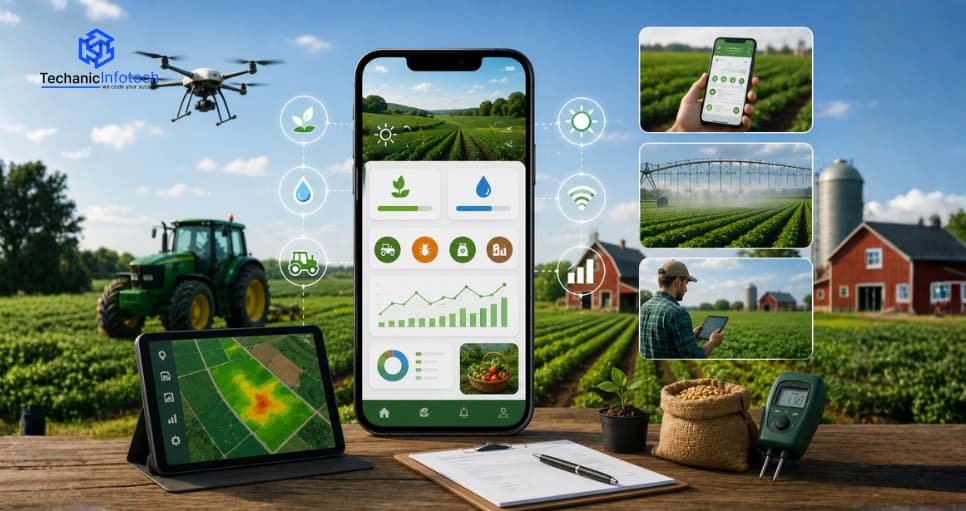
Agriculture App Development
Farm Management App Development: Features, Benefits, and Cost
June 26, 2026
June 26, 2026
Agriculture is rapidly evolving through digital innovation, helping farmers make smarter decisions, improve productivity, and manage operations more efficiently. Modern farming now relies on technologies such as artificial intelligence (AI), the Internet of Things (IoT), cloud computing, GPS tracking, and real-time analytics to optimise agricultural processes.
As a result, farm management app development has become an essential investment for agribusinesses, commercial farms, cooperatives, and agricultural startups. These applications enable farmers to monitor crops, manage livestock, track equipment, analyse field data, and automate day-to-day farm activities from a single platform.
Whether you're planning a crop monitoring solution, livestock management platform, or precision farming application, understanding the development process, essential features, and associated costs will help you build a successful digital farming solution.
'Farm management app development' refers to the process of designing and developing mobile and web applications that help farmers and agricultural businesses efficiently manage farming operations through digital technologies.
Modern agriculture app development solutions provide tools for crop planning, weather monitoring, irrigation scheduling, livestock tracking, inventory management, equipment monitoring, financial reporting, and real-time analytics.
Businesses offering farm management software development focus on creating customised solutions that improve productivity while reducing operational costs. Partnering with experienced development teams helps build scalable applications capable of supporting modern farming practices and future technological advancements.
The agriculture technology industry is experiencing remarkable growth as farmers increasingly adopt digital solutions to improve efficiency and sustainability.
Current Market Size: The global smart agriculture market was valued at approximately USD 18–20 billion in 2024.
Future Market Forecast: The market is expected to surpass USD 40 billion by 2030, driven by increasing adoption of precision farming technologies.
Growth Rate: The smart agriculture market is projected to grow at a CAGR of around 12–14% during the forecast period.
Precision Agriculture Growth: Precision agriculture technologies are witnessing rapid adoption due to increasing demand for data-driven farming and resource optimisation.
IoT Adoption: Millions of connected agricultural sensors are being deployed worldwide for soil monitoring, irrigation management, livestock tracking, and equipment monitoring.
An effective farm management application should simplify agricultural operations while providing farmers with real-time insights and automation. Below are some of the essential features in a mobile app designed for modern agriculture.
A centralised dashboard provides farmers with a complete overview of their agricultural operations. It displays crop status, livestock information, weather forecasts, ongoing farm activities, equipment usage, financial reports, and task reminders in one place, enabling quick and informed decision-making.
A robust crop management app development solution helps farmers plan crop cycles, manage planting schedules, monitor crop health, track fertiliser and pesticide usage, identify diseases, and schedule harvesting activities. These features improve productivity while minimising crop losses.
Livestock Management App Development enables farmers to monitor animal health, vaccination schedules, feeding routines, breeding records, milk production, and medical history. Automated reminders help ensure proper livestock care and improve overall farm efficiency.
Real-time weather updates, rainfall forecasts, humidity levels, temperature tracking, and wind-speed monitoring help farmers make informed decisions regarding irrigation, planting, harvesting, and crop protection, reducing the impact of unpredictable weather conditions.
Smart irrigation features use weather data, soil moisture sensors, and AI-powered recommendations to optimise water usage. Automated irrigation scheduling reduces water wastage while ensuring crops receive the right amount of moisture for healthy growth.
GPS-enabled field mapping allows farmers to create digital maps of their farmland, monitor field boundaries, track crop locations, and optimise land utilisation. This feature is particularly valuable for large-scale farming operations and precision agriculture.
The application helps farmers efficiently manage inventories of seeds, fertilisers, pesticides, animal feed, machinery parts, fuel, and other agricultural supplies. Real-time inventory tracking minimises shortages, prevents overstocking, and improves operational planning.
Farmers can monitor tractors, harvesters, irrigation systems, drones, and other agricultural equipment. Maintenance reminders, usage history, fuel consumption tracking, and repair schedules help extend machinery lifespan while reducing downtime.
Integrated financial management tools allow users to record expenses, monitor revenue, generate invoices, track profits, manage budgets, and analyse the overall financial performance of the farm, making business planning more effective.
Modern farming applications increasingly leverage the AI App Development Guide and AI-powered technologies to predict crop yields, identify plant diseases, optimise irrigation schedules, detect pest infestations, and recommend suitable farming practices based on historical and real-time data.
Comprehensive dashboards and detailed reports provide valuable insights into crop production, livestock performance, operational costs, equipment utilisation, resource consumption, and profitability. These analytics help farmers make data-driven decisions that improve productivity and long-term sustainability.
Investing in Smart Farming App Development provides significant advantages for farmers, agribusinesses, and agricultural enterprises. By digitising daily farming operations, these applications improve productivity, reduce costs, and enable data-driven decision-making. Here are some of the key benefits of implementing a farm management app.
Automation simplifies routine farming activities such as crop planning, irrigation scheduling, equipment monitoring, and livestock management. This reduces manual effort, saves time, and allows farmers to focus on improving productivity and maximising overall farm output.
Farm management apps provide real-time insights into weather conditions, soil health, crop performance, and livestock data. With access to accurate analytics, farmers can make informed decisions that improve operational efficiency and minimise risks.
Automating irrigation systems, inventory management, equipment maintenance, and labour scheduling helps reduce unnecessary expenses. Efficient resource utilisation also minimises waste and lowers the overall cost of farm operations.
Modern precision agriculture app development solutions leverage GPS technology, AI, and data analytics to optimise planting schedules, fertiliser application, irrigation, and pest control. These capabilities help improve crop quality and maximise agricultural yield.
Farm management applications enable farmers to monitor and optimise the use of water, fertilisers, pesticides, seeds, machinery, and labour. Better resource allocation leads to increased productivity while supporting sustainable farming practices.
With livestock management app development, farmers can efficiently track animal health, feeding schedules, breeding records, vaccination history, and medical treatments. Continuous monitoring improves livestock productivity and reduces health-related risks.
Integrated financial tools allow farmers to track expenses, revenue, profits, budgets, and operational costs from a single dashboard. Detailed financial reports help businesses manage cash flow and make informed investment decisions.
Digital farming applications help farmers plan seasonal activities, schedule harvesting, monitor crop cycles, and allocate resources more effectively. Better planning reduces delays and improves overall farm management efficiency.
Real-time reports and performance analytics enable farmers to identify trends, evaluate productivity, and make strategic improvements based on actionable insights rather than assumptions.
Modern digital farming solutions encourage sustainable agriculture by optimising water usage, reducing fertiliser and pesticide waste, lowering carbon emissions, and promoting environmentally responsible farming practices.
Building a successful farm management app development solution requires a well-planned and structured development approach. From understanding farming challenges to deploying a scalable application, each stage plays a vital role in delivering a reliable digital farming platform.
The development process begins with identifying business goals, farming challenges, target users, and project requirements. At this stage, developers work closely with stakeholders to define the application's core features, user roles, and long-term objectives, ensuring the solution aligns with modern agricultural needs.
Before development begins, businesses analyse competitors, market trends, and customer expectations to create a clear product roadmap. Many startups choose MVP development to launch a basic version of the application with essential features, validate market demand, and gather user feedback before investing in a full-scale product.
A user-friendly interface is essential for ensuring farmers can easily navigate the application regardless of their technical expertise. During this stage, designers focus on mobile app design by creating wireframes, interactive prototypes, and intuitive dashboards that simplify crop management, livestock monitoring, inventory tracking, and other farming activities.
Selecting the right technology stack is critical for building a secure, scalable, and high-performing application. A comprehensive mobile app tech stack guide helps businesses choose suitable frontend frameworks, backend technologies, cloud platforms, databases, APIs, and IoT integrations based on project requirements.
During this stage, developers build the application's frontend and backend while integrating essential features such as crop management, livestock tracking, weather forecasting, GPS field mapping, inventory management, payment gateways, IoT sensors, and cloud infrastructure. Businesses often collaborate with the best full-stack development companies to ensure seamless development and long-term scalability.
Before launch, the application undergoes comprehensive mobile app testing to verify functionality, security, performance, compatibility, and usability across multiple devices and operating systems. Once all issues are resolved, the application is deployed to the Google Play Store, Apple App Store, or enterprise environments.
The development process continues after deployment through regular updates, bug fixes, security enhancements, and feature improvements. Ongoing mobile app maintenance is essential to keep the application secure, compatible with evolving technologies, and aligned with the changing needs of modern agriculture.
The Farm Management App Development Cost typically ranges from $12,000 to $100,000+, depending on the application's complexity, AI capabilities, IoT integrations, cloud infrastructure, and customisation requirements.
The table below provides an estimated cost breakdown based on project scope.
|
App Type |
Estimated Cost Range |
Development Timeline |
|
Basic Farm Management App |
$10,000 - $20,000 |
2-3 Months |
|
Mid-Level Agriculture App |
$20,000 - $45,000 |
3-5 Months |
|
Smart Farming App |
$45,000 - $70,000 |
5-7 Months |
|
Enterprise Farm Management Platform with AI & IoT |
$70,000 - $90,000+ |
7-10 Months |
Businesses should also evaluate the overall mobile app development cost before finalising their project budget. Startups and agribusinesses can also benefit from software development for SMBs to build cost-effective yet scalable digital farming solutions.
Modern agriculture is rapidly embracing digital transformation, making farm management app development a valuable investment for farms of all sizes. From crop monitoring and livestock management to AI-powered analytics and precision agriculture, these applications help improve productivity, reduce operational costs, and support sustainable farming practices.
Whether you're planning an agritech startup or digitising an existing agricultural business, investing in a customised farm management solution can provide long-term operational and financial benefits.
Farm Management App Development is the process of building mobile and web applications that help farmers manage crops, livestock, equipment, inventory, irrigation, and other agricultural operations through a single digital platform.
A farm management app should include crop management, livestock tracking, weather forecasting, GPS field mapping, inventory management, irrigation scheduling, financial reporting, analytics, and AI-powered insights.
The farm management app development cost typically ranges from $10,000 to $90,000+. The final cost depends on factors such as app complexity, features, AI and IoT integration, third-party APIs, and customisation requirements.
The development timeline usually ranges from 2 to 10 months, depending on the project's scope, functionality, and technology requirements.
Yes. AI can be integrated to monitor crop health, detect plant diseases, predict yields, optimise irrigation schedules, automate farm operations, and provide data-driven recommendations for better decision-making.
Common technologies include Flutter, React Native, Node.js, Python, PostgreSQL, MongoDB, AWS, Google Cloud, IoT sensors, GPS mapping, and AI-powered analytics.
Digital farming solutions help improve farm productivity, reduce operational costs, optimise resource utilisation, enable data-driven decision-making, and promote sustainable farming practices, making them a valuable investment for modern agriculture.


Shailendra is a dedicated professional known for his strong client-focused approach and clear understanding of business needs. He brings a thoughtful understanding of client needs and focuses on building long-term relationships through clear communication and quality-driven work. With a blend of strategic thinking, content expertise, and a hands-on approach, Shailendra plays a key role in shaping content that aligns with both business goals and user expectations.