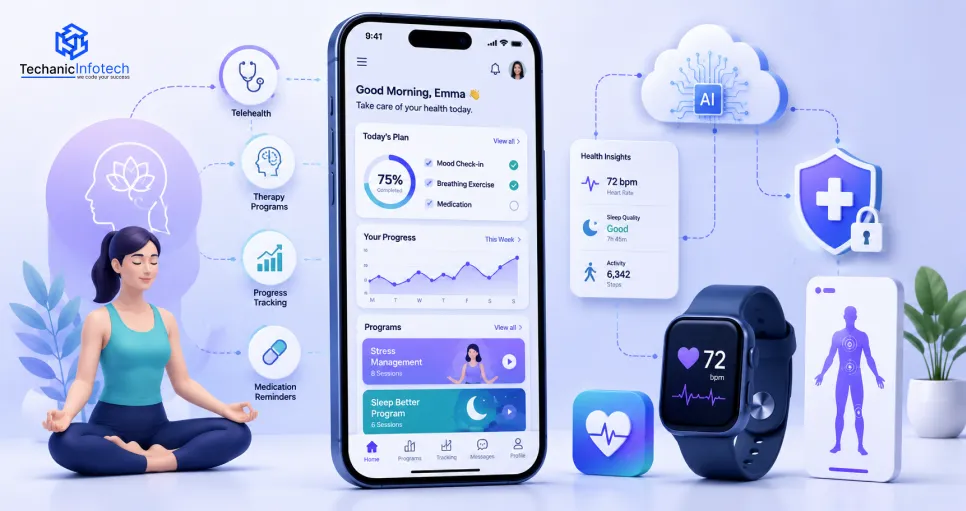
Healthcare App Development
Digital Therapeutics App Development: Features, Cost, and Architecture
July 22, 2026
July 22, 2026
Key Takeaways
Digital therapeutics combine clinically validated treatments with modern software to improve long-term patient outcomes.
Scalable architecture, secure data management, and regulatory compliance are essential for successful DTx platforms.
AI-powered capabilities and remote monitoring enhance patient engagement and support personalised healthcare.
Integrating wearable devices and healthcare systems creates a connected digital care ecosystem.
Development costs generally range from $10,000 to $100,000+, depending on platform complexity and clinical requirements.
Healthcare is undergoing a major digital transformation, shifting from reactive treatment models to continuous, data-driven patient care. As chronic diseases become more prevalent and healthcare providers seek scalable treatment options, software-based therapies are emerging as an effective way to complement traditional medical care.
This evolution has accelerated the demand for digital therapeutics app development, enabling healthcare organisations to deliver clinically validated treatments through mobile and web applications. Unlike standard wellness apps, digital therapeutics are designed to prevent, manage, or treat medical conditions using evidence-based interventions supported by clinical research.
Modern digital therapeutics software development combines remote patient monitoring, personalised treatment plans, behavioural therapy, and real-time analytics to improve patient outcomes while reducing healthcare costs. Whether you're building a prescription-based therapeutic solution or a chronic disease management platform, investing in digital health app development helps organisations deliver accessible, personalised, and measurable healthcare experiences.
The global digital therapeutics market size was valued at USD 10.15 billion in 2025 and is projected to grow from USD 12.45 billion in 2026 to USD 67.58 billion by 2034, exhibiting a CAGR of 23.55% during the forecast period.
App Volume: There are over 337,000 digital health apps available globally, with 140 being FDA-approved Prescription Digital Therapeutics (PDTs).
The treatment segment is projected to hold a 69.35% market share in 2026.
Digital therapeutics are changing the way healthcare providers manage long-term conditions by extending care beyond hospitals and clinics. Instead of relying solely on periodic consultations, patients can receive continuous guidance, personalised interventions, and real-time progress tracking through digital platforms.
Patients living with chronic illnesses often require ongoing monitoring rather than occasional medical appointments. Digital therapeutics provide continuous support by tracking health data, medication adherence, lifestyle habits, and treatment progress, allowing clinicians to intervene when necessary.
Healthcare organisations investing in chronic disease management software development are increasingly incorporating digital therapeutics to improve long-term disease management while reducing hospital readmissions.
Unlike traditional healthcare applications, digital therapeutics adapt treatment programmes based on patient behaviour, symptoms, and clinical progress. Personalised care plans improve treatment adherence and create more effective healthcare experiences.
Interactive dashboards, medication reminders, educational content, gamification, and progress tracking encourage patients to remain actively involved in their treatment journey. Higher engagement often leads to better clinical outcomes and improved quality of life.
Healthcare providers can remotely monitor patient health metrics, identify potential risks, and make informed treatment decisions without requiring frequent in-person visits. This approach improves healthcare accessibility while reducing pressure on medical facilities.
Digital therapeutic platforms are also becoming increasingly valuable in senior care app development, enabling elderly patients to receive continuous monitoring, medication reminders, cognitive support, and remote healthcare services from the comfort of their homes.
A successful digital therapeutics platform goes beyond basic health tracking by delivering clinically validated interventions, personalised treatment plans, and continuous patient engagement. Whether you're planning DTx app development for a startup or an enterprise healthcare organisation, the following features are essential for building an effective therapeutic solution.
Every patient has unique medical conditions, treatment goals, and health histories. A comprehensive onboarding process collects relevant clinical information to create personalised therapy plans and improve treatment effectiveness from the beginning.
Unlike traditional wellness applications, digital therapeutics deliver clinically validated treatment protocols designed to manage or treat specific medical conditions. These programmes are regularly updated based on medical research and healthcare guidelines, making them a key component in the development of prescription digital therapeutics.
Continuous monitoring allows healthcare professionals to track patient progress, medication adherence, symptoms, and vital health metrics in real time. This helps identify potential health risks early and supports proactive clinical interventions.
Automated reminders encourage patients to take medications, complete therapy sessions, perform daily exercises, and follow prescribed treatment schedules. Improved adherence contributes to better health outcomes and long-term patient engagement.
Built-in messaging, video consultations, and secure notifications enable seamless communication between patients and healthcare providers. This improves accessibility while ensuring timely medical guidance throughout the treatment journey.
Interactive dashboards allow both patients and clinicians to monitor treatment progress through measurable health indicators, therapy completion rates, symptom improvements, and adherence reports. These insights support informed clinical decision-making.
Modern therapeutic platforms increasingly leverage AI integration in mobile apps to deliver personalised recommendations, predictive health insights, intelligent reminders, and adaptive treatment experiences. Many organisations also incorporate AI symptom checker app development capabilities to help patients assess symptoms, receive preliminary guidance, and determine when professional medical consultation is required.
Integration with smartwatches, fitness trackers, glucose monitors, blood pressure devices, and other connected medical equipment enables continuous health monitoring while automatically synchronising patient data with the application.
Developing a successful digital therapeutics platform requires much more than building a healthcare application. Since these solutions deliver evidence-based interventions and often support patients with chronic or behavioural health conditions, the development process must balance clinical effectiveness, regulatory compliance, security, and user engagement.
Begin by identifying the medical condition the application will address, such as diabetes, hypertension, insomnia, anxiety, or cardiovascular disease. Work closely with clinicians, healthcare providers, and medical experts to define treatment goals, patient journeys, and measurable clinical outcomes.
Determine the core functionality of the platform, including patient onboarding, therapy programmes, medication reminders, progress tracking, remote monitoring, and clinician dashboards. At the same time, plan for compliance with healthcare regulations such as HIPAA, GDPR, and other regional standards to ensure patient data remains secure.
Digital therapeutics applications rely heavily on patient engagement and long-term adherence. Create intuitive interfaces, personalised treatment journeys, accessibility features, and motivational elements that encourage users to consistently follow their prescribed digital therapy programmes.
Build the frontend, backend, secure APIs, cloud infrastructure, and administrative dashboard. Many healthcare organisations also integrate AI into mobile apps to deliver personalised treatment recommendations, predictive health insights, and intelligent patient engagement throughout the therapy journey.
Connect the application with electronic health records (EHRs), wearable devices, IoT sensors, pharmacy systems, payment gateways, and third-party healthcare APIs. A well-integrated platform enables clinicians to access real-time patient data while improving care coordination across healthcare providers.
Conduct comprehensive testing to verify functionality, security, usability, and performance. Clinical validation, user acceptance testing, and compliance assessments ensure the platform is reliable, safe, and ready for deployment in real-world healthcare environments.
After deployment, monitor patient engagement, treatment adherence, platform performance, and clinical outcomes. Release regular updates, strengthen security, optimise AI models, and introduce new therapeutic programmes based on user feedback and evolving medical research.
Building a reliable digital therapeutics platform requires more than an intuitive interface. A scalable architecture must support clinical workflows, secure patient data, enable real-time monitoring, ensure regulatory compliance, and enable seamless integration with healthcare systems. Successful digital therapeutics platform development focuses on creating an ecosystem that delivers personalised care while maintaining high performance and security.
The patient-facing application serves as the primary touchpoint for therapy programmes, medication reminders, progress tracking, educational content, and communication with healthcare professionals. The interface should remain simple, accessible, and responsive across smartphones and tablets.
Doctors, therapists, and care teams require a centralised dashboard to monitor patient progress, review health reports, adjust treatment plans, and communicate securely with patients. Organisations investing in digital healthcare often combine therapeutic applications with advanced provider portals to improve clinical efficiency.
Cloud-native architecture enables secure storage of patient records, treatment history, analytics, and wearable device data while supporting automatic scaling as the number of users grows. High availability and disaster recovery mechanisms ensure uninterrupted healthcare services.
Clinical-grade platforms should integrate with electronic health records (EHRs), wearable devices, laboratory systems, payment gateways, and telemedicine platforms. These integrations create a unified healthcare ecosystem while reducing manual data entry and improving operational efficiency.
Advanced analytics engines process patient behaviour, treatment adherence, and clinical outcomes to generate meaningful insights for healthcare providers. These insights support evidence-based decision-making and continuous improvement of treatment programmes.
Digital therapeutics applications handle highly sensitive medical information, making security and regulatory compliance essential throughout the development lifecycle. Beyond protecting patient data, organisations must also build platforms that can evolve with changing healthcare technologies and clinical requirements.
Choosing the right technologies during the planning phase simplifies future expansion, improves system performance, and supports long-term maintainability. Referring to a comprehensive mobile app tech stack guide helps businesses evaluate suitable frameworks, cloud platforms, databases, and integration tools for healthcare applications.
Healthcare applications should comply with regulations such as HIPAA, GDPR, and other regional healthcare standards. Implementing encryption, role-based access control, secure authentication, and audit logs helps protect patient information while maintaining compliance.
Modern AI-powered digital therapeutics solutions use artificial intelligence to personalise treatment plans, analyse patient behaviour, predict health risks, and improve therapy adherence. However, AI models should always operate with transparency, clinical validation, and human oversight to ensure patient safety.
Developing regulated healthcare software requires expertise in clinical workflows, cloud architecture, AI integration, and secure software engineering. Partnering with a trusted mobile app development company helps healthcare organisations build reliable digital therapeutics platforms while reducing implementation risks. Businesses can also learn from top telemedicine app development companies that have experience delivering scalable digital healthcare ecosystems.
Healthcare startups and providers should design solutions that can expand as user demand increases. Organisations looking for cost-effective digital transformation strategies can benefit from custom software development for SMBs, allowing them to develop scalable platforms while optimising long-term investment and operational efficiency.
The digital therapeutics app cost typically ranges from $10,000 to $100,000+, depending on clinical complexity, regulatory requirements, AI capabilities, wearable integrations, cloud infrastructure, and the overall scope of the platform. Rather than developing a full-featured solution from day one, many healthcare startups and providers adopt a phased development strategy, launching a clinically focused MVP first and expanding the platform as user adoption, clinical validation, and business requirements grow.
The first stage focuses on building a secure and functional digital therapeutics application with the essential features required to validate the product, conduct pilot programmes, or launch an initial treatment solution.
Estimated Investment: $10,000–$20,000
Best suited for:
Healthcare startups
Digital health innovators
Clinical pilot programs
Proof-of-concept (PoC) solutions
Once the application gains traction, businesses can expand the platform with advanced clinical capabilities such as AI-powered treatment recommendations, remote patient monitoring, wearable integrations, medication reminders, healthcare analytics, and secure communication between patients and care providers.
Estimated Investment: $20,000–$50,000
Best suited for:
Growing digital health companies
Hospitals and specialty clinics
Chronic disease management providers
Healthcare organizations scaling digital services
Enterprise-grade digital therapeutics platforms are designed to support large patient populations, multiple treatment programmes, healthcare system integrations, regulatory compliance, advanced analytics, and AI-driven clinical decision support.
Estimated Investment: $50,000–$100,000+
Best suited for:
Enterprise healthcare providers
Pharmaceutical companies
Multi-hospital healthcare networks
Global digital therapeutics organizations
Organisations should also evaluate the overall healthcare app development cost and mobile app development cost while planning their budget, as both contribute to the total investment required to build, deploy, and maintain a clinically compliant digital therapeutics platform.
A healthcare provider specialising in diabetes management wanted to improve patient adherence between clinical visits. The organisation partnered with a technology team to build a digital therapeutics platform that combined personalised treatment plans, medication reminders, wearable device integration, and AI-powered progress tracking.
Patients could log daily health metrics, receive tailored lifestyle recommendations, and communicate securely with healthcare professionals through the application. Clinicians accessed a centralised dashboard to monitor patient progress, identify potential risks, and adjust treatment plans based on real-time data.
Within the first year of deployment, the organisation reported:
Improved patient adherence to prescribed treatment plans.
Better engagement through personalised health recommendations.
Reduced manual follow-ups for healthcare professionals.
Faster identification of high-risk patients using predictive analytics.
Enhanced clinical decision-making through real-time patient insights.
Digital therapeutics are reshaping healthcare by delivering evidence-based treatments through intelligent digital platforms. With advancements in AI, remote monitoring, and connected healthcare technologies, these solutions are enabling providers to deliver more personalised, accessible, and measurable patient care.
Organisations investing in well-designed digital therapeutics platforms today will be better positioned to improve clinical outcomes, increase patient engagement, and adapt to the future of digital healthcare.
Digital therapeutics app development involves creating clinically validated software applications that help prevent, manage, or treat medical conditions through evidence-based digital interventions.
Development costs typically range from $10,000 to $100,000+, depending on features, AI capabilities, compliance requirements, and platform complexity.
Essential features include personalised treatment plans, remote patient monitoring, medication reminders, wearable integration, secure communication, analytics, and AI-powered health insights.
Wellness apps focus on general health and fitness, while digital therapeutics applications provide clinically validated interventions designed to prevent, manage, or treat specific medical conditions.
Yes. AI helps personalise treatment plans, predict health risks, improve patient engagement, analyse clinical data, and support better healthcare decisions.
Yes. Modern DTx platforms implement encryption, secure authentication, regulatory compliance, and role-based access controls to protect sensitive patient information.
Depending on the project's complexity, development generally takes 2 to 10 months from planning to deployment


Neha Sharma is a tech expert at heart who loves exploring new technologies and turning complex ideas into easy-to-understand content. With a passion for learning and writing, she enjoys sharing insights on emerging tech, digital products, and innovation that help businesses stay ahead.