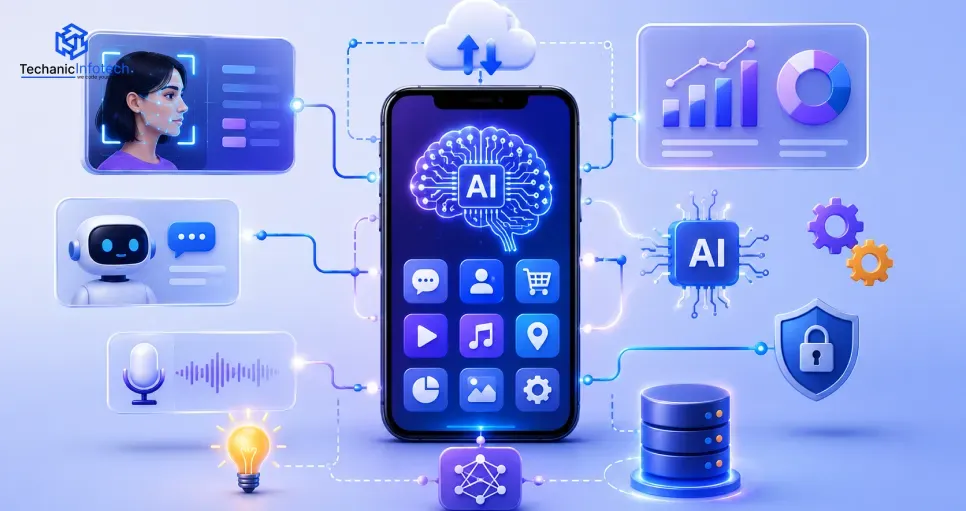
AI Development
AI Integration in Mobile Apps: Personalization, Analytics, and Modern Architecture
June 19, 2026
June 19, 2026
Key Takeaways
AI-powered personalization improves engagement by adapting recommendations, content, and experiences in real time based on user behavior.
Predictive analytics transforms raw data into actionable insights, enabling smarter decisions, automation, and proactive customer engagement.
Scalable AI app architecture relies on microservices, event-driven systems, and cloud-native infrastructure for reliable performance.
MLOps helps prevent model drift through continuous monitoring, automated retraining, version control, and production optimization.
Successful AI integration requires strong data foundations, trustworthy UX, scalable infrastructure, and a phased implementation strategy.
AI integration in mobile apps has evolved from simple automation features into a core business strategy for modern digital products. Users now expect intelligent recommendations, predictive workflows, conversational interfaces, and adaptive experiences across fintech, healthcare, ecommerce, streaming, and SaaS applications.
The problem is that while AI adoption is accelerating, most organisations still fail to scale AI successfully. Recent industry reports show that nearly 88% of companies are already using AI in some form, but a large percentage of AI initiatives never move beyond isolated pilots. The reason is simple: many businesses treat AI as a surface-level feature instead of designing it as a core infrastructure layer deeply connected to data systems, application architecture, and user experience.
Modern AI integration is no longer just about adding a chatbot or recommendation engine. It requires real-time data pipelines, scalable infrastructure, continuous model monitoring, and UX systems designed around user trust and transparency. Companies that fail to build this foundation often struggle with latency, inconsistent predictions, unreliable outputs, and poor adoption.
In this guide, you'll learn how Mobile App Personalization with AI improves user engagement, how predictive analytics pipelines work, and why scalable AI infrastructure is critical for production applications.
You'll also discover how MLOps prevents model degradation, UX strategies for building trust in AI-driven experiences, the ideal AI tech stack, and a step-by-step roadmap for successful AI integration.
Building an effective AI-driven user experience requires balancing automation with transparency and user control. AI-powered personalization has evolved far beyond recommending products or changing homepage banners. In 2026, personalization systems operate continuously across the entire customer journey, adapting layouts, notifications, pricing, search results, onboarding flows, and even support experiences in real time.
Teams looking for a complete guide to building AI apps often discover that personalization and user trust are just as important as model performance.
Many AI systems fail because users feel manipulated or confused by automated behavior. Modern AI applications must prioritize transparency and user control to establish trust. This approach is particularly valuable for businesses planning to build an AI chatbot app, like character AI, where users expect personalized and controllable AI interactions.
For example:
Netflix allows users to reset recommendation preferences
Spotify enables users to influence recommendation algorithms
AI copilots provide editable suggestions rather than forced automation
This “human-in-the-loop” approach creates psychological safety for users.
At the infrastructure level, personalization depends on behavioral data collection pipelines. Every user interaction becomes a signal that feeds recommendation systems and predictive engines.
These signals include:
Click events
Session duration
Scroll behavior
Purchase history
Search queries
Navigation patterns
Device and location context
Most enterprise systems use event collection layers such as Apache Kafka to stream this behavioral data in real time. Kafka enables applications to process millions of user events continuously without overwhelming backend systems.
Many development teams also evaluate the best AI tools for mobile app development to accelerate recommendation engines and personalization workflows.
|
Feature |
Batch Processing |
Real-Time Processing |
|
Update Frequency |
Scheduled hourly or daily |
Instant continuous updates |
|
Impact on UX |
Slower adaptation to behavior |
Dynamic and responsive experiences |
|
Best Use Cases |
Homepage recommendations, email campaigns |
In-session recommendations, live content changes |
Real-time personalization significantly improves engagement because the system adapts as the user interacts with the application. E-commerce platforms, streaming apps, and fintech dashboards increasingly rely on real-time inference pipelines to continuously optimize user journeys.
Another critical aspect of UX for AI apps is explainability. User confidence in AI increases when they can understand how recommendations and decisions are generated. Small UI enhancements like “Recommended because you watched X” or “Suggested based on your recent activity” dramatically improve transparency and adoption.
Ultimately, successful AI personalization is not about making applications feel automated. It is about making them feel intelligently helpful without removing user autonomy.
Predictive analytics has shifted dramatically in recent years. Traditional systems focused primarily on forecasting outcomes, predicting churn, fraud, demand, or customer behavior. As adoption grows, businesses increasingly evaluate how much it costs to build AI agent applications before investing in autonomous workflows.
This evolution changes everything.
Instead of simply identifying a high-risk customer, modern AI systems can automatically trigger retention campaigns, adjust pricing strategies, escalate support tickets, or generate personalized offers without requiring manual intervention.
However, these intelligent systems are only as reliable as the data infrastructure supporting them.
One of the biggest reasons AI initiatives fail is a fragmented data architecture. Models trained on inconsistent or siloed datasets produce unreliable outputs. This is why modern enterprises increasingly rely on unified data foundations such as Lakehouses and Feature Stores.
A Lakehouse combines the flexibility of data lakes with the governance capabilities of data warehouses. Meanwhile, Feature Stores standardize and centralize machine learning features so models across departments use consistent definitions and inputs.
A scalable predictive analytics pipeline typically includes three major stages:
Raw data is continuously collected from multiple sources:
Mobile applications
APIs
CRM systems
IoT devices
Payment systems
User activity streams
Tools like Kafka, Apache Flink, The Ideal AI Integration Tech Stack, and Spark Streaming are commonly used for large-scale ingestion pipelines.
Raw data must be transformed into machine-learning-ready features.
Examples include:
Average purchase value
Customer engagement score
Session frequency
Churn probability indicators
Fraud risk metrics
Feature engineering is one of the most critical phases because poor feature quality directly impacts prediction accuracy.
Similar inference pipelines are widely used in chatgpt-like app development projects where real-time responses are critical.
Examples include:
Fraud detection
Dynamic pricing
Product recommendations
Customer churn predictions
Predictive maintenance alerts
|
Analytics Type |
What it Does |
Real-World Example |
|
Predictive Analytics |
Forecasts future outcomes |
Predicting customer churn |
|
Prescriptive Analytics |
Recommends or automates actions |
Automatically offering discounts to retain users |
Another essential component of enterprise AI systems is MLOps.
Machine learning models degrade over time due to changing user behavior, evolving datasets, and market shifts. This phenomenon is called model drift.
Without continuous monitoring, even highly accurate models eventually fail in production.
MLOps frameworks solve this problem by enabling:
Organizations often rely on professional AI development services for mobile apps to implement scalable MLOps frameworks and monitoring systems.
Automated retraining
Performance monitoring
Version control for models
CI/CD pipelines for AI deployment
Real-time anomaly detection
In production environments, AI success is less about building models and more about maintaining them reliably at scale.
The architecture layer ultimately determines whether an AI application scales successfully or collapses under production demand.
Many organizations still attempt to integrate AI into monolithic systems originally designed for traditional applications. This creates severe scalability bottlenecks because AI workloads behave very differently from standard application logic.
AI inference workloads are computationally intensive, unpredictable, and resource-sensitive. They often require GPU acceleration, asynchronous processing, and real-time event streaming.
Monolithic systems struggle to handle these requirements efficiently.
Many ai development companies that build AI-powered applications now adopt microservices-first architectures to support long-term scalability.
Microservices allow different system components to scale independently.
For example:
Recommendation services can scale separately from authentication systems
AI inference services can use GPU clusters without affecting frontend services
Failures remain isolated instead of crashing the entire application
This separation dramatically improves resilience, scalability, and deployment speed.
Microservices also simplify continuous AI experimentation because teams can deploy and update models independently without disrupting the full platform.
Modern AI systems rely heavily on event-driven architecture.
Instead of processing data in rigid batches, platforms increasingly stream events continuously through systems like Apache Kafka.
Kafka acts as a distributed event backbone that enables:
Real-time analytics
Stream processing
Live personalization
Instant fraud detection
Event synchronization across services
For example, when a user clicks on a product, that event can instantly trigger:
Recommendation updates
Inventory checks
Dynamic pricing adjustments
Marketing automation workflows
All in real time.
Choosing between Edge AI and Cloud AI depends on latency requirements, privacy constraints, and computational complexity.
Edge AI runs models directly on devices.
Best for:
AR/VR applications
Healthcare monitoring
Autonomous vehicles
Smart cameras
Voice assistants
Advantages:
Ultra-low latency
Better privacy
Offline functionality
Reduced cloud dependency
Cloud AI performs inference on centralized infrastructure.
Best for:
Large language models
Complex predictive systems
Heavy analytics workloads
Enterprise-scale processing
Advantages:
Massive scalability
Easier model updates
Centralized monitoring
High computational power
mobile app development trends increasingly highlight hybrid AI infrastructure as a key technology shaping modern enterprise applications.
Teams comparing infrastructure options often refer to a mobile app tech stack guide for developers before finalizing architecture decisions. A scalable AI application stack in 2026 commonly includes:
Flutter: Cross-platform frontend development
Node.js: High-concurrency API backend handling
Python: ML inference, training pipelines, and AI services
Kubernetes: Container orchestration and auto-scaling infrastructure
Apache Kafka: Event streaming and real-time pipelines
Redis: Low-latency caching
PostgreSQL + Lakehouse: Unified data storage architecture
The combination of microservices, streaming systems, and scalable orchestration creates the foundation required for enterprise AI reliability.
Successfully integrating AI requires far more than selecting a model or integrating an API. Organizations need a structured implementation strategy that aligns technical capabilities with measurable business outcomes.
The biggest mistake companies make is launching vague AI experiments without clear business objectives.
Every AI initiative should connect directly to:
Revenue growth
Cost reduction
Risk mitigation
Operational efficiency
Customer retention
Instead of saying:“Let’s add AI to the app.”
Define measurable goals like:“Reduce customer churn by 18% using predictive retention models.”
ROI-driven alignment prevents wasted development cycles and helps prioritize high-impact use cases.
Before touching machine learning models, organizations must audit their data infrastructure.
Key questions include:
Is data centralized or fragmented?
Are events tracked consistently?
Are datasets clean and standardized?
Is real-time ingestion available?
Without high-quality data pipelines, even advanced models produce poor outcomes.
This phase often includes:
Building event schemas
Creating Feature Stores
Standardizing data governance
Implementing data quality monitoring
AI performance always reflects data quality.
Many AI products fail because teams focus entirely on model accuracy while ignoring user experience.
Early-stage prototypes should test:
User trust
Recommendation clarity
Explainability
Feedback systems
Override controls
Users must feel confident interacting with AI systems.
Collect qualitative feedback early before scaling infrastructure aggressively.
Production AI systems must survive real-world traffic spikes, infrastructure failures, and unpredictable behavior.
Testing should include:
Load testing
GPU utilization monitoring
API latency testing
Failure recovery simulation
Edge-case handling
AI systems often behave differently under production load compared to staging environments.
Many organizations partner with an experienced mobile app development company to validate performance, scalability, and deployment readiness.
Successful companies rarely launch AI features to 100% of users immediately.
Instead, they use progressive rollout strategies:
5% traffic exposure
25% controlled expansion
Full deployment after validation
This minimizes business risk while enabling continuous optimization.
MLOps pipelines should simultaneously monitor:
Model drift
User engagement
Error rates
Latency metrics
Conversion impact
AI integration is not a one-time deployment. It is an ongoing operational process.
Even well-funded AI projects frequently fail in production because organizations underestimate infrastructure complexity, data quality requirements, and user adoption challenges.
Below are the most common reasons AI applications collapse after deployment.
Treating AI as a “Bolt-on” Feature: AI cannot succeed as a superficial add-on layered over outdated workflows. Modern AI systems must be deeply integrated into business logic, operations, and product architecture from the beginning.
Poor Data Readiness: Fragmented, inconsistent, or low-quality data ruins machine learning performance. Organizations often invest heavily in models while ignoring foundational data engineering problems.
Ignoring Compliance & Security: AI systems process enormous volumes of sensitive data. Businesses must prioritize GDPR compliance, HIPAA requirements, encryption standards, access control policies, and audit logging to avoid regulatory and reputational risks.
Lack of User Trust: Users avoid AI systems they do not understand. Poor explainability, unexpected automation, and lack of transparency create resistance even when predictions are technically accurate.
This is especially important for businesses evaluating AI chatbot development cost, where adoption directly impacts ROI.
No MLOps Strategy: Without continuous monitoring and retraining, models degrade quickly due to evolving behavior patterns and changing market conditions.
Scaling Infrastructure Too Late: Many startups validate AI prototypes successfully but fail under production traffic because infrastructure was never designed for high concurrency, GPU scaling, or real-time inference.
AI success depends equally on engineering discipline, operational maturity, and user-centered design.
The future of artificial intelligence in mobile applications will depend on scalable infrastructure, trustworthy UX, and continuous model optimization. It will belong to organizations that build scalable AI ecosystems powered by strong architecture, unified data infrastructure, real-time pipelines, and trustworthy user experiences.
In 2026, architecture is the deciding factor between AI systems that scale successfully and those that collapse under the complexity of production.
The next wave of innovation is already moving toward autonomous Enterprises powered by agentic AI systems capable of making decisions, optimizing workflows, and executing actions with minimal human intervention.
Businesses that start building these foundations today will gain long-term competitive advantages in speed, personalization, efficiency, and customer retention.
Now is the time to audit your data infrastructure, modernize your architecture, and begin building AI-native applications designed for scale from day one.
AI integration in mobile apps involves embedding intelligent capabilities like recommendations, automation, predictive analytics, and conversational experiences to improve user engagement, efficiency, and decision-making.
AI personalization analyzes user behavior and preferences to deliver relevant content, recommendations, and interactions, creating more engaging experiences and improving customer retention rates.
Predictive analytics uses historical and real-time data to forecast user behavior, business outcomes, potential risks, and future trends, helping organizations make data-driven decisions.
Scalable AI architecture ensures applications can handle increasing data volumes, user traffic, and model workloads without performance issues, downtime, or degraded user experiences.
MLOps streamlines model deployment, monitoring, retraining, and maintenance. It helps organizations manage model drift, improve reliability, and keep AI systems performing effectively over time.
Modern AI mobile apps often use Python, Node.js, Flutter, Kubernetes, Apache Kafka, Redis, and cloud infrastructure to support intelligent features, scalability, and real-time processing.
Common challenges include poor data quality, lack of scalability, model drift, compliance requirements, infrastructure complexity, and building user trust through transparent AI experiences.
Businesses should focus on clear use cases, strong data foundations, scalable architecture, user-centered design, continuous monitoring, and phased deployment to maximize AI adoption and ROI.


Bharat Sharma is the CTO of Techanic Infotech, bringing deep technical expertise in software architecture, mobile app development, and scalable system design. He leads the engineering team with a strong focus on innovation, performance, and security.