Mobile App Development
Digital Vehicle Inspection App Development: A Complete Guide for Used Car Dealerships
August 12, 2026
August 12, 2026
Used car dealerships inspect vehicles every day before purchasing, reconditioning, listing, selling, or delivering them to customers. These inspections can involve dozens of checkpoints covering the engine, brakes, tires, body condition, interior, electrical systems, fluids, safety equipment, and previous damage.
When inspection information is recorded on paper, spreadsheets, or disconnected tools, important details can easily be missed or become difficult to retrieve. Photos may be stored separately, technicians may describe the same issue differently, and sales teams may have limited visibility into a vehicle's actual condition. These problems can slow down reconditioning, increase administrative work, and make it harder to provide customers with clear vehicle information.
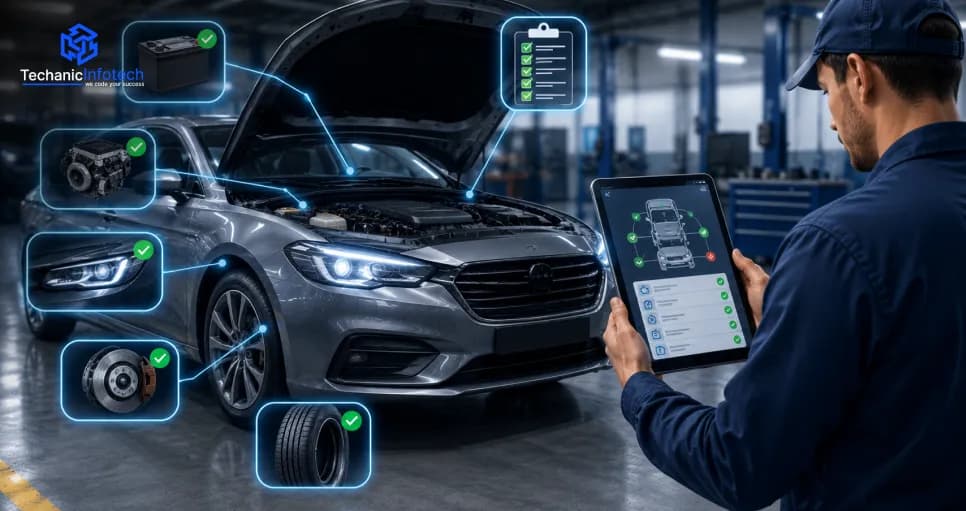
Digital vehicle inspection app development addresses these challenges by moving the inspection process into a centralised digital platform. Inspectors can complete checklists from mobile devices, capture photos and videos, record defects, add notes, assign repair recommendations, and generate standardised inspection reports.
This guide explains how digital inspection platforms work, the features dealerships need, the development process, technology requirements, estimated vehicle inspection app development costs, and how AI can improve vehicle assessment and dealership operations.
According to GII Research, the global digital vehicle inspection market is valued at approximately USD 2.05 billion in 2026 and is projected to reach USD 3.22 billion by 2030, expanding at a compound annual growth rate (CAGR) of 11.9%.
Automotive dealerships capture the largest slice at 38.7% of total market value.
According to the business research company, the proliferation of connected vehicles is driving the market growth due to the increasing integration of IoT-enabled telematics and real-time vehicle connectivity.
Vehicle inspection is closely connected to purchasing decisions, reconditioning costs, inventory preparation, and customer trust. When the process is inconsistent or difficult to track, a dealership can lose both time and money.
A digital inspection platform creates a standardised process where every vehicle is evaluated using consistent checkpoints and documented evidence.
Inspectors can complete digital checklists directly from a smartphone or tablet instead of filling out paper forms. Required fields, predefined inspection points, and digital workflows help teams complete assessments faster and reduce missing information.
Different inspectors may describe the same vehicle issue differently when using handwritten notes. A standardised digital checklist creates a consistent reporting format across vehicles, inspectors, and dealership locations. This makes inspection results easier for managers, technicians, and sales teams to understand.
Inspection results can identify mechanical or cosmetic issues before a vehicle enters the sales inventory. Dealership managers can use these findings to estimate repair requirements, prioritise work, and determine whether a vehicle is financially worth reconditioning. The inspection platform can also connect with field service management software or internal repair workflows when dealerships manage larger service operations.
Photos, videos, notes, inspection scores, and defect records can be attached directly to a vehicle profile. This creates a complete digital history that can be accessed whenever the vehicle is evaluated or sold.
Dealerships can use inspection reports to provide customers with clearer information about a vehicle's condition. Sharing selected inspection findings and supporting images can strengthen confidence during the purchasing process.
Dealership groups operating across multiple locations can centralise inspection data, templates, employee permissions, and reporting. Automotive app development can help connect these capabilities, allowing managers to compare inspection activity and identify recurring vehicle issues across their inventory.
Digital reports eliminate much of the manual work involved in transferring inspection information between paper forms, spreadsheets, repair teams, and sales departments. Automated reporting and notifications allow employees to focus more on vehicle preparation and customer service.
A digital inspection platform connects the inspection process with the dealership's vehicle records and reconditioning workflow. Instead of treating inspection as a standalone checklist, the system creates a traceable digital record from the moment a vehicle enters the dealership.
|
Inspection Stage |
What Happens |
Digital System Response |
|
Vehicle Intake |
Vehicle details and identification are recorded |
Creates or updates the vehicle profile |
|
Inspection Setup |
The inspector selects the appropriate checklist |
Loads vehicle-specific inspection points |
|
Physical Inspection |
The inspector checks mechanical, electrical, interior, an d exterior components |
Records pass, fail, or attention-required results |
|
Evidence Capture |
Defects are photographed or recorded on video |
Links media directly to the inspection item |
|
Assessment |
The inspector adds notes, severity, and recommendations |
Builds a structured condition report |
|
Reconditioning Review |
Managers review required repairs |
Creates repair or service tasks |
|
Approval |
The dealership decides whether to repair, price, or sell the vehicle |
Updates vehicle status |
|
Report Generation |
The final inspection is completed |
Generates a standardized digital report |
|
Customer Sharing |
Selected inspection information may be shared with buyers |
Improves transparency and purchase confidence |
Every inspection should be connected to a unique vehicle profile containing information such as VIN, mileage, stock number, purchase details, previous inspections, repair history, photographs, and current inventory status.
Inspection findings become more valuable when they automatically flow into the dealership's reconditioning process. For example, a failed brake inspection could create a repair task, while cosmetic damage could be assigned to the appropriate preparation team.
A vehicle may be inspected multiple times during its lifecycle. The system should preserve previous reports rather than replacing them with the newest assessment.
A complete inspection history helps dealerships understand recurring issues, monitor repair outcomes, and maintain better records when vehicles move between locations.
A dealership may require different checklists depending on the vehicle’s stage or purpose.
|
Inspection Type |
Primary Purpose |
|
Acquisition Inspection |
Evaluate a vehicle before purchasing it |
|
Incoming Inventory Inspection |
Document condition when the vehicle arrives |
|
Reconditioning Inspection |
Identify repairs and preparation requirements |
|
Quality-Control Inspection |
Verify completed repairs |
|
Pre-Sale Inspection |
Confirm vehicle readiness before listing |
|
Delivery Inspection |
Document condition before customer handover |
This flexible workflow makes used car inspection app development more useful than a basic digital checklist because the platform supports the complete dealership inspection lifecycle.
A dealership inspection platform should do more than provide a digital checklist. It needs to capture reliable vehicle information, preserve inspection evidence, connect findings with reconditioning tasks, and make the final report useful to managers and customers.
Inspectors need a fast interface that works reliably on the dealership floor, service bay, or lot.
Digital Inspection Checklists: Create customisable checklists covering mechanical, electrical, safety, exterior, interior, tires, fluids, and other inspection categories. Required fields can reduce incomplete reports.
Vehicle Identification: Inspectors should be able to identify vehicles using VIN scanning, QR codes, stock numbers, or manual entry. Linking every inspection to the correct vehicle prevents record errors.
Photo and Video Evidence: Inspectors can capture photos and videos of scratches, dents, warning lights, damaged components, tire conditions, and other defects directly from the application.
Defect Marking: A vehicle diagram can allow inspectors to mark the exact location of exterior or interior damage. Severity levels can also be assigned to help managers prioritise repairs.
Voice Notes and Comments: Voice-to-text notes can help inspectors document observations quickly without repeatedly typing detailed descriptions during an inspection.
Managers need visibility beyond individual inspection reports.
Inspection Review Dashboard: Managers can view completed, pending, failed, and partially completed inspections from one dashboard.
Reconditioning Task Management: Inspection failures can be converted into repair or preparation tasks and assigned to technicians or service teams.
Vehicle Condition Scoring: The system can generate standardised condition scores based on inspection results, helping managers compare vehicles and identify those requiring immediate attention.
Approval Workflows: Managers can review inspection findings and decide whether a vehicle should be purchased, repaired, listed, held, or sent for further evaluation.
Multi-Location Management: Large dealership groups can manage inspection templates, users, vehicles, and reports across multiple branches while maintaining centralised oversight.
A car dealership inspection app can also turn inspection data into a customer-facing asset.
Digital Inspection Reports: Generate professional reports containing inspection results, selected photographs, vehicle details, and recommendations.
Report Sharing: Dealerships can share approved inspection reports through secure links, email, or customer portals.
Service History: Customers can access relevant maintenance and inspection information when dealerships choose to make it available.
Digital Signatures: Electronic signatures can be used for inspection acknowledgements, repair approvals, or customer handover documentation.
A scalable digital vehicle inspection software platform should also support the dealership's wider technology environment.
|
Integration / Module |
Purpose |
|
Inventory Management |
Connect inspection results with vehicle stock |
|
DMS / ERP Integration |
Synchronize dealership and business records |
|
CRM Integration |
Connect inspection information with customer profiles |
|
Payment Systems |
Support repair or service transactions |
|
Cloud Storage |
Store inspection reports and media securely |
|
Notifications |
Alert teams about failed inspections and pending tasks |
|
Analytics |
Track inspection volume, defects, repairs, and performance |
For dealerships building a broader digital ecosystem, custom software development can be used to connect inspection workflows with existing dealership systems instead of forcing employees to manage separate platforms.
A dealership inspection platform should be developed around the actual inspection lifecycle. The following ten steps focus specifically on vehicle assessment, evidence collection, dealership workflows, and system integration.
Start by identifying everything the dealership needs to inspect, including the engine, brakes, tires, fluids, electrical systems, exterior, interior, safety equipment, and vehicle documentation.
Convert paper checklists into structured digital templates. Create different templates for vehicle acquisition, reconditioning, quality control, pre-sale checks, and delivery inspections.
Build a vehicle profile containing the VIN, stock number, mileage, make, model, inspection history, photographs, repair records, and current inventory status.
A mobile app development company can create a mobile-first inspection interface where technicians can quickly mark conditions, add notes, capture photos, record videos, and identify defects without leaving the inspection screen.
Implement vehicle diagrams, damage markers, severity labels, image annotations, and multimedia attachments so inspectors can document exactly where and how a vehicle is damaged.
Connect failed inspection points with repair workflows. Managers should be able to assign required work, track repair progress, approve completed tasks, and update the vehicle's readiness status.
Generate standardised digital reports that combine checklist results, condition scores, photographs, notes, recommendations, and approval information into a single document.
Integrate the inspection platform with inventory systems, DMS, CRM, ERP, accounting software, VIN services, cloud storage, and other dealership tools to prevent duplicate data entry.
A vehicle inspection platform handles more than text-based records. It must process images and videos, synchronise vehicle data, support mobile inspections, connect with dealership systems, and keep inspection information secure. The technology architecture should therefore be designed around these operational requirements.
|
Technology Layer |
Recommended Options |
Estimated Implementation Cost |
|
Mobile Application |
Flutter, React Native, Swift, Kotlin |
$5,000–$12,000 |
|
Backend & APIs |
Node.js, Python, Java, .NET |
$6,000–$15,000 |
|
Database |
PostgreSQL, MongoDB |
$2,000–$5,000 |
|
Cloud & Media Storage |
AWS, Azure, Google Cloud |
$2,000–$6,000 |
|
VIN & Vehicle APIs |
VIN decoding/vehicle data APIs |
$1,000–$3,000 |
|
Image & Video Processing |
Cloudinary, AWS Media Services |
$1,000–$4,000 |
|
Authentication |
OAuth 2.0, JWT, MFA |
$1,000–$3,000 |
|
Notifications |
Firebase Cloud Messaging, Twilio |
$500–$2,000 |
|
Analytics |
Firebase Analytics, Power BI |
$1,000–$3,000 |
|
AI & Computer Vision |
Python, OpenAI APIs, ML models |
$3,000–$10,000+ |
These figures are estimated development and implementation contributions. Cloud hosting, API usage, AI services, storage, messaging, and other third-party services may have separate recurring charges.
Businesses selecting a software development company should evaluate its experience with mobile applications, media processing, APIs, cloud architecture, security, and AI rather than choosing a technology stack based only on development speed.
The cost of a digital inspection platform is best understood by looking at the level of functionality a dealership needs. A business replacing paper inspections will have a very different budget from a dealership group building an integrated inspection and reconditioning ecosystem.
Estimated investment: $8,000–$15,000
A basic platform can digitise the core inspection process without introducing complex integrations.
The initial product can include:
Vehicle profiles
Digital inspection checklists
Pass/fail conditions
Notes and comments
Photo attachments
Basic inspection reports
User accounts
Admin management
Typical timeline: 2–3 months
This approach works well for dealerships that want to replace paper-based inspections and validate the workflow before adding advanced capabilities.
Estimated investment: $15,000–$30,000
Once the inspection process becomes part of daily dealership operations, additional functionality is usually required. This may include:
Defect severity tracking
Reconditioning task management
Manager approvals
Vehicle condition scoring
Inspection history
Advanced dashboards
Multiple inspection templates
Inventory integration
Typical timeline: 3–5 months
At this stage, the application becomes more than an inspection tool; it becomes part of the dealership's operational workflow.
Estimated investment: $30,000–$50,000
Larger dealerships may need the inspection platform to communicate with existing business systems and support multiple locations.
Additional investment may cover:
DMS and ERP integrations
CRM connectivity
VIN and vehicle-data APIs
Cloud media storage
Offline inspection functionality
Multi-location management
Advanced reporting
Role-based permissions
Automated workflows
Typical timeline: 5–7 months
The additional integration and synchronisation requirements increase both development effort and testing requirements.
Estimated investment: $50,000–$70,000+
AI can be introduced when dealerships have sufficient inspection data and a clear business case for automation.
Advanced capabilities may include:
Image-based damage detection
Automated defect classification
AI-generated inspection summaries
Predictive repair recommendations
Anomaly detection
Automated condition scoring
Predictive maintenance insights
Typical timeline: 7–10 months
AI development can also create ongoing expenses for model training, cloud processing, API usage, monitoring, and optimisation.
Digital vehicle inspection is becoming an important part of modern used car dealership operations. By replacing paper checklists with connected inspection workflows, dealerships can improve documentation, accelerate reconditioning, strengthen internal coordination, and provide customers with clearer information about vehicle condition.
The strongest solution is not necessarily the one with the most features. It is the platform that fits the dealership's inspection workflow, integrates with its existing systems, and provides a practical foundation for future automation and AI.
It involves building software that digitises vehicle checklists, defect reporting, photos, inspection records, and dealership workflows.
Development can range from $8,000 to $70,000+, depending on features, integrations, and AI requirements.
Key features include digital checklists, vehicle profiles, photo capture, defect tracking, inspection reports, approvals, and reconditioning workflows.
Yes. Computer vision can assist with identifying visible damage from vehicle inspection images.
Yes. Offline inspection functionality can allow inspectors to capture data and synchronise it later.
Yes. APIs can connect inspection platforms with DMS, ERP, CRM, inventory, and other business systems.
Typical users include inspectors, technicians, service managers, dealership administrators, and sales teams.


Bharat Sharma is the CTO of Techanic Infotech, bringing deep technical expertise in software architecture, mobile app development, and scalable system design. He leads the engineering team with a strong focus on innovation, performance, and security.