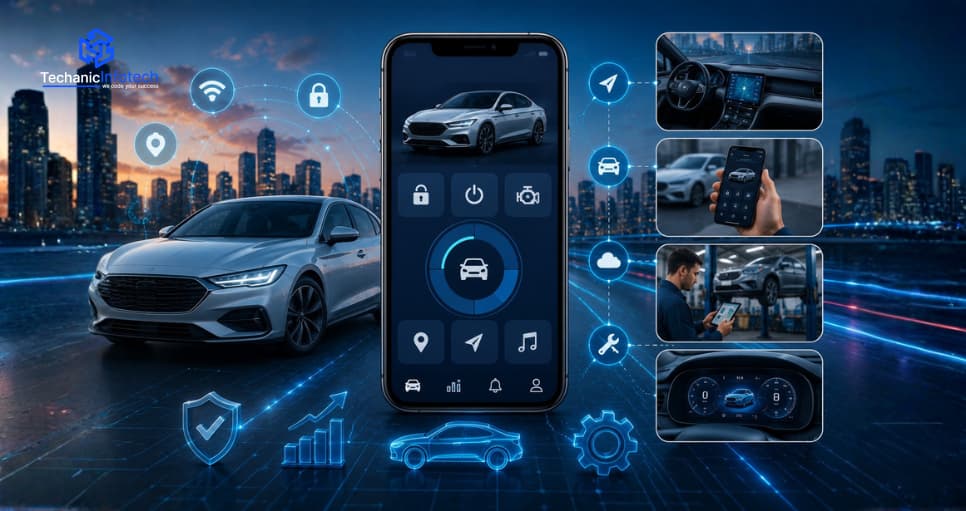
Automotive app Development
Automotive App Development: Features, Costs, and Emerging Trends in 2026
June 29, 2026
June 29, 2026
Key Takeaways
Automotive apps connect vehicles, drivers, and businesses through smart digital mobility solutions.
Connected car technology improves tracking, diagnostics, safety, and personalized driving experiences.
AI, IoT, cloud, and telematics power modern automotive software solutions.
Strong development processes create secure, scalable, and reliable connected vehicle apps.
Businesses use automotive apps to boost loyalty, efficiency, and new revenue opportunities.
The future of mobility depends on intelligent transportation and software-driven vehicles.
Your car is no longer just a machine. It’s becoming a connected digital partner.
A simple tap on a phone can now unlock a vehicle, check battery health, find the best route, or even schedule maintenance. This shift is powered by automotive app development, where connected vehicles, smart mobility, and digital mobility solutions come together to improve everyday travel.
Modern automotive applications are helping businesses build better experiences through vehicle tracking, real-time data, predictive maintenance, and personalised features. From electric vehicles to next-generation vehicles, connected car technology is changing how people interact with mobility. .
In this blog, we’ll explore how automotive app development works, key features, technologies, benefits, costs, and how connected mobility is shaping the future of transportation.
Automotive app development is the process of creating mobile and software solutions that connect drivers, vehicles, and businesses through smart features like vehicle tracking, remote controls, diagnostics, navigation, and connected car technology.
For example, apps like Tesla allow owners to monitor battery status, start climate control, and unlock their vehicles remotely. Similarly, FordPass enables users to locate their vehicle, schedule maintenance, and receive real-time vehicle health updates. These real-world examples show how automotive apps are improving the connected driving experience.
Businesses are investing in automotive applications because customer expectations are changing fast. People now want the same convenience from their cars that they get from everyday digital services.
The automotive software market is growing as vehicles become more dependent on software, AI, and connectivity. According to the MarketsandMarkets report, the market is expected to grow from $19.0 billion in 2023 to $32.3 billion by 2030.
This growth shows a clear shift toward software-defined vehicles (SDVs), where software features like ADAS, infotainment, and smart controls help brands stand out.
Customer Demand: Drivers expect digital experiences with remote controls, tracking, personalization, and instant vehicle access.
Connected Cars: IoT-powered vehicles use sensors, cloud systems, and data sharing to deliver smarter driving experiences.
EV Growth: Electric vehicles increase demand for apps managing charging, battery status, range, and energy usage. This is why many companies are exploring solutions like EV charging app development to support the growing electric vehicle ecosystem and make charging more accessible.
Digital Transformation: Automotive brands are adopting APIs, telematics, and AI solutions to create smarter mobility services.
The way people use vehicles is changing quickly. Cars are becoming connected devices, and smart mobility app development is helping businesses create smarter, safer, and more personalised travel experiences.
Modern drivers expect more than just transportation. Connected car apps and car companion apps offer features like digital key, remote access, infotainment, and personalized controls that make every journey smoother.
Connected vehicles now share live information through sensors, telematics applications, and vehicle connectivity systems. Users can check vehicle location, battery monitoring, fuel status, and vehicle health from anywhere.
Remote vehicle control allows users to manage important functions from their smartphones. Features like remote lock/unlock, climate control, and security alerts are turning regular cars into smart mobility solutions.
Smart navigation uses GPS navigation, traffic updates, and route optimization to improve travel decisions. As part of smart mobility app development, these features help create efficient and connected transportation experiences.
Automotive applications collect valuable insights from connected devices, APIs, and cloud platforms. Businesses use this data to improve fleet operations, customer services, and solutions like fleet management app development for better mobility outcomes.
Automotive IoT app development covers different types of applications designed to improve connected mobility, vehicle management, and the overall driving experience. These apps connect drivers, businesses, and connected vehicles through smart features and digital solutions.
|
App Type |
Purpose |
How It Helps |
|
Connected Car Apps |
Vehicle control |
These car companion apps connect with vehicles to offer remote lock/unlock, vehicle diagnostics, digital key access, and personalized user experiences. |
|
EV Charging Apps |
Charging infrastructure |
EV charging apps help electric vehicle users find charging stations, check availability, manage smart charging, and monitor battery health. |
|
Fleet Management Apps |
Fleet monitoring |
Fleet management apps use GPS, telematics applications, and real-time data processing to track vehicles, monitor drivers, and improve operations. |
|
Vehicle Tracking Apps |
GPS tracking |
These apps provide real-time location tracking, route optimization, and traffic updates for better vehicle visibility and safety. |
|
Car Rental Apps |
Vehicle rentals |
Car rental apps make booking easier with digital access, vehicle information, payment options, and location-based services. |
|
Ride-Sharing Apps |
Smart mobility |
Ride-sharing apps support Mobility-as-a-Service (MaaS) by connecting passengers and drivers through intelligent transportation systems. |
|
Dealership Apps |
Vehicle sales |
Dealership apps improve customer experience with vehicle browsing, test drive scheduling, service reminders, and direct communication. |
|
Automotive Infotainment Apps |
Entertainment |
Infotainment apps bring music, voice assistance, navigation apps, and in-car entertainment into connected vehicle systems. |
Automotive apps need the right features to deliver smooth driving experiences and business value. Automotive mobile app development projects should include tracking, diagnostics, connectivity, security, and smart features for modern vehicles.
|
Feature |
Purpose & Benefits |
|
Login & User Authentication |
Secure login with identity management helps users safely access their vehicle profile, preferences, and connected services. |
|
Vehicle Dashboard |
A smart dashboard gives users a complete view of vehicle status, alerts, driving details, and important controls in one place. |
|
Live GPS Tracking |
Real-time location services help users track vehicles, improve safety, and access accurate movement updates. |
|
Route Optimization |
Smart route planning uses traffic information and intelligent navigation to suggest faster and better travel paths. |
|
Push Notifications |
Instant alerts keep users informed about service reminders, security updates, battery status, and important vehicle events. |
|
Digital Keys |
Digital key features allow smartphone-based vehicle access, making traditional keys less necessary. |
|
Voice Assistant |
Voice-based controls improve convenience by allowing drivers to manage navigation, calls, and vehicle functions hands-free. |
|
Fuel Monitoring |
Fuel tracking helps users view consumption patterns and manage driving habits with better visibility. |
|
EV Charging Locator |
EV charging locator features help electric vehicle owners find charging points and plan trips around charging availability. |
|
Payment Gateway |
Integrated payments allow users to handle services, charging, rentals, and other vehicle-related transactions easily. |
|
Service Booking |
Users can schedule maintenance, request support, and manage vehicle care through the app. |
|
Feature |
Purpose & Benefits |
|
Admin Dashboard |
A central dashboard helps businesses manage users, vehicles, services, and connected mobility operations. |
|
Fleet Monitoring |
Fleet monitoring tools provide visibility into vehicle activity, driver performance, and operational efficiency. |
|
User Management |
Admins can manage user accounts, permissions, profiles, and access levels securely. |
|
Analytics & Reports |
Data insights help businesses understand usage patterns, customer behavior, and vehicle performance trends. |
|
Vehicle Health Monitoring |
Vehicle health tools track diagnostics, battery condition, system alerts, and maintenance needs. |
|
Notification Management |
Admin teams can create and control alerts for users, service updates, and important announcements. |
Choosing the right technology stack decides how well an automotive app performs, scales, and connects with vehicles. A detailed mobile app tech stack guide helps businesses select tools for smarter mobility solutions.
|
Technology |
Purpose in Automotive App Development |
|
AI (Artificial Intelligence) |
Enables predictive maintenance, smart assistants, voice commands, and personalized driving experiences. |
|
IoT (Internet of Things) |
Connects vehicles, sensors, and apps for real-time monitoring and control. |
|
Cloud Computing |
Stores vehicle data, supports remote access, and manages connected car services. |
|
Blockchain |
Protects vehicle records, digital identities, and secure data transactions. |
|
5G Technology |
Provides faster communication between vehicles, apps, and connected systems. |
|
GPS Technology |
Supports navigation, location tracking, route planning, and geofencing features. |
|
AR (Augmented Reality) |
Creates interactive vehicle manuals, navigation overlays, and smart assistance features. |
|
APIs |
Connects automotive apps with vehicles, third-party services, maps, and payment systems. |
|
Edge Computing |
Processes vehicle data closer to the source for faster responses and reduced delays. |
|
Voice Recognition |
Allows hands-free controls, commands, and better in-car interactions. |
|
Cybersecurity Technologies |
Protects connected vehicles, user information, and communication channels from attacks. |
|
Mobile Frameworks (Flutter, React Native) |
Helps build cross-platform automotive apps faster with consistent performance. |
|
Backend Technologies (Node.js, Python, Java) |
Handles app logic, APIs, databases, and communication between systems. |
|
Databases (SQL, NoSQL) |
Manages user profiles, vehicle data, analytics, and app information efficiently. |
Building a successful automotive app requires the right planning, technology, and execution. A skilled mobile app development company follows a structured process to create secure, scalable, and user-friendly connected vehicle solutions.
The discovery phase defines the foundation of the project. Teams understand business goals, target users, vehicle requirements, and expected features before starting development.
During this stage, experts study:
Business objectives
User expectations
Connected vehicle requirements
Core app functions
This helps create a clear roadmap for connected mobility solutions.
Market research helps identify customer needs, competitors, and industry trends. Developers analyze existing automotive applications to find gaps and better opportunities.
The focus is on:
User behavior
Market demand
Competitor analysis
Future of mobility trends
This step helps businesses build solutions that fit real-world needs.
A strong UI/UX design makes automotive apps simple and enjoyable to use. Designers create easy navigation, clean layouts, and interactive screens for better user experience.
The design process usually includes:
Wireframes
App prototypes
User flow planning
Visual design
A good interface helps drivers access features like GPS navigation, vehicle controls, and alerts without confusion.
MVP development helps businesses launch a basic version of the app with important features before building the complete product.
A minimal viable product development approach allows teams to test ideas, collect user feedback, and improve the app faster.
It usually includes:
Core features
Basic vehicle connectivity
User testing
Initial feedback
Backend development creates the engine behind the automotive app. It manages data, user accounts, vehicle information, and communication between systems.
Developers work on:
Cloud infrastructure
Database management
Microservices architecture
Secure data handling
Strong backend support is important for connected vehicles and scalable automotive software solutions.
API integration connects the app with vehicles, external services, and smart systems. It allows smooth communication between different platforms.
Teams integrate:
Automotive APIs
Vehicle APIs
Telematics API
Payment and mapping services
This enables features like vehicle diagnostics, remote access, and real-time updates. Proper API integration also supports intelligent transportation app development by connecting vehicles with external mobility platforms.
Testing checks if the app works correctly across devices, vehicles, and different conditions. It helps identify issues before users experience them.
Testing includes:
Performance testing
Security checks
Vehicle connectivity testing
User experience testing
Automotive cybersecurity and data protection are important parts of this stage.
Deployment is where the finished app becomes available for users. The app is prepared and released through platforms like Upload on App Store and Upload on Play Store.
Before launch, teams review:
App performance
Store guidelines
User access
Final improvements
A smooth launch helps businesses reach customers faster.
App development does not end after launch. Regular maintenance keeps the app secure, updated, and ready for new technology changes.
Maintenance includes:
Bug fixes
Feature updates
Performance improvements
Security updates
A reliable mobile app maintenance strategy helps automotive apps stay competitive as smart mobility and connected technology continue to grow.
Connected car apps help businesses improve customer relationships, streamline vehicle services, and create smarter mobility experiences. With connected car app development, companies can offer real-time features, collect valuable insights, and build stronger digital connections with drivers.
Automotive applications help brands stay connected with users through updates, services, and personalized interactions. A smooth app experience keeps customers engaged and encourages long-term relationships.
Features like remote vehicle control, digital key access, and real-time vehicle updates make driving more convenient. Businesses can deliver a simpler experience that feels modern and customer-focused.
Connected car apps open new revenue opportunities through premium features, subscriptions, and digital services. Companies can offer value beyond vehicle sales with smart mobility solutions.
Automotive software solutions help companies manage processes faster with automation, real-time data, and connected systems. These improvements reduce manual work and support better decision-making.
Fleet management features help businesses monitor vehicles, track performance, and improve driver operations. Companies using custom solutions, including custom software development for SMBs, can manage fleets more effectively.
Safety-focused features like driver behavior monitoring, alerts, and vehicle health checks help reduce risks. Connected technology supports safer journeys for drivers and passengers.
A reliable automotive app creates regular touchpoints between brands and users. Helpful services, quick support, and personalized experiences help build stronger customer loyalty.
Vehicle monitoring and maintenance alerts help prevent unexpected breakdowns. Businesses can keep vehicles active and reduce delays caused by service issues.
Automotive apps collect valuable insights from connected devices and user activity. These analytics help companies understand customers, improve services, and follow new mobile app development trends.
Building an automotive app looks exciting on the surface, but real-world challenges appear when cars, users, data, and systems start working together. A good development approach helps avoid roadblocks before they become expensive problems.
Data Security: Protect vehicle and user data with encryption, secure APIs, and regular security testing to prevent cyber threats.
Vehicle Compatibility: Support different vehicle models through flexible architecture, standard protocols, and testing across multiple car systems.
Connectivity Issues: Handle weak networks with offline modes, data caching, and smart syncing so users stay connected during signal drops.
Real-Time Data Processing: Process live vehicle data using cloud systems, optimized databases, and AI integration in mobile apps for faster insights.
Compliance Requirements: Follow automotive regulations and privacy laws by adding compliance checks during development instead of fixing issues later.
Scalability Problems: Build a scalable backend with cloud infrastructure so the app can handle more vehicles and users smoothly.
OTA Updates: Deliver secure over-the-air updates with version control, testing environments, and safe rollback options to avoid system failures.
Legacy System Integration: Connect older vehicle technologies using APIs and middleware solutions without replacing the complete existing system.
The mobile app development cost of building an automotive app depends on what the app needs to do. A basic vehicle tracking app is much simpler than a connected car platform with real-time diagnostics, AI features, and fleet management tools. Even small feature changes can shift the budget quite a bit.
|
Automotive App Type |
Estimated Development Cost (USD) |
Timeline |
Best For |
|
Basic Automotive App |
$8,000 – $15,000 |
2–3 months |
Simple apps with vehicle details, service reminders, location tracking, and basic user features |
|
Mid-Level Automotive App |
$15,000 – $35,000 |
3–5 months |
Apps with GPS, vehicle monitoring, booking, notifications, and connected features |
|
Advanced Automotive App |
$35,000 – $60,000 |
5–8 months |
Smart vehicle apps with IoT integration, real-time data, analytics, and driver assistance features |
|
Enterprise Automotive Solution |
$60,000 – $90,000+ |
8–12+ months |
Large-scale platforms for car brands, fleet operators, and mobility companies with complex systems |
Automotive app development is changing how people interact with vehicles, creating a smarter and more connected mobility experience.
From connected car apps and EV solutions to AI-powered features, businesses can improve customer experiences and unlock new opportunities. As vehicles become software-driven, investing in automotive software solutions helps brands stay ready for the future of mobility.
The right technology, development process, and security approach can turn a simple vehicle app into a powerful digital mobility platform.
Automotive app development creates mobile and software solutions that connect vehicles, drivers, and businesses through smart digital features.
Businesses invest in automotive apps to improve customer experience, support connected vehicles, increase revenue, and offer smarter mobility services.
Common features include vehicle tracking, GPS navigation, remote control, digital keys, diagnostics, maintenance alerts, and EV charging support.
The cost usually ranges from $8,000 to $90,000+ depending on features, integrations, complexity, and development requirements.
Automotive apps use AI, IoT, cloud computing, APIs, GPS, telematics, 5G, machine learning, and cybersecurity technologies.
Development time can range from 2–12+ months based on app type, features, testing needs, and platform complexity.
EV apps help users monitor battery health, find charging stations, manage charging schedules, and improve range planning.
Yes, apps can support multiple vehicles using automotive APIs, telematics systems, and flexible software architectures.


Abhishek Jangid is the CEO of Techanic Infotech, with extensive experience in mobile app and web development. He specializes in helping businesses turn innovative ideas into scalable digital solutions through strategic planning and modern technology.