Software Development
Employee Management Software Development Guide: Modules, AI, Cost & Development Process
July 28, 2026
July 28, 2026
Key Takeaways:
Employee management software centralises HR operations and reduces manual administrative work.
AI-powered capabilities improve hiring, workforce analytics, and employee engagement.
A modular development approach makes future expansion easier and more cost-effective.
Selecting the right technology stack ensures security, scalability, and long-term performance.
Investing in a customised solution helps organisations improve productivity while supporting business growth.
As businesses grow, managing employees through spreadsheets, emails, and disconnected HR tools becomes increasingly inefficient. Attendance records, leave requests, performance reviews, payroll coordination, recruitment, and employee communication often become scattered across multiple systems, creating unnecessary administrative work and reducing overall productivity.
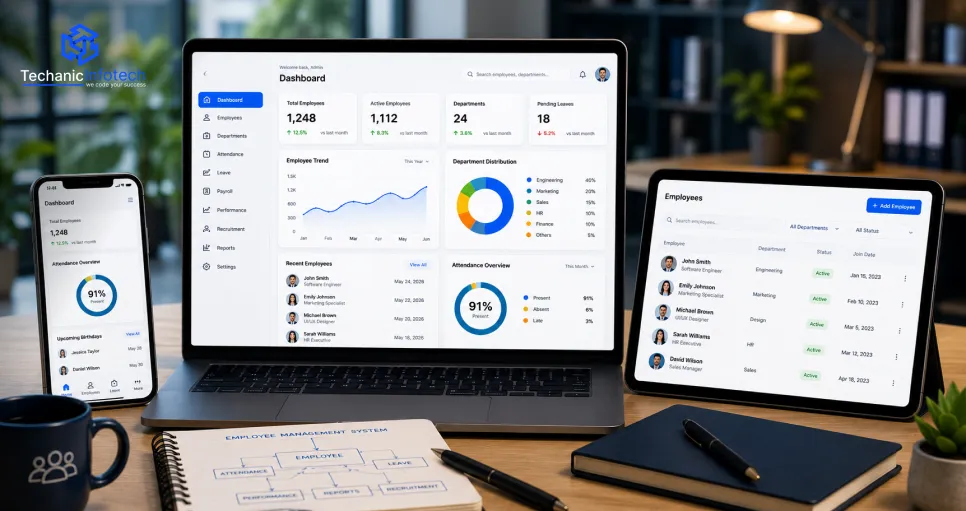
This is why organisations across industries are investing in employee management software development to centralise workforce operations within a single digital platform. A modern employee management system enables HR teams, managers, and employees to collaborate more efficiently while automating repetitive processes and providing real-time operational insights.
Whether you're planning a complete employee management system development, upgrading existing human resource management software, or building a custom employee management software solution tailored to your business, choosing the right development strategy can significantly improve operational efficiency and support long-term business growth.
Modern organisations are no longer relying on spreadsheets and disconnected software to manage their workforce. As businesses grow, manual HR processes become slower, more expensive, and increasingly difficult to maintain. Employee expectations have also changed. With teams now expecting digital access to leave requests, attendance records, performance reviews, and internal communication from anywhere.
This shift has encouraged organisations of all sizes to modernise their HR operations through intelligent workforce management platforms.
According to Grand View Research, the global Human Resource Management (HRM) market is expected to grow steadily as organisations continue investing in digital workforce solutions and cloud-based HR technologies.
Gartner reports that organisations are increasingly prioritising HR technology investments to improve employee experience, automate administrative tasks, and support hybrid work environments.
Research from Deloitte's Global Human Capital Trends highlights that businesses are accelerating investments in workforce technology, AI, and digital employee experiences to improve productivity and organisational agility.
As organisations expand, workforce management becomes increasingly complex. HR teams must handle recruitment, attendance, payroll coordination, employee records, performance evaluations, compliance, and internal communication, all while ensuring accuracy and operational efficiency. Relying on manual processes or disconnected tools often leads to delays, errors, and unnecessary administrative overhead.
Modern Workforce Management Software development focuses on solving these operational challenges by bringing every HR function into a single centralised platform.
When employee information is stored across spreadsheets, emails, and multiple software tools, HR teams spend significant time searching for data and updating records manually. This often leads to inconsistencies and duplicate information.
How software helps: A centralised employee database keeps personal details, employment history, documents, attendance, and performance records securely organised and easily accessible.
Tracking attendance, overtime, remote work, and leave requests manually becomes increasingly difficult as organisations grow. HR teams often spend hours verifying records and correcting payroll-related discrepancies.
How software helps: An automated attendance system simplifies time tracking, leave approvals, shift management, and holiday calendars while reducing administrative effort.
Hiring new employees involves coordinating applications, interviews, document verification, onboarding tasks, and communication between multiple departments. Without automation, the process becomes slow and difficult to manage.
How software helps: Many organisations integrate recruitment app development capabilities into employee management systems, allowing HR teams to streamline hiring, onboarding, and candidate management from a unified platform.
Managers often struggle to measure employee productivity, monitor team performance, and identify areas that require improvement when information is scattered across different systems.
How software helps: Performance dashboards, KPI tracking, appraisal management, and real-time analytics provide decision-makers with actionable insights that support better workforce planning.
As businesses grow, keeping employees informed about company updates, policy changes, approvals, and announcements becomes increasingly challenging, especially for remote and hybrid teams.
How software helps: Integrating an enterprise portal development strategy enables organisations to centralise announcements, employee communication, document sharing, and self-service resources within a secure digital workspace.
Processes that work well for a team of 20 employees often become inefficient for organisations managing hundreds or thousands of people. Manual workflows increase operational costs and reduce overall productivity.
How software helps: Modern Staff Management Software development enables businesses to automate repetitive HR processes, improve operational efficiency, and build scalable workforce management systems capable of supporting future organisational growth.
A successful employee management platform serves multiple stakeholders across an organisation. Employees need quick access to daily HR services; HR teams require automation for workforce operations; and administrators need complete visibility into organisational performance. Structuring the platform into dedicated modules ensures every user has the tools they need while maintaining security and operational efficiency.
The employee portal should empower staff members to manage routine HR activities independently without relying on manual HR intervention. A well-designed self-service module improves employee experience while reducing the administrative workload for HR teams.
Key capabilities include:
Secure employee login and profile management
Attendance and work-hour tracking
Leave application and approval status
Salary slips and tax document access
Company announcements and internal notifications
Document uploads and personal information updates
Holiday calendars and work schedules
The HR dashboard acts as the operational hub of the platform, allowing HR professionals to manage the complete employee lifecycle, from hiring and onboarding to performance reviews and workforce planning.
Key capabilities include:
Employee onboarding and offboarding
Recruitment workflow management
Attendance and shift management
Performance reviews and KPI tracking
Payroll coordination
Policy and document management
Workforce analytics and reporting
Organisations often combine these capabilities with recruitment app development solutions to create a seamless hiring and employee management ecosystem.
The administrator panel provides complete control over the platform while ensuring security, compliance, and smooth day-to-day operations. It also allows decision-makers to monitor organisational performance through centralised reporting and system management.
Key capabilities include:
User roles and permission management
Department and branch management
System configuration
Audit logs and compliance monitoring
Dashboard analytics and custom reports
Security settings and access control
Integration management
Many enterprises also integrate enterprise portal development capabilities to provide employees with a unified digital workspace for communication, collaboration, and organisational resources.
As organisations expand, employee management software evolves beyond basic HR operations. Businesses frequently introduce additional modules to improve efficiency, automation, and decision-making.
Asset management
Training and learning management
Expense reimbursement
Helpdesk and employee support
Project allocation
Workforce planning
AI-powered workforce insights
Businesses investing in employee tracking software development and healthcare insurance software solutions (if applicable for employee benefits) or other enterprise systems often integrate these modules to create a connected workplace ecosystem that supports long-term operational growth.
Artificial intelligence is transforming employee management from a reactive process into a proactive one. Instead of simply storing employee records, modern platforms can analyse workforce data, automate repetitive tasks, and provide intelligent recommendations to help HR teams make faster, more informed decisions.
Hiring teams often spend hours reviewing hundreds of applications for a single position. AI-powered resume screening automatically analyses candidate profiles, matches skills with job requirements, and prioritises the most relevant applicants, significantly reducing recruitment time.
AI can identify attendance trends, overtime patterns, absenteeism, and workforce utilisation in real time. These insights help HR teams detect operational issues early and improve workforce planning.
Instead of answering repetitive HR questions manually, AI-powered virtual assistants can help employees check leave balances, company policies, payroll information, and HR procedures through conversational interfaces available 24/7.
Modern AI engines analyse performance reviews, KPIs, project contributions, and employee feedback to identify high-performing teams, recognise improvement opportunities, and support fair performance evaluations.
AI helps organisations forecast hiring needs, identify potential skill gaps, estimate future workforce requirements, and support long-term business planning based on historical data and organisational trends.
AI can recommend personalised learning programmes, training resources, career development opportunities, and internal job openings based on an employee's role, skills, and professional goals. These personalised experiences improve engagement while supporting employee retention.
Developing an employee management platform requires careful planning, technical expertise, and a deep understanding of organisational workflows. Rather than building every module at once, businesses should follow a structured development process that minimises risks, accelerates implementation, and creates a scalable solution capable of supporting future growth.
Every project begins by identifying business goals, HR challenges, existing workflows, and the expectations of different stakeholders. This discovery phase ensures the software aligns with the organisation's operational needs.
Key deliverables:
Business requirement document
User roles and permissions
Project scope
Development roadmap
Based on the collected requirements, the development team identifies which modules will be included in the first release. Prioritising essential functionality helps control costs while reducing development complexity.
Key deliverables:
Employee module
HR management module
Admin panel
Feature prioritization
UI/UX designers create wireframes, workflows, and interactive prototypes that simplify navigation for employees, HR professionals, and administrators. A well-planned interface improves user adoption and reduces training requirements after deployment.
Key deliverables:
Wireframes
User journeys
Interactive prototypes
Design system
At this stage, many businesses choose to work with an experienced mobile app development company that understands enterprise software architecture, cloud infrastructure, and secure HR systems. Partnering with the right development team helps ensure the platform is scalable. User-friendly and capable of supporting future business growth across both web and mobile platforms.
Key deliverables:
Employee portal
HR dashboard
Admin console
Backend services
Database architecture
Organisations often choose experienced teams that provide end-to-end app development services to ensure every component is developed using scalable and maintainable architecture.
Modern employee management software rarely operates in isolation. Third-party integrations help connect the platform with payroll systems, attendance devices, email services, communication tools, and enterprise applications.
Key deliverables:
Payroll integration
Email & notification services
Authentication systems
Reporting tools
Third-party APIs
Before deployment, every module should undergo comprehensive testing to verify functionality, security, usability, and performance. Identifying issues before launch significantly reduces long-term maintenance costs.
Key deliverables:
Functional testing
Security testing
Performance optimization
Bug resolution
User acceptance testing
Once testing is complete, the software is deployed to the production environment. At the same time, employees, HR teams, and administrators receive training to ensure successful adoption across the organisation.
Key deliverables:
Production deployment
Data migration
User training
Go-live support
Software development doesn't end after launch. Regular updates, security improvements, feature enhancements, and performance monitoring ensure the platform continues to meet evolving business requirements.
Key deliverables:
Software maintenance
Feature upgrades
Performance monitoring
Security updates
Scalability planning
A well-planned technology stack determines how efficiently an employee management system performs as the organisation grows. Since HR platforms manage sensitive employee data, attendance records, payroll information, and real-time workflows, the underlying architecture must be secure, scalable, and capable of supporting future integrations.
|
Component |
Recommended Technologies |
|
Frontend |
React.js, Angular, Flutter |
|
Backend |
Node.js, .NET, Java Spring Boot |
|
Database |
PostgreSQL, MySQL, MongoDB |
|
Cloud Platform |
AWS, Microsoft Azure, Google Cloud |
|
Authentication |
OAuth 2.0, JWT, Single Sign-On (SSO) |
|
Notifications |
Firebase Cloud Messaging, OneSignal |
|
Analytics |
Power BI, Google Analytics, Tableau |
|
AI & Automation |
OpenAI APIs, TensorFlow, Azure AI |
|
DevOps |
Docker, Kubernetes, GitHub Actions |
Organisations planning enterprise-grade solutions often refer to a comprehensive mobile app tech stack guide before selecting technologies.
A well-planned technology stack determines how efficiently an employee management system performs as the organisation grows. Since HR platforms manage sensitive employee data, attendance records, payroll information, and real-time workflows, the underlying architecture must be secure, scalable, and capable of supporting future integrations.
|
Business Stage |
Typical Software Scope |
Estimated Investment |
|
Small Businesses & Startups |
Employee records, attendance, leave management, basic reporting |
$10,000–$25,000 |
|
Growing Businesses |
Performance management, recruitment, payroll integration, employee self-service |
$25,000–$50,000 |
|
Large Enterprises |
AI automation, enterprise integrations, advanced analytics, multi-location management |
$50,000–$100,000+ |
Organisations planning long-term digital transformation should also evaluate the broader mobile app development cost if mobile access is required for employees and managers. For growing businesses with limited budgets, adopting custom software development for SMBs enables phased implementation while maintaining scalability and keeping investment under control.
A mid-sized logistics company with more than 250 employees was managing attendance, leave requests, onboarding, and employee records using spreadsheets and multiple disconnected HR tools. As the workforce expanded, HR teams spent more time on manual administrative tasks, resulting in delayed approvals, inconsistent employee records, and limited visibility into workforce performance.
To streamline operations, the company implemented a custom employee management solution with attendance tracking, employee self-service, leave management, performance monitoring, and centralised reporting. The platform was later integrated with payroll software and internal communication tools to create a unified HR ecosystem.
Within a few months, the HR team reduced manual administrative work, managers gained faster access to workforce insights, and employees benefited from a simpler self-service experience. The phased implementation also allowed the business to expand the platform without disrupting day-to-day operations.
As organisations continue to grow, managing employees through disconnected systems becomes increasingly inefficient. A well-designed employee management platform simplifies HR operations, improves collaboration, automates repetitive tasks, and provides the insights businesses need to make better workforce decisions.
Whether you're building a solution for a growing company or a large enterprise, investing in the right architecture, business-focused modules, and scalable technology creates a platform that supports both current operational needs and future organisational growth.
Employee management software development is the process of building software that helps organisations manage attendance, employee records, leave, performance, payroll coordination, recruitment, and other HR operations through a centralised digital platform.
The overall investment typically ranges from $10,000 to $100,000+, depending on the number of modules, integrations, customisation, security requirements, and business complexity.
Most modern systems include employee self-service, attendance management, leave management, payroll coordination, recruitment, performance management, reporting, and administrator controls.
Yes. AI can automate resume screening, workforce analytics, employee support, attendance analysis, and performance insights, helping organisations improve operational efficiency.
Development timelines usually range from 3 to 10 months, depending on project scope, required integrations, and customisation.
For businesses with unique workflows, custom software offers greater flexibility, scalability, easier integrations, and the ability to add new modules as organisational needs evolve.


Abhishek Jangid is the CEO of Techanic Infotech, with extensive experience in mobile app and web development. He specializes in helping businesses turn innovative ideas into scalable digital solutions through strategic planning and modern technology.