Mobile App Development
The Complete Guide to Choosing the Right Mobile App Tech Stack
December 10, 2025
December 10, 2025
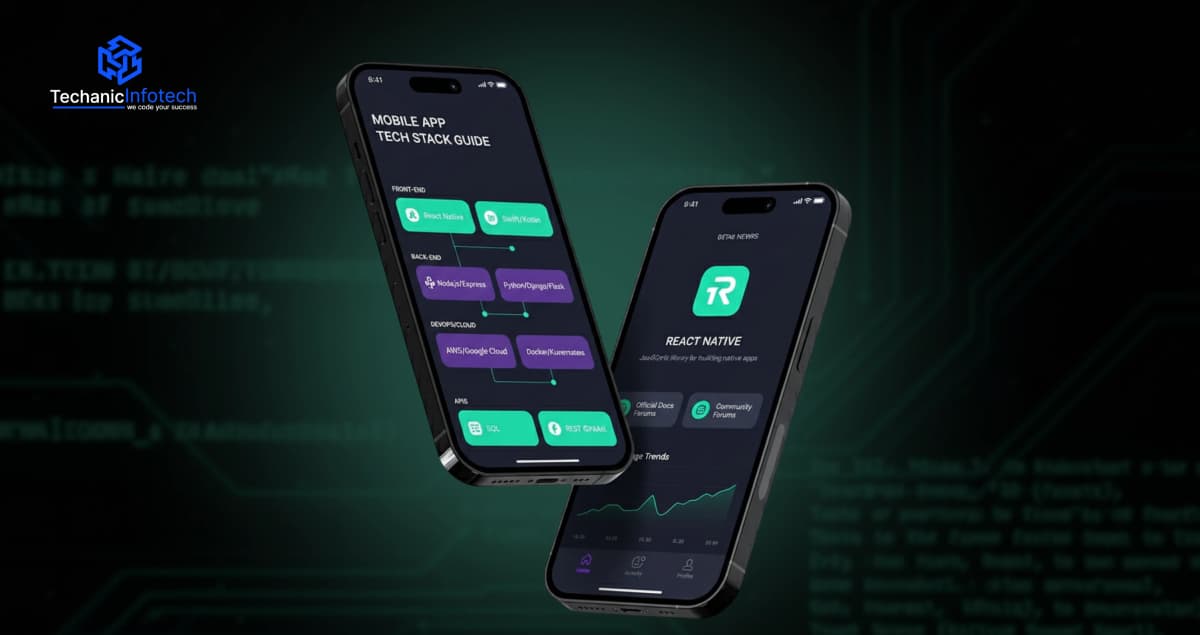
Every mobile app you use, whether it’s WhatsApp, Zomato, Instagram, or Uber, is built using a specific mobile app tech stack. This tech stack is simply the set of programming languages, frameworks, tools, and technologies used to develop an app.
Choosing the right technology stack for mobile app development is extremely important because it affects everything: performance, security, development speed, and even long-term scalability.
If the tech stack is chosen wisely, your app becomes fast, stable, and easy to update. But if the wrong tech stack is selected, the app may crash, feel slow, or become too expensive to maintain.
In this guide, you’ll learn what a mobile app tech stack is, the different types used for Android and iOS apps, popular backend options, and how to pick the best stack for your project. This simple, step-by-step explanation will help you understand exactly what powers a great mobile app.
A mobile app tech stack is the collection of tools, programming languages, frameworks, and technologies used to build a mobile application. Think of it as the “recipe” behind an app. Just like a good dish needs the right ingredients, an app needs the right tech stack to run smoothly, stay secure, and scale as the user base grows.
A tech stack is usually divided into two main parts:
This is the part users see and interact with, screens, buttons, animations, and overall design. Frontend technologies include Swift or Objective-C for iOS, Kotlin or Java for Android, and frameworks like Flutter or React Native for cross-platform apps.
This is the engine of the app. It manages data, user accounts, payments, notifications, and communication between the app and the server. Backend technologies include Node.js, Laravel, Django, Ruby on Rails, and cloud services like AWS or Firebase.
Choosing the right mobile app tech stack ensures the app loads fast, works well on all devices, and can easily be improved later. Understanding this foundation helps you make smarter decisions for your app-building journey.
Choosing the right tech stack for mobile apps is one of the most important decisions in the development journey. Here’s why it matters so much:
A strong mobile app tech stack ensures your app loads fast, runs smoothly, and works well on all devices.If you pick outdated or weak technologies, your app may lag, freeze, or crash frequently. Good performance keeps users happy and improves your app ratings.
The technology stack for mobile app development affects how quickly your app can be built.
Native tech stacks like Swift (iOS) and Kotlin (Android) take more time.
Cross-platform stacks like Flutter and React Native speed up development.
Choosing the right tools saves weeks or even months.
Your tech choices strongly influence your mobile app development cost. Some technologies need larger teams and more development hours.
Others allow faster builds and lower costs. The right stack gives you the perfect balance between speed, quality, and budget.
Apps today handle sensitive data like payments, GPS location, and personal details.
The right mobile app’s tech stack includes modern security features:
Encryption
Secure APIs
Data validation
Authentication frameworks
Strong security protects your users and prevents costly risks.
When your app grows from 1,000 to 100,000 users, the backend must handle more traffic.
A good tech stack supports:
High user load
More transactions
Faster processing
Picking scalable technologies like Node.js, Firebase, or Django ensures your app keeps growing without breaking
Choosing popular and well-supported mobile app development technologies makes updates easier.
Modern tech stacks give you:
Regular updates
Community support
Pre-built plugins
Easy bug fixes
This keeps your app stable in the long run.
Smooth navigation, fast loading, accurate features, and modern UI are possible only when the right tech stack for mobile apps is used.
A strong tech foundation leads to:
Better performance
Higher user satisfaction
More 5-star reviews
A poor tech stack can force you to rebuild the app later, costing double. A strong, modern tech stack avoids technical debt and ensures your app stays future-proof.
Before choosing the right tech stack for mobile apps, you must understand the different mobile app development approaches available. Each approach uses different app development technologies, cost levels, and performance capabilities.
Here’s a simple breakdown:
Native apps are built specifically for one platform, Android or iOS.
Android uses Kotlin or Java
iOS uses Swift or Objective-C
How it works: Native apps directly use the device’s hardware and system features, which makes them very fast and reliable. Because developers write separate codebases for Android and iOS, these apps offer the best performance and user experience.
Best for: High-performance apps like banking, gaming, fitness, and social apps.
Best speed and performance
Smooth animations
Strong security
Full access to device features (GPS, camera, sensors)
Development cost is higher
Takes more time because two apps must be built separately
If performance is your priority, this is the best technology stack for mobile app development.
Cross-platform apps run on both Android and iOS using a single codebase.
Popular frameworks include:
Flutter
React Native
Xamarin
How it works: Developers write code once, and the framework compiles it for both platforms. This reduces development time and mobile app development cost while still giving decent performance
Best for: Startups, delivery apps, booking apps, eCommerce, MVPs.
Faster development
Lower budget
One codebase for both platforms
Clean UI and smooth performance (especially with Flutter)
Slightly weaker performance compared to native
Some advanced features may require native coding
Cross-platform is a great option when you want a modern app quickly without overspending on your mobile app tech stack.
Hybrid apps are built using web technologies like HTML, CSS, and JavaScript, and wrapped inside a native shell (like Ionic or Cordova).
How it works: They behave like mobile apps but run inside a WebView. This means they are easier to build but not as fast as native or cross-platform apps.
Simple apps with basic features.
Very low development cost
Fastest to build
Uses common web technologies
Slower performance
Limited access to advanced device features
Not ideal for large or complex apps
This approach is less common today but still used for simple business applications.
PWAs are mobile-friendly websites that behave like apps. They can be added to the home screen and work offline.
How it works: Built with web technologies but give an app-like experience. They do not require app store approval.
Best for: News sites, eCommerce brands, education platforms.
No download required
Cheaper to build
Works on all devices
Fast loading
Limited access to device APIs
Not suitable for heavy apps (tracking, rides, payments)
PWAs are great for businesses that want to reach without investing heavily in a full app.
Understanding the core components of a mobile app tech stack is important before you start building your app. Each layer of the tech stack plays a different role, from what users see on the screen to how data is stored, managed, and secured behind the scenes.
Here are the main components that make up the technology stack for mobile app development:
The frontend is everything the user interacts with. It includes screens, buttons, animations, navigation, and overall app design.
Frontend frameworks and languages depend on the app type:
Android: Kotlin, Java
iOS: Swift, Objective-C
Cross-platform: Flutter, React Native
The frontend must be fast, smooth, and responsive. Choosing the right tech stack for mobile apps at this stage ensures better user experience and performance. The frontend is also responsible for communicating with the backend to fetch and display real-time data.
The backend is the engine powering your app. It manages:
User accounts
Authentication
Payments
Notifications
File uploads
Business logic
Order management (if applicable)
Popular backend mobile app development technologies include:
Node.js – fast, scalable, widely used
Django / Python – secure and reliable
Laravel / PHP – great for rapid development
Ruby on Rails – ideal for startups
GoLang – high performance
A strong backend makes your app stable, scalable, and secure, especially when handling thousands of users.
APIs allow your app to connect with external services. No modern app works without them. Common integrations include:
Maps & GPS (Google Maps, Mapbox)
Payment gateways (Stripe, Razorpay)
SMS/email services
Social login
Push notifications
APIs help your mobile app’s tech stack offer features quickly without building everything from scratch.
Databases store user information, orders, messages, and all app data. You can choose:
SQL databases: MySQL, PostgreSQL
NoSQL databases: Firebase, MongoDB, DynamoDB
Local storage: SQLite, Realm
Choosing the right database ensures fast loading, smooth performance, and secure data management across devices.
Cloud platforms and DevOps tools help deploy, manage, and scale your app. Common tools include:
AWS, Google Cloud, Azure
Docker & Kubernetes (for containerization)
CI/CD tools like GitHub Actions
These tools ensure your app stays fast, secure, and available even during heavy traffic.
Security is a crucial part of every technology stack for mobile app development. Essential methods include:
SSL encryption
Token-based authentication
Secure APIs
Firewalls
Data encryption
A secure app protects users, builds trust, and reduces risks.
These components together form a complete mobile app tech stack and determine how efficient, scalable, and user-friendly your app will be.
When you are building an Android app, choosing the right mobile app tech stack is one of the most important decisions. The tools and technologies you choose will directly impact your app’s speed, security, performance, and long-term scalability.
Here are the most popular and trusted mobile tech stacks for Android apps, explained in simple language.
Kotlin is the most recommended language for Android development today. It is modern, safe, and easy to read. Google officially supports Kotlin, and most new apps are now built using this language.
Why Kotlin is a good choice:
Cleaner and faster than Java
Fewer errors and safer code
Works perfectly with old Java code
Ideal for both small and large apps
If you want a future-proof technology stack for mobile app development, Kotlin is the top choice for Android.
Before Kotlin, Java was the main language for Android. It is still widely used because it is stable, powerful, and has huge community support.
Why developers still choose Java:
Great for large enterprise apps
Tons of libraries and tools available
Secure and scalable
Java is a solid option, especially if your team already knows it or if you're building a very large system.
No mobile tech stack for Android apps is complete without the Android SDK (Software Development Kit).The SDK provides all the tools you need to build app screens, handle user input, integrate GPS, camera, sensors, and more. Android Studio is the official development environment used to create, test, and debug Android apps.
Android Jetpack is a set of libraries that make development easier and faster. These libraries include tools for navigation, UI design, background tasks, live data, and architecture.
Benefits:
Reduces development time
Helps you follow best practices
Makes apps more stable
Jetpack is a must-have part of any modern mobile app tech stack.
Although Android apps run on the device, they need backend services to store data, process requests, and manage users. Popular backend tech options include:
Node.js: fast and scalable
Laravel (PHP): easy and quick to develop
Django (Python): secure and powerful
Firebase: real-time updates, easy to use
Your backend choice depends on the type of app, budget, and scalability needs.
A strong combination of Kotlin/Java, Android SDK, Jetpack libraries, and a reliable backend forms the ideal mobile tech stack for Android apps. This ensures your Android app is fast, secure, and ready for long-term growth.
When building an iOS app, choosing the right mobile app tech stack is extremely important. Apple devices follow strict performance and design rules, so using the correct tools ensures your app is fast, secure, and smooth on all iPhones and iPads.
Below are the most popular and widely used technology stacks for mobile app development on iOS.
Swift is the modern, fast, and safe language created by Apple. Most new iOS apps today are built using Swift because it offers great performance and clean syntax.
Why Swift is the best choice:
Extremely fast and responsive
Safer code with fewer errors
Easy to read and maintainPerfect for both simple and complex apps
If you’re deciding the right tech stack for mobile apps, Swift should be your first option for iOS development.
Before Swift, all iOS apps were built using Objective-C. While it is older, it is still used by many large companies because of its stability.
Why developers use Objective-C:
Very stable and well-tested
Strong support for older iOS apps
Works perfectly with Apple frameworks
Objective-C is ideal when maintaining legacy apps or upgrading older projects.
Xcode is Apple’s official tool for building iOS apps. It includes everything developers need:
Interface Builder for designing screens
Simulators for testing
Tools for debugging and performance checks
Any modern mobile app’s tech stack for iOS must include Xcode.
Apple provides powerful iOS frameworks that help speed up development and improve app quality.
Common ones include:
UIKit / SwiftUI – for building app interfaces
Core Data – for local storage
Core Animation – for smooth animations
ARKit – for augmented reality features
HealthKit – for fitness and health apps
Using these frameworks ensures your app feels “native” and high-performing on Apple devices.
Just like Android apps, iOS apps also need a strong backend. Popular backend choices include:
Node.js
Python / Django
Laravel / PHP
Firebase
Choosing the right backend ensures your app loads quickly, handles large traffic, and stays secure.
A strong iOS mobile app tech stack usually combines Swift, Xcode, Apple frameworks, and a reliable backend. This combination helps you create apps that are fast, secure, scalable, and perfectly optimized for the Apple ecosystem.
A strong backend is the heart of every mobile application. It manages user data, authentication, notifications, payments, real-time features, and communication between the frontend and server.
Choosing the right backend is a major part of selecting the perfect mobile app tech stack because it directly affects app performance, scalability, and long-term maintenance.
Below are the most popular backend technologies used in modern mobile apps, explained in simple language.
Node.js is one of the most popular backend choices in the technology stack for mobile app development. It uses JavaScript, making it easy for teams already familiar with web technologies.
Why Node.js is great:
Handles thousands of requests efficiently
Ideal for real-time apps like delivery, chat, tracking
Large ecosystem of packages
Very high scalability
Node.js is often used when the app needs speed and high performance. It’s a top pick when choosing the right tech stack for mobile apps that involve live updates or continuous data transfer.
Laravel is a modern PHP framework known for its simplicity and rapid development capabilities.
Why choose Laravel:
Very easy to learn
Perfect for startups with smaller budgets
Built-in security features
Fast development with clean structure
Laravel is great for job portals, eCommerce, booking apps, and business applications. It’s a dependable part of a cost-effective mobile app development technology stack.
Django is one of the most secure backend frameworks, loved by enterprises and startups alike.
Why Django stands out:
Built-in security against common attacks
Very clean and structured code
Ideal for AI/ML-based mobile apps
Scales smoothly as the user base grows
Python is also great for apps that need recommendation systems, automation, or advanced logic. This makes Django a premium choice for a high-performance mobile app’s tech stack.
Ruby on Rails helps developers build backend systems quickly with minimal code.
Why Ruby on Rails is useful:
Fast development cycle
Great for MVPs and startups
Clean conventions and developer-friendly structure
It’s suitable for apps that need quick launch and continuous updates, such as social platforms or marketplace apps.
GoLang (Go), created by Google, is known for its extremely high speed and efficiency.
Why GoLang is powerful:
Excellent for heavy-traffic apps
Very fast execution
Great for real-time processing
Strong concurrency support
Apps that require high performance, like finance apps, streaming platforms, or large delivery systems, benefit from GoLang as a backend choice.
Choosing the right backend is essential for building a fast, secure, and scalable app. Each of these backend technologies can become the backbone of your mobile app tech stack, depending on your app’s goals, real-time needs, security requirements, and budget.
Cross-platform app development has become extremely popular because it allows businesses to build one app that works on both Android and iOS using a single codebase. This reduces development time, lowers costs, and speeds up launch time. To achieve this, you must choose the right tech stack for mobile apps that balances performance, UI quality, and scalability. Below are the top mobile app development technologies used for cross-platform mobile apps today.
Flutter, created by Google, is one of the fastest-growing tools in the mobile industry. It uses the Dart programming language and allows developers to create apps with beautiful, smooth, and highly responsive UI.
Why Flutter is a top choice:
Single codebase for Android, iOS, Web, and Desktop
Fast performance, almost like native apps
Hot reload speeds up development
A large library of pre-designed UI components
Easy to scale and maintain
Flutter is perfect for startups and enterprises that want a visually rich app without spending too much time on separate native builds. It is considered one of the best options in today’s mobile app tech stack.
React Native, developed by Meta (Facebook), is another leading framework for cross-platform apps. It uses JavaScript and allows developers to reuse code efficiently.
Why businesses prefer React Native:
Supports fast development
Reusable components
Strong community support
Works well for apps needing real-time updates
Easy integration with backend technologies
React Native is ideal for social apps, chat apps, eCommerce apps, and delivery platforms. It offers a clean UI and near-native experience, making it a reliable technology stack for mobile app development.
Xamarin uses C# and .NET, making it a preferred choice for enterprise-level applications.
Benefits of Xamarin:
Ability to share up to 90% of code
Strong performance for enterprise apps
Seamless integration with Microsoft Azure backend
Great documentation and tool support
Xamarin is best suited for businesses already using Microsoft technologies.
Ionic uses HTML, CSS, and JavaScript to build hybrid apps. While not as powerful as Flutter or React Native, it is still a good choice for simple use cases.
Why choose Ionic:
Easy to learn for web developers
Quick to build
Large plugin ecosystem
Works for apps that don’t need heavy performance
Ionic is a budget-friendly option for MVPs or basic applications.
Your frontend needs strong backend support. Popular backend choices include:
Node.js fast and scalable
Firebase: real-time updates & easy setup
Django (Python): secure and structured
Laravel (PHP): perfect for quick development
Choosing a modern backend ensures your app loads faster, handles more users, and remains secure.
Your ideal mobile app’s tech stack depends on your app’s goals:
|
App Type |
Best Cross-Platform Tech Stack |
|
High-performance app |
Flutter |
|
Social or chat app |
React Native |
|
Enterprise solutions |
Xamarin |
|
Simple MVP |
Ionic |
|
Real-time apps |
Flutter or React Native |
|
Budget-friendly solutions |
Ionic or React Native |
A database is an essential part of every mobile app tech stack because it stores all the important information your app uses, user profiles, messages, orders, payments, settings, and more. Choosing the right database ensures your app loads faster, runs smoothly, and handles large amounts of data without slowing down. Here are the main types of databases used in modern mobile apps.
SQL databases store data in structured tables. They are ideal for apps that need organized and consistent data handling.
Why SQL databases are used:
Reliable and stable
Perfect for apps with transactions (eCommerce, booking apps, finance apps)
Strong support for structured records
Easy to maintain
MySQL and PostgreSQL are widely used because they are powerful, fast, and proven. They form a dependable part of the technology stack for mobile app development when you need accuracy and reliability.
NoSQL databases store data in a flexible format, making them perfect for real-time apps.
Benefits of NoSQL:
High speed
Great for real-time updates
Easy to scale
Suitable for unstructured or semi-structured data
Firebase is very popular because it offers real-time syncing, authentication, and cloud storage, a strong choice for chat apps, delivery apps, and social media platforms.
MongoDB and DynamoDB are best for apps that handle large volumes of dynamic data.
NoSQL storage is often part of the right tech stack for mobile apps that need fast responses and live updates.
Local databases store data inside the user’s device.
Why local storage is important:
Enables offline mode
Faster access for small datasets
Reduces server load
Apps like note-taking tools, fitness trackers, or offline maps often use SQLite or Realm for seamless performance.
Cloud and DevOps tools are essential elements of a modern mobile app tech stack. They help with hosting, deployment, scaling, and maintaining the app efficiently.
Cloud services are used for hosting the backend, storing data, running APIs, and handling user traffic.
Why cloud platforms are important:
High scalability (handle millions of users)
Strong security and backup
Faster deployments
Global performance with CDN support
AWS is the most widely used, while Google Cloud and Azure are great alternatives depending on business needs.
CI/CD tools automate the development and deployment process.
What CI/CD does:
Automatically tests new code
Reduces bugs
Speeds up app updates
Ensures smooth, error-free releases
Common tools include GitHub Actions, GitLab CI, and Jenkins. These tools make updates easier, especially for apps with frequent feature rollouts.
Containerization allows apps to run consistently across different environments.
Why Docker and Kubernetes are used:
Makes scaling easier
Speeds up deployment
Ensures predictable performance
Helps manage complex apps
Kubernetes is especially useful for big apps with heavy traffic and many microservices.
Together, databases, cloud platforms, CI/CD, and containerization tools form a crucial part of the technology stack for mobile app development, helping developers build apps that are fast, reliable, and ready to scale.
Choosing the right tech stack for your mobile app is one of the most important decisions you will make during development.
The tools, languages, and frameworks you select determine how fast your app runs, how secure it is, how much it costs to build, and how easy it will be to scale in the future. While there is no “one perfect option” for every app, you can make a smart decision by evaluating your needs, budget, and long-term goals carefully.
Here is a simple guide to help you choose the ideal mobile app tech stack for your project.
Your app category plays a huge role in choosing the right technology. For example:
A delivery app needs real-time tracking – strong backend + real-time database
A social app needs fast UI – cross-platform or native
A banking app needs high security – native stack + secure backend
Define what your app must achieve. Once your goals are clear, choosing the technology stack for mobile app development becomes easier.
This is one of the biggest decisions.
Native Development
Best for high-performance apps like fintech, streaming, medical apps, and social networks.
iOS – Swift
Android – Kotlin
Native apps offer speed, security, and smooth animations but cost more.
Cross-Platform Development
Best for startups, delivery apps, eCommerce, and on-demand services.
Flutter
React Native
These allow you to create one app for both platforms, saving time and budget.
Hybrid / PWA
Best for simple apps with minimal features.
Choosing the right approach saves money and reduces development time.
If you expect the app to grow fast, choose a scalable backend:
Node.js
Django
GoLang
Firebase
These tools help the app handle high traffic and large databases. A scalable backend is essential for any long-term mobile app’s tech stack.
Budget is a major factor.
Native development – highest cost
Cross-platform – middle-range cost
Hybrid – budget-friendly
Backend choice also affects cost, complex databases and cloud services cost more.Choose a tech stack you can maintain in the long run, not just build once.
Apps dealing with sensitive data, banking, payments, healthcare, must choose tech stacks with strong built-in security. Look for:
Encryption
Secure authentication
Safe APIs
Proper data storage
Picking secure mobile app development technologies reduces future risks.
Use a tech stack your team is comfortable with. If your developers know JavaScript well, Node.js + React Native may work better. If they know Kotlin and Swift, native development may be ideal.
A familiar tech stack reduces development time and bugs.
Choose technologies with:
Active communities
Regular updates
Good documentation
Strong ecosystem
For example, Flutter, React Native, Node.js, and Django have excellent support worldwide. Strong community support ensures your app stays future-proof.
Maintenance is an ongoing cost. Apps need updates, bug fixes, new features, OS compatibility changes, and security patches. Choose a tech stack that allows:
Easy updates
Smooth integrations
Affordable long-term maintenance
Choosing the right tech stack for mobile apps requires understanding your goals, budget, performance needs, and future scaling plans. A smart choice helps you reduce costs, speed up development, improve app quality, and build a reliable product that grows with your business.
The mobile app tech stack you choose has a major impact on your overall development cost. Different technologies require different skill levels, development time, and resources, all of which affect pricing.
For example, native technologies like Swift (iOS) and Kotlin (Android) offer top performance but require building two separate apps, doubling development time and cost. In contrast, cross-platform frameworks like Flutter or React Native allow you to create one app for both platforms, making them a more budget-friendly option.
Your backend technology stack for mobile app development also affects cost. Advanced backends like Node.js, Django, or GoLang offer speed and scalability but require experienced developers, which increases pricing. Simpler frameworks like Laravel reduce costs because they’re faster to develop.
Databases, cloud services (AWS, Firebase), and third-party integrations (payment gateways, maps, notifications) also add to the cost depending on their complexity.
In short, the right tech stack for mobile apps helps control development cost by reducing effort, improving efficiency, and minimizing rework. Choosing wisely ensures your app stays within budget while still delivering strong performance and scalability.
Selecting the right tech stack for mobile apps is crucial, but many businesses and developers make mistakes that lead to performance issues, high costs, or long-term maintenance problems.
Understanding these common errors can help you avoid costly setbacks and choose the best technology stack for mobile app development.
One of the biggest mistakes is picking technologies without analyzing the app’s needs.For example:
A real-time delivery app needs strong live tracking and a scalable backend.
A banking app requires high security and native development.
Choosing based on trends instead of actual requirements often leads to poor performance.
Many businesses focus only on launching fast and cheap, ignoring future growth.A weak backend or database structure can crash when users grow. Always choose a mobile app tech stack that can scale smoothly as your app expands.
Using outdated frameworks or uncommon languages may seem cheaper at first, but maintaining them becomes difficult. You may struggle to find developers, updates, or community support later.Stick to widely used mobile app development technologies like Flutter, React Native, Swift, Kotlin, Node.js, or Django.
Trying to save money by choosing the cheapest tech stack often backfires.Low-quality technologies lead to:
Slow loading
Bugs and crashes
Higher maintenance cost later
It’s better to balance cost with performance and reliability.
Security is a major factor in selecting a mobile app’s tech stack.If your app handles sensitive data, using weak frameworks or databases increases the risk of breaches.Always choose technologies that support encryption, secure APIs, and strong authentication.6. Ignoring Developer Expertise
Even the best tech stack fails if your team doesn’t know how to use it effectively. Always choose technologies your developers are skilled in, or hire experts accordingly.
If you want both Android and iOS support, selecting only native technologies may increase cost and development time.Cross-platform tools like Flutter or React Native may be better in such cases.
Avoiding these mistakes ensures you select the right tech stack for mobile apps, saving time, reducing cost, and improving long-term success.
Choosing the right tech stack can be confusing, but Techanic Infotech makes the process simple and strategic.
As an experienced mobile app development company, we study your app idea, audience, features, budget, and long-term goals to recommend the perfect combination of tools and technologies. Our team analyzes whether your project needs native development for top performance or cross-platform solutions like Flutter and React Native for faster launch and lower costs.
Our goal is to ensure your mobile app tech stack is future-proof, cost-effective, and aligned with your business vision.
With Techanic Infotech, you get an app that is fast, secure, scalable, and built on the right foundation.
Choosing the right mobile app tech stack is one of the most important decisions in the entire development journey. The tools and technologies you select directly impact your app’s performance, speed, security, cost, and long-term scalability.
Whether you choose native, cross-platform, or hybrid development, understanding your goals and technical needs is essential. With the right technology stack for mobile app development, you can build an app that is smooth, secure, future-ready, and user-friendly.
And with expert guidance from Techanic Infotech, selecting the right stack becomes easy and strategic. A strong tech foundation not only improves your app’s quality but also boosts its chances of long-term success.
A mobile app tech stack is the collection of programming languages, frameworks, libraries, databases, and tools used to build a mobile app. It includes frontend, backend, APIs, cloud services, and security technologies.
You should consider your app type, features, performance needs, budget, platform choice (Android/iOS), security requirements, and future scalability. Consulting a professional mobile app development company can help you make the right decision.
You should consider your app type, features, performance needs, budget, platform choice (Android/iOS), security requirements, and future scalability. Consulting a professional mobile app development company can help you make the right decision.
Kotlin, Java, Android SDK, Jetpack libraries, and a strong backend like Node.js or Firebase are commonly used to build stable and scalable Android apps.
Kotlin, Java, Android SDK, Jetpack libraries, and a strong backend like Node.js or Firebase are commonly used to build stable and scalable Android apps.
Swift, Xcode, SwiftUI/UIKit, and backend technologies like Django, Node.js, or Laravel are the most popular choices for high-performance iOS apps.
Swift, Xcode, SwiftUI/UIKit, and backend technologies like Django, Node.js, or Laravel are the most popular choices for high-performance iOS apps.
Both are excellent. Flutter provides faster UI performance and beautiful designs, while React Native is great for apps needing quick development and strong community support. The best choice depends on your project’s goals.
Both are excellent. Flutter provides faster UI performance and beautiful designs, while React Native is great for apps needing quick development and strong community support. The best choice depends on your project’s goals.


Bharat Sharma is the CTO of Techanic Infotech, bringing deep technical expertise in software architecture, mobile app development, and scalable system design. He leads the engineering team with a strong focus on innovation, performance, and security.