Software Development
Fabrication Shop Software Development: Guide to Real-Time Production Tracking
August 7, 2026
August 7, 2026
Fabrication businesses are becoming increasingly complex as customer expectations, production volumes, and operational demands continue to grow. Managing quotations, work orders, material inventory, machine schedules, workforce allocation, and production timelines manually often results in delays, communication gaps, and costly errors.
To remain competitive, fabrication companies are investing in fabrication shop software development that centralises production workflows and provides real-time visibility across every stage of manufacturing. Instead of relying on disconnected spreadsheets or paper-based processes, businesses can monitor jobs, track production status, manage resources, and improve operational efficiency from a single platform.
Whether you operate a metal fabrication workshop, sheet metal manufacturing facility, or industrial fabrication business, implementing a digital production management solution helps increase productivity, reduce downtime, and support long-term business growth.
Digital transformation is reshaping fabrication and manufacturing businesses worldwide as organisations invest in production automation, connected factories, and real-time operational visibility.
Manufacturing Software Market Growth: The global Manufacturing Execution System (MES) market was valued at approximately USD 16.5 billion in 2024 and is expected to exceed USD 33 billion by 2032, driven by Industry 4.0 adoption, factory automation, and digital manufacturing initiatives.
Smart Manufacturing Expansion: According to Fortune Business Insights, the global smart manufacturing market is projected to grow from USD 233.33 billion in 2024 to more than USD 479 billion by 2032, reflecting rapid investment in connected production technologies.
Industry 4.0 Adoption: Deloitte reports that manufacturers adopting digital technologies such as IoT, AI, and cloud platforms achieve higher operational efficiency, reduced downtime, and improved production quality.
Modern fabrication shops are embracing digital transformation to improve production accuracy, streamline operations, and gain better control over manufacturing processes. Real-time visibility into every production stage enables businesses to respond faster to customer demands while minimising operational bottlenecks.
Managers can monitor production progress, machine utilisation, work orders, and job completion status in real time, allowing faster decision-making and improved operational control.
Digital fabrication platforms help optimise labour allocation, machine scheduling, raw material usage, and production planning, reducing idle time and maximising productivity.
Production managers, supervisors, technicians, and business owners can access centralised information, improving communication and reducing delays caused by disconnected workflows.
Automated workflows reduce manual data entry, minimise production errors, improve inventory tracking, and maintain accurate production records throughout the manufacturing process.
As fabrication businesses continue adopting digital technologies, many partner with an experienced software development company to build customised solutions that streamline production workflows, improve operational visibility, and support long-term business growth.
As fabrication businesses grow, managing production becomes increasingly difficult. Multiple work orders, changing customer requirements, machine availability, inventory movement, and workforce coordination all need to operate in sync. Without the right systems, small operational issues can quickly impact productivity and profitability.
The table below highlights some of the most common challenges fabrication businesses encounter and how they affect day-to-day operations.
|
Business Challenge |
Operational Impact |
|
Production Delays |
Missed delivery deadlines due to poor scheduling and limited production visibility. |
|
Manual Work Order Tracking |
Increased paperwork, slower updates, and higher chances of human error. |
|
Inventory Shortages |
Production stops when raw materials are unavailable, or inventory records are inaccurate. |
|
Machine Downtime |
Equipment failures reduce production capacity and increase operating costs. |
|
Limited Shop Floor Visibility |
Managers struggle to monitor live production progress and identify bottlenecks quickly. |
|
Disconnected Departments |
Poor communication between production, warehouse, purchasing, and quality teams delays projects. |
|
Quality Control Issues |
Inconsistent inspection processes lead to product defects and costly rework. |
|
Lack of Real-Time Reporting |
Business decisions rely on outdated information rather than live operational data. |
|
Difficulty Scaling Operations |
Manual processes become harder to manage as production volumes and customer orders increase. |
|
Customer Communication Gaps |
Delayed production updates reduce transparency and negatively affect customer satisfaction. |
Every fabrication business reaches a point where increasing production no longer depends on buying more machines; it depends on gaining better control over existing operations. The biggest challenge isn't usually production capacity. It's knowing exactly what is happening, where it's happening, and what needs attention next.
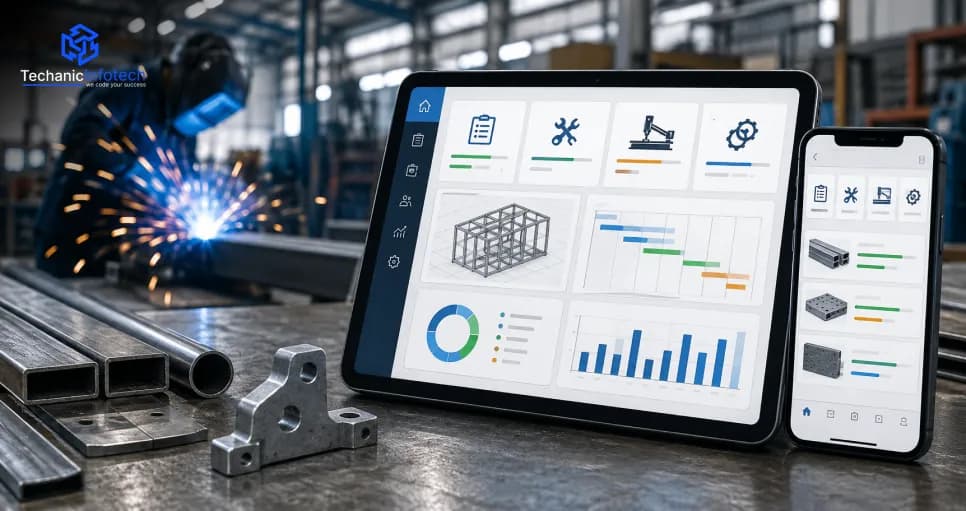
Fabrication shop software creates that visibility by turning disconnected production activities into one continuous digital workflow. Instead of asking supervisors for updates or checking multiple spreadsheets, managers can view every stage of production from a single dashboard.
When production information is updated automatically, managers spend less time collecting data and more time solving problems. They can immediately identify delayed work orders, overloaded machines, unavailable materials, or idle resources before those issues affect customer deliveries.
Production rarely depends on one team. Purchasing, warehouse staff, machine operators, quality inspectors, and dispatch teams all contribute to completing a single customer order.
Instead of operating independently, fabrication software creates a connected workflow where information moves automatically between departments. Material shortages become visible earlier, completed jobs instantly update inventory, and quality inspections become part of the production process rather than a separate task.
Businesses investing in manufacturing software development increasingly focus on building these connected production environments because they reduce communication delays and improve operational efficiency.
Customers don't simply want their products delivered; they want accurate timelines and reliable updates throughout the manufacturing process.
With centralised production tracking, service teams can immediately answer questions about manufacturing progress, estimated completion dates, or dispatch schedules without contacting multiple departments.
Every fabrication company operates differently. Some focus on custom metal fabrication, while others manage high-volume industrial production or contract manufacturing.
Instead of forcing businesses to adapt to generic software, many manufacturers choose to work with a trusted software development company that builds solutions around their existing workflows, production methods, approval processes, and reporting requirements. This approach allows technology to support operations rather than disrupt them.
A well-designed fabrication management platform combines multiple operational modules that simplify production while improving collaboration between production managers, machine operators, warehouse staff, and business owners.
Production managers can assign jobs, schedule manufacturing activities, allocate machines, and monitor production timelines from a centralised dashboard.
Digital work orders help track every production job, including customer requirements, assigned employees, production stages, material usage, and completion status.
The system monitors raw materials, finished goods, supplier information, stock availability, and purchase requirements to reduce production interruptions caused by inventory shortages.
Businesses can track employee assignments, machine utilisation, production capacity, maintenance schedules, and overall equipment efficiency to maximise operational performance.
Integrated quality inspection modules help manufacturers record inspection reports, identify production defects, monitor compliance standards, and reduce product rework.
Interactive dashboards provide insights into production performance, operational costs, material consumption, employee productivity, machine efficiency, and overall business performance.
As fabrication businesses grow, many choose custom software development to build specialised production workflows, approval systems, reporting dashboards, and operational features tailored to their manufacturing processes instead of relying on generic software.
Real-time production tracking is the foundation of modern fabrication management software. It enables manufacturers to monitor every stage of production, identify bottlenecks, optimise resource utilisation, and deliver projects on schedule. A centralised tracking system also improves communication between production teams, supervisors, and business owners.
Live production status monitoring
Work order progress tracking
Machine utilization monitoring
Employee productivity tracking
Material consumption reporting
Production delay alerts
Quality inspection updates
Performance dashboards
Developing fabrication shop software requires careful planning, scalable architecture, and close alignment with manufacturing workflows. Following a structured roadmap helps businesses build reliable software that supports future growth.
Identify production workflows, operational challenges, user roles, reporting needs, and long-term business objectives before defining the project scope.
Prioritise essential modules such as production planning, inventory management, work orders, quality control, reporting, and customer management.
Document every stage of the production lifecycle to ensure the software accurately reflects day-to-day fabrication processes.
Create intuitive dashboards for production managers, supervisors, machine operators, warehouse teams, and administrators to simplify daily operations.
Develop secure APIs, databases, authentication systems, cloud infrastructure, and business logic capable of handling large production datasets.
Implement frontend interfaces, production dashboards, reporting modules, inventory management, notifications, and workflow automation. Many manufacturers partner with an experienced mobile app development company to build companion mobile applications that enable supervisors and managers to monitor production activities remotely.
Connect ERP software, accounting platforms, barcode scanners, inventory systems, IoT devices, and reporting tools to create a connected manufacturing ecosystem.
Conduct functional testing, security validation, performance testing, API verification, and user acceptance testing to ensure reliable system performance.
Deploy the software, migrate existing production data, configure user permissions, and train employees to ensure smooth adoption across the organisation.
Monitor system performance, gather user feedback, introduce automation, strengthen security, and release regular feature updates to support evolving manufacturing requirements.
Imagine trying to track hundreds of production jobs while machines, workers, inventory, and customer deadlines are constantly changing. Without the right technology, even the most experienced production manager struggles to maintain complete control.
This is why successful fabrication software is designed around one objective: keeping every production activity connected in real time. Every work order, machine update, inventory movement, and quality inspection flows into a centralised system, giving decision-makers instant visibility instead of delayed reports.
|
Component |
Recommended Technologies |
|
Frontend |
React.js, Angular, Flutter |
|
Backend |
Node.js, Python, Java, .NET |
|
Database |
PostgreSQL, MongoDB, MySQL |
|
Cloud Platform |
AWS, Microsoft Azure, Google Cloud |
|
Authentication |
OAuth 2.0, JWT |
|
Reporting & Analytics |
Power BI, Grafana |
|
Notifications |
Firebase Cloud Messaging, OneSignal |
|
API Integration |
REST APIs, GraphQL |
Modern fabrication facilities increasingly connect machines, sensors, and production equipment to digital platforms for real-time monitoring. Through IoT app development, manufacturers can collect live operational data, monitor machine performance, detect equipment failures, and improve production efficiency with greater visibility across the shop floor.
Growing fabrication businesses require software capable of supporting multiple production units, warehouses, suppliers, and business locations. Investing in enterprise software development enables organisations to build scalable platforms that integrate production management, inventory, procurement, finance, and reporting into one unified ecosystem.
Artificial intelligence is transforming fabrication operations by predicting machine failures, optimising production schedules, improving quality inspections, and forecasting material requirements. Businesses often collaborate with an experienced AI development company to implement intelligent automation, while advancements in AI in manufacturing continue helping organisations reduce operational costs, improve production accuracy, and increase overall productivity.
Every fabrication software project begins with the same goal: improving production efficiency, but not every business needs the same level of investment. The overall budget depends on how far you want to digitise your operations.
Budget: $8,000–$15,000
At this stage, businesses replace manual paperwork with digital workflows. The software focuses on work orders, production scheduling, inventory management, customer records, and basic reporting.
Timeline: Approximately 2–3 months
Budget: $15,000–$30,000
Once the foundation is in place, the platform expands to include real-time production tracking, employee management, quality inspections, automated notifications, and performance dashboards.
Timeline: Approximately 3–5 months
Budget: $30,000–$45,000
Manufacturers begin integrating IoT devices, ERP platforms, advanced reporting, production analytics, and workflow automation to improve operational efficiency and reduce downtime.
Timeline: Approximately 5–7 months
Budget: $45,000–$60,000+
Enterprise projects focus on multi-location operations, intelligent production planning, cloud scalability, AI-driven analytics, supplier integrations, and centralised manufacturing management.
Timeline: Approximately 7–10 months
Fabrication businesses are under increasing pressure to deliver faster, operate more efficiently, and remain competitive in an evolving manufacturing landscape. Achieving these goals requires more than upgrading machinery; it requires modernising the systems that manage production itself.
A well-designed fabrication management platform provides the visibility, automation, and operational control needed to improve day-to-day performance while supporting future expansion. Whether you're digitising a single workshop or transforming an enterprise manufacturing operation, investing in the right software lays the foundation for smarter production, better decision-making, and sustainable business growth.
Fabrication shop software development involves building custom software that helps manufacturers manage production planning, work orders, inventory, quality control, workforce activities, and reporting from a centralised platform.
The cost typically ranges from $8,000 to $60,000+, depending on the software's complexity, integrations, automation requirements, and customisation.
Essential features include production planning, work order management, inventory tracking, quality control, reporting dashboards, employee management, and customer management.
Yes. Modern fabrication software can integrate with ERP platforms, accounting systems, inventory solutions, CRM software, barcode systems, and production equipment.
IoT enables real-time machine monitoring, predictive maintenance, equipment performance tracking, and automated production data collection, helping manufacturers improve efficiency and reduce downtime.
Yes. AI supports production forecasting, intelligent scheduling, quality analysis, predictive maintenance, and operational optimisation, helping manufacturers make faster and more informed business decisions.


Abhishek Jangid is the CEO of Techanic Infotech, with extensive experience in mobile app and web development. He specializes in helping businesses turn innovative ideas into scalable digital solutions through strategic planning and modern technology.