
AI is no longer an “innovation experiment.” In 2026, it’s a business requirement.
From personalized recommendations and chat assistants to predictive analytics and automation, AI-powered apps are shaping how users interact with products every day.
But building an AI app isn’t the same as building a traditional mobile or web app. It involves data strategy, model selection, governance, and long-term planning, areas many teams underestimate.
This guide explains how to develop an AI app, what features actually matter, how much it costs in 2026, and the real-world AI app development process businesses should follow to avoid wasted time and budget.
An AI app is a software application that uses machine learning, natural language processing, computer vision, or predictive models to make decisions, automate tasks, or personalize user experiences.
Unlike rule-based software, AI apps:
Learn from data
Improve over time
Adapt outputs based on context and user behavior
Most products of AI are hybrid, combining traditional logic with AI models that enhance specific workflows rather than replacing the entire system.
AI adoption has matured beyond experimentation; it’s central to digital innovation in 2026. Users now expect smarter, faster, and context-aware experiences as the default.
Across industries, businesses are leveraging intelligent automation, personalization, and predictive insights to stay competitive.
Here’s a snapshot of why AI matters:
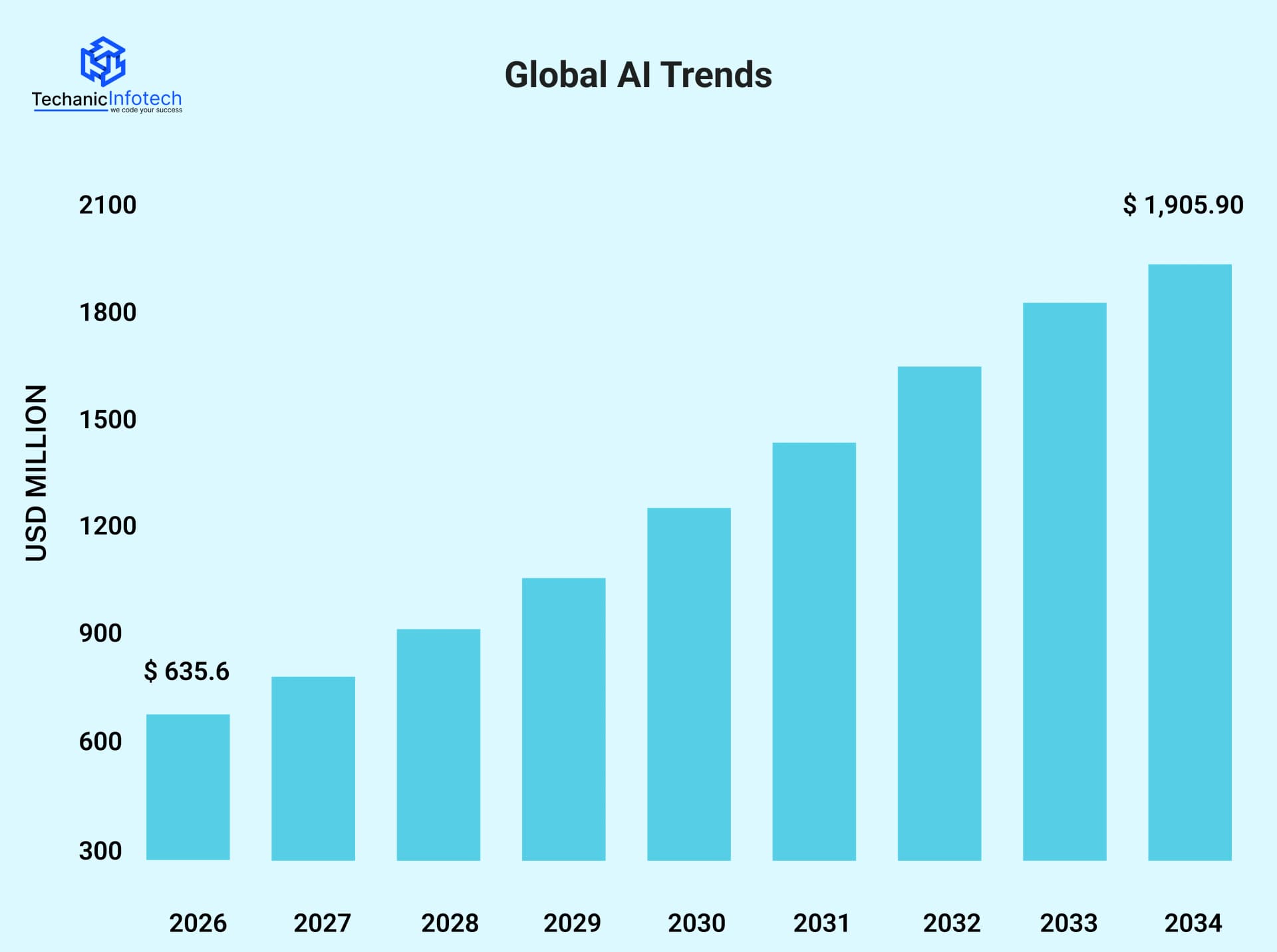
Globally, 88% of organizations use AI in at least one business function, and generative AI adoption has jumped dramatically in recent years, moving from early trials to core operations.
AI apps are becoming mainstream: 38% of mobile and web apps now use generative AI features, doubling from the previous year.
The global AI market is forecast to be worth over $621.69 billion in 2026 and is expected to exceed $4789.04 billion by 2035, reflecting long-term enterprise investment.
The mobile AI market specifically is expanding rapidly, projected to grow from around $40.26 billion in 2026 to over $325.21 billion by 2035 as on-device and cloud AI proliferate.
That’s why businesses across healthcare, fintech, retail, SaaS, logistics, and consumer apps are investing in AI mobile app development and web-based AI platforms.
The goal isn’t to “add AI” for novelty; the goal is to solve real problems better than non-AI alternatives by delivering personalized experiences, automating repetitive work, and deriving insights that humans cannot achieve at scale.
Not every AI feature improves a product. The most successful AI apps focus on practical, user-driven outcomes that solve real problems and enhance everyday experiences.
In AI app development in 2026, businesses are prioritizing mobile app features that deliver measurable value rather than novelty.
Below are AI-powered app features commonly used in high-performing AI applications today:
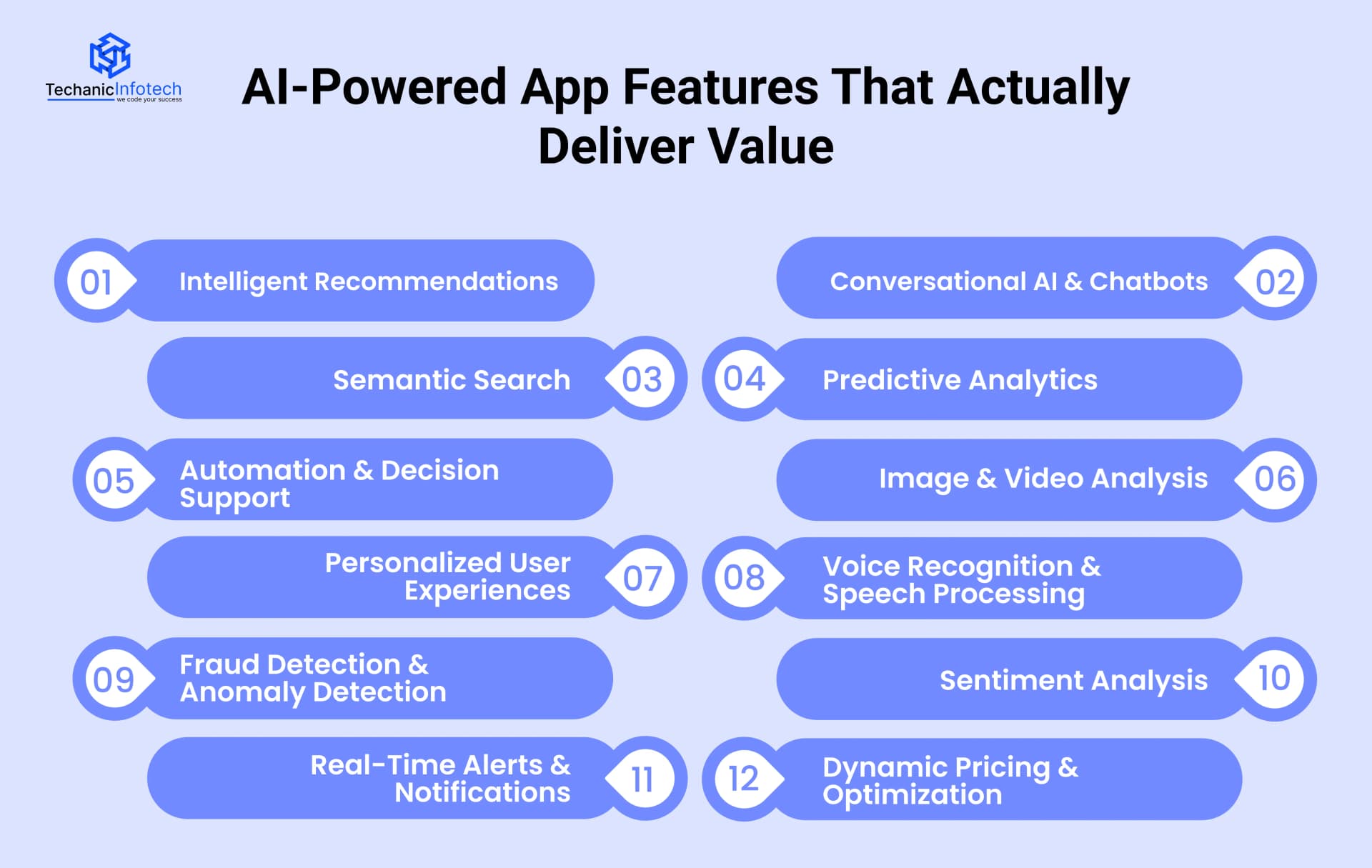
Intelligent Recommendations: AI suggests products, content, or actions based on user behavior, preferences, and real-time context.
Conversational AI & Chatbots: Context-aware assistants that handle customer support, onboarding, and routine interactions automatically.
Semantic Search: AI understands user intent rather than relying on exact keywords, delivering more relevant search results.
Predictive Analytics: Uses historical and real-time data to forecast demand, churn, risks, or future outcomes.
Automation & Decision Support: Automates repetitive tasks such as document processing, ticket routing, and approval workflows.
Image & Video Analysis: Enables content moderation, object recognition, visual tagging, and quality inspections.
Personalized User Experiences; Adapts interfaces, content, and recommendations based on individual user behavior and preferences.
Voice Recognition & Speech Processing: Allows voice commands, transcription, and hands-free interactions for better accessibility.
Fraud Detection & Anomaly Detection: Identifies unusual patterns or suspicious behavior to prevent fraud and security risks.
Sentiment Analysis: Analyzes user feedback, reviews, or conversations to understand emotions and satisfaction levels.
Real-Time Alerts & Notifications: Sends intelligent alerts based on patterns, thresholds, or predictive insights.
Dynamic Pricing & Optimization: Adjusts pricing or offers automatically based on demand, competition, and user behavior.
Important Note:
The most successful teams start with one or two high-impact AI features, validate their effectiveness, and then scale gradually.
This approach helps control AI app development costs while maximizing real business value.

Using AI APIs is ideal when you need speed, lower upfront cost, and proven functionality for common use cases like chat or recommendations.
Custom AI app development makes more sense when AI is central to your product, requires deep customization, or involves proprietary data or long-term competitive differentiation.
|
Factor |
Custom AI App Development |
Using AI APIs |
|
Development Cost |
Higher upfront cost due to model training and data work |
Lower cost with pay-as-you-go pricing |
|
Time to Market |
Longer development timeline |
Faster implementation |
|
Customization Level |
Fully tailored to business logic and data |
Limited to API capabilities |
|
Data Control |
Full control over data and models |
Data handled by third-party provider |
|
Scalability & Control |
High control, scalable for long-term growth |
Scales easily but with vendor dependency |
|
Best For |
Complex, differentiated AI products |
MVPs, common AI features, faster launches |
The AI app development process is very different from traditional development. While standard apps follow fixed rules, AI apps learn from data, adapt over time, and require continuous monitoring.
That’s why experienced teams follow a more structured and thoughtful approach when building AI-powered products.
Below is a practical breakdown of how to develop an AI app in 2026, step by step.
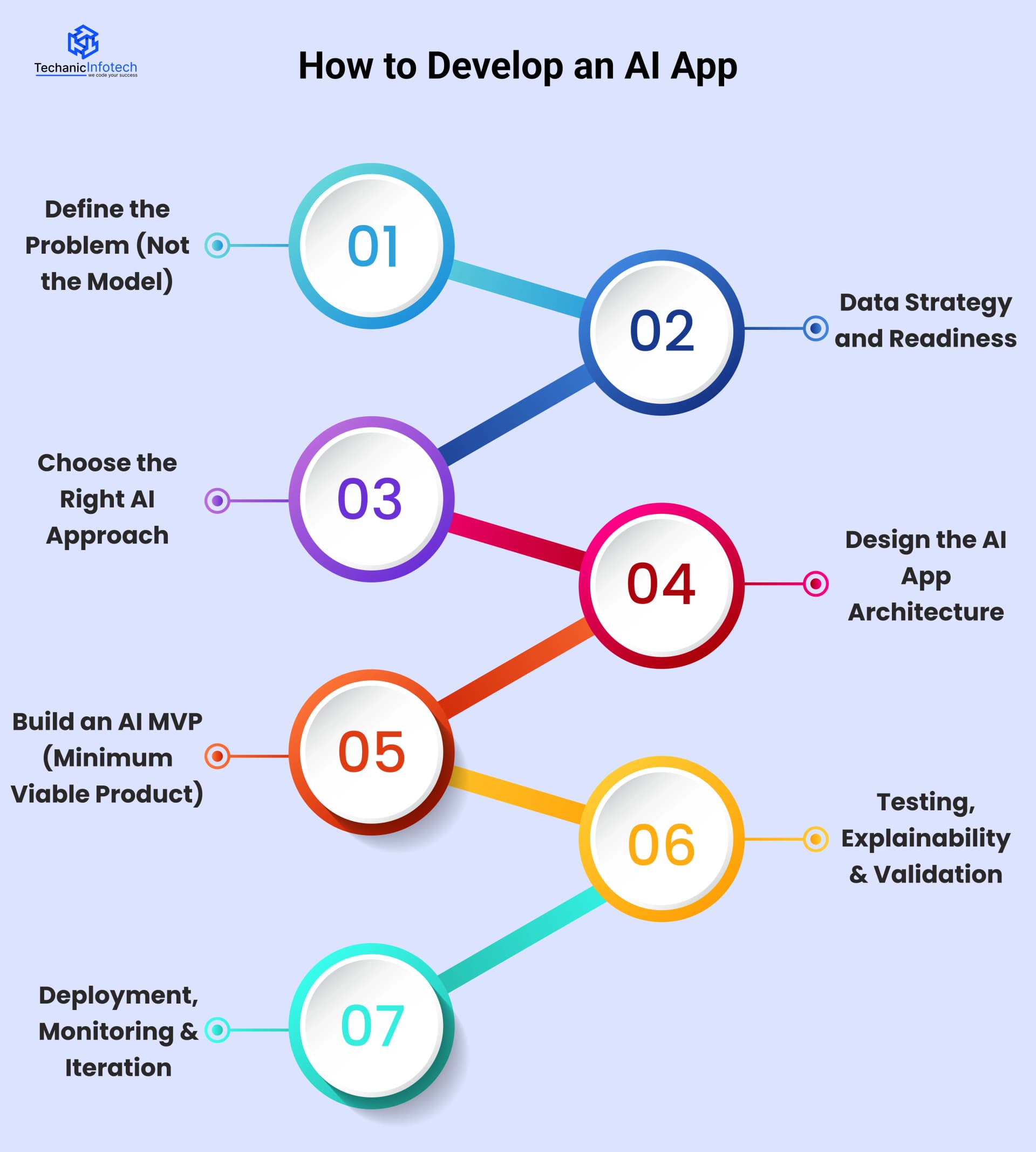
The biggest mistake teams make is starting with technology instead of the problem. Before choosing tools or models, clearly define why the AI app is being built.
Ask the right questions:
What specific user problem are you solving?
Why is AI required instead of simple logic?
What business outcome will define success?
Good AI apps focus on outcomes like reduced operational cost, better user engagement, faster decisions, or improved accuracy, not on algorithms.
At this stage, you decide whether to:
Use AI at all
Build a lightweight MVP
Invest in custom AI app development
This clarity sets the direction for the entire process of mobile app development.
Data is the foundation of every AI app. Without the right data, even the most advanced models will fail.
Teams evaluate:
What data is available today?
Is the data clean, structured, and labeled?
Is the data legally compliant and ethically usable?
Do you need new data sources or partnerships?
Data preparation often consumes 30–50% of total effort. This includes cleaning, labeling, validation, and documentation.
Skipping this step leads to inaccurate predictions, biased results, and low user trust, regardless of how powerful the AI model is.
This is where many AI projects either succeed or collapse financially.
You typically choose between:
Pre-trained AI APIs: fast to implement and cost-effective
Fine-tuned models: adapted to your domain or data
Fully custom models: expensive but offer full control
Most companies succeed with a hybrid approach:
Use APIs for general intelligence (chat, vision, embeddings)
Apply custom logic or fine-tuning for domain-specific needs
This balance helps control AI app development costs while still delivering unique value.
AI apps require a different architecture than traditional apps because models, data, and inference must scale independently.
A typical AI app tech stack includes:
Frontend (web or AI mobile app development)
Backend APIs and business logic
Model inference layer
Data pipelines and storage
Monitoring, logging, and analytics
Security and access control systems
In AI app development in 2026, scalability, latency, and cost optimization are critical, especially for real-time AI features.
Poor architectural decisions at this stage can cause performance issues and high cloud costs later.
Instead of building a full product immediately, experienced teams start small.
An AI MVP focuses on:
One high-impact AI feature
End-to-end integration
Real user feedback
This phase helps validate:
Model accuracy
Performance under real conditions
User trust and adoption
Actual business impact
Building an MVP significantly reduces AI app development cost, shortens timelines, and lowers risk when building an AI app.
AI apps require deeper testing than standard software.
Testing includes:
Functional testing of AI features
Model accuracy and reliability checks
Bias and fairness evaluations
Performance and load testing
Edge-case and failure scenario testing
In regulated industries like healthcare, finance, or insurance, explainability is mandatory.
Users and auditors must understand why an AI system made a decision. This step is essential for compliance, trust, and long-term adoption.
AI development doesn’t stop after launch.
Post-launch activities include:
Model monitoring and drift detection
Retraining pipelines using new data
Performance optimization
Feature refinement based on user behavior
Continuous improvement defines success. AI systems must evolve as data, users, and business needs change. This phase ensures your AI app stays accurate, reliable, and valuable over time.
In 2026, the cost to develop a mobile app varies based on complexity, data requirements, and whether you use APIs or build custom models.
On average, businesses can expect AI app development costs to fall between $20,000 and $120,000.
Lightweight MVPs that rely on pre-trained AI APIs sit at the lower end, while apps with custom logic, data pipelines, and compliance needs move toward the higher range.
In terms of time, most AI projects take 3 to 6 months end-to-end. This includes planning, data preparation, development, testing, and post-launch monitoring setup.
AI projects are iterative by nature, so timelines often overlap, especially during testing and optimization.
Below is a practical breakdown of time and cost by each step in the AI app development process.
|
Development Step |
What It Covers |
Avg Cost Range |
Avg Time |
|
Problem Definition |
Use cases, KPIs, scope |
$2,000–$5,000 |
1–2 weeks |
|
Data Strategy & Readiness |
Data audit, cleaning, labeling |
$5,000–$20,000 |
3–5 weeks |
|
AI Approach Selection |
API vs fine-tuning vs custom |
$3,000 – $10,000 |
1–2 weeks |
|
Architecture & Tech Stack |
System design, infra planning |
$4,000–$12,000 |
2–3 weeks |
|
MVP Development |
Feature build & integration |
$6,000 – $40,000 |
6–10 weeks |
|
Testing & Explainability |
Accuracy, bias, performance |
$3,000 – $15,000 |
2–4 weeks |
|
Deployment & Monitoring |
Launch, drift monitoring |
$2,000–$8,000 |
1–2 weeks |
AI is powerful, but it’s not always the right solution. The smartest products use AI only when it clearly improves outcomes.
In AI app development in 2026, businesses succeed by applying AI where it delivers measurable value.
Here are situations where developing an AI app truly makes business sense:
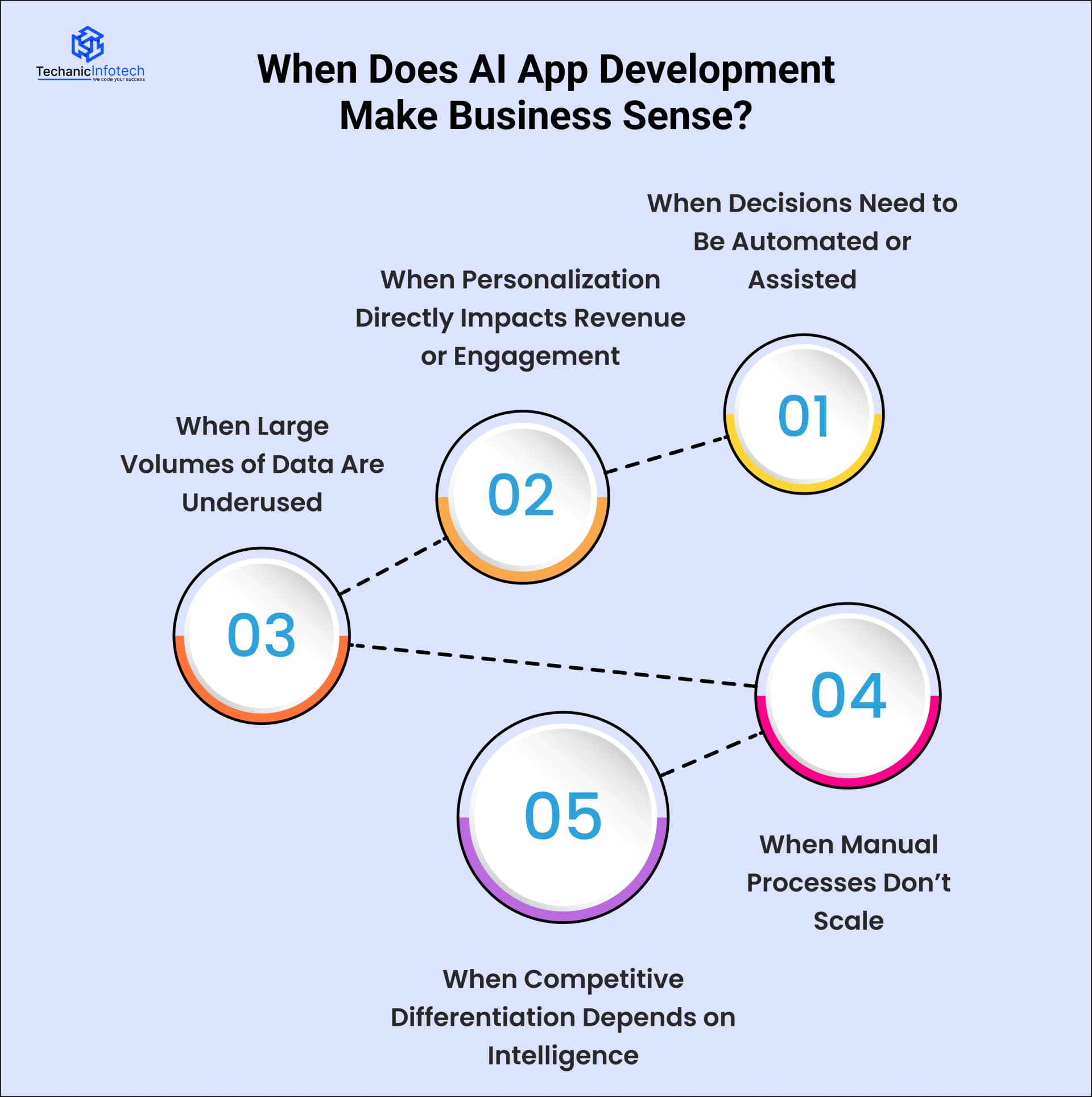
If your business relies on repetitive decisions, such as approvals, risk checks, recommendations, or prioritization, AI can reduce manual effort and improve speed and accuracy.
AI is valuable when tailoring content, pricing, or experiences increases conversions, retention, or customer satisfaction. This is common in eCommerce, SaaS, media, and fintech apps.
If your organization collects data but struggles to extract insights, AI can uncover patterns that humans miss. Predictive analytics and forecasting are strong examples.
AI makes sense when human-driven workflows become too slow or expensive at scale, such as customer support, document processing, or moderation.
In crowded markets, AI-powered features can become a long-term differentiator, especially when paired with proprietary data or domain expertise.
Important Reminder:
If AI doesn’t clearly reduce cost, improve accuracy, or enhance user experience, it’s better to avoid it. Successful AI apps solve real problems, not just showcase advanced app technology stacks.
AI app development offers powerful advantages, but many projects fail due to avoidable mistakes.
Understanding these pitfalls early can save app development time, cost, and frustration, especially in AI development, where user expectations and compliance standards are higher than ever.
One of the most common mistakes is choosing AI tools or models before clearly defining the business problem.
This often leads to features that look impressive but deliver little value.
How to avoid it: Start with user pain points and measurable outcomes, then decide if AI is truly needed.
AI systems are only as good as the data behind them. Teams often assume existing data is ready to use, only to discover it’s incomplete or biased.
How to avoid it: Allocate sufficient time and budget for data cleaning, labeling, and validation from the start.
Building a full-scale AI system without validation increases risk and cost. Many teams invest heavily before proving real user demand.
How to avoid it: Begin with an MVP that tests one high-impact AI feature before scaling further.
AI decisions that can’t be explained or audited create trust and legal issues, especially in regulated industries.
How to avoid it: Include fairness checks, documentation, and explainability features as part of the core development process.
AI models degrade over time as data and user behavior change. Without monitoring, performance declines quickly.
How to avoid it: Plan for ongoing monitoring, retraining, and iteration after launch.
By avoiding these pitfalls, businesses can build AI apps that are reliable, ethical, and scalable, delivering long-term value rather than short-term experimentation.
Techanic Infotech helps businesses move beyond AI buzzwords and build applications that deliver measurable value.
With hands-on experience across AI mobile app development, data-driven platforms, and intelligent automation, the team focuses on practical outcomes, performance, scalability, and cost control.
From defining the right AI use case to choosing between APIs and custom AI app development, our AI app development company follows a clear, transparent process backed by strong data and governance practices.
Whether you’re launching an MVP or scaling an enterprise-grade solution, Techanic Infotech partners with you to build AI apps that are reliable, compliant, and ready to grow in 2026 and beyond.
AI app development in 2026 is no longer about experimentation; it’s about building smarter products that solve real problems and scale with confidence.
From choosing the right AI features and defining a clear data strategy to managing cost, timelines, and long-term governance, every step plays a critical role in success.
Businesses that approach AI with clarity, realistic expectations, and a strong development process are the ones seeing real returns. Whether you start with AI APIs or invest in custom AI development, the key is to focus on value, not hype.
With the right strategy and execution, an AI app can become a powerful driver of efficiency, innovation, and long-term growth.
The AI app development cost typically ranges from $20,000 to $120,000, depending on app complexity, data requirements, and whether you use AI APIs or custom models. Advanced, enterprise-grade solutions may cost more.
Most AI apps take 3 to 6 months to develop, including planning, data preparation, development, and testing. MVPs can be built faster, while complex platforms take longer.
Many businesses start with AI APIs for speed and cost efficiency. Custom AI app development is recommended when AI is core to your product or relies on proprietary data.
Healthcare, fintech, retail, SaaS, logistics, and consumer apps see strong benefits from AI, especially in automation, personalization, and predictive analytics.
Yes, when built correctly. Security, data privacy, explainability, and monitoring are essential parts of modern AI app development in 2026.
Absolutely. With the right architecture and monitoring, AI apps can scale efficiently while maintaining performance and accuracy.


Bharat Sharma is the CTO of Techanic Infotech, bringing deep technical expertise in software architecture, mobile app development, and scalable system design. He leads the engineering team with a strong focus on innovation, performance, and security.