Software Development
Fleet Maintenance Software Development: A Guide for Trucking Companies
August 6, 2026
August 6, 2026
For trucking companies, every hour a vehicle spends off the road directly affects revenue. Unexpected breakdowns, missed maintenance schedules, delayed repairs, and inefficient service planning not only increase operating costs but also disrupt deliveries, reduce fleet availability, and impact customer satisfaction. As fleets grow larger, managing maintenance manually becomes increasingly difficult, especially when multiple vehicles operate across different routes and locations.
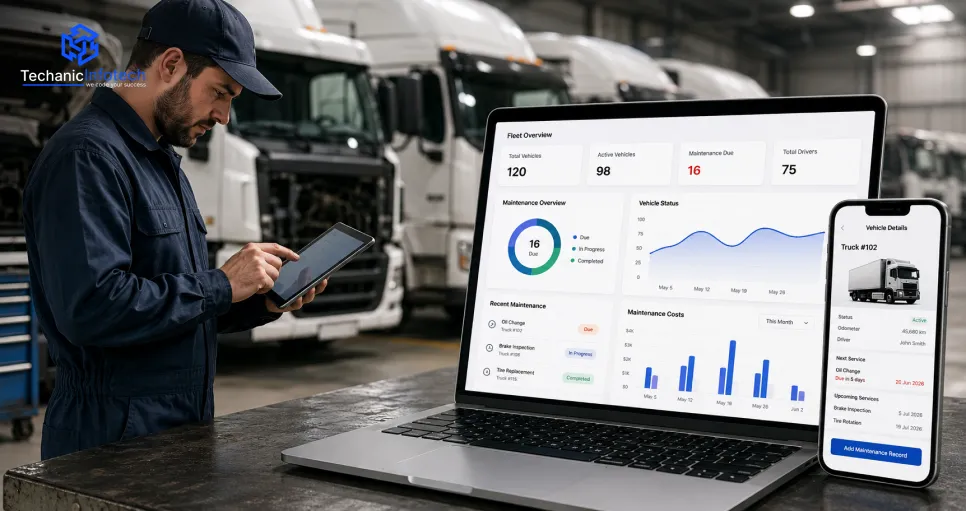
This is why businesses are investing in fleet maintenance software development. Instead of relying on spreadsheets or paper-based maintenance records, modern software enables fleet operators to monitor vehicle health, schedule preventive maintenance, track service history, manage repair workflows, and receive real-time maintenance alerts from a centralised platform.
A comprehensive fleet maintenance software guide focuses on much more than servicing vehicles. It helps trucking companies improve fleet reliability, extend vehicle lifespan, reduce downtime, optimise maintenance costs, and maintain regulatory compliance through intelligent digital workflows.
In this guide, we'll explore how modern fleet maintenance platforms support trucking businesses, the operational modules that deliver the greatest value, development strategies, investment considerations, and the technologies shaping the future of commercial fleet operations.
Fleet Management Market Growth: According to Fortune Business Insights, the global fleet management market was valued at USD 28.6 billion in 2024 and is projected to exceed USD 61 billion by 2032, driven by increasing demand for connected fleet operations and digital maintenance solutions.
Commercial Fleet Expansion: According to Grand View Research, the rise of eCommerce, logistics and last-mile delivery services continues to increase the number of commercial vehicles on the road, creating greater demand for maintenance automation and fleet management software.
Predictive Maintenance Adoption: Marketsand Markets reports that predictive maintenance technologies are experiencing strong adoption across transportation and logistics as businesses focus on reducing unexpected vehicle failures and maintenance costs.
Connected Vehicle Technology: According to the International Energy Agency (IEA), IoT-enabled telematics, GPS tracking, and real-time vehicle diagnostics are becoming standard across commercial fleets, helping organisations improve maintenance planning and operational visibility.
For many trucking businesses, purchasing vehicles is only the beginning of the investment. Keeping those vehicles roadworthy over several years often costs significantly more than expected. Fuel, spare parts, labour, inspections, unexpected repairs, and vehicle downtime all contribute to rising operational expenses.
As fleets become larger, maintenance shifts from being a workshop activity to becoming a critical business function that directly affects profitability.
Unexpected mechanical failures usually result in higher repair costs than scheduled servicing. Emergency repairs often involve expensive replacement parts, towing charges, and extended vehicle downtime.
When a truck remains in the workshop instead of on the road, businesses lose more than transportation capacity. Missed deliveries, delayed schedules, dissatisfied customers, and idle drivers all contribute to financial losses.
Commercial fleets must comply with regular inspections, maintenance records, safety regulations, and emission standards. Managing these requirements manually becomes increasingly difficult as the number of vehicles grows.
Without centralised maintenance records, fleet managers often struggle to identify which vehicles require servicing, which repairs are pending, and which assets are generating excessive maintenance costs.
As transportation businesses expand into new regions and operate larger fleets, digital maintenance systems become essential rather than optional. Partnering with an experienced software develo pment company enables trucking businesses to build scalable maintenance platforms that improve operational visibility, reduce downtime, and support long-term fleet growth.
Many trucking companies don't realise the true cost of manual maintenance management until operational issues begin affecting deliveries, customer satisfaction, and profitability. Small maintenance delays often develop into larger business problems when vehicle information is scattered across spreadsheets, paper files, or disconnected systems.
The table below highlights the most common consequences of operating without a digital fleet maintenance platform.
|
Operational Issue |
Business Impact |
|
Missed Service Schedules |
Vehicles remain on the road beyond recommended maintenance intervals, increasing the risk of breakdowns. |
|
Unexpected Vehicle Failures |
Emergency repairs result in expensive downtime, delayed deliveries, and dissatisfied customers. |
|
Poor Maintenance Records |
Service history becomes difficult to track, affecting compliance and future repair planning. |
|
Limited Fleet Visibility |
Managers cannot quickly identify which vehicles are operational, under repair, or awaiting maintenance. |
|
Manual Work Orders |
Paper-based maintenance requests slow communication between fleet managers and technicians. |
|
Inventory Shortages |
Spare parts are not always available when needed, extending repair timelines. |
|
Compliance Risks |
Missing inspection records or maintenance documentation may lead to regulatory penalties. |
|
Higher Operating Costs |
Reactive maintenance increases repair expenses and reduces vehicle lifespan. |
|
Low Fleet Utilization |
Trucks spend more time in workshops and less time generating revenue. |
Successful trucking companies don't wait for vehicles to break down before taking action. Instead, they build a preventive maintenance ecosystem where every inspection, repair, and service activity is planned, monitored, and documented through a connected digital platform. This proactive approach minimises unexpected failures while improving fleet reliability.
Every truck should have its own digital profile containing maintenance history, warranty information, inspection reports, service intervals, insurance records, and repair logs. Having all information in one place helps maintenance teams make faster and more informed decisions.
Instead of manually tracking maintenance dates, the system automatically schedules servicing based on mileage, engine hours, operating conditions, or predefined maintenance intervals. This ensures no critical service is overlooked.
When maintenance is required, technicians receive digital work orders that include repair instructions, vehicle details, required parts, and service priorities. This eliminates paperwork while improving communication between workshop staff and fleet managers.
A connected maintenance platform monitors spare parts availability, records inventory usage, and alerts managers when stock levels become low. This reduces repair delays caused by missing components.
Maintenance reports provide insights into recurring mechanical issues, repair frequency, maintenance costs, and vehicle reliability. These insights help businesses decide whether to repair, replace, or upgrade specific assets.
Every trucking company follows different maintainance processes. Businesses investing in custom software development can tailor preventive maintenance workflows, inspection procedures, approval systems, and reporting dashboards to match their operational requirements rather than adapting to off-the-shelf software.
Fleet maintenance software is most effective when it functions as an integrated operational system rather than a collection of disconnected features. Each module contributes to keeping vehicles on the road, technicians productive, and maintenance activities organised.
This module serves as the operational hub where managers monitor upcoming services, ongoing repairs, completed work orders, and vehicle availability from a single dashboard.
Key capabilities include:
Preventive maintenance scheduling
Repair planning
Maintenance calendar
Vehicle service history
Work order management
Technicians require mobile access to maintenance requests and repair information while working in workshops or at remote locations.
Key capabilities include:
Digital work orders
Inspection checklists
Parts request management
Repair documentation
Image uploads
Job completion updates
Rather than waiting for vehicles to fail, businesses monitor overall fleet performance through maintenance analytics and operational insights.
Key capabilities include:
Vehicle health reports
Breakdown tracking
Maintenance history
Downtime analysis
Service cost reporting
Efficient inventory control helps maintenance teams complete repairs faster while reducing unnecessary spare-part purchases.
Key capabilities include:
Spare parts inventory
Stock level monitoring
Purchase requests
Supplier management
Parts usage history
Fleet managers and business owners need complete visibility into maintenance performance across the organisation. Many companies combine these capabilities with logistics apps. development solutions to manage fleet operations, deliveries, maintenance, and transportation activities from a connected digital ecosystem.
Key capabilities include:
Fleet performance analytics
Maintenance expenditure reports
Technician productivity
Vehicle utilization
Operational KPIs
Executive dashboards
Building fleet maintenance software requires a clear understanding of how vehicles, technicians, fleet managers, and maintenance teams work together every day. Instead of developing isolated features, successful platforms are built around real operational workflows that improve efficiency from the first service request to the final maintenance report.
Begin by evaluating fleet size, vehicle categories, maintenance processes, compliance requirements, workshop operations, and business goals. Understanding these requirements helps define the platform's overall architecture.
Map every stage of the maintenance lifecycle, including service requests, inspections, approvals, repairs, quality checks, and vehicle release. A structured workflow minimises delays and improves accountability.
Create dedicated dashboards for fleet managers, technicians, workshop supervisors, and administrators. Each interface should display only the information required for that role, improving usability and productivity.
Build the maintenance scheduler, work order system, inventory management, reporting dashboard, notification engine, and vehicle history database. Businesses adopting fleet management app development often integrate these modules with existing fleet operations to create a unified management platform.
Integrate accounting software, GPS services, ERP platforms, telematics providers, spare-part suppliers, and communication tools to eliminate manual data entry and improve operational efficiency.
Perform functional testing, workflow validation, performance testing, security assessments, and compatibility testing to ensure the platform performs reliably under real-world operating conditions.
Launch the software in phases, migrate existing maintenance records, onboard workshop staff, and train fleet managers to maximise adoption across the organisation.
Monitor maintenance performance, gather employee feedback, introduce automation, and expand functionality over time. Partnering with an experienced mobile app development company helps businesses keep the platform secure, scalable, and aligned with changing operational requirements.
Modern fleet maintenance software is no longer limited to recording repairs. Today's platforms combine connected technologies, automation, and real-time data to help trucking companies predict maintenance needs, reduce downtime, and optimise fleet performance.
Instead of relying solely on fixed service intervals, many trucking companies now work with an experienced AI development company to implement predictive maintenance. By analysing mileage, engine diagnostics, repair history, and driving patterns, AI can recommend servicing before mechanical failures occur.
Through IoT app development, fleet operators can connect telematics devices, GPS units, onboard sensors, and diagnostic systems directly to the maintenance platform. This provides continuous visibility into vehicle health, engine performance, fuel consumption, and fault alerts.
Rather than operating separate systems for maintenance, dispatch, and fleet operations, businesses can consolidate operational data into one dashboard. Managers gain complete visibility over maintenance schedules, vehicle availability, technician workloads, and overall fleet performance.
Interactive dashboards transform maintenance data into meaningful business insights. Managers can identify high-maintenance vehicles, compare repair costs, monitor workshop productivity, and evaluate fleet utilisation to make better long-term investment decisions.
As trucking operations expand, maintenance platforms should grow alongside the business. A scalable architecture allows companies to add new vehicles, service centres, users, and advanced technologies without interrupting daily operations or rebuilding the system from scratch.
Every trucking business reaches a different stage of digital maturity. Some only need to replace paper maintenance logs, while others want predictive maintenance powered by connected vehicles and AI. Your investment grows as the platform becomes more intelligent.
This stage focuses on replacing manual maintenance processes with digital workflows.
Includes:
Digital maintenance schedules
Vehicle service history
Technician work orders
Basic reporting
Estimated Investment: $8,000–$18,000
Once daily maintenance becomes digital, businesses typically connect inventory, maintenance teams, approvals, and reporting into one platform.
Includes:
Spare parts management
Workshop coordination
Automated notifications
Maintenance dashboards
Fleet-wide reporting
Estimated Investment: $18,000–$35,000
At this level, the software begins helping managers make decisions instead of simply recording information.
Includes:
AI-powered maintenance prediction
IoT & telematics integration
Performance analytics
Automated maintenance recommendations
Enterprise integrations
Estimated Investment: $35,000–$60,000+
Fleet maintenance directly influences profitability, vehicle reliability, and customer satisfaction. As trucking businesses expand, manual maintenance processes become increasingly difficult to manage, making digital maintenance platforms a strategic investment rather than an operational convenience.
Whether you're managing a regional transport fleet or a nationwide logistics operation, investing in modern fleet maintenance software creates better visibility, stronger operational control, and a more reliable transportation business built for the future.
Fleet maintenance software development involves building digital platforms that help trucking companies manage vehicle servicing, work orders, maintenance schedules, inspections, inventory, and technician operations from a centralised system.
The overall fleet maintenance software cost generally ranges from $8,000 to $60,000+, depending on fleet size, integrations, automation requirements, and customisation.
Core features include maintenance scheduling, work order management, vehicle history, technician management, inventory tracking, reporting dashboards, compliance monitoring, and predictive maintenance tools.
Most projects require 2 to 10 months, depending on platform complexity, integrations, and business requirements.
Yes. AI can predict maintenance requirements, identify recurring mechanical issues, optimise servicing schedules, and reduce unexpected vehicle downtime.
Yes. Modern platforms can integrate with GPS devices, telematics providers, onboard diagnostics, fuel management systems, and ERP software to provide real-time fleet visibility.
Preventive maintenance reduces unexpected breakdowns, lowers repair costs, improves vehicle reliability, extends asset lifespan, and minimises business disruption caused by unplanned downtime.


Abhishek Jangid is the CEO of Techanic Infotech, with extensive experience in mobile app and web development. He specializes in helping businesses turn innovative ideas into scalable digital solutions through strategic planning and modern technology.