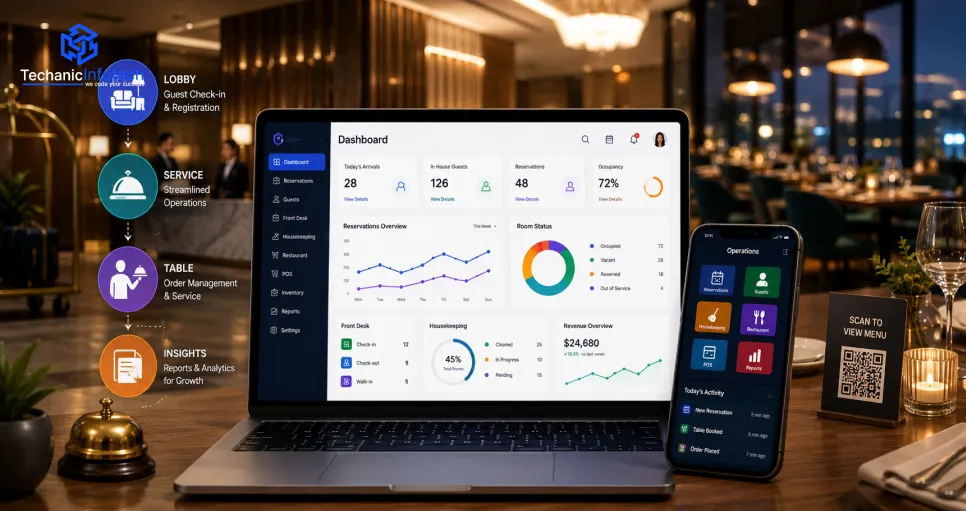
The hospitality industry is evolving rapidly as hotels, resorts, restaurants, vacation rentals, and other service providers embrace digital technologies to deliver exceptional guest experiences. Today's customers expect seamless online bookings, personalised services, contactless check-ins, digital payments, and instant support across multiple channels.
This growing demand has accelerated the adoption of hospitality software development, enabling businesses to automate daily operations, improve guest engagement, and manage everything from reservations to customer relationships through a centralised platform. Whether you're investing in hotel management software development or a complete hospitality management software solution, modern technology helps streamline operations while improving efficiency and profitability.
From hotel booking systems and restaurant management platforms to customer relationship management and staff coordination, digital solutions are transforming how hospitality businesses operate and compete in an increasingly customer-centric market.
Superior Guest Experience: According to a Deloitte study, 70% of guests believe that hotels adopting advanced technology deliver a superior experience.
Personalised Marketing: Big data allows brands to predict demand, set optimum pricing, and build 360-degree views of customer behaviour.
Sustainability and Demand: Research by Expedia Group shows 67% of travellers prefer hotels that demonstrate environmental responsibility, a metric supported by IoT-based real-time energy monitoring systems.
Customer expectations continue to evolve, making digital transformation a necessity for hospitality businesses. Modern software solutions help organisations improve operational efficiency, reduce manual work, and deliver personalised guest experiences while remaining competitive.
Guests expect fast bookings, mobile check-ins, personalised recommendations, and instant support. Digital platforms help hospitality businesses provide seamless experiences throughout the customer journey, resulting in higher satisfaction and increased customer loyalty.
Managing reservations, housekeeping, staff schedules, payments, inventory, and customer requests manually can become overwhelming. Hospitality software centralises these operations, reducing administrative effort while improving service quality.
Automation minimises repetitive tasks such as booking confirmations, invoice generation, room allocation, and guest communication. This allows employees to focus on delivering better customer service instead of handling manual processes.
Real-time dashboards and analytics provide valuable insights into occupancy rates, revenue, customer preferences, and operational performance. These insights help businesses optimise pricing strategies, allocate resources effectively, and improve overall profitability.
Many businesses benchmark their digital strategies against leading travel app development companies to understand emerging customer expectations and adopt innovative technologies that enhance guest experiences.
A successful hospitality management system development project combines multiple business functions into one integrated platform. These components help hotels, restaurants, resorts, and hospitality businesses operate more efficiently while delivering superior customer experiences.
An advanced booking module simplifies room reservations, availability management, cancellations, online payments, and confirmations. Businesses investing in hotel booking software development can automate reservation workflows while improving the overall booking experience.
An integrated hospitality CRM software module stores guest profiles, booking history, preferences, feedback, and loyalty information. This enables businesses to deliver personalised services, targeted promotions, and stronger customer relationships.
Hospitality platforms often integrate restaurant operations, including table reservations, digital menus, order management, kitchen coordination, and billing. Many hospitality businesses also evaluate solutions offered by restaurant app development companies to strengthen their food service operations.
An efficient housekeeping and maintenance module helps staff manage room cleaning schedules, maintenance requests, room inspections, and service assignments from a centralised dashboard. Real-time room status updates enable housekeeping teams to prepare rooms quickly, while automated maintenance alerts help resolve issues before they affect the guest experience.
A robust billing and payment module simplifies financial operations by automating invoice generation, payment processing, tax calculations, refunds, and expense tracking. Integration with secure payment gateways supports multiple payment methods while providing guests with a seamless checkout experience.
A successful hospitality software development project should provide a seamless experience for both guests and staff while simplifying daily operations. From reservations and customer engagement to analytics and automation, the right features help hospitality businesses improve efficiency and deliver exceptional service.
Allow guests to create accounts, manage bookings, update personal information, save preferences, and access loyalty rewards through a secure and user-friendly portal. Personalised guest profiles help businesses deliver customised experiences.
An intuitive booking engine enables customers to check availability, make reservations, modify bookings, and receive instant confirmations. Real-time synchronisation prevents double bookings while improving operational efficiency.
An effective room and inventory management module enables hospitality businesses to monitor room availability, occupancy status, housekeeping schedules, maintenance requests, and inventory levels from a centralised dashboard.
A robust hospitality CRM software module helps businesses manage guest profiles, booking history, preferences, feedback, loyalty programmes, and communication from a centralised platform. By providing personalised services, targeted marketing campaigns, and timely customer support, it strengthens guest relationships, increases retention, and enhances the overall customer experience.
Managers can assign tasks, monitor employee performance, schedule shifts, and track operational activities through a centralised workforce management system, improving team productivity and accountability.
An integrated billing and payment system enables businesses to generate invoices, process secure online payments, manage refunds, track transaction history, and support multiple payment methods. Automated payment processing reduces manual errors, improves financial transparency, and provides guests with a seamless and secure checkout experience.
Modern hospitality software solutions increasingly leverage AI integration in mobile apps to deliver personalised recommendations, intelligent chatbots, dynamic pricing, automated customer support, and predictive demand forecasting. These capabilities enhance guest satisfaction while improving operational efficiency.
Comprehensive dashboards provide insights into occupancy rates, booking trends, revenue performance, guest behaviour, and operational KPIs. These analytics help businesses make informed decisions and identify opportunities for continuous improvement.
Developing a successful hospitality platform requires careful planning, scalable architecture, and a guest-first approach. Following industry best practices helps businesses build software that delivers long-term value while adapting to changing customer expectations.
Before development begins, identify the operational challenges your software will solve. Whether you're building a hotel management system, restaurant platform, or resort management solution, defining clear business objectives helps prioritise features and streamline development.
Many hospitality businesses choose to launch with core functionalities before expanding the platform. This approach allows organisations to develop a minimal viable product, validate market demand, gather customer feedback, and reduce development risks before investing in advanced features.
As your business grows, the software should support additional properties, users, services, and integrations without affecting performance. Businesses investing in hospitality management system development should adopt scalable architectures that simplify future upgrades.
Building hospitality software requires expertise in cloud technologies, API integrations, security, and user experience. Partnering with an experienced mobile app development company ensures your solution is secure, scalable, and tailored to your business requirements.
Software requires regular updates, security improvements, performance optimisation, and feature enhancements after launch. Ongoing maintenance ensures the platform remains reliable, secure, and compatible with evolving business needs.
The hospitality software development cost typically ranges from $10,000 to $100,000+, depending on the project's complexity, number of modules, third-party integrations, deployment model, and customisation requirements. A basic hospitality solution with essential booking and management features requires a smaller investment, while enterprise-grade platforms with AI capabilities, CRM, analytics, and multi-property management involve higher development costs.
|
Software Type |
Estimated Cost |
Development Timeline |
|
Basic Hospitality Management Software |
$10,000–$20,000 |
2–3 Months |
|
Standard Hotel Management Platform |
$20,000–$45,000 |
3–5 Months |
|
Advanced Hospitality Management Solution |
$45,000–$75,000 |
5–7 Months |
|
Enterprise Hospitality Software Platform |
$75,000–$100,000+ |
7–10 Months |
Before finalising the budget, businesses should also evaluate the overall mobile app development cost if the project includes companion mobile applications for guests or staff. Small and growing hospitality businesses can further optimise their investment through software development for SMBs, enabling them to build scalable solutions while effectively managing development expenses.
The hospitality industry is becoming increasingly technology-driven, making digital transformation essential for businesses that want to improve guest experiences and streamline operations. Investing in hospitality software development enables hotels, resorts, restaurants, and other hospitality providers to automate daily workflows, strengthen customer relationships, and improve overall operational efficiency.
Whether you're developing a hotel management platform, a reservation system, or a comprehensive hospitality management software solution, choosing the right features, scalable architecture, and a long-term development strategy is key to success. A well-designed platform not only enhances service quality but also helps businesses adapt to changing customer expectations and remain competitive in the evolving hospitality market.
Hospitality software development is the process of creating digital solutions that help hotels, restaurants, resorts, and other hospitality businesses manage reservations, guest services, operations, billing, and customer relationships through a centralised platform.
The hospitality software development cost typically ranges from $10,000 to $100,000+, depending on the project's complexity, features, integrations, and customisation requirements.
Essential features include online booking, guest management, CRM, room management, staff scheduling, payment processing, reporting, analytics, and AI-powered automation.
Hotels, resorts, restaurants, vacation rentals, hostels, boutique hotels, serviced apartments, event venues, and travel businesses can all improve their operations with hospitality software.
Development generally takes 2 to 10 months, depending on the software's complexity, business requirements, integrations, and level of customisation.
Yes. Modern hospitality software can integrate with payment gateways, CRM systems, accounting software, POS solutions, channel managers, and other third-party platforms through secure APIs.
Custom hospitality software is ideal for businesses with unique operational requirements because it offers greater flexibility, scalability, and seamless integration with existing workflows.
Yes. Enterprise hospitality platforms can manage multiple hotels, resorts, or business locations from a centralised dashboard, allowing administrators to monitor operations, reservations, staff, and performance across all properties.


Abhishek Jangid is the CEO of Techanic Infotech, with extensive experience in mobile app and web development. He specializes in helping businesses turn innovative ideas into scalable digital solutions through strategic planning and modern technology.