
Key Takeaways:
Cloud services help businesses develop, test, deploy, and scale digital products more efficiently.
Cloud infrastructure provides flexible resources that can adapt as product requirements and user demand change.
Automated testing, deployment, and CI/CD workflows can help development teams release updates faster.
Cloud platforms can support AI-powered products with scalable computing, storage, and data processing capabilities.
Proper security, monitoring, and cost management are essential for getting long-term value from cloud infrastructure.
Building a digital product involves much more than developing features. Businesses also need reliable infrastructure for storing data, running applications, testing new releases, and supporting users as the product grows. Traditional infrastructure can make these activities slower because teams often need to purchase, configure, and maintain physical servers.
Cloud services provide an alternative by giving development teams access to computing resources, databases, storage, security tools, and other infrastructure through the internet. Businesses can provision resources as needed and adjust capacity as requirements change.
For companies working on new digital products, this flexibility can shorten development cycles and make it easier to move from an initial idea to a working product. Whether a business is building a mobile application, SaaS platform, e-commerce product, or enterprise system, cloud infrastructure can support development from the early stages through post-launch growth.
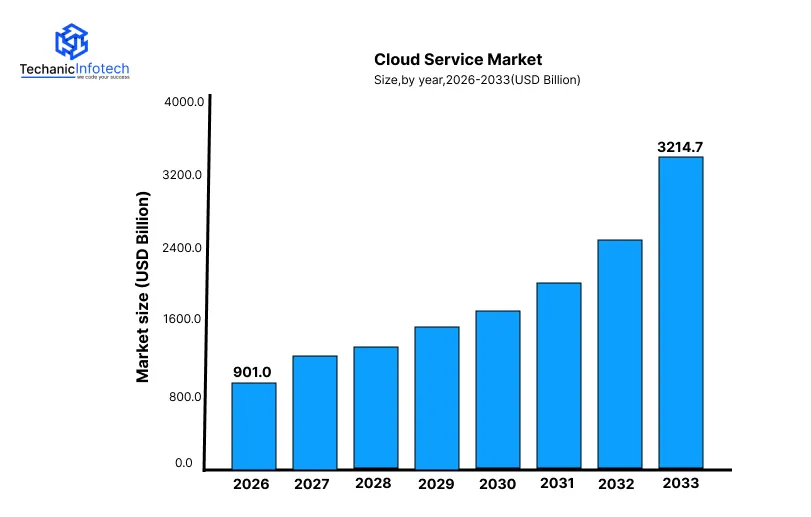
The global cloud services market was valued at USD 782.5 billion in 2025 and is projected to grow from USD 901.2 billion in 2026 to USD 3,214.7 billion in 2033, at a CAGR of 19.9% from 2026 to 2033.
According to CNCF's 2026 Annual Cloud Native Survey, 82% of container users run Kubernetes in production, showing the maturity of cloud-native infrastructure.
Businesses are increasingly using cloud infrastructure because it can reduce the time and effort required to manage technical resources. Instead of setting up physical infrastructure for every project, development teams can access the resources they need through cloud platforms.
This is particularly useful when businesses need to experiment with new products, release updates frequently, or support users across different locations.
Cloud resources can generally be provisioned much faster than traditional physical infrastructure. Development teams can create servers, databases, storage environments, and testing environments without waiting for hardware procurement and installation.
Cloud-based development environments allow distributed teams to access shared resources and project environments. Developers, testers, designers, and product managers can work with connected systems without depending entirely on locally configured infrastructure.
Product requirements can change quickly during development. Cloud infrastructure allows businesses to increase or decrease computing and storage resources according to workload, helping teams avoid investing heavily in infrastructure before the product's demand is known.
Cloud infrastructure can support everything from early-stage MVPs to complex enterprise platforms. Businesses can start with a smaller infrastructure setup and expand it as users, transactions, and data volumes increase.
Cloud services can influence almost every stage of product development. They provide development teams with ready-to-use infrastructure, managed services, and deployment tools that reduce the amount of time spent building and maintaining basic infrastructure.
Development teams can quickly create environments for development, testing, and production. This allows businesses to begin building and validating their products without spending weeks preparing physical infrastructure.
Startups can use cloud infrastructure to launch an initial version of a product with only the resources required for the MVP. This approach allows businesses to test their idea with real users before investing in a larger infrastructure setup.
For example, a startup developing a marketplace app could launch its first version with cloud-based storage, databases, authentication, and hosting. Once user adoption increases, additional resources can be introduced without rebuilding the entire product infrastructure.
Businesses using MVP development can therefore validate products faster while keeping the initial infrastructure relatively flexible.
Cloud environments allow teams to create separate testing environments and access different computing resources when required. This can make it easier to test new features, integrations, and application versions before releasing them to customers.
Cloud platforms provide tools for deploying applications and updates without relying entirely on manual server configuration. This helps development teams move tested features into production more efficiently.
When a product gains users, its infrastructure requirements can increase rapidly. Cloud services allow businesses to expand computing resources, storage, databases, and other components as demand grows.
The result is a development environment that can adapt to changing business requirements rather than forcing the product team to work around fixed infrastructure limitations.
Cloud platforms provide a range of managed services that can reduce infrastructure work and help development teams focus on building the actual product.
|
Cloud Service |
How It Helps Development |
|
Cloud Computing |
Provides on-demand processing power for applications and development environments. |
|
Cloud Storage |
Stores application files, images, videos, backups, and other data without requiring physical storage infrastructure. |
|
Cloud Databases |
Provides scalable databases for storing and managing application data. |
|
Cloud Hosting |
Allows websites, APIs, and applications to be hosted and accessed online. |
|
Cloud Monitoring |
Helps teams track application performance, availability, and infrastructure issues. |
|
Cloud Backup |
Protects important application and business data through automated backups. |
|
Cloud Security Services |
Supports access control, encryption, threat monitoring, and other security requirements. |
Using these services can reduce the amount of infrastructure that development teams need to build and manage themselves. This allows businesses to allocate more time and resources toward product functionality, user experience, and market validation.
For larger organizations, enterprise software development can also benefit from cloud infrastructure because applications can be designed to support multiple teams, locations, users, and business operations in a scalable environment.
Cloud infrastructure can make development workflows more flexible by giving teams faster access to shared environments, development tools, databases, and computing resources.
Developers can create consistent environments for different stages of a project without manually configuring physical servers. This helps reduce setup time and makes it easier for team members to work with similar configurations.
Cloud-based tools allow developers, testers, and other stakeholders to work with shared project resources. Teams can access applications and development environments remotely, which is particularly useful for distributed teams.
Cloud platforms can connect development, testing, and deployment activities into a more streamlined workflow. Automated builds and testing can identify issues earlier and reduce repetitive manual tasks.
Businesses investing in software development services can use cloud infrastructure to create development environments that are easier to manage and adapt as project requirements change.
Development teams can allocate computing resources according to project requirements. They can use additional capacity for demanding development or testing activities and reduce resources when workloads are lower.
Because infrastructure can be provisioned and adjusted quickly, teams can test ideas, make changes, and release improvements without waiting for lengthy infrastructure changes. This supports a more iterative approach to product development.
Testing and deployment can become time-consuming when development teams depend on manually configured infrastructure. Cloud services provide flexible environments that can help teams test applications consistently and release updates more efficiently.
Teams can create separate environments for development, testing, staging, and production. This allows developers to test new functionality without affecting the live application.
Cloud infrastructure can support automated testing for application functionality, performance, compatibility, and security. Automated tests can run whenever new code is introduced, helping teams identify issues earlier.
A CI/CD pipeline setup can automate steps such as code integration, testing, building, and deployment. When a developer submits a change, the pipeline can automatically run predefined checks and move approved code toward production.
For example, an e-commerce company releasing a new checkout feature can use a CI/CD pipeline to automatically test the update before deploying it. This reduces repetitive manual work and helps the team release improvements more quickly.
Cloud deployment tools can allow tested application versions to be released without manually configuring every production server. Teams can also roll out updates gradually and monitor the application's performance after release.
If a new release creates an unexpected problem, cloud-based deployment systems can support faster rollback to a previous stable version. This can reduce downtime and help maintain a consistent customer experience.
A product that attracts more users will eventually require more computing power, storage, and database capacity. Cloud infrastructure allows businesses to increase resources as demand grows without completely changing their underlying infrastructure.
Cloud resources can be adjusted according to application traffic. This is useful for products that experience seasonal demand, marketing-driven traffic spikes, or rapid user growth.
As a product enters new markets or adds new features, its infrastructure requirements can increase. Cloud services can support additional workloads, data, integrations, and users as the business expands.
Businesses can use cloud infrastructure across multiple servers and locations to reduce dependence on a single system. Properly designed infrastructure can help applications remain available even when individual resources experience problems.
Applications can generate significant amounts of customer, transaction, media, and operational data. Cloud storage and database services provide flexible options for managing this growing volume.
Instead of purchasing new physical servers whenever demand increases, businesses can adjust their cloud resources based on actual requirements. This gives product teams more flexibility while they focus on improving the application.
For example, a food delivery app may experience significantly higher traffic during weekends or promotional campaigns. Cloud infrastructure can help the business handle these temporary increases without maintaining the same level of physical capacity throughout the year.
This flexibility is especially valuable for businesses investing in custom software development, where product requirements may continue changing after the initial launch.
Cloud infrastructure has become an important foundation for many AI-powered products because AI applications often require significant computing resources, data processing, storage, and scalable infrastructure.
Cloud platforms can provide access to AI and machine-learning services that developers can integrate into applications without building every AI component from scratch.
AI workloads can vary significantly depending on user activity and data volume. Cloud resources can be increased when additional processing power is required and adjusted when demand decreases.
Development teams can use managed cloud tools for data storage, model development, testing, and deployment. This can reduce infrastructure management and allow teams to focus more on developing useful AI features.
For example, a customer-support platform could use cloud infrastructure to store conversation data and connect an AI model that helps generate responses. As the number of customer interactions increases, the infrastructure can be scaled to support the additional workload.
Businesses working with an AI development services provider can also combine cloud infrastructure with AI capabilities such as predictive analytics, recommendation engines, intelligent search, and conversational assistants.
Once an AI-powered product is launched, models and AI features may need regular monitoring and improvement. Cloud infrastructure can support the data processing, testing, deployment, and monitoring workflows required for ongoing optimisation.
Moving product infrastructure to the cloud does not remove the need for strong security practices. Businesses must protect application data, user information, APIs, and cloud resources throughout the development and deployment lifecycle.
Encryption can help protect sensitive information while it is being transferred between systems and while it is stored in cloud environments.
Role-based access controls and authentication mechanisms can limit access to applications, databases, and infrastructure based on user responsibilities.
Automated cloud backups can help businesses recover important application and business data if systems are affected by technical failures, accidental deletion, or other incidents.
Cloud monitoring tools can track infrastructure activity and identify unusual behaviour or potential security issues. Continuous monitoring can help development teams respond to problems more quickly.
Security should be considered from the beginning of product development rather than added just before launch. Teams can include security testing, dependency updates, vulnerability scanning, and secure API practices throughout the development lifecycle.
Cloud services can help businesses manage development costs by reducing the need for upfront investment in physical servers and infrastructure. Instead of purchasing hardware for expected future demand, businesses can use cloud resources according to their current requirements.
The overall mobile app development cost can also be influenced by the type of cloud infrastructure, database, storage, security, integrations, and scalability requirements involved in the project.
Cloud providers generally allow businesses to select resources based on their workload. This can be useful for startups that need a smaller infrastructure during the early stages and expect usage to increase over time.
Businesses do not necessarily need to purchase and maintain extensive physical infrastructure. This can reduce hardware-related expenses and allow development teams to focus more on building and improving the product.
Cloud infrastructure can be scaled as demand changes. A business can start with a smaller setup and increase resources when the application gains users, helping avoid unnecessary infrastructure investment during the early stages.
Cloud-based development environments, automated testing, and deployment tools can reduce repetitive infrastructure work. Faster development cycles can help businesses reach the market sooner and potentially reduce the amount of time spent on development resources.
Although cloud services can accelerate product development, businesses still need to manage several technical and operational challenges.
|
Challenge |
How Businesses Can Address It |
|
Cloud Cost Management |
Monitor resource usage and optimise infrastructure regularly. |
|
Security Risks |
Use encryption, access controls, monitoring, and regular security testing. |
|
Vendor Dependency |
Plan architecture carefully and avoid unnecessary dependence on proprietary services. |
|
Performance Issues |
Monitor workloads and optimise databases, APIs, and computing resources. |
|
Data Management |
Establish clear policies for storage, backups, access, and data retention. |
|
Migration Complexity |
Plan migration in stages and test systems before moving critical workloads. |
Businesses should also ensure that their development teams understand the cloud environment being used. Following established DevOps principles can help teams improve collaboration, automate repetitive processes, monitor applications, and maintain more consistent development and deployment workflows.
With proper planning and ongoing monitoring, businesses can overcome these challenges while gaining the flexibility and speed that cloud-based product development provides.
Cloud services have changed how businesses build and scale digital products by reducing infrastructure barriers and enabling faster development, testing, deployment, and scaling. From MVPs to enterprise platforms, cloud infrastructure gives development teams the flexibility to adapt to changing requirements and user demand.
For a mobile app development company, cloud technology can support secure backends, APIs, databases, analytics, and continuous product updates. With the right architecture, security practices, and cost management, businesses can bring products to market faster while creating a strong foundation for long-term growth.
Cloud services provide ready-to-use infrastructure, development environments, databases, and deployment tools, helping teams build and launch products faster.
Common services include cloud computing, storage, databases, hosting, monitoring, backup, security, and AI services.
Yes. Businesses can avoid large upfront infrastructure investments and pay for cloud resources based on usage.
Yes. Cloud platforms allow businesses to quickly set up the infrastructure needed to develop, test, and launch an MVP.
Cloud infrastructure provides scalable computing, storage, and data-processing capabilities required to develop and run AI features.
Yes. Encryption, access controls, monitoring, backups, and secure configurations help protect applications and business data.
Yes. Cloud infrastructure can increase or decrease resources based on traffic, data volume, and changing business requirements.


Abhishek Jangid is the CEO of Techanic Infotech, with extensive experience in mobile app and web development. He specializes in helping businesses turn innovative ideas into scalable digital solutions through strategic planning and modern technology.