Software Development
Insurance CRM Software Development: Features, Benefits, Cost & Implementation Guide
July 23, 2026
July 23, 2026
Key Takeaways
Insurance CRM software centralises customer, policy, and claims data to improve operational efficiency.
Automation of renewals, lead management, and workflows helps increase productivity while reducing manual tasks.
AI-powered capabilities enhance customer engagement through personalised recommendations and intelligent automation.
The development cost of an insurance CRM typically ranges from $10,000 to $100,000+, depending on project complexity and required features.
Choosing a scalable technology stack and a phased implementation approach supports long-term business growth and easier future enhancements.
The insurance industry is undergoing a major digital transformation as agencies, brokers, and insurers strive to deliver faster, more personalised, and customer-centric services. Managing policyholders, tracking renewals, processing claims, and maintaining long-term client relationships have become increasingly complex, making traditional methods less efficient in today's competitive market.
This shift has accelerated the demand for insurance CRM software development, enabling insurance businesses to centralise customer data, automate daily operations, and improve overall service quality. Whether you're planning insurance CRM development, building modern insurance CRM software, or investing in insurance management software development, a well-designed CRM solution can streamline business processes while strengthening customer engagement.
Modern CRM platforms empower insurance professionals with intelligent lead management, policy tracking, claims monitoring, sales automation, reporting dashboards, and seamless communication tools. By digitising core operations, insurers can improve productivity, reduce manual work, and build stronger customer relationships that drive long-term business growth.
Many insurance agencies still rely on spreadsheets, disconnected software, manual paperwork, and email-based communication to manage customers and policies. While these methods may work for smaller operations, they become inefficient as businesses grow, leading to delayed responses, data inconsistencies, and missed sales opportunities.
Customer records are often scattered across multiple systems, making it difficult for agents to access policy details, communication history, claims, and renewal information from one place. An integrated insurance agency CRM software solution centralises customer data, enabling faster service and better decision-making.
Tracking policy renewals manually increases the risk of missed deadlines and lost revenue. Automated reminders and renewal workflows help insurance teams stay proactive while improving customer retention.
Without centralised lead management, potential customers can be overlooked or receive delayed follow-ups. Businesses investing in insurance sales CRM development can automate lead assignment, monitor sales pipelines, and improve conversion rates through timely customer engagement.
Managers often struggle to monitor agent performance, sales activities, and customer interactions when information is spread across different tools. Centralised dashboards provide real-time insights that support better planning and operational efficiency.
Insurance brokers handle multiple carriers, policy types, and client portfolios simultaneously. Implementing insurance broker CRM software simplifies client management, streamlines communication, and helps brokers deliver faster, more personalised services while maintaining accurate records.
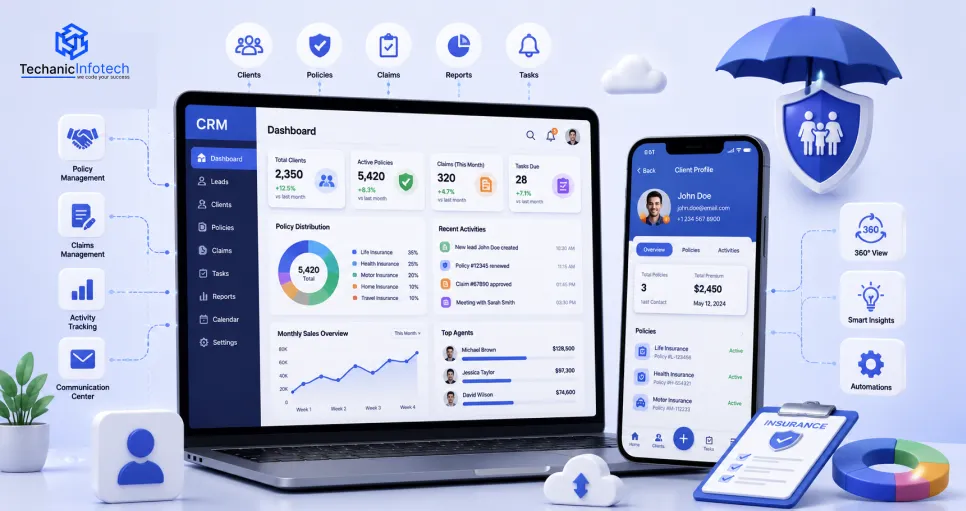
An effective insurance CRM software development solution should go beyond basic customer management by streamlining sales, policy administration, claims processing, and customer engagement. The right modules help insurance agencies, brokers, and enterprises improve operational efficiency while delivering exceptional customer experiences.
A robust CRM should capture leads from multiple channels, assign them to agents automatically, and track every interaction throughout the sales pipeline. Intelligent lead scoring and follow-up reminders help insurance teams convert prospects into long-term customers more efficiently.
Centralise customer profiles, policy details, communication history, and document records within a single dashboard. A well-designed custom insurance CRM software solution enables agents to quickly access client information, update policy details, and deliver personalised services.
Claims processing is one of the most critical functions in the insurance industry. The CRM should allow users to register claims, upload supporting documents, monitor claim status, and communicate with customers throughout the settlement process, reducing delays and improving transparency.
Automated notifications for policy renewals, premium due dates, and policy expirations help agencies reduce lapses and improve customer retention. Scheduled reminders ensure that both agents and policyholders stay informed without relying on manual follow-ups.
Insurance businesses manage large volumes of documents, including policy agreements, claim forms, invoices, identity proofs, and compliance records. A centralised document management system allows secure storage, quick retrieval, version control, and controlled access for authorised users.
Interactive dashboards provide real-time insights into sales performance, renewal rates, policy distribution, claims processing, agent productivity, and customer engagement. These analytics help management make informed business decisions and identify growth opportunities.
Modern CRM platforms increasingly leverage AI integration in mobile apps to automate customer interactions, predict policy renewal opportunities, recommend suitable insurance products, and provide AI-powered virtual assistants for faster customer support. These intelligent capabilities improve response times while enhancing the overall customer experience.
A modern insurance management software development solution should seamlessly integrate with payment gateways, accounting software, email platforms, SMS services, customer support tools, and regulatory systems. These integrations eliminate repetitive tasks and create a unified digital ecosystem for insurance operations.
The success of an insurance CRM depends on selecting technologies that provide scalability, security, and high performance. Since CRM platforms manage sensitive customer information, policy records, and financial data, the underlying technology stack should support seamless integrations, real-time processing, and long-term business growth.
|
Component |
Recommended Technologies |
|
Frontend |
React, Angular, Vue.js |
|
Backend |
Node.js, Python, Java, .NET |
|
Database |
PostgreSQL, MySQL, MongoDB |
|
Cloud Platform |
AWS, Microsoft Azure, Google Cloud |
|
Authentication |
OAuth 2.0, JWT, Multi-Factor Authentication (MFA) |
|
Storage |
Amazon S3, Azure Blob Storage |
|
Notifications |
Firebase Cloud Messaging (FCM), Twilio |
|
Analytics & BI |
Power BI, Google Analytics, Tableau |
|
API Integrations |
REST APIs, GraphQL, Payment Gateway APIs |
Cloud infrastructure enables insurance companies to securely store customer records, scale operations as demand grows, and maintain high system availability. Cloud-based CRM platforms also simplify disaster recovery, provide automated backups, and enable remote access for agents and administrators.
Insurance CRM systems handle confidential customer and financial information, making security a top priority. Features such as end-to-end encryption, role-based access control, secure APIs, audit logs, and multi-factor authentication help protect sensitive data while supporting regulatory compliance.
A modern CRM should integrate seamlessly with policy management systems, payment gateways, accounting software, customer support platforms, email services, and third-party APIs. A flexible architecture ensures future enhancements can be implemented without disrupting existing operations.
Building a secure and scalable CRM requires expertise in software architecture, cloud technologies, and enterprise integrations. Reviewing a comprehensive mobile app tech stack guide helps businesses choose the right frameworks and infrastructure for long-term success. Partnering with experienced full-stack development companies and a trusted insurance app development company can further simplify development, accelerate deployment, and ensure reliable post-launch support.
The insurance CRM software cost typically ranges from $10,000 to $100,000+, depending on the project's complexity, feature set, integrations, security requirements, cloud infrastructure, and customisation level. A basic CRM with customer and policy management requires a lower investment, while enterprise-grade platforms with advanced automation, analytics, and AI capabilities involve a higher development budget.
|
CRM Type |
Estimated Cost |
Development Timeline |
|
Basic Insurance CRM |
$10,000–$20,000 |
2–3 Months |
|
Standard Insurance CRM Platform |
$20,000–$45,000 |
3–5 Months |
|
Advanced Insurance Management CRM |
$45,000–$75,000 |
5–7 Months |
|
Enterprise Insurance CRM Solution |
$75,000–$100,000+ |
7–10 Months |
Before planning the project budget, businesses should evaluate the overall software development cost, particularly if the CRM will integrate with existing enterprise systems or additional digital platforms. Organisations can also estimate the mobile app development cost when planning companion mobile applications for agents and customers. For startups and growing agencies, custom software development for SMBs offers a practical approach to building scalable CRM solutions while optimising long-term development expenses.
A regional insurance agency faced challenges with managing customer information, tracking policy renewals, and following up with sales leads. Relying on spreadsheets and disconnected tools resulted in delayed responses, missed renewal opportunities, and inconsistent customer communication.
To modernise its operations, the agency first focused on how to build a minimum viable product by developing a CRM with essential features such as customer management, lead tracking, renewal reminders, and policy records. After validating the solution internally, advanced capabilities like automated workflows, analytics dashboards, claims tracking, and AI-powered customer engagement were introduced.
Within the first six months of deployment, the agency significantly improved lead response times, increased policy renewal rates, reduced manual administrative work, and enhanced customer satisfaction. The scalable CRM also enabled the business to support a growing client base without increasing operational complexity, demonstrating how a phased implementation strategy can deliver measurable business value.
Insurance CRM software has become an essential investment for agencies, brokers, and insurers looking to modernise operations and strengthen customer relationships. By centralising customer data, automating repetitive tasks, improving policy management, and providing actionable insights, a well-designed CRM helps businesses operate more efficiently while delivering a superior customer experience.
Whether you're building a new insurance CRM or upgrading an existing system, investing in scalable architecture, strong security, and user-focused functionality lays the foundation for long-term growth and operational success.
Insurance CRM software development is the process of creating customer relationship management software tailored for insurance agencies, brokers, and insurers to manage leads, policies, claims, renewals, and customer interactions.
Insurance CRM software development is the process of creating customer relationship management software tailored for insurance agencies, brokers, and insurers to manage leads, policies, claims, renewals, and customer interactions.
The Insurance CRM software cost generally ranges from $10,000 to $100,000+, depending on features, integrations, customisation, and project complexity.
The Insurance CRM software cost generally ranges from $10,000 to $100,000+, depending on features, integrations, customisation, and project complexity.
Essential features include lead management, customer profiles, policy management, claims tracking, renewal reminders, document management, reporting dashboards, and secure communication tools.
Essential features include lead management, customer profiles, policy management, claims tracking, renewal reminders, document management, reporting dashboards, and secure communication tools.
Development usually takes 2 to 10 months, depending on the software's complexity, required integrations, and level of customisation.
Development usually takes 2 to 10 months, depending on the software's complexity, required integrations, and level of customisation.
Yes. AI can automate customer support, identify sales opportunities, predict policy renewals, personalise recommendations, and improve operational efficiency.
Yes. AI can automate customer support, identify sales opportunities, predict policy renewals, personalise recommendations, and improve operational efficiency.
Cloud-based CRM solutions offer greater scalability, remote accessibility, automatic backups, and easier maintenance, making them a preferred choice for many modern insurance businesses.
Cloud-based CRM solutions offer greater scalability, remote accessibility, automatic backups, and easier maintenance, making them a preferred choice for many modern insurance businesses.
Yes. Modern CRM platforms can integrate with policy management software, payment gateways, accounting systems, email platforms, and other third-party business applications.
Yes. Modern CRM platforms can integrate with policy management software, payment gateways, accounting systems, email platforms, and other third-party business applications.
Insurance agencies, brokers, carriers, policy administrators, and enterprise insurance companies can all benefit from implementing a customised insurance CRM solution.
Insurance agencies, brokers, carriers, policy administrators, and enterprise insurance companies can all benefit from implementing a customised insurance CRM solution.


Abhishek Jangid is the CEO of Techanic Infotech, with extensive experience in mobile app and web development. He specializes in helping businesses turn innovative ideas into scalable digital solutions through strategic planning and modern technology.