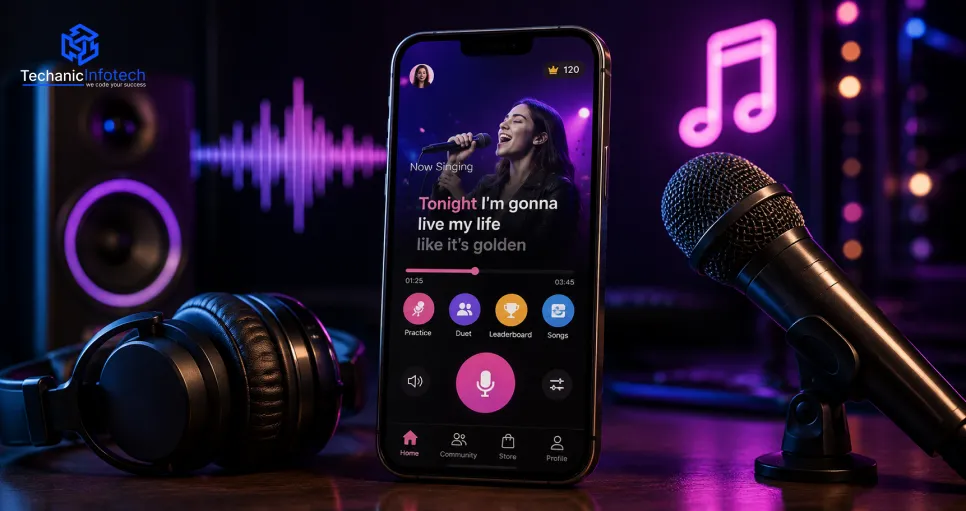
Music Streaming App Development
Karaoke App Development Cost: Features, Technology & Timeline
August 19, 2026
August 19, 2026
Key Takeaways
Karaoke app development cost can range from $8,000 to $80,000+, depending on complexity, features, and technology requirements.
Essential features include song libraries, synchronized lyrics, recording, audio effects, social sharing, and subscriptions.
AI can enhance karaoke apps through voice improvement, pitch analysis, recommendations, and performance scoring.
Development can take approximately 2–10+ months, depending on the application's scope.
Music licensing, audio/video infrastructure, and cloud storage should be considered separately from the initial development budget.
Subscription, freemium, advertising, in-app purchases, and creator monetization can provide multiple revenue streams.
Karaoke has evolved from a traditional entertainment activity into a digital experience powered by smartphones, streaming technology, social interaction, and artificial intelligence. Users can now discover songs, follow lyrics, record performances, apply audio effects, and share their recordings without needing specialized karaoke equipment.
For businesses, this creates opportunities to build karaoke platforms for casual users, music communities, entertainment venues, creators, or subscription-based audiences. A modern karaoke application can combine music libraries, real-time lyrics, recording tools, social features, subscriptions, and AI-powered enhancements in a single platform.
However, karaoke app development cost depends on much more than the number of screens. Audio streaming infrastructure, music licensing, recording functionality, real-time synchronization, third-party APIs, AI features, platform selection, and backend architecture can all influence the final investment.
This karaoke app development guide explains the major features, technology requirements, development process, timeline, pricing factors, monetization options, and challenges businesses should consider before launching a karaoke application.
The global karaoke app market was valued at USD 7.52 billion in 2025 and is projected to reach USD 8.29 billion in 2026, further increasing to USD 9.13 billion in 2027.
According to Global Growth Insights, over the projected revenue period from 2026 to 2035, the market will expand rapidly and reach USD 19.84 billion by 2035, registering a CAGR of 10.19%.
The U.S. karaoke app market is seeing consistent momentum driven by high digital engagement and evolving user preferences. Around 61% of karaoke app users in the United States access services via mobile apps, and 42% actively opt for premium-tier experiences offering advanced features.
The popularity of short-form video, music streaming, creator platforms, and social entertainment has created new opportunities for digital karaoke products. Users are no longer limited to singing at parties or dedicated karaoke venues; they can record and share performances directly from their smartphones.
Modern karaoke apps can combine singing with social networking. Users can follow performers, like recordings, comment on performances, participate in challenges, and share their content with friends.
Smartphones provide microphones, cameras, high-quality audio processing, and fast internet connectivity, making them suitable for interactive karaoke experiences. This allows businesses to offer karaoke without requiring users to purchase dedicated equipment.
Karaoke applications can become platforms for user-generated content. Users can record performances, create profiles, participate in competitions, and build audiences around their content.
Businesses can offer free basic access while charging for premium features such as unlimited recordings, advanced vocal effects, exclusive songs, ad-free listening, or enhanced recording quality.
Artificial intelligence can introduce features such as vocal enhancement, pitch analysis, personalized song recommendations, noise reduction, and automated performance feedback. Businesses exploring these capabilities may work with an AI development company to integrate appropriate AI models and APIs.
Karaoke apps can connect with music libraries, streaming services, social platforms, payment systems, and creator tools. Businesses with experience in music streaming app development can leverage similar technologies for song discovery, audio delivery, playlists, and user engagement.
Because karaoke is a widely recognized form of entertainment, businesses can design applications for specific languages, regions, genres, or audiences. Features such as localised song catalogues and multilingual lyrics can help create differentiated experiences.
The opportunity is strongest when a karaoke app offers more than a digital songbook. Combining music, social interaction, personalization, and creator-focused features can help businesses build a product users return to regularly.
The right karaoke app model depends on your target audience, content strategy, and monetization approach. Businesses can choose a focused model or combine several concepts into one platform.
Users can browse a song catalogue, search for tracks, view synchronized lyrics, and sing along in real time. Premium subscriptions can provide access to a larger catalogue and advanced features.
This model combines karaoke with social networking. Users can create profiles, follow singers, upload performances, like and comment on recordings, and participate in singing challenges.
AI can analyze vocals, improve sound quality, reduce background noise, detect pitch, and provide performance feedback. Personalized song recommendations can also help users discover tracks suited to their voice or preferences.
A recording-focused application allows users to select a song, record vocals or video, apply effects, and save or share their performances. This model can be simpler than a full social karaoke platform.
Businesses can create applications for restaurants, clubs, hotels, parties, and karaoke venues. Users can browse available songs, join a queue, request tracks, and interact with venue systems through the app.
This model can focus on family-friendly songs, simple interfaces, parental controls, animated lyrics, and educational or entertainment content.
A specialized platform can allow creators or celebrities to release exclusive karaoke tracks, host challenges, or interact with fans through performances and live sessions.
Choosing the right model early helps determine the application's feature set, infrastructure, content requirements, and overall karaoke app development cost.
A successful karaoke platform needs features that make singing, recording, discovering music, and sharing performances simple. The exact functionality will depend on the app model and target audience.
|
Feature |
Purpose |
|
User Registration & Profiles |
Allows users to create accounts and personalize their experience. |
|
Music Library |
Provides searchable karaoke tracks and categories. |
|
Synchronized Lyrics |
Displays lyrics in time with the music. |
|
Audio & Video Recording |
Lets users record their performances. |
|
Vocal Effects |
Adds effects such as reverb, echo, and voice enhancement. |
|
Pitch Detection |
Helps analyze singing accuracy and performance. |
|
AI Voice Enhancement |
Improves vocal clarity and reduces background noise. |
|
Song Recommendations |
Suggests tracks based on user preferences and activity. |
|
Duet & Collaboration |
Allows multiple users to perform together. |
|
Social Feed |
Enables users to discover and interact with performances. |
|
Likes, Comments & Shares |
Encourages community engagement. |
|
Challenges & Leaderboards |
Creates competition and increases retention. |
|
Subscriptions & Payments |
Supports premium plans and paid features. |
|
Push Notifications |
Alerts users about challenges, followers, and new content. |
|
Admin Dashboard |
Manages users, songs, content, subscriptions, and reports. |
The technology stack determines how efficiently a karaoke application can handle audio streaming app development, real-time lyrics, recording, social features, AI processing, and growing user traffic. The final stack should be selected according to the app's feature set and scalability requirements.
|
Technology Layer |
Recommended Technologies |
Estimated Cost Contribution |
|
Mobile Development |
Flutter, React Native, Swift, Kotlin |
$3,000–$15,000 |
|
UI/UX Design |
Figma, Adobe XD |
$1,000–$5,000 |
|
Backend |
Node.js, Python, Laravel |
$3,000–$12,000 |
|
Database |
PostgreSQL, MySQL, MongoDB |
$1,000–$5,000 |
|
Audio Streaming |
AWS Media Services, CloudFront, FFmpeg |
$2,000–$8,000 |
|
AI/ML |
Python, TensorFlow, OpenAI APIs |
$2,000–$10,000+ |
|
Cloud Infrastructure |
AWS, Google Cloud, Azure |
$1,000–$6,000+ |
|
Real-Time Communication |
WebSockets, WebRTC |
$1,500–$7,000 |
|
Analytics & Notifications |
Firebase, Mixpanel |
$500–$3,000 |
A structured development process helps turn a karaoke app concept into a stable product while keeping the scope, budget, and timeline under control.
Identify the target audience, competitors, preferred music genres, monetization model, and core problem the application will solve. This stage also helps determine whether you need a social, streaming, recording, or AI-focused karaoke platform.
Create a detailed list of essential features such as song search, synchronized lyrics, recording, audio effects, profiles, social sharing, subscriptions, and an admin panel. Prioritize the MVP features before adding advanced functionality.
Design wireframes, user flows, prototypes, and final interfaces. The experience should make it easy to discover a song, start singing, record a performance, and share it with minimal steps.
Develop the backend infrastructure for user accounts, music catalogues, recordings, subscriptions, social interactions, notifications, and third-party integrations.
Develop the iOS and Android applications using the selected technology stack. A mobile app development company can use native or cross-platform technologies depending on performance and feature requirements.
Implement streaming, recording, audio processing, lyrics synchronization, vocal effects, and AI-powered functionality where required. Music licensing and content rights should also be addressed before commercial launch.
Test audio and video performance, lyric synchronization, recording quality, payments, account security, device compatibility, and application performance under different network conditions.
Prepare the application for App Store and Google Play release, configure cloud infrastructure, implement analytics and monitoring, and complete the final production setup.
After launch, monitor crashes, user feedback, streaming performance, and engagement. Regular updates can introduce new songs, features, security improvements, and performance enhancements.
A phased approach allows businesses to build a karaoke app with essential functionality first and expand the platform based on user demand and performance data.
The development timeline depends on the number of platforms, feature complexity, integrations, audio/video requirements, and AI functionality. A simple karaoke application can be launched relatively quickly, while a feature-rich social platform requires considerably more time.
|
Development Stage |
Basic App |
Mid-Level App |
Advanced App |
|
Planning & Research |
1–2 weeks |
2–3 weeks |
3–4 weeks |
|
UI/UX Design |
2–3 weeks |
3–4 weeks |
4–6 weeks |
|
Backend Development |
3–4 weeks |
4–7 weeks |
7–10 weeks |
|
Mobile App Development |
4–6 weeks |
6–10 weeks |
10–16 weeks |
|
Audio/Video Integration |
1–2 weeks |
2–4 weeks |
4–6 weeks |
|
AI & Advanced Features |
1–2 weeks |
2–4 weeks |
4–8 weeks |
|
Testing & QA |
2–3 weeks |
3–5 weeks |
5–7 weeks |
|
Deployment |
1 week |
1–2 weeks |
2–3 weeks |
|
Overall Timeline |
2–3 months |
3–5 months |
5–8+ months |
For businesses working with a karaoke software development company, defining the MVP before development begins can help prevent unnecessary scope expansion and keep the project closer to its planned timeline.
The karaoke app development cost typically ranges from $8,000 to $80,000+, depending on the app's complexity, number of platforms, audio/video capabilities, music licensing, AI features, integrations, and development team.
|
App Category |
Estimated Cost |
Development Timeline |
Typical Features |
|
Basic Karaoke App |
$8,000–$18,000 |
2–3 months |
Song library, lyrics, basic recording, profiles |
|
Standard Karaoke App |
$18,000–$35,000 |
3–5 months |
Audio effects, playlists, sharing, notifications, subscriptions |
|
Advanced Karaoke App |
$35,000–$55,000 |
5–7 months |
AI features, video recording, social feed, duets, advanced audio processing |
|
Premium Karaoke Platform |
$55,000–$80,000+ |
7–10+ months |
Live singing, AI voice analysis, advanced social features, analytics, scalable infrastructure |
The final cost of a karaoke application depends on several technical and business decisions. Two apps with similar concepts can have very different budgets because of differences in functionality, infrastructure, and content requirements.
|
Cost Factor |
Impact on Development Cost |
|
Number of Platforms |
Supporting both iOS and Android increases development and testing requirements. |
|
App Complexity |
Advanced workflows, social features, and real-time functionality require more development effort. |
|
Audio & Video Processing |
Recording, mixing, effects, compression, and playback add technical complexity. |
|
Music Licensing |
Commercial song catalogues may require licensing agreements and recurring fees. |
|
AI Integration |
Voice analysis, pitch detection, recommendations, and enhancement increase development and API costs. |
|
Real-Time Features |
Live singing, duets, and collaboration require specialized infrastructure. |
|
Backend Infrastructure |
Large audio/video files require additional storage, bandwidth, processing, and CDN resources. |
|
Third-Party APIs |
Payment, authentication, analytics, music, and communication APIs may involve implementation and usage fees. |
|
UI/UX Design |
Custom interfaces, animations, and interactive experiences require additional design effort. |
|
Security & Moderation |
User-generated content requires authentication, reporting, moderation, and security mechanisms. |
|
Maintenance |
OS updates, bug fixes, server management, and new features create ongoing costs. |
A karaoke app can generate revenue through multiple models. The best approach depends on the target audience, content strategy, and features offered.
Subscriptions provide recurring revenue and can offer access to premium song catalogues, unlimited recordings, advanced effects, AI tools, and exclusive content.
A free version can attract users while premium features encourage upgrades. This approach allows users to experience the core product before making a purchase.
Advertising can work well for applications with a large free user base. Businesses should ensure advertisements do not interrupt the core singing experience.
Social karaoke platforms can introduce virtual gifts, fan subscriptions, paid challenges, or premium creator content. This can create additional revenue while encouraging creators to remain active on the platform.
A karaoke platform can also offer specialized solutions to restaurants, clubs, hotels, event organisers, and karaoke venues. These businesses may pay for queue management, song requests, audience interaction, or branded experiences.
Karaoke applications involve unique technical and business challenges because they combine music content, audio processing, user-generated content, and often real-time social features.
|
Challenge |
Why It Matters |
How to Address It |
|
Music Licensing |
Commercial songs require appropriate usage and distribution rights. |
Secure licenses before offering copyrighted content. |
|
Audio Quality |
Poor sound quality can negatively affect the user experience. |
Use reliable audio processing, compression, and streaming technologies. |
|
Lyrics Synchronization |
Incorrect timing can make singing difficult. |
Use accurately timed lyric data and test synchronization thoroughly. |
|
High Storage & Bandwidth |
User recordings can consume significant resources. |
Use scalable cloud storage and content delivery networks. |
|
AI Accuracy |
Incorrect pitch or voice analysis can reduce user trust. |
Test models with diverse voices and continuously improve performance. |
|
User-Generated Content |
Recordings may contain inappropriate or copyrighted material. |
Implement reporting, moderation, content policies, and automated detection where appropriate. |
|
Real-Time Performance |
Live singing and duets require low-latency communication. |
Use suitable real-time protocols and scalable infrastructure. |
|
User Retention |
Users may lose interest after initial experimentation. |
Introduce challenges, social features, recommendations, and fresh content. |
|
Platform Compatibility |
Audio behaviour can differ across devices and operating systems. |
Conduct extensive device and platform testing. |
Karaoke apps have evolved into interactive entertainment platforms that combine music streaming, synchronized lyrics, recording, social engagement, and AI-powered experiences. For businesses, this creates opportunities to build differentiated products for consumers, creators, entertainment venues, and music communities.
The overall development investment can range from $8,000 to $80,000+, depending on the required features, platforms, audio/video capabilities, integrations, and infrastructure. Businesses should also account for music licensing, cloud usage, maintenance, and other ongoing expenses.
Starting with a focused MVP, validating user demand, and gradually introducing advanced features can help control the initial investment while creating a scalable karaoke platform.
A karaoke app can cost around $8,000–$80,000+, depending on its features and complexity.
A basic app may take 2–3 months, while advanced platforms can take 7–10+ months.
Song search, synchronized lyrics, recording, audio effects, profiles, sharing, and subscriptions are common features.
Yes. AI can support pitch detection, voice enhancement, noise reduction, and personalized song recommendations.
Yes. Commercial songs generally require appropriate licensing and usage rights.
Yes. Subscriptions, advertising, in-app purchases, premium songs, and creator monetization are common options.
Yes. Duet and real-time collaboration features can allow multiple users to perform together.
Common technologies include Flutter, React Native, Swift, Kotlin, Node.js, Python, AWS, FFmpeg, and WebRTC, depending on the required features.


Abhishek Jangid is the CEO of Techanic Infotech, with extensive experience in mobile app and web development. He specializes in helping businesses turn innovative ideas into scalable digital solutions through strategic planning and modern technology.