Job Portal App Development
How Much Does It Cost to Build a Professional Networking App Like LinkedIn?
August 15, 2026
August 15, 2026
Key Takeaways:
A LinkedIn-like application combines professional profiles, networking, content, messaging, recruitment, and community functionality.
A focused MVP can launch with essential networking features before advanced recruitment, AI, analytics, and premium capabilities are introduced.
The estimated LinkedIn clone app development cost can range from $10,000 to $90,000+, depending on complexity, integrations, platform scope, and infrastructure.
AI, advanced search, recruitment workflows, real-time messaging, security, and large-scale infrastructure are among the biggest cost drivers.
Post-launch expenses such as cloud infrastructure, moderation, third-party APIs, security, AI usage, and maintenance should be included in the long-term budget.
Professional networking has evolved far beyond exchanging business cards or maintaining a static online profile. Today, professionals expect digital platforms where they can build their identities, discover career opportunities, connect with industry peers, share knowledge, and communicate with businesses from a single application.
LinkedIn has become a leading example of this model by combining professional profiles, networking, content publishing, job discovery, messaging, recruiting, and business services into one ecosystem. Its success has encouraged entrepreneurs and businesses to explore professional networking app development for niche industries, regional communities, specialised professions, and new business models.
However, the cost to build an app like LinkedIn depends on much more than the number of screens or features. User profiles, networking algorithms, content systems, messaging, job functionality, subscriptions, search, AI capabilities, security, cloud infrastructure, and third-party integrations can all influence the final investment.
Whether you're planning to build a networking app like LinkedIn for a specific industry or create a broader professional community, understanding the product scope and development requirements is essential before setting a realistic budget.
This networking app development guide explains the features, technology, development process, pricing levels, monetisation strategies, and ongoing costs involved in creating a LinkedIn-like professional networking platform.
The professional networking market continues to expand as professionals, recruiters, employers, and businesses increasingly use digital platforms for career discovery, hiring, knowledge sharing, and business relationships.
Growth is heavily driven by mobile-first workforces, AI matchmaking integrations, and small-to-medium enterprises.
According to Mordor Intelligence, LinkedIn Premium subscriptions passed USD 2 billion in 2025, equal to roughly 12% of total revenue, with around 40% of premium users engaging at least one AI-powered feature.
According to ValueMarketResearch, a survey conducted by LinkedIn, 70% of employers use social media to screen candidates, underscoring the importance of a strong online profile.
LinkedIn is more than a social platform. Its value comes from connecting professional identities, relationships, content, career opportunities, and business activities within one ecosystem. A successful LinkedIn-like product should therefore be designed around the professional journey rather than simply copying conventional social media functionality.
Users need more than a username and profile picture. A professional profile can include work experience, education, skills, certifications, portfolio information, achievements, and career interests. This creates a digital professional identity that can be discovered by recruiters, businesses, and other members.
The networking layer allows users to connect with colleagues, industry professionals, recruiters, mentors, and potential business partners. Connection suggestions can be based on shared industries, skills, education, location, mutual connections, or professional interests.
Professional networks become more valuable when members can publish posts, articles, industry insights, videos, or other useful content. A strong content system can encourage knowledge sharing while giving businesses opportunities to build authority within their professional communities.
Job discovery can become an important part of the platform by connecting professional profiles with relevant employment opportunities. This is where job portal app development functionality can complement the networking experience, allowing users to discover jobs without leaving the professional ecosystem.
Employers and recruiters require different tools from individual professionals. Business profiles, job publishing, candidate search, application management, recruiter messaging, and analytics can turn the application into a broader professional marketplace.
As the platform grows, personalisation becomes increasingly important. AI can analyse user interests, professional activity, connections, and engagement patterns to recommend relevant people, content, jobs, and opportunities.
Businesses working with an AI development company can gradually introduce these capabilities as the platform accumulates enough relevant data.
A professional networking platform needs features that support the complete user journey, from creating a professional identity and making connections to discovering jobs, sharing expertise, and communicating with businesses.
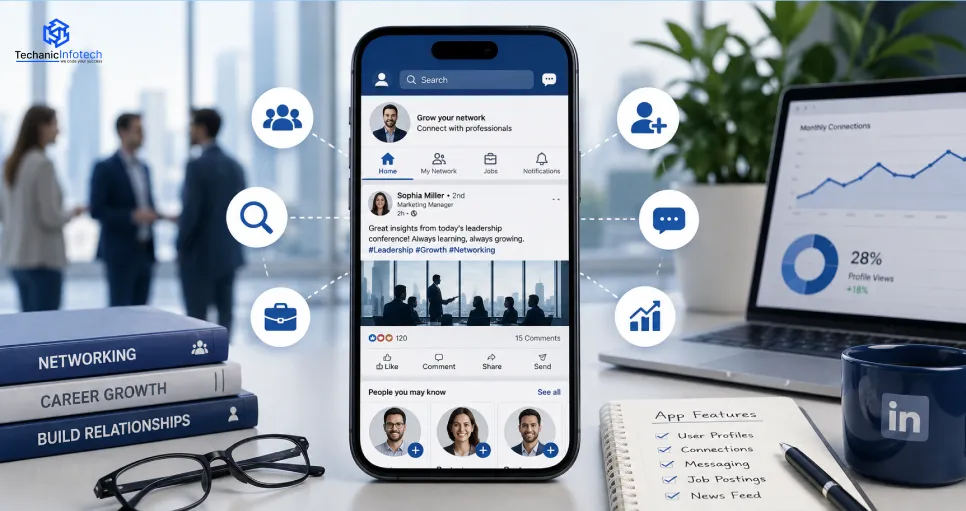
Users should be able to create detailed profiles containing their work experience, education, skills, certifications, portfolio, accomplishments, and professional interests. Profile customisation can also include profile visibility settings, verification badges, resumes, and links to external portfolios or professional websites.
The core networking experience should allow users to send and accept connection requests, follow professionals, discover relevant people, and manage their professional network.
A recommendation engine can suggest connections based on industry, skills, location, education, mutual connections, and shared interests.
Users should be able to publish posts, articles, images, videos, polls, and professional updates. Reactions, comments, shares, bookmarks, and hashtags can encourage meaningful engagement. A well-designed content system can transform the platform from a simple contact directory into an active professional community.
Advanced search allows users to find professionals, companies, jobs, services, and content using filters such as skills, industry, experience, location, education, and professional interests.
Private messaging enables users to communicate with connections, recruiters, employers, and potential business partners. Push notifications can alert users about new messages, connection requests, profile views, job opportunities, and content interactions.
A LinkedIn-like platform can include job search, job posting, applications, recruiter dashboards, candidate profiles, and application tracking.
Businesses may integrate this functionality with a job portal app development company when building a platform that combines professional networking with a dedicated recruitment ecosystem.
Industry-specific groups allow professionals to discuss trends, exchange knowledge, ask questions, and build relationships around shared interests.
These capabilities can also be expanded through community app development to create specialised professional communities with their own moderation and engagement tools.
Paid memberships can unlock advanced search, profile insights, recruiter tools, increased messaging capabilities, exclusive content, learning resources, and other premium services.
Users and businesses can access analytics such as profile views, content performance, connection growth, engagement, job applications, and recruiter activity. Advanced analytics can help users understand which professional activities are generating the greatest results.
A LinkedIn-like application can become extremely feature-rich, but launching every capability at once can increase development time and budget unnecessarily. A better approach is to identify the functionality required for the first release and introduce advanced capabilities after validating the product.
|
Essential Features |
Advanced Features |
|
Professional profiles |
AI-powered networking recommendations |
|
Connection requests |
Intelligent job matching |
|
News feed |
AI-generated profile optimization |
|
Content publishing |
Personalized content feeds |
|
Search & filters |
Predictive career insights |
|
Messaging |
AI-powered networking assistant |
|
Job listings |
Advanced recruiter intelligence |
|
Basic notifications |
Automated lead and candidate recommendations |
|
Groups & communities |
Premium analytics and behavioral insights |
|
Admin dashboard |
Advanced moderation and fraud detection |
The MVP should focus on the activities that define the platform: creating a professional profile, discovering people, sending connections, publishing content, searching, messaging, and managing basic job opportunities. This provides enough functionality to test whether users actually find value in the professional network.
If hiring is part of the business model, job posting, candidate profiles, applications, and employer tools can be introduced as the platform matures. Businesses already working with job portal app development solutions can also reuse recruitment workflows and integrations when expanding the networking platform.
Features such as AI-powered recommendations, intelligent matching, content personalisation, and career predictions require more sophisticated data processing and ongoing optimisation.
Adding them after the core product is stable can help businesses control the initial budget while giving the platform room to become more intelligent over time.
Every additional feature influences backend complexity, testing, infrastructure, security, and maintenance. Organisations can therefore use custom software development to build only the functionality that supports their specific networking model instead of paying for features that may not be relevant to their audience.
Building a professional networking platform requires more than developing profiles and messaging. The application needs a clear product strategy, scalable architecture, reliable networking functionality, and a roadmap for future recruitment, community, and AI capabilities.
Start by identifying exactly who the platform will serve. It could target professionals in a specific industry, entrepreneurs, students, freelancers, recruiters, or a broader professional audience. A focused audience makes it easier to define the right features, content strategy, and monetisation model.
Decide how the platform will generate revenue before development begins. Possible models include premium memberships, recruiter subscriptions, sponsored listings, advertising, job-posting fees, and business accounts. The business model directly influences which features should be prioritised in the first version.
Map the primary workflows for professionals, recruiters, businesses, and administrators.
Typical user journeys may include:
Account registration and profile creation
Professional discovery and connection
Content publishing and engagement
Job search and applications
Messaging and notifications
Premium subscription management
Clear user journeys help designers and developers build a more intuitive platform.
Create wireframes and prototypes for profiles, feeds, search, messaging, job listings, groups, recruiter dashboards, and administration tools.
The design should remain simple and professional because users may interact with the platform frequently throughout their careers.
Build the essential functionality first rather than attempting to replicate every feature of LinkedIn.
The MVP can include:
Professional profiles
Connection management
News feed
Content publishing
Search
Messaging
Basic job listings
Notifications
Admin controls
Launching a focused MVP reduces initial risk and provides real user feedback before advanced functionality is introduced.
Once the core networking experience is stable, businesses can add employer dashboards, candidate management, job applications, professional groups, communities, and premium features. This is where job portal app development functionality can complement the networking platform and create a broader professional ecosystem.
Advanced platforms can introduce AI-powered recommendations for people, jobs, content, and professional opportunities. AI can also support profile optimisation, recruiter assistance, intelligent search, and personalised feeds. Businesses may work with an AI development company when implementing more specialised recommendation or matching systems.
Professional networking platforms manage large amounts of personal and career information, making security a major priority. Testing should cover authentication, privacy controls, messaging, content moderation, payments, API security, performance, and compatibility across supported devices.
After deployment, monitor user activity, connection growth, content engagement, job applications, retention, and system performance. Analytics can reveal which features are creating value and which parts of the user journey require improvement.
As adoption grows, the platform may require improved database capacity, cloud infrastructure, search performance, content delivery, moderation systems, and analytics.
The technology stack determines how efficiently a professional networking platform can handle profiles, connections, content, messaging, search, job listings, notifications, and analytics. Since a LinkedIn-style application can grow to support large communities and high volumes of real-time activity, the architecture should be selected with scalability and long-term maintenance in mind.
|
Technology Layer |
Recommended Technologies |
Estimated Implementation Cost |
|
Mobile Application |
Flutter, React Native, Swift, Kotlin |
$6,000–$15,000 |
|
Web Application |
React.js, Next.js, Angular |
$5,000–$12,000 |
|
Backend & APIs |
Node.js, Python, Java, .NET |
$7,000–$18,000 |
|
Database |
PostgreSQL, MongoDB, Redis |
$2,000–$6,000 |
|
Cloud Infrastructure |
AWS, Microsoft Azure, Google Cloud |
$2,000–$7,000 |
|
Search & Discovery |
Elasticsearch, OpenSearch |
$2,000–$5,000 |
|
Real-Time Messaging |
WebSockets, Socket.IO, Firebase |
$2,000–$5,000 |
|
Notifications |
Firebase Cloud Messaging, OneSignal, Twilio |
$500–$2,000 |
|
AI & Recommendations |
Python, OpenAI APIs, ML models |
$3,000–$12,000+ |
|
Analytics |
Firebase Analytics, Google Analytics, Power BI |
$1,000–$3,000 |
|
Payments & Subscriptions |
Stripe, PayPal, Razorpay |
$1,000–$3,000 |
|
Security & Authentication |
OAuth 2.0, JWT, MFA, encryption |
$1,500–$5,000 |
These are estimated development and implementation contributions, not fixed vendor or API prices. Cloud hosting, AI usage, SMS, payment processing, storage, and other third-party services may create separate recurring expenses.
Businesses should also evaluate the mobile app development company they partner with based on architecture quality, security practices, scalability, integration expertise, and long-term maintenance rather than selecting a technology stack only because it is popular.
The LinkedIn clone app development cost depends on the number of user roles, networking features, content functionality, recruitment tools, integrations, AI capabilities, supported platforms, and infrastructure requirements.
A simple professional networking MVP requires far less investment than a large-scale platform combining social networking, recruitment, content publishing, communities, messaging, analytics, and AI-powered personalisation.
A practical development range for most professional networking projects is $10,000–$90,000+.
|
Platform Level |
What It Includes |
Estimated Cost |
Development Timeline |
|
Basic Networking MVP |
Profiles, connections, basic feed, search, messaging, notifications |
$10,000–$20,000 |
2–3 months |
|
Mid-Range Networking App |
Advanced profiles, content publishing, groups, job listings, subscriptions, analytics |
$20,000–$40,000 |
3–5 months |
|
Advanced LinkedIn-Like Platform |
Recruiter tools, advanced search, recommendations, communities, premium features, integrations |
$40,000–$65,000 |
5–7 months |
|
Enterprise Professional Network |
Large-scale infrastructure, AI personalization, advanced recruitment, analytics, multiple platforms, enterprise security |
$65,000–$90,000+ |
7–10+ months |
The cost of building a professional networking platform is influenced by more than the number of features. The complexity of the workflows, integrations, data processing, security, and expected user scale can have a much greater impact on the final investment.
A platform serving only professionals is simpler than one supporting professionals, recruiters, employers, administrators, advertisers, and premium members. Each additional user type may require separate dashboards, permissions, workflows, and testing.
Basic connection requests are relatively straightforward. Advanced networking requires recommendation engines that analyse skills, industries, locations, mutual connections, interests, and user activity. The complexity increases further when AI is introduced for personalised recommendations.
A professional social network may need posts, articles, videos, polls, comments, reactions, sharing, bookmarks, moderation, and personalised feeds. High-volume content systems also require efficient storage, caching, search, and content-delivery infrastructure.
Adding job listings, applications, recruiter dashboards, candidate search, employer profiles, interview workflows, and application tracking creates a second major product layer.
Businesses combining professional networking with job portal app development should budget for these additional workflows separately rather than treating recruitment as a minor extension.
Searching millions of professionals, companies, jobs, and posts requires specialised indexing and filtering infrastructure. Advanced filters such as skills, experience, location, industry, education, and job preferences can increase backend complexity.
One-to-one messaging is relatively simple compared with a platform supporting group conversations, media sharing, typing indicators, read receipts, presence, notifications, and real-time synchronisation across multiple devices.
AI-powered features can include intelligent job matching, connection recommendations, profile optimisation, content ranking, career insights, and automated recruiter assistance.
These capabilities can increase both development and ongoing operating expenses because they may require model integration, data processing, monitoring, and API usage.
Professional networking platforms store personal, employment, education, and communication data. Strong authentication, access controls, encryption, moderation, privacy settings, and security testing are therefore important cost considerations.
Supporting iOS, Android, web, and administration portals requires more development and testing than launching on a single platform. Businesses should decide early whether they need native applications, cross-platform development, or a staged rollout.
Integrating CRM, HR systems, recruitment tools, payment gateways, email services, analytics platforms, identity providers, and other third-party systems can significantly increase development effort.
Organisations often work with a mobile app development company when they need these integrations combined into one scalable application architecture.
The initial development budget is only one part of the total investment required to operate a professional networking platform. Once the application launches, businesses need to budget for infrastructure, third-party services, security, content, and continuous product improvements.
As the number of users, profiles, posts, images, videos, messages, and documents increases, cloud usage also grows. Businesses may need additional database capacity, media storage, bandwidth, caching, and monitoring.
Professional networking platforms often rely on external services for email, SMS, push notifications, payments, analytics, authentication, video, search, and other functionality. These services may charge based on users, requests, messages, or overall usage.
AI-powered recommendations, job matching, content personalisation, profile analysis, and intelligent assistants can create recurring model or API expenses after launch. As usage grows, AI infrastructure can become an important part of the operating budget.
Security is an ongoing responsibility rather than a one-time development task. Businesses should budget for vulnerability testing, security updates, monitoring, access-control improvements, and privacy enhancements as the platform evolves.
A professional network with user-generated content requires moderation policies and operational processes. Depending on the platform, businesses may need human moderators, automated moderation tools, content review systems, and abuse-prevention mechanisms.
Operating systems, browsers, APIs, cloud services, and third-party integrations change over time. Regular maintenance keeps the platform compatible, stable, and secure. Businesses should also plan for new features based on user feedback and market changes.
A platform may initially launch as a mobile application and later expand into a web experience, employer portal, recruiter dashboard, or additional mobile applications.
When planning this expansion, businesses should evaluate the mobile app development cost separately from the initial product investment.
Continuous monitoring, performance optimisation, technical support, bug fixes, and feature development are essential for a platform expected to operate for years.
Building a professional networking platform like LinkedIn requires a clear understanding of the audience, business model, technology requirements, and long-term product strategy. The goal should not be to reproduce every feature of an established platform immediately, but to create a differentiated experience that solves a specific professional networking problem.
Starting with a well-defined MVP allows businesses to validate their concept, understand user behaviour, and prioritise future investments based on real demand. With scalable architecture and a carefully planned roadmap, the platform can gradually expand into recruitment, communities, AI-powered personalisation, premium services, and enterprise functionality.
The estimated cost to build an app like LinkedIn is approximately $10,000–$90,000+, depending on the features, user roles, integrations, platforms, AI capabilities, and scalability requirements.
Core features include professional profiles, connection management, search, content publishing, messaging, notifications, job listings, groups, analytics, and premium memberships.
A basic MVP can take around 2–3 months, while an advanced or enterprise networking platform may require 7–10 months or longer.
Yes. AI can support professional recommendations, job matching, content personalisation, profile optimisation, recruiter assistance, and intelligent search.
Yes. A professional networking platform can integrate job discovery, job posting, applications, recruiter dashboards, and candidate management.
Common monetisation methods include premium memberships, recruiter subscriptions, paid job listings, advertising, business accounts, professional services, and educational offerings.
Yes. An MVP helps validate the networking concept, gather user feedback, and determine which advanced capabilities deserve further investment.
Yes. A scalable architecture can support professionals, recruiters, employers, administrators, advertisers, and premium members with role-specific features and permissions.


Bharat Sharma is the CTO of Techanic Infotech, bringing deep technical expertise in software architecture, mobile app development, and scalable system design. He leads the engineering team with a strong focus on innovation, performance, and security.