Key Takeaways
Community apps help businesses build stronger relationships with users by creating a dedicated platform where members can interact, share ideas, and collaborate outside traditional social media platforms.
Key features such as user profiles, discussion forums, messaging, content sharing, and push notifications are essential for encouraging engagement and maintaining active communities.
Advanced technologies like AI recommendations, live streaming, gamification, and analytics can significantly enhance user experience and increase participation within the community platform.
Community app development costs vary widely depending on the complexity of features, technology stack, integrations, and design requirements, typically ranging from $10,000 to $90,000+.
The development timeline generally takes 3–6 months, including planning, UI/UX design, development, testing, deployment, and post-launch maintenance.
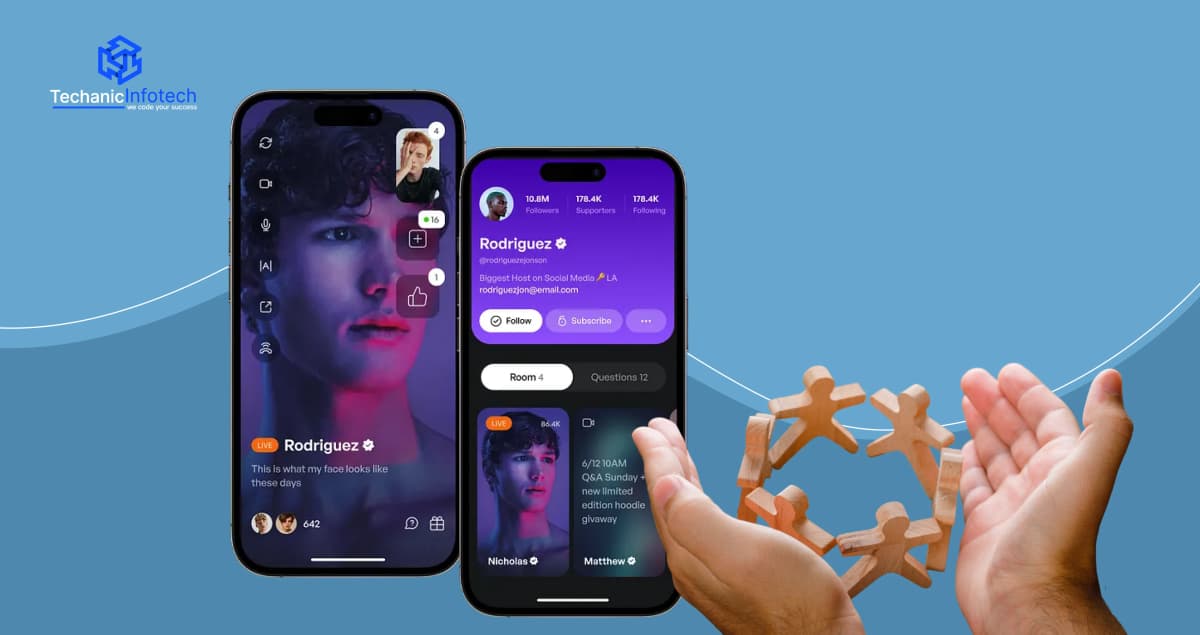
Community apps are becoming essential tools for businesses, brands, creators, and organizations that want to build strong relationships with their audiences.
These apps provide a dedicated digital space where users can interact, share ideas, ask questions, and collaborate with like-minded people.
Unlike traditional social platforms, community apps offer greater control over content, user engagement, and branding.
Businesses use these apps to strengthen customer loyalty, provide support, gather feedback, and promote products or services in a more personalized environment.
With features such as messaging, discussion forums, content sharing, and event management, community apps help create meaningful connections.
Community apps help businesses create direct connections with their audiences, strengthen brand loyalty, encourage engagement, and build a dedicated space where users interact, collaborate, and share experiences.
Community apps allow brands to interact with users directly through discussions, posts, and comments.
This constant interaction keeps users engaged, builds trust, and creates a sense of belonging around the brand’s ecosystem.
When users feel connected to a brand through a dedicated community platform, they become more loyal.
Regular interactions, exclusive content, and meaningful discussions strengthen relationships and encourage long-term engagement.
Businesses can communicate announcements, updates, promotions, and support messages directly to their audience without relying heavily on third-party platforms or algorithms controlling content visibility.
Community platforms provide a space where users share opinions, ideas, and experiences.
Businesses can collect valuable feedback, understand user preferences, and improve their products or services based on real insights.
Community members can help each other solve problems by sharing solutions and experiences.
This reduces the pressure on customer support teams while improving user satisfaction and faster issue resolution.
Active community members often become brand advocates who promote the brand organically.
Their recommendations, reviews, and shared experiences help attract new users and build credibility.
A successful community app by a reliable mobile app development company requires essential features.
Considering those features helpful in encouraging engagement, communication, and collaboration while providing users with a smooth, secure, and enjoyable experience.
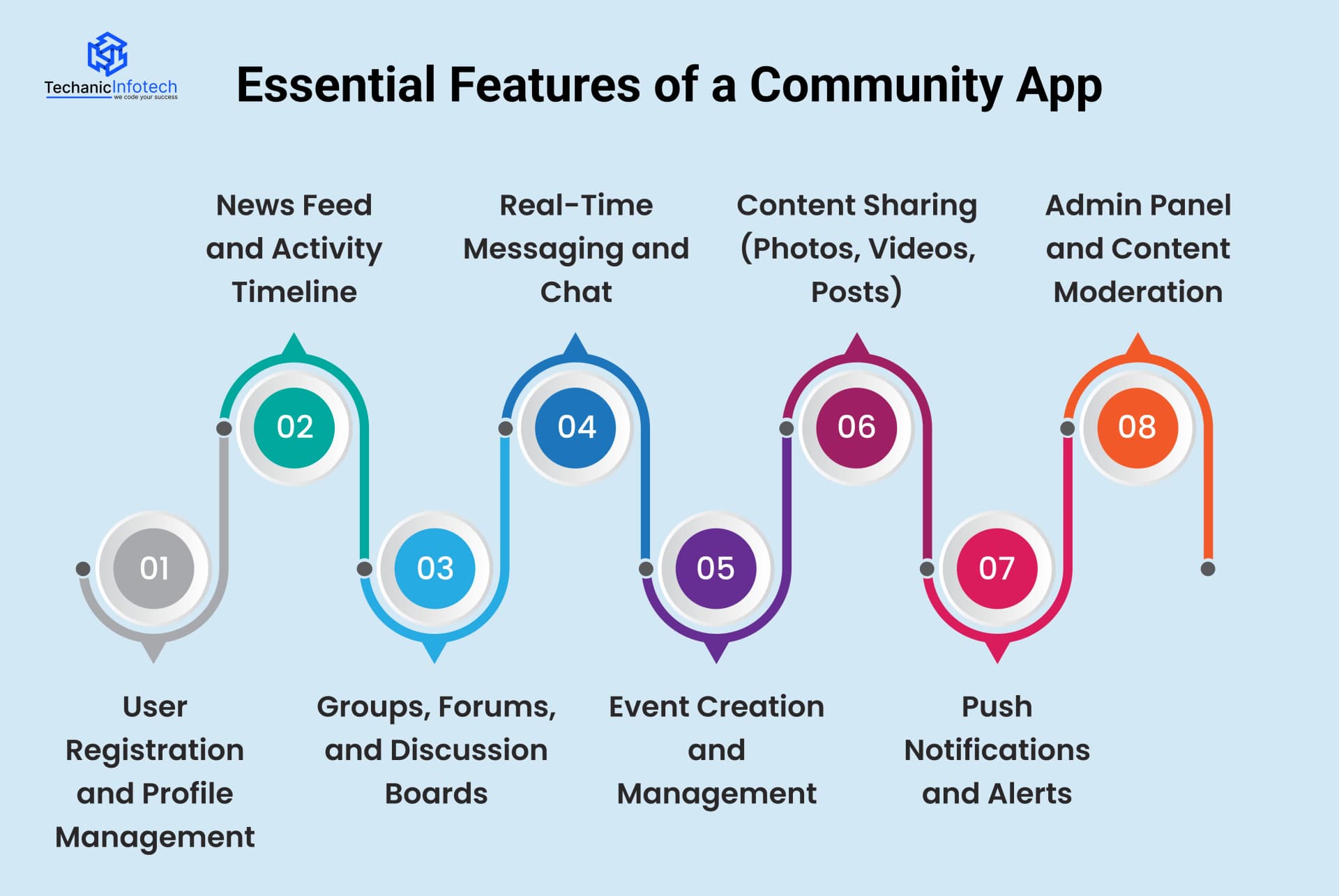
User registration enables new members to quickly create accounts using email addresses, phone numbers, or social media logins.
A well-designed registration process should be simple, secure, and user-friendly to encourage more people to join the platform.
Profile management allows users to personalize their accounts by adding profile pictures, updating personal details, listing interests, and managing privacy settings.
The news feed serves as the central hub of the community platform where users can view the latest updates, posts, discussions, and activities from other members.
An engaging activity timeline keeps users informed about trending topics, recent contributions, and community interactions.
Groups, forums, and discussion boards allow members to organize conversations around specific topics, interests, or goals.
These spaces encourage meaningful discussions where users can ask questions, share knowledge, exchange ideas, and collaborate with others who have similar interests.
Real-time messaging allows community members to communicate instantly through private chats or group conversations.
This feature enhances interaction by enabling users to quickly exchange ideas, ask questions, or build relationships with other members.
Event management features allow administrators or community members to organize and promote online or offline events such as webinars, meetups, workshops, networking sessions, or conferences.
Users can discover upcoming events, register to participate, and receive reminders.
This functionality encourages deeper engagement by bringing community members together for learning, collaboration, and real-world interaction beyond regular online discussions.
Content sharing enables users to create and publish various forms of media, including text posts, images, videos, articles, and links.
This feature empowers community members to express ideas, showcase creativity, share experiences, and contribute valuable knowledge.
Push notifications and alerts keep users informed about important activities happening within the community.
These notifications may include new messages, comments, replies, event reminders, announcements, or updates from followed groups.
A powerful admin panel provides administrators with the tools needed to effectively manage the community platform.
Administrators can monitor user activity, manage member accounts, moderate discussions, remove inappropriate content, and enforce community guidelines.
Modern community apps integrate advanced technologies to enhance user engagement, personalize experiences, and provide powerful tools for interaction, analytics, and content discovery.
The following are the step-by-step guides that one should consider to make the mobile app development process smoother.
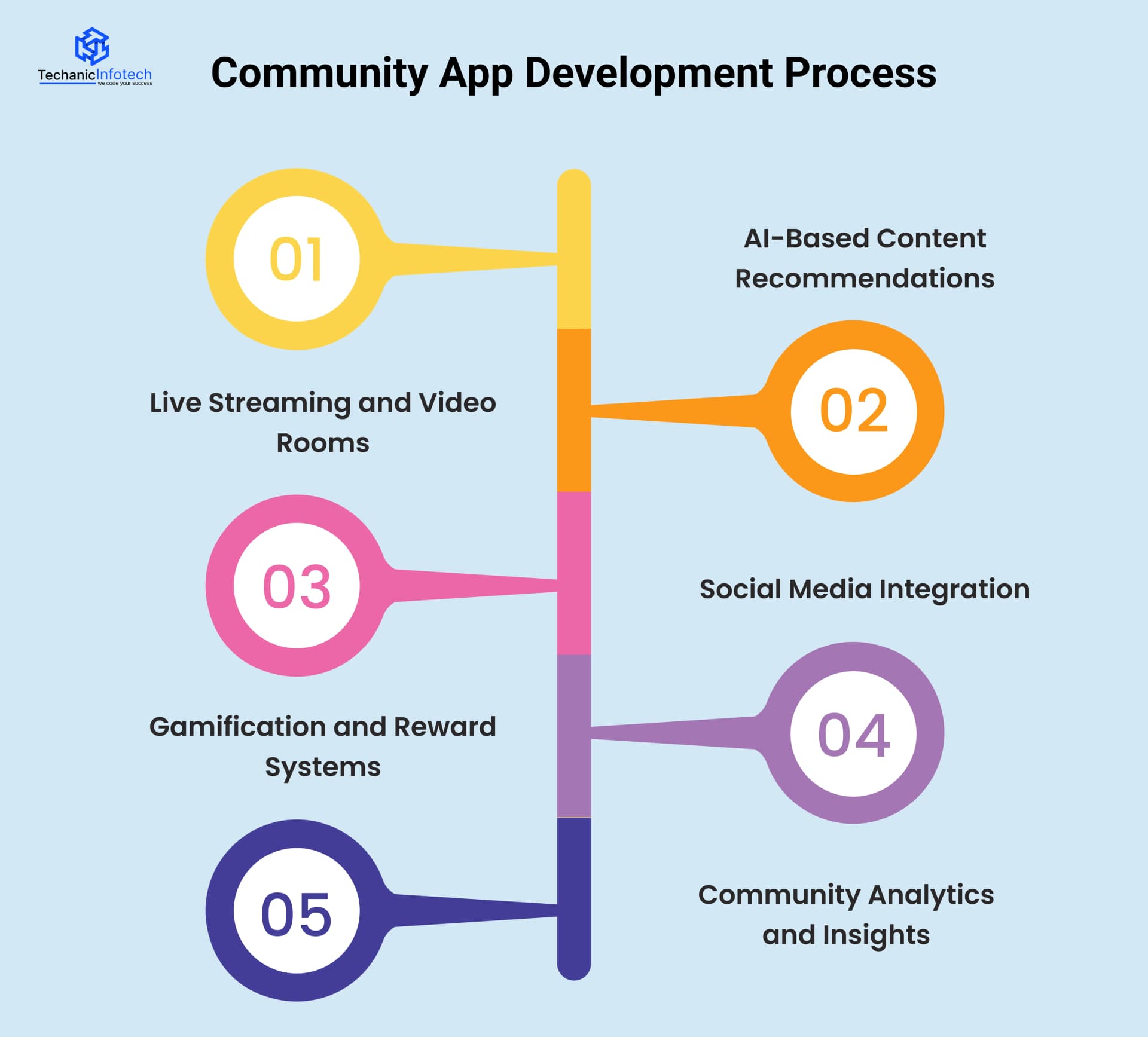
Artificial intelligence analyzes user behavior and interests to recommend relevant posts, discussions, or groups, helping users discover content they are most likely to engage with.
Live streaming allows creators, brands, or moderators to host live sessions, webinars, or Q&A events where community members can participate and interact in real time.
Integrating social media platforms allows users to share community content externally, sign in using social accounts, and invite friends to join the platform easily.
Gamification features like badges, leaderboards, and reward points motivate users to participate actively, contribute content, and stay engaged with the community.
Analytics tools help administrators track engagement metrics such as active users, popular discussions, content performance, and user growth to improve community strategies.
Choosing the right mobile app tech stack plays a crucial role in building scalable, secure, and high-performance community apps that support real-time interaction and large user bases.
Frontend technologies such as React, Flutter, and Angular help developers create responsive and interactive user interfaces that work smoothly across different devices and platforms.
Backend frameworks like Node.js, Django, and Laravel manage server operations, APIs, authentication systems, and data processing required for community interactions.
Databases such as MongoDB, PostgreSQL, and MySQL store user profiles, posts, messages, and other data while ensuring fast access and secure storage.
Cloud platforms like AWS, Google Cloud, and Microsoft Azure provide scalable infrastructure, storage, and server management for handling large community traffic.
APIs enable additional functionalities such as payment gateways, social logins, analytics tools, and notification services to enhance the app’s capabilities.
Mobile app development costs vary depending on features, complexity, technology stack, development team location, and platform requirements such as Android, iOS, or web.
The following table shows the complete cost breakdown of developing the community applications.
|
Level |
Features (Key Points) |
Cost Estimation |
|
Basic Community App |
• User profiles • Posts and content sharing • Discussion forums • Basic community interaction |
$10,000 – $25,000 |
|
Medium Complexity App |
• Messaging system • Event management • Push notifications • Multimedia sharing |
$25,000 – $60,000 |
|
Advanced Community Platform |
• AI-powered features • Live streaming • Analytics dashboards • Gamification systems |
$60,000 – $90,000+ |
|
Design & UI/UX Customization |
• Professional UI/UX design • Custom layouts & branding • Improved usability • Enhanced user engagement |
Varies depending on customization |
|
Third-Party Integrations |
• Payment gateway integration • Analytics tools integration • Social media connectivity • External API integrations |
Varies based on the services integrated |
|
Maintenance & Updates |
• Bug fixes and security patches • Feature updates • Server and hosting management • Performance monitoring |
Ongoing cost (monthly/yearly) |
The development time depends on the complexity of features, design requirements, development team size, and testing phases.
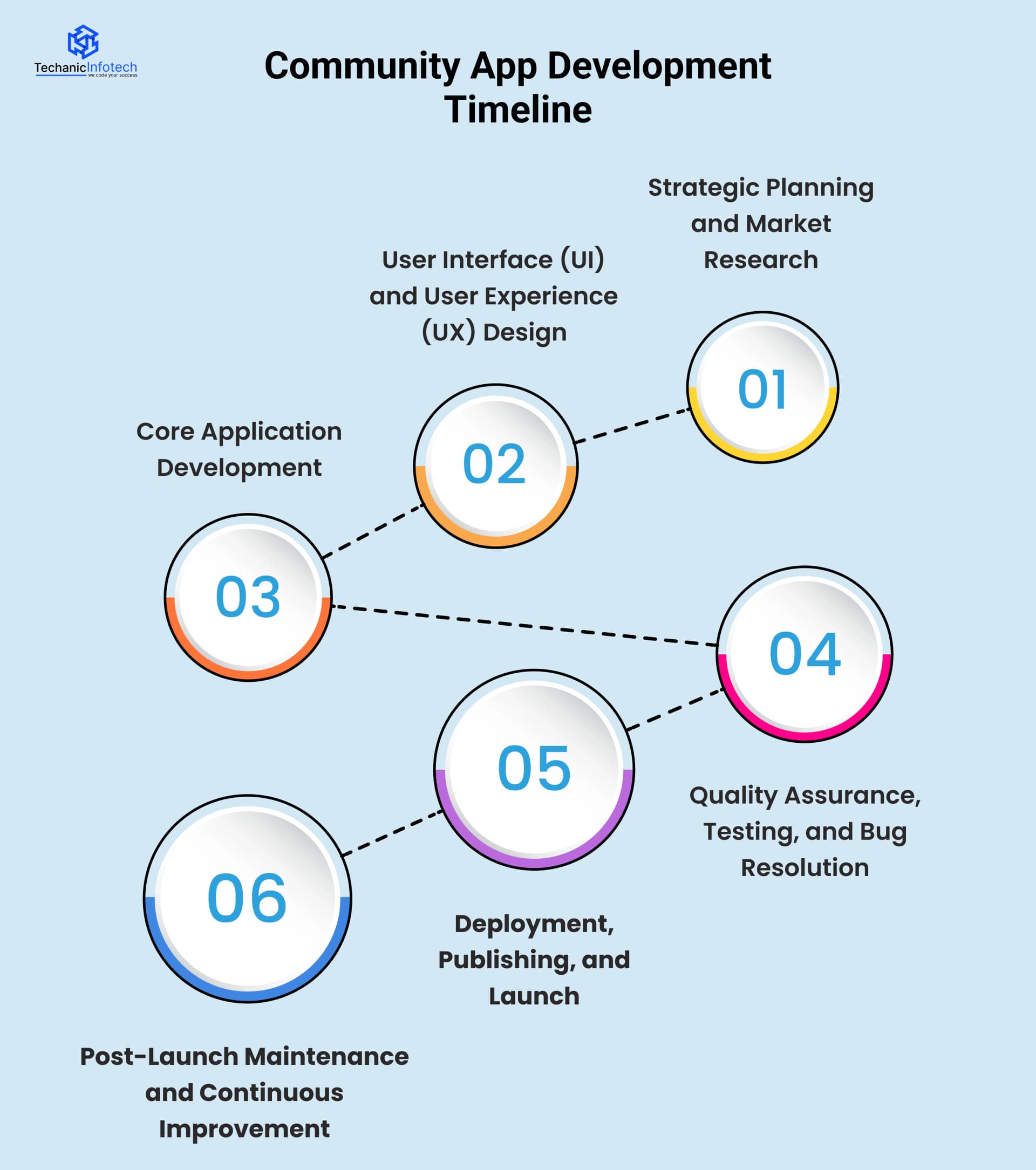
This initial phase generally takes two to three weeks and focuses on conducting comprehensive market analysis, evaluating competitors, identifying target audiences, defining user personas, and outlining a clear product roadmap and minimum viable product development strategy.
The design stage typically requires three to four weeks. During this phase, designers create wireframes, interactive prototypes, visual design systems, and user journey maps to ensure the application is both visually appealing and highly user-friendly.
The main mobile app development timeline takes two to four months. This includes frontend development, backend architecture, database integration, API implementation, and feature development, depending on the complexity and scalability requirements of the platform.
This stage usually lasts two to three weeks and involves functional testing, performance testing, usability testing, and security checks to identify bugs, optimize performance, and ensure the application delivers a stable and seamless user experience.
Launching the application may take one to two weeks. This step includes final optimizations, server configuration, app store submission, compliance checks, and live deployment on platforms such as web servers or mobile app stores.
After the release, the development team focuses on monitoring performance, fixing emerging issues, improving security, and introducing new mobile app features or updates based on user feedback, analytics insights, and evolving community needs.
Developing a community app comes with several challenges related to user engagement, content moderation, scalability, and maintaining a safe and active digital environment.
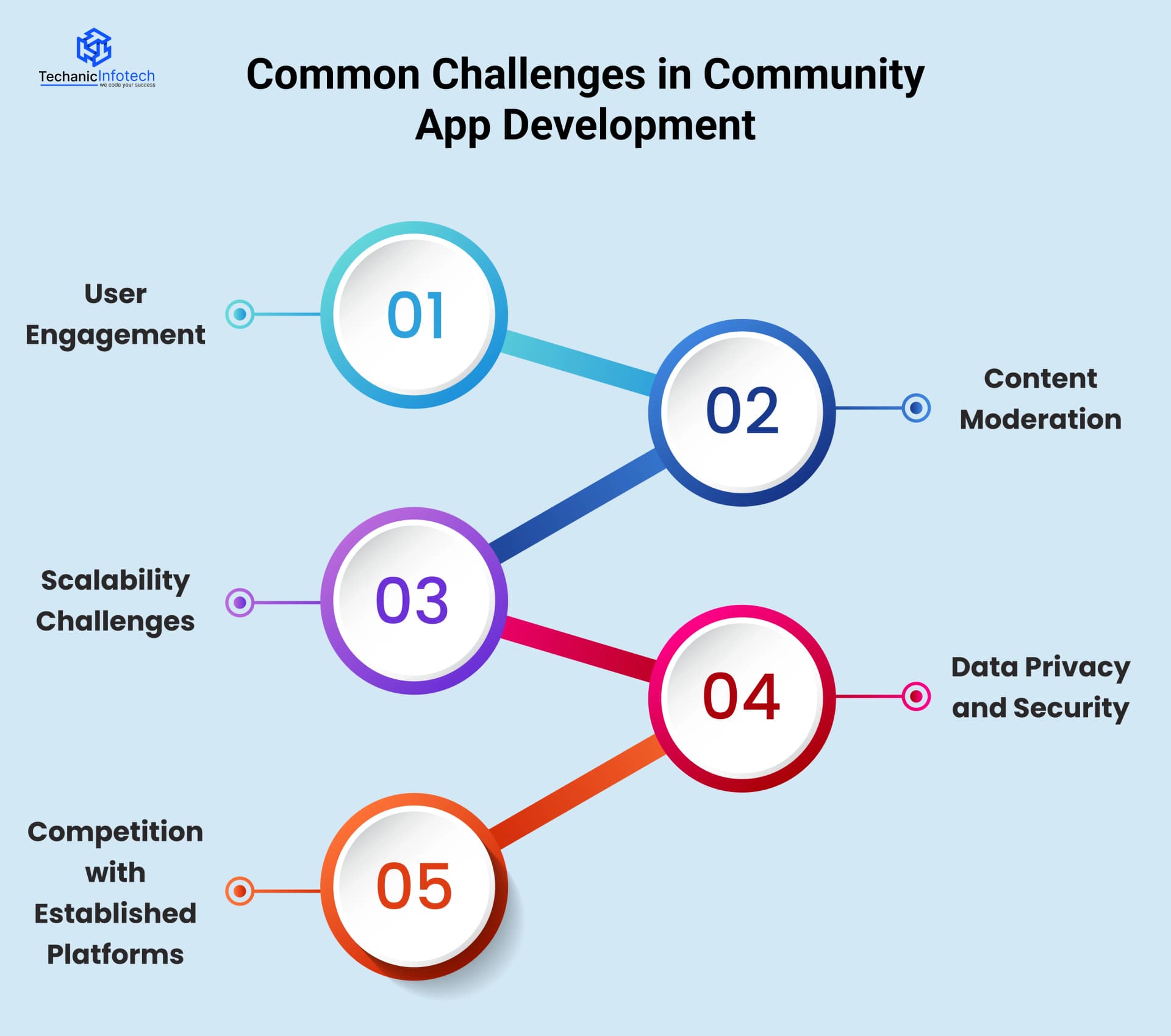
Maintaining consistent user engagement is one of the biggest challenges for community applications.
Developers must integrate interactive features such as discussion forums, live events, reward systems, and personalized notifications.
Regular content updates and meaningful user interactions help keep the community active and encourage long-term participation.
Ensuring a safe and respectful environment requires strong content moderation systems.
Community apps must effectively detect and manage spam, misinformation, inappropriate content, and abusive behavior.
This can be achieved through automated moderation tools, AI filtering, reporting systems, and clearly defined community guidelines.
As the platform grows and attracts more users, the application must handle higher volumes of traffic, data processing, and real-time interactions.
Scalable infrastructure, cloud services, load balancing, and efficient backend architecture are essential to mobile app maintenance, smooth performance, and avoiding system slowdowns.
Protecting user information is critical for building trust and credibility.
Community apps must implement strong authentication mechanisms, end-to-end encryption, secure APIs, and compliance with data protection regulations.
Regular security audits and vulnerability checks are also necessary to prevent breaches.
Community apps often compete with large and well-established social media platforms.
To succeed, developers must provide unique value, specialized communities, niche content, or innovative features that differentiate the platform and attract a dedicated user base.
Community apps are powerful platforms that help businesses, brands, and organizations build stronger relationships with their audiences.
By offering a dedicated space for discussions, content sharing, and collaboration, these apps create meaningful engagement beyond traditional social media platforms.
Developing a successful community app requires careful planning, selecting the right features, implementing modern technologies, and focusing on user experience.
From user registration and messaging to advanced features like AI recommendations and analytics, each element plays an important role in creating a vibrant digital community.
A community app is a digital platform that allows users to interact, share content, participate in discussions, and connect with others who share similar interests or goals.
Community app development usually takes three to six months, depending on the complexity of features, design requirements, testing phases, and the size of the development team.
Essential features include user registration, discussion forums, messaging, content sharing, notifications, event management, and an admin panel for managing users and moderating content.
Yes, community apps can generate revenue through subscriptions, advertisements, premium memberships, event tickets, sponsored content, and partnerships.
Industries such as education, fitness, gaming, technology, e-commerce, and professional networking commonly use community apps to engage users and build loyal communities.


Bharat Sharma is the CTO of Techanic Infotech, bringing deep technical expertise in software architecture, mobile app development, and scalable system design. He leads the engineering team with a strong focus on innovation, performance, and security.