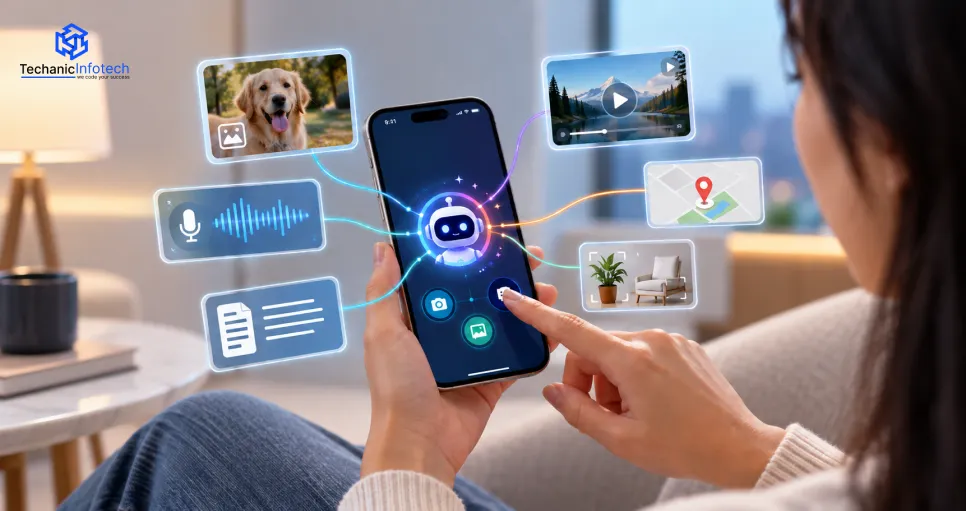
Mobile apps have traditionally handled one type of input at a time. Users type a search query, upload an image, speak into a microphone, or tap through menus to tell the application what they need.
Multimodal AI changes that experience.
It allows an application to understand different forms of information together, including text, images, voice, video, documents, and contextual data. A user can show an app something through the camera, explain what they need through voice, and receive a response that considers both inputs.
This creates opportunities for mobile experiences that feel more natural and require fewer steps.
For businesses, multimodal AI is not simply another feature to add to an app. It can change how customers search, shop, learn, travel, communicate, and complete everyday tasks.
Companies planning these experiences need to connect AI models with mobile interfaces, cameras, microphones, backend systems, APIs, databases, and privacy controls. Professional mobile app development services can help businesses build these capabilities into a reliable product rather than adding disconnected AI tools later.
Multimodal AI refers to artificial intelligence systems that can process and understand more than one type of information.
A conventional language model may primarily work with text. A computer vision system may analyze images. A speech recognition system may process voice.
Multimodal AI can bring these capabilities together.
For example, a customer could photograph a damaged appliance and ask:
What appears to be wrong with this part?
The application can analyze the photograph while also understanding the user's question.
A shopper could upload an image of a sofa and ask for similar products within a particular budget.
A traveler could point the camera at a landmark and ask for information about it.
The value comes from understanding the relationship between different forms of input instead of processing each one separately.
Building applications around these capabilities can involve computer vision, natural language processing, machine learning, speech recognition, and generative AI. Techanic Infotech provides AI development services for businesses that want to combine these technologies with practical mobile and software products.
Smartphones already contain many of the tools needed for multimodal interaction.
They have cameras, microphones, touchscreens, location services, sensors, and access to application data when users provide permission.
The missing layer has often been the ability to understand these inputs together.
Multimodal AI provides that layer.
This is particularly useful because many real world situations are difficult to explain through a search box.
A user may see a product but not know its name. Someone may need help understanding a document. A traveler may see an unfamiliar sign. A student may want an explanation of a diagram.
In these situations, showing the app can be easier than describing the problem.
Voice can make the interaction even more natural. Instead of capturing an image and then navigating through several filters, users can explain what they want while the AI analyzes what they are showing.
The biggest change is not simply that apps can process more data. Multimodal AI gives users new ways to communicate with software.
Traditional mobile search starts with words.
Visual search can start with an image.
A user can photograph an object or upload an existing picture, and AI can analyze its visual characteristics to find relevant information.
Consider someone who sees a piece of furniture they like but does not know how to describe it.
Instead of searching for several combinations of keywords, the user can photograph the furniture and ask the app to find similar products.
The AI can examine shape, material, style, and other visual characteristics before returning suitable results.
Visual search can be useful in retail, fashion, home decor, automotive, travel, real estate, and marketplace apps.
Voice assistants are already common on smartphones, but multimodal AI gives voice more context.
Users can refer directly to something shown through the camera.
Someone using a home maintenance app could point toward an appliance and ask what type of service may be required.
A cooking application could examine available ingredients while the user asks what meals can be prepared.
A retail employee could photograph a shelf and ask which products appear to need attention.
The user does not have to explain every visual detail because the application can see part of the context itself.
Mobile cameras have traditionally been used to capture photos, scan codes, and upload documents.
With multimodal AI, the camera can become an active part of the application interface.
An educational app might analyze a diagram while the student asks a question about it.
A field service app could identify equipment and retrieve relevant maintenance information.
A travel app could provide information about something currently visible through the camera.
This can reduce the gap between what the user sees in the physical world and what the application understands.
Mobile apps frequently ask users to upload invoices, receipts, forms, identity documents, reports, and other files.
Multimodal AI can help applications understand the combination of text, layout, tables, images, and other visual information contained in those documents.
An expense app could extract purchase details from a receipt.
An insurance application could organize information from claim documents.
A business app could summarize a long report and allow users to ask questions about it.
This can reduce manual data entry and make document heavy workflows easier to complete from a phone.
Not every business needs multimodal functionality. It works best where customers naturally deal with images, documents, voice, video, or their physical surroundings.
Multimodal AI can make product discovery much easier in ecommerce applications.
A shopper could upload a photograph of an item and search for visually similar products. They could then use conversational input to narrow the results according to size, price, color, material, or availability.
The same experience can combine product recommendations, visual search, conversational shopping, and personalized suggestions.
Businesses planning these experiences can work with an experienced ecommerce development company to connect AI capabilities with product catalogs, inventory, payments, customer accounts, and the wider shopping experience.
Healthcare apps often involve a mixture of text, documents, images, voice, and structured patient information.
Multimodal systems can help organize uploaded documents, support information discovery, assist with administrative workflows, and make some patient interactions easier.
For example, a user may upload a supported healthcare document and ask the app to explain where specific information appears.
These applications require careful privacy, security, and human oversight. AI should support appropriate workflows rather than replace qualified medical judgment.
Techanic Infotech provides healthcare app development services for healthcare providers, startups, clinics, pharmacies, and wellness businesses that need secure digital products with modern AI capabilities.
Learning rarely happens through text alone.
Students work with diagrams, equations, images, handwriting, audio, video, and spoken explanations.
Multimodal AI can bring these forms of information into the same learning experience.
A student might photograph a mathematics question and ask for an explanation. A language learning app could analyze pronunciation while showing the related written text. A science app could explain an object or diagram captured through the camera.
Businesses developing learning platforms can integrate these capabilities through education app development services, creating products that support more interactive and personalized learning experiences.
Travel creates natural opportunities for multimodal interaction because users constantly encounter unfamiliar places, signs, menus, landmarks, maps, and languages.
A traveler could point a camera at a landmark and ask what it is.
An application could recognize a location, provide useful information, and combine that context with the user's itinerary.
Visual understanding could also work with translation, recommendations, booking information, and navigation.
For travel businesses, professional travel app development services can combine AI with booking systems, location services, payments, APIs, recommendations, and itinerary management.
Fitness apps can combine video, images, movement information, voice, and activity data.
A user could position the camera during an exercise while the application analyzes movement and provides relevant guidance.
Voice interaction can make the experience easier because users may not want to repeatedly touch the device during a workout.
The app could also combine workout activity with user goals and historical information to personalize future recommendations.
Businesses building digital fitness products can use fitness app development services to create applications with AI coaching, wearable integration, workout management, activity tracking, and intelligent personalization.
Many mobile apps force users to translate what they want into the structure of the interface.
They select categories, enter keywords, open filters, upload information, and move through several screens before reaching a result.
Multimodal AI can sometimes shorten that journey.
A shopper could show the app a product and describe the preferred price range.
A user could upload a document and ask for a specific piece of information instead of reading the entire file.
A traveler could point the camera at something unfamiliar and ask about it.
A user seeking support could show the problem rather than trying to describe it accurately.
The advantage is not that the app contains more artificial intelligence.
The advantage is that users can complete tasks with less effort.
A multimodal feature that appears simple on screen can require several systems behind it.
The application may need to capture image or voice input, process the information securely, send relevant data to an AI model, retrieve information from the backend, and return the response without introducing noticeable delays.
Depending on the product, the architecture may include:
Computer vision
Speech processing
Large language models
Application APIs
Cloud infrastructure
Databases and business systems
Some processing may happen directly on the mobile device while more demanding AI tasks may use cloud infrastructure.
The right approach depends on response speed, privacy requirements, device capability, operating cost, and model size.
For a broader view of how AI technologies fit into the mobile development process, businesses can also explore Techanic Infotech's guide to AI mobile app development.
A multimodal AI model may accept several types of input, but that does not mean users should be forced to use all of them.
A good app gives people options.
Someone who prefers typing should not be required to use voice.
A user who does not want camera access should still be able to use unrelated application features.
The interface should also make it clear when the microphone or camera is active and what information the system is processing.
Multimodal AI works best when it simplifies an existing task.
If it introduces additional steps or confusion, the feature is not improving the product regardless of how advanced the underlying model may be.
Camera, voice, documents, and location information can be more sensitive than ordinary application interactions.
That makes data handling an important part of product planning.
Businesses should know what information is captured, whether it is stored, where it is processed, and which systems can access it.
Users should also understand why permissions are being requested.
An app should not ask for camera, microphone, or location access simply because those capabilities might be useful later.
The feature should have a clear reason.
The development team also needs to consider external AI providers. If images, recordings, or documents are sent to third party models, businesses need to understand how that information is processed and protected.
There is a temptation to add the latest AI capability simply because users may find it impressive.
That usually creates unnecessary complexity.
A banking app does not need visual AI for a basic balance check.
A delivery application does not need voice interaction for every order.
A productivity tool does not need image understanding when all of its information is already structured.
The technology is useful when another form of input genuinely makes an important task easier.
A good product team should therefore begin with the user problem and then determine whether multimodal AI provides a better way to solve it.
Techanic Infotech's AI app development guide provides a broader look at AI feature selection, architecture, development planning, and implementation for businesses evaluating intelligent applications.
Building a multimodal mobile application requires more than connecting an app to an AI model.
The AI layer must work with the mobile interface, backend systems, databases, APIs, permissions, cloud infrastructure, and existing business logic.
Techanic Infotech can help businesses develop new multimodal mobile products or introduce these capabilities into existing applications.
Depending on the use case, implementation may include visual search, camera based assistance, voice interaction, document understanding, conversational AI, computer vision, recommendation systems, or personalized experiences.
The development approach should match the product.
An ecommerce app may need visual product discovery.
An education app may need image and voice understanding.
A field service product may benefit from camera based assistance.
A travel platform may combine visual recognition with location and booking information.
The purpose is not to use as many AI technologies as possible. It is to select the combination that makes the mobile product more useful.
Multimodal AI is changing mobile apps because it allows software to work with information in a way that is closer to how people naturally communicate.
People do not experience the world only through text. They look at objects, speak, listen, read documents, watch movement, and use their surroundings to explain what they need.
Smartphones already capture many of these signals.
Multimodal AI gives applications a way to understand them together.
For businesses, the opportunity is to identify where voice, images, documents, or visual context can remove friction from the user journey.
The strongest multimodal apps will not be the ones that use every available AI capability. They will be the ones that use the right capability at the right moment to help users complete something more easily.
Multimodal AI allows a mobile application to process and connect multiple types of information such as text, images, voice, video, documents, and contextual data.
Common examples include visual search, voice and image interaction, camera based assistance, document understanding, conversational interfaces, and AI systems that analyze several types of user input together.
Ecommerce, healthcare, education, travel, fitness, retail, real estate, field services, and other industries where users regularly interact with visual, voice, or document based information can benefit.
Yes. Existing apps can add capabilities such as visual search, document analysis, voice interaction, and camera based AI through model integration, APIs, backend updates, and interface changes.
The main challenges include model accuracy, processing speed, data privacy, mobile performance, infrastructure costs, permissions, integration complexity, and creating an interface that remains easy to use.
Yes. Techanic Infotech can build multimodal mobile apps and integrate capabilities such as computer vision, voice processing, conversational AI, intelligent search, document understanding, and personalized recommendations based on the product requirements.


Bharat Sharma is the CTO of Techanic Infotech, bringing deep technical expertise in software architecture, mobile app development, and scalable system design. He leads the engineering team with a strong focus on innovation, performance, and security.