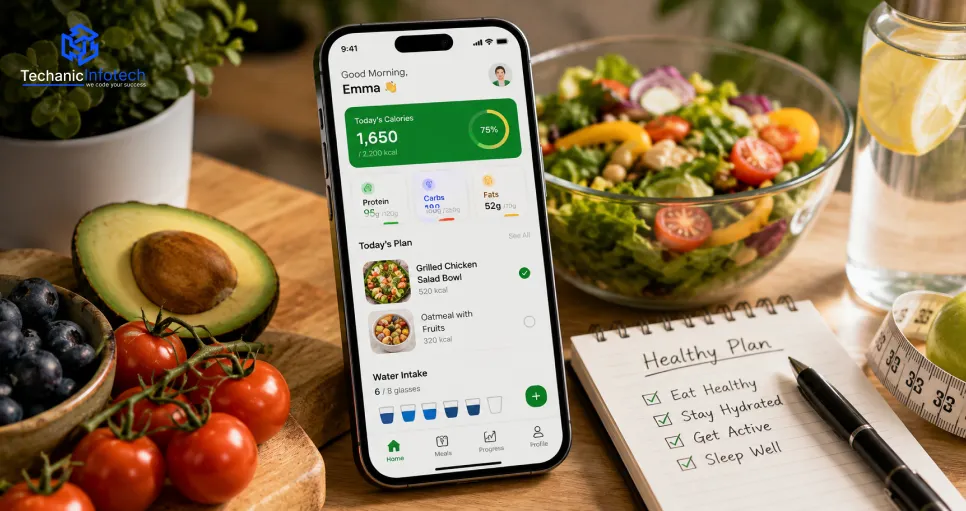
Fitness App Development
Nutrition App Development: Features, Cost, Technology & Development Process
August 18, 2026
August 18, 2026
Key Takeaways
Nutrition apps can support meal tracking, personalized diet planning, professional consultations, and digital wellness.
Essential features include food databases, meal logging, nutrition tracking, personalized recommendations, progress dashboards, and notifications.
AI can enhance personalization, food recognition, meal recommendations, and nutrition insights when implemented responsibly.
A nutrition app can cost approximately $8,000 to $70,000+, depending on complexity, features, integrations, and technology requirements.
Data accuracy, privacy, security, API integrations, and user engagement should be considered from the beginning.
Starting with an MVP allows businesses to validate the concept before investing in advanced functionality.
Nutrition has become an important part of the digital wellness ecosystem as people increasingly use mobile applications to monitor meals, track nutrients, plan diets, and build healthier eating habits. From calorie tracking and personalized meal plans to food databases and progress monitoring, nutrition apps make it easier for users to manage their daily dietary goals from one place.
For businesses, this growing demand creates opportunities to develop applications for nutritionists, dietitians, fitness platforms, healthcare providers, wellness brands, and consumers. A well-designed platform can connect users with nutrition professionals while also providing personalized recommendations, meal planning, progress tracking, and educational content.
However, successful nutrition app development requires more than adding a calorie counter and food database. Businesses need to consider user experience, data accuracy, privacy, personalization, integrations, scalability, and the appropriate technology stack.
This nutrition app development guide explores the major features, benefits, development process, technology requirements, challenges, and costs involved in creating a modern nutrition application.
The global diet and nutrition apps market is valued at approximately USD 2.1 billion to USD 3.15 billion, while the broader digital wellness and fitness app sector ranges between USD 13.9 billion and USD 15.35 billion in 2026.
According to Grand View Research, these markets are expanding rapidly at a compound annual growth rate (CAGR) of 11% to 15%, driven by rising mobile connectivity and preventive health needs.
The global fitness and nutrition segment within the mHealth apps market generated approximately $1.18 billion in 2024 and is expected to reach $2.85 billion by 2030. Grand View Research estimates a 15.7% CAGR for this segment, highlighting the increasing overlap between nutrition, fitness, and digital wellness.
Digital wellness is moving toward more personalized and measurable health experiences. Instead of relying only on generic diet plans, users increasingly want tools that help them understand their eating patterns, monitor progress, and make informed daily decisions.
Nutrition apps bring these capabilities together in a convenient mobile experience.
People are becoming more proactive about nutrition, weight management, fitness, and healthy eating. A nutrition app can help users track their habits consistently and identify patterns that may influence their wellness goals.
Different users have different dietary preferences, lifestyles, goals, and nutritional requirements. Applications can use user-provided information to generate personalized meal suggestions, calorie targets, nutrient goals, and food recommendations rather than providing the same plan to everyone.
Manually recording meals can be time-consuming. Features such as barcode scanning, searchable food databases, saved meals, portion tracking, and automatic nutrient calculations can make nutrition tracking app development more practical and engaging.
Nutrition and physical activity are closely connected. Integrating nutrition applications with wearable devices and fitness platforms can allow users to view information such as activity levels, exercise data, and calorie expenditure alongside their dietary information.
Businesses that already offer fitness app development solutions can extend their platforms with nutrition-focused features to create a more comprehensive digital wellness ecosystem.
Nutrition apps can also provide tools for dietitians and nutritionists to manage clients, share meal plans, monitor progress, communicate with users, and review dietary records. This creates opportunities for both consumer-focused and professional healthcare solutions.
A nutrition platform can generate revenue through subscriptions, premium meal plans, consultations, personalized programmes, partnerships, or in-app purchases. With the right product strategy, businesses can build recurring engagement around everyday nutrition rather than one-time interactions.
Nutrition applications can serve different audiences and business models. Defining the app type early helps determine the features, technology requirements, and overall development scope.
These apps allow users to record meals and monitor calories, proteins, carbohydrates, fats, vitamins, and other nutrients. Food databases, barcode scanning, and progress charts can make tracking easier.
These platforms create meal plans based on user goals, dietary preferences, allergies, lifestyle, and nutritional requirements. Advanced versions can use AI to adjust recommendations based on user progress.
These applications connect users with nutrition professionals for consultations, personalized plans, progress monitoring, messaging, and appointment management. They can support both individual practitioners and nutrition clinics.
Meal planning applications help users organize meals for the week, generate shopping lists, save recipes, and track ingredients. They can also recommend meals according to calorie or nutrient targets.
These platforms combine exercise and dietary tracking in one application. Users can monitor workouts, calories, nutrition, body measurements, and progress through a unified dashboard.
Healthcare-focused applications can help professionals monitor dietary information and support nutrition-related care programmes. These platforms require stronger privacy, security, and data-management practices.
AI-enabled platforms can analyze dietary patterns, recommend meals, answer nutrition-related questions, personalize plans, and automate parts of the user experience. Businesses developing these solutions may work with an AI development company to integrate suitable AI models and APIs.
A successful nutrition application should make healthy eating easier rather than making users deal with complicated tracking processes. The right combination of features can improve usability, personalization, engagement, and long-term retention.
|
Feature |
Purpose |
|
User Profiles |
Stores goals, dietary preferences, allergies, and basic information. |
|
Food Database |
Allows users to search foods and view nutritional information. |
|
Meal Tracking |
Records meals, portions, calories, and nutrients. |
|
Barcode Scanner |
Quickly identifies packaged foods and retrieves nutritional data. |
|
Personalized Meal Plans |
Creates meal recommendations based on individual goals. |
|
Recipe Library |
Provides healthy recipes with ingredients and nutritional details. |
|
Progress Dashboard |
Displays calorie, nutrient, weight, and goal progress. |
|
Reminders & Notifications |
Encourages consistent meal logging and healthy habits. |
|
Professional Consultation |
Connects users with nutritionists or dietitians. |
|
AI Recommendations |
Provides personalized food and meal suggestions. |
|
Wearable Integration |
Connects activity and health data from supported devices. |
|
Admin Dashboard |
Allows businesses to manage users, content, subscriptions, and reports. |
Food logging should be quick and convenient. Search, barcode scanning, saved meals, recent foods, and portion controls can reduce the effort required to record meals.
Personalization can make the application more useful by considering dietary preferences, nutritional targets, allergies, activity levels, and user progress when generating recommendations.
For platforms involving nutritionists or dietitians, features such as appointments, secure messaging, digital meal plans, progress reports, and consultation management can create a more complete service experience.
AI can assist with meal suggestions, food recognition, nutrition insights, and personalized recommendations. However, nutrition-related recommendations should be designed carefully and should not present the application as a substitute for qualified medical or dietary professionals.
Connecting the application with wearables, health platforms, payment gateways, calendars, and other services can provide a more connected user experience. Businesses planning healthcare app development should also pay particular attention to data privacy, authentication, and secure integrations.
A well-designed nutrition application can create value for both users and businesses. Beyond helping people track their food, it can become a long-term platform for personalized wellness services and professional support.
Meal logging, progress tracking, reminders, challenges, and personalized recommendations encourage users to interact with the application regularly.
Users can receive meal suggestions and nutrition guidance based on their individual goals, preferences, dietary restrictions, and lifestyle. This creates a more relevant experience than generic nutrition content.
Applications can connect users with nutritionists and dietitians through consultations, messaging, digital meal plans, and appointment scheduling. This allows businesses to offer services beyond traditional in-person interactions.
Businesses can monetise nutrition applications through:
Premium subscriptions
Personalized meal plans
Nutritionist consultations
In-app purchases
Corporate wellness programs
Sponsored content and partnerships
With appropriate consent and privacy practices, aggregated usage data can help businesses understand user engagement, popular content, dietary preferences, and feature performance. These insights can guide future product improvements.
A nutrition platform can connect with fitness applications, wearable devices, health platforms, and other digital wellness services. Businesses offering custom software development can use these integrations to create a broader ecosystem rather than operating nutrition tracking as an isolated feature.
A nutrition application can begin with a focused set of features and gradually expand into meal planning, professional consultations, AI-powered personalization, wellness subscriptions, or other services as the user base grows. This makes it possible to build the product incrementally while responding to actual user demand.
Before starting development, businesses should establish a clear product strategy. Proper planning helps control the scope, prioritize useful features, and avoid costly changes later.
Decide whether the application will primarily serve consumers or athletes, nutritionists, dietitians, healthcare organizations, or a combination of these groups. The target audience will influence the features and business model.
Determine what the application should solve. It could focus on calorie tracking, personalized meal planning, professional consultations, healthy recipes, dietary monitoring, or a combination of these services.
Choose the appropriate product model before development begins. For example, you could build a
Consumer nutrition tracker
Dietitian-client platform
Meal planning application
Subscription-based nutrition service
AI-powered nutrition assistant
Healthcare nutrition platform
Start with essential functionality rather than attempting to launch every possible feature. A typical MVP could include user profiles, food tracking, a nutrition database, basic meal recommendations, progress tracking, and an admin panel.
Advanced features such as AI recommendations, wearable integrations, and professional consultations can be introduced in later versions.
Nutrition applications may handle personal information and potentially sensitive health-related data. Define data collection, storage, permissions, authentication, encryption, and access-control requirements before development begins.
Determine how the application will generate revenue. Subscription plans, premium features, consultations, personalized meal plans, and corporate wellness programmes are common options.
If you outsource development, evaluate a mobile app development company based on its experience with wellness or healthcare products, technical capabilities, security practices, portfolio, communication process, and post-launch support.
A clear product scope at this stage provides the foundation for building a nutrition app process and makes it easier to estimate development time, resources, and investment accurately.
A structured development process helps transform a nutrition app idea into a reliable product while keeping the project aligned with user needs and business goals.
Research your target audience, competitors, existing nutrition platforms, and market gaps. Validate whether your proposed features solve a genuine user problem.
Document the application's user roles, core features, workflows, integrations, monetization model, and technical requirements. This becomes the foundation for development planning.
Create wireframes and prototypes before development begins. The interface should make food logging, meal planning, progress tracking, and navigation simple enough for everyday use.
Develop the essential features first, such as registration, food search, meal tracking, nutrition calculations, profiles, and progress dashboards. This allows the business to launch a functional product without initially building every advanced feature.
Build the server-side architecture, database, authentication, APIs, admin dashboard, and business logic. Integrations with food databases, payment gateways, wearables, or health platforms can be added during this stage.
If required, integrate AI-powered recommendations, meal suggestions, food recognition, or conversational assistance. AI functionality should be tested carefully to ensure recommendations are appropriate and clearly communicated.
QA teams test functionality, usability, performance, compatibility, APIs, and security. Applications handling personal or health-related information should receive additional attention to authentication, encryption, permissions, and data protection.
After testing, the application is prepared for release on the relevant app stores. Backend infrastructure, analytics, monitoring, and production configurations are also finalised.
Post-launch analytics and user feedback help identify problems and opportunities for improvement. New features can then be introduced through regular updates rather than attempting to complete everything in the first release.
The technology stack determines how well a nutrition application performs, scales, integrates with external services, and handles user data. The right choices depend on the app's features, target platforms, security requirements, and expected user volume.
|
Technology Layer |
Recommended Technologies |
Purpose |
|
Mobile App |
Flutter, React Native, Swift, Kotlin |
iOS and Android development |
|
Backend |
Node.js, Python, Django, Laravel |
APIs and business logic |
|
Database |
PostgreSQL, MySQL, MongoDB |
User, meal, nutrition, and application data |
|
Cloud |
AWS, Google Cloud, Microsoft Azure |
Hosting, storage, scaling, and backups |
|
AI/ML |
Python, TensorFlow, OpenAI APIs |
Recommendations and personalization |
|
APIs |
REST, GraphQL |
Communication between application services |
|
Maps & Location |
Google Maps Platform, Mapbox |
Location-based functionality |
|
Notifications |
Firebase Cloud Messaging, Apple Push Notification service |
User alerts and reminders |
|
Analytics |
Firebase Analytics, Mixpanel |
Engagement and product insights |
|
Security |
OAuth 2.0, JWT, encryption |
Authentication and data protection |
The Nutrition app development cost typically ranges from $8,000 to $70,000+, depending on the app's complexity, features, platform choice, integrations, AI capabilities, and development team. For businesses planning a nutrition platform, the following estimates provide a practical budgeting range.
|
App Type |
Typical Features |
Estimated Cost |
Timeline |
|
Basic Nutrition App |
Profiles, food database, calorie tracking, basic dashboard |
$8,000–$18,000 |
2–3 months |
|
Mid-Level Nutrition App |
Meal planning, recipes, reminders, payments, analytics |
$18,000–$35,000 |
3–5 months |
|
Advanced Nutrition App |
AI recommendations, wearable integration, consultations, advanced analytics |
$35,000–$50,000 |
5–7 months |
|
Enterprise Nutrition Platform |
AI, multiple user roles, healthcare integrations, scalable infrastructure |
$50,000–$70,000+ |
7–10+ months |
Features and functionality: Advanced tracking, AI, subscriptions, chat, consultations, and real-time features require additional development effort.
Platform selection: Developing for both iOS and Android generally requires more resources than launching on a single platform.
UI/UX design: Custom interfaces, personalized dashboards, animations, and multiple user journeys increase design and development time.
Integrations: Food databases, wearable devices, payment gateways, health platforms, and third-party APIs can add implementation and testing costs.
AI capabilities: Food recognition, personalized recommendations, AI assistants, and predictive insights require additional technology, development, and potentially recurring API costs.
Security: Applications handling personal or health-related information require strong authentication, encryption, access controls, testing, and monitoring.
These figures are estimated development ranges, not fixed quotations. A focused MVP can help businesses launch within a controlled budget and introduce advanced functionality after validating user demand.
Building a nutrition application involves more than implementing meal tracking and calorie calculations. Businesses need to address data accuracy, privacy, personalization, and long-term user engagement to create a reliable product.
|
Challenge |
Why It Matters |
Recommended Approach |
|
Nutrition Data Accuracy |
Incorrect calorie or nutrient information can reduce user trust. |
Use reliable food databases and regularly update nutritional data. |
|
Data Privacy & Security |
Apps may handle personal and health-related information. |
Implement encryption, secure authentication, access controls, and privacy-focused architecture. |
|
Personalization |
Users have different goals, allergies, preferences, and lifestyles. |
Use customizable profiles and data-driven recommendations. |
|
Third-Party Integrations |
Food databases, wearables, health platforms, and payment APIs can create technical dependencies. |
Use reliable APIs and establish proper monitoring and fallback mechanisms. |
|
User Engagement |
Repetitive food logging can cause users to lose interest. |
Add reminders, progress tracking, personalized insights, challenges, and saved meals. |
|
AI Reliability |
Incorrect or unsuitable AI-generated nutrition suggestions can affect user confidence. |
Test AI outputs carefully and clearly distinguish wellness guidance from professional advice. |
|
AI Reliability |
Growing users and data can place greater demands on backend infrastructure. |
Use scalable cloud architecture, optimised databases, caching, and performance monitoring. |
|
Regulatory Considerations |
Nutrition and health-related applications may face additional privacy or compliance requirements depending on their functionality and market. |
Review applicable regulations and involve qualified legal/compliance professionals where necessary. |
Nutrition apps are becoming valuable digital tools for people who want to manage their eating habits, track nutrients, plan meals, and receive personalized wellness support. For businesses, they also create opportunities to offer subscriptions, professional consultations, personalized programmes, and other digital services.
A successful nutrition application should combine an intuitive user experience with accurate nutrition data, useful personalization, strong security, and a scalable technical foundation. Starting with essential features and expanding based on user feedback can help businesses control investment while building a product that can grow over time.
A nutrition app can cost $8,000–$70,000+, depending on its complexity and features.
A basic app may take 2–3 months, while advanced platforms can take 7–10+ months.
Food tracking, nutrition databases, meal planning, progress tracking, notifications, and personalized recommendations are common features.
Yes. AI can support meal recommendations, food recognition, personalization, and nutrition insights.
Yes. Wearables can provide activity, exercise, and other relevant data for a more personalized experience.
Yes. Common models include subscriptions, premium features, consultations, personalized plans, and partnerships.
Start by defining the target audience and MVP, then proceed with UI/UX design, development, testing, deployment, and continuous improvement.


Bharat Sharma is the CTO of Techanic Infotech, bringing deep technical expertise in software architecture, mobile app development, and scalable system design. He leads the engineering team with a strong focus on innovation, performance, and security.