Mobile App Development
Pest Control App Development: Features, Cost & Technician Management
August 15, 2026
August 15, 2026
Key Takeaways:
A modern pest control app can connect customers, technicians, administrators, and field operations through one platform.
Technician scheduling, GPS tracking, digital treatment records, and automated notifications are central to efficient field operations.
Development costs can range from $8,000 to $70,000+, depending on platform complexity and functionality.
AI and IoT can gradually transform traditional pest management into a more predictive and automated service model.
Planning for scalability, integrations, security, and maintenance early can reduce future redevelopment costs.
Pest control businesses operate in a highly field-driven environment where technicians move between multiple customer locations, appointments change throughout the day, and service quality depends on accurate scheduling, timely communication, and proper treatment records. Managing these activities through phone calls, spreadsheets, and paper-based reports can quickly become difficult as the number of customers and technicians grows.
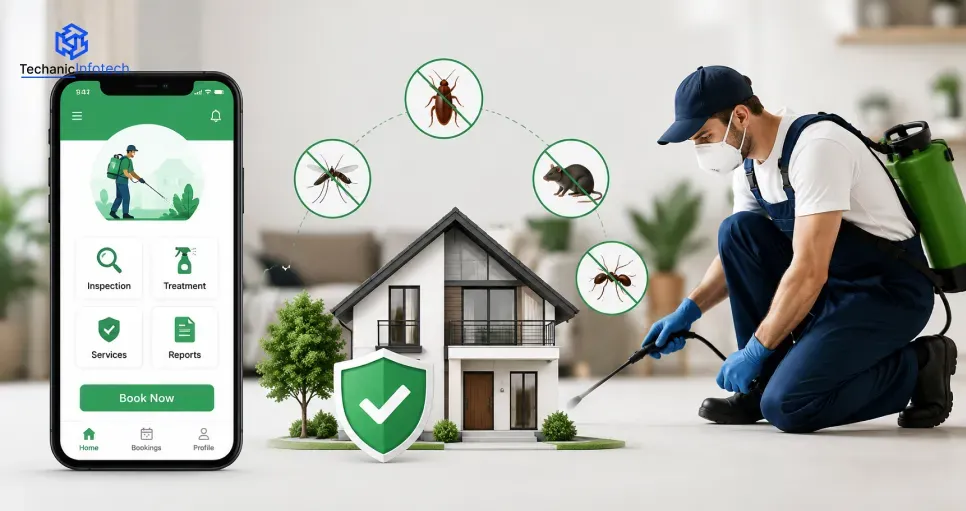
This is where pest control app development can make a significant difference. A dedicated digital platform can bring customer bookings, technician assignments, service schedules, treatment records, payments, notifications, and business reporting into one centralised system.
Modern pest control applications are no longer limited to appointment booking. They can support recurring service plans, technician GPS tracking, digital inspection reports, chemical and equipment records, customer communication, automated reminders, and real-time operational dashboards.
For businesses planning an on-demand pest control app, the goal is not simply to digitise existing processes. A well-designed platform should help technicians work more efficiently, give customers greater visibility into their appointments, and provide business owners with better control over daily field operations.
This pest control app development guide explores the essential features, technician management capabilities, development stages, technology requirements, estimated costs, and future opportunities for building a scalable pest control business platform.
According to WorldMetrics, the global pest control service market is likely to grow at a CAGR of 5.2% from 2021 to 2026.
According to WorldMetrics, insect pest control is projected to reach USD 17.7 billion by the year 2025 globally.
According to WorldMetrics, the mosquito control product market is expected to exceed US$ 850 million by the year 2026; the largest segment in the pest control market is rodent control, accounting for over a share of 40%.
The global cockroach control market is likely to reach US$1.03 billion by 2026, and the termite baits market is projected to reach up to US$218.8 million by the year 2026.
According to Pristinemarketinsights, the growth towards sustainable agricultural practices additionally influences the demand for advanced pest control technologies, reflecting broader pest control market growth dynamics
Pest control is a recurring, location-based service business. Technicians need to reach the right property at the right time, carry the appropriate equipment, follow treatment instructions, and document completed work. As customer volume increases, managing these activities manually becomes increasingly difficult.
A growing pest control company may handle inspections, one-time treatments, recurring visits, emergency requests, and follow-up appointments simultaneously. Without centralised scheduling, overlapping bookings and missed appointments can affect both customer satisfaction and technician productivity.
Technicians spend a significant portion of their working day travelling between customer locations. Better assignment and route planning can reduce unnecessary travel while helping businesses complete more service calls.
Pest control services often require detailed records covering the property, treatment performed, products used, service date, technician notes, and recommended follow-up. Digital records make this information easier to retrieve during future visits.
Customers expect clear information about appointment times, technician arrival, treatment instructions, follow-up visits, and invoices. Automated notifications can reduce the need for repeated phone calls while keeping customers informed throughout the service process.
Many pest control businesses depend on recurring treatment programmes. Digital platforms can automatically schedule future appointments, send reminders, process recurring payments, and notify customers before their next service.
Business owners need to understand more than the number of appointments completed. They also need visibility into technician performance, revenue, recurring customers, service areas, cancellations, customer retention, and operational costs.
As a pest control company expands into new service areas, a software development company can help automate repetitive tasks and maintain centralised control while the business grows. Digital workflows enable businesses to automate repetitive tasks and maintain centralised control as they expand their operations.
For companies with unique workflows, custom software development can provide the flexibility to build features around their specific service model rather than forcing operations into a generic platform.
Most pest control platforms are really three connected products:
|
App |
Primary User |
Core Job |
|
Customer app/portal |
Homeowners, business clients |
Book service, view history, pay, message |
|
Technician app |
Field staff |
See routes, log jobs, capture signatures/photos |
|
Admin dashboard |
Owners, dispatchers, office staff |
Scheduling, invoicing, reporting, technician oversight |
A successful pest control platform should serve three primary users: customers who book services, technicians who perform treatments, and administrators who manage the business. Separating features by user role helps create a more efficient workflow and prevents the application from becoming unnecessarily complicated.
Customer-Side Features: Customer-side features provide customers with a simple and convenient way to interact with the pest control service. Through the app or web portal, users can book appointments, manage schedules, receive service updates, view technician details, and access service history.
Service Discovery: Customers should be able to browse available pest control services, including general pest treatment, termite control, rodent control, mosquito treatment, inspections, and recurring maintenance plans.
Online Booking: Customers can select a service, choose a preferred date and time, provide property details, and confirm appointments without calling the business.
Property Profiles: The application can store property information such as address, property type, previous treatments, pest concerns, and service history for faster future bookings.
Real-Time Appointment Updates: Push notifications can inform customers about booking confirmations, technician assignments, arrival updates, rescheduling, and completed services.
Digital Payments & Invoices: Secure payment integration allows customers to pay online, view invoices, and access transaction history directly from the application.
Ratings & Feedback: Customers can rate completed services and provide feedback, helping businesses monitor service quality and improve customer satisfaction.
A dedicated pest control technician management app should help field technicians manage their daily assignments without relying on constant communication with office staff.
Technician Dashboard: Technicians can view today's appointments, customer information, service instructions, property details, and pending tasks from one dashboard.
Smart Job Assignment: Managers can assign jobs according to technician availability, location, skills, service type, and workload.
GPS & Route Navigation: GPS integration helps technicians navigate between appointments efficiently while allowing managers to monitor job progress when required.
Digital Treatment Records: Technicians can record treatment details, products used, observations, photographs, recommendations, and follow-up requirements directly from the application.
Service Status Updates: Technicians can update job statuses such as Assigned, En Route, Arrived, In Progress, and Completed, giving both managers and customers better visibility.
Digital Signatures: Customers can digitally acknowledge completed services, treatment information, or service reports without requiring physical paperwork.
The administrative dashboard provides business owners with centralised control over customers, technicians, services, appointments, payments, and operational performance.
Appointment & Workforce Management: Administrators can create schedules, assign technicians, manage cancellations, reschedule appointments, and monitor daily workloads.
Customer Management: A centralised customer database stores contact information, property details, service history, invoices, treatment records, and recurring service plans.
Service & Pricing Management: Business owners can create service packages, update pricing, configure recurring plans, and manage promotional offers from the administration panel.
Reports & Analytics: Dashboards can track completed jobs, technician productivity, revenue, cancellations, recurring customers, service demand, and customer retention.
CRM Integration: Connecting the application with CRM development services can help businesses manage customer relationships, follow-ups, marketing campaigns, and long-term service opportunities from a centralised system.
Technician coordination directly affects how many service calls a pest control business can complete each day. A well-designed platform gives managers real-time visibility while giving technicians the tools they need to complete jobs accurately and efficiently.
Each technician can have a digital profile containing contact information, service skills, certifications, assigned service areas, availability, and completed job history. Managers can use this information when assigning specialised treatments.
Instead of assigning appointments manually, the system can recommend suitable technicians based on location, availability, workload, service type, and required expertise. This helps distribute work more efficiently and reduce scheduling conflicts.
GPS functionality can provide real-time technician locations and help identify the most efficient routes between appointments. Managers can monitor field activity while technicians can navigate directly to customer properties.
Businesses that require more advanced routing and workforce coordination can combine these capabilities with logistics app development solutions.
Technicians can view their complete daily schedule, appointment priorities, customer instructions, and service requirements from one dashboard. Managers can also reassign jobs when cancellations, emergencies, or unexpected delays occur.
After completing a treatment, technicians can record the work performed, products used, photographs, customer observations, recommendations, and follow-up requirements. This creates a complete digital service record for future visits.
When a technician changes the job status, customers can automatically receive updates such as appointment confirmation, technician arrival, treatment completion, and follow-up reminders.
Managers can evaluate technician performance using metrics such as completed jobs, average service time, cancellations, customer ratings, travel time, and repeat service requirements.
A well-designed system can eventually incorporate AI-powered scheduling and workload optimisation. Working with an AI development company can help businesses introduce intelligent recommendations without disrupting the core technician workflow.
A pest control application needs more than a customer-facing mobile interface. It must support technician mobility, location tracking, scheduling, payments, notifications, customer records, and administrative operations. The technology stack should therefore be selected around reliability, scalability, and field-service requirements.
|
Technology Layer |
Recommended Technologies |
Estimated Implementation Cost |
|
Mobile App |
Flutter, React Native, Swift, Kotlin |
$5,000–$12,000 |
|
Backend & APIs |
Node.js, Python, Laravel, .NET |
$6,000–$15,000 |
|
Database |
PostgreSQL, MongoDB |
$2,000–$5,000 |
|
Cloud Infrastructure |
AWS, Microsoft Azure, Google Cloud |
$2,000–$6,000 |
|
Maps & GPS |
Google Maps API, Mapbox |
$1,000–$3,000 |
|
Payments |
Stripe, PayPal, Razorpay |
$1,000–$2,000 |
|
Notifications |
Firebase Cloud Messaging, OneSignal |
$500–$2,000 |
|
Analytics |
Firebase Analytics, Google Analytics |
$1,000–$3,000 |
|
AI Features |
Python, OpenAI APIs, ML models |
$3,000–$10,000+ |
These are estimated implementation contributions, not fixed vendor prices. API usage, cloud hosting, storage, messaging, maps, and AI services may create additional recurring expenses.
The platform should separate the customer application, technician interface, administration dashboard, and backend services while allowing them to exchange information in real time. This architecture makes it easier to add new service areas, technicians, branches, recurring plans, and business integrations as the company grows.
GPS and mapping services are particularly important for field technicians. The system can use location data to assign nearby jobs, provide navigation, estimate arrival times, and improve daily route planning.
Cloud infrastructure allows customer records, treatment histories, photographs, invoices, schedules, and operational reports to remain accessible across devices. Businesses should also implement backups, access controls, encryption, and monitoring to protect sensitive information.
A mature pest control platform may connect with accounting software, payment gateways, CRM systems, inventory tools, messaging services, and other business applications. Using APIs keeps information synchronised and reduces repetitive data entry.
Businesses evaluating a mobile app development company should consider its experience with field-service applications, cloud architecture, GPS integrations, secure APIs, and long-term maintenance rather than choosing a stack based only on initial development speed.
Building a pest control application involves several connected phases, from defining service workflows to developing customer and technician interfaces, integrating scheduling and GPS systems, and testing the complete platform.
|
Phase |
Description |
Typical Duration |
|
Discovery & Planning |
Requirements, user flows, service workflows, technical planning |
2–4 weeks |
|
UI/UX Design |
Customer, technician, and admin interfaces with interactive prototypes |
3–5 weeks |
|
Backend Development |
APIs, database, authentication, scheduling, and admin dashboard |
6–10 weeks |
|
Mobile App Development |
Customer and technician applications |
8–12 weeks |
|
Integration |
GPS, payments, notifications, CRM, and third-party services |
2–5 weeks |
|
QA & Testing |
Functional, security, performance, and device testing |
3–5 weeks |
|
Deployment |
App Store/Play Store submission and production server launch |
1–2 weeks |
Several phases can run in parallel when dedicated teams work on design, backend, mobile development, and testing simultaneously. As a result, the durations above should not simply be added together. The final timeline depends on the number of features, platform requirements, integration complexity, customisation level, and testing scope.
Pest control app development costs vary depending on the number of applications, technician management requirements, integrations, platform choice, development team location, and feature depth. For a typical pest control platform, the investment range is $8,000-$70,000+.
|
Scope |
Description |
Estimated Cost (USD) |
Typical Timeline |
|
MVP |
Customer booking, basic scheduling, service catalog, simple technician module, and admin panel |
$8,000–$15,000 |
2–3 months |
|
Mid-Range Platform |
Customer app, technician management, GPS tracking, payments, notifications, and reporting |
$15,000–$35,000 |
3–5 months |
|
Advanced Platform |
Customer, technician, and admin applications; route optimization, recurring services, CRM, analytics, and integrations |
$35,000–$55,000 |
5–7 months |
|
Full-Featured Platform |
Advanced analytics, AI-powered automation, multi-location management, extensive integrations, and enterprise features |
$55,000–$70,000+ |
7–10 months |
Pest control businesses are increasingly adopting digital platforms to manage appointments, technicians, treatment records, payments, and customer relationships more efficiently. A well-designed application can reduce administrative work while giving technicians better tools to manage their daily field activities.
Whether you're building a simple booking solution or a complete pest control technician management app, the most effective approach is to start with essential workflows and expand the platform as operational requirements grow. A scalable architecture also makes it easier to introduce automation, AI, integrations, and connected pest monitoring in the future.
It involves building a digital platform for managing pest control bookings, technicians, treatments, payments, and customer records.
Development generally ranges from $8,000 to $70,000+, depending on features, integrations, and complexity.
Key features include online booking, technician management, GPS tracking, digital treatment records, payments, notifications, and reporting.
Yes. It can support technician profiles, job assignments, GPS navigation, service updates, workload management, and performance tracking.
Yes. AI can support scheduling, technician assignment, demand forecasting, route optimisation, and customer support.
Yes. Businesses can add recurring appointments, automated reminders, subscription plans, and recurring payment functionality.


Bharat Sharma is the CTO of Techanic Infotech, bringing deep technical expertise in software architecture, mobile app development, and scalable system design. He leads the engineering team with a strong focus on innovation, performance, and security.