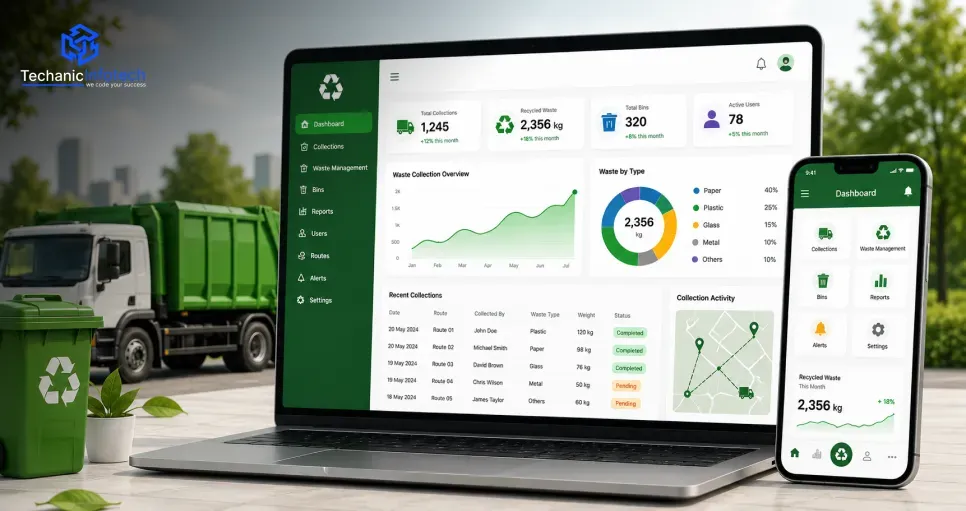
Waste Management App Development
How to Build Recycling Management Software: Features, Cost & Technology Guide
August 21, 2026
August 21, 2026
Key Takeaways:
Recycling management software can centralize collection, transportation, sorting, processing, inventory, sales, and reporting activities.
The recycling software development cost can range from $7,000 to $80,000+, depending on the project's complexity and technology requirements.
Essential features include pickup scheduling, GPS tracking, material tracking, fleet management, inventory, notifications, payments, analytics, and reporting.
IoT can connect smart bins, weighing systems, RFID devices, GPS trackers, and recycling equipment for real-time monitoring.
AI can support route optimization, material classification, demand forecasting, predictive maintenance, and contamination detection.
A basic platform may take 2–3 months, while an advanced enterprise solution can require 7–10+ months.
Starting with an MVP allows recycling businesses to control initial costs and gradually introduce advanced IoT, AI, and automation capabilities.
Recycling operations involve multiple activities, including waste collection, material sorting, transportation, processing, inventory management, compliance tracking, and reporting. Managing these activities manually can make it difficult to maintain accurate records, coordinate teams, and monitor material movement.
Recycling management software provides a centralized digital platform for managing these processes. Recycling businesses can use it to track recyclable materials, schedule collections, manage vehicles and workers, monitor processing activities, and generate operational reports.
Modern recycling software development can also incorporate IoT sensors, GPS tracking, cloud computing, analytics, and artificial intelligence. These technologies can help businesses improve visibility across collection and processing operations while supporting data-driven decision-making.
For businesses handling large-scale waste collection and transportation, integrating waste management software development capabilities can further connect recycling workflows with broader waste management operations.
The overall recycling software development cost depends on factors such as feature complexity, number of platforms, IoT integrations, AI capabilities, third-party APIs, and scalability requirements. A well-planned solution can help recycling businesses digitise operations while creating a foundation for future automation.
According to DI Reports, the recycling operations and specialized waste management software market is valued at approximately $4.2 billion to $5.75 billion in 2026.
According to DI Reports, driven by strict environmental rules and smart city tracking, it is projected to grow to over $9.8 billion by 2034 at a compound annual growth rate of roughly 9.8% to 12.7%.
This significant growth is primarily driven by the escalating global focus on circular economy principles, increasingly stringent environmental regulations, and the imperative for operational efficiency within the broader waste management sector.
Recycling management software is a digital platform designed to coordinate and monitor the different stages of recycling operations, from waste collection and material tracking to transportation, processing, inventory, and reporting.
Instead of relying on spreadsheets, paper records, and separate systems, recycling businesses can use one centralized platform to manage operational data and improve coordination between field teams, drivers, processing facilities, and administrators.
A typical recycling management system can work through the following workflow:
Waste Collection Requests: Customers, businesses, or municipal users can submit requests for recyclable material pickup through a web or mobile application.
Scheduling & Assignment: The system assigns collection requests to available drivers or field workers based on location, vehicle availability, capacity, and schedules.
Route Management: GPS and mapping integrations can help optimize collection routes and provide real-time vehicle tracking.
Material Tracking: Collected materials can be categorized and tracked by type, weight, source, destination, and processing status.
Sorting & Processing: Facilities can record sorting, processing, recovery, and disposal activities to maintain accurate material records.
Inventory Management: Recyclable materials can be monitored as they move through different stages, including storage and sale.
Analytics & Reporting: Managers can access reports covering collection volumes, recovery rates, vehicle performance, revenue, operational costs, and other key metrics.
Businesses planning to expand beyond recycling-specific workflows should also consider the waste management app cost, which can vary depending on collection scheduling, fleet tracking, route optimization, customer management, IoT integration, and other required features.
This centralized approach gives recycling businesses better visibility into their operations while reducing manual data entry and improving coordination across the recycling supply chain.
Recycling businesses handle multiple activities across collection, transportation, sorting, processing, storage, and sales. A centralized software platform can connect these operations and give managers better visibility into the movement of recyclable materials.
|
Operational Area |
What the Software Can Manage |
|
Collection Management |
Pickup requests, schedules, collection locations, and service status |
|
Route Management |
Driver assignments, routes, GPS tracking, and estimated arrival times |
|
Material Tracking |
Material type, weight, source, destination, and processing status |
|
Sorting Operations |
Categorization, sorting quantities, contamination records, and recovery data |
|
Processing Management |
Processing stages, output quantities, equipment usage, and production records |
|
Inventory Management |
Stored recyclable materials, quantities, warehouse locations, and stock movement |
|
Vehicle Management |
Vehicle availability, maintenance, fuel usage, capacity, and trip history |
|
Workforce Management |
Driver assignments, employee schedules, tasks, and field activities |
|
Customer Management |
Customer profiles, pickup history, service requests, and billing records |
|
Sales Management |
Recycled material sales, buyers, pricing, invoices, and transactions |
|
Compliance & Reporting |
Recycling volumes, operational records, regulatory documentation, and reports |
|
Business Analytics |
Collection trends, recovery rates, revenue, costs, and operational performance |
A modern recycling platform should support the complete recycling workflow, from collection requests and material tracking to transportation, processing, sales, and reporting. The feature set can be customized according to the scale and type of recycling business.
|
Feature |
Purpose |
|
User Registration & Profiles |
Allows customers, employees, drivers, and administrators to access relevant functions. |
|
Pickup Request Management |
Enables customers to schedule and manage recyclable waste collections. |
|
Smart Scheduling |
Assigns collection requests based on availability, location, and capacity. |
|
GPS & Route Tracking |
Tracks vehicles and helps optimize collection routes. |
|
Material Tracking |
Records material type, weight, source, destination, and processing status. |
|
Digital Weighing Integration |
Captures and stores material weights digitally. |
|
Sorting Management |
Records material categories, contamination, and recovered quantities. |
|
Inventory Management |
Tracks recyclable materials stored at processing facilities. |
|
Vehicle & Fleet Management |
Monitors vehicles, maintenance, fuel usage, capacity, and trip history. |
|
Employee Management |
Manages staff assignments, schedules, tasks, and field activities. |
|
Customer Management |
Stores customer details, service history, contracts, and pickup records. |
|
Billing & Payments |
Supports invoices, payments, pricing, and transaction records. |
|
Notifications |
Sends pickup confirmations, schedule updates, alerts, and reminders. |
|
Analytics Dashboard |
Displays collection volumes, recovery rates, revenue, costs, and operational KPIs. |
|
Reports & Compliance |
Generates operational and regulatory reports. |
|
Admin Panel |
Provides centralized control over users, services, vehicles, materials, and system settings. |
Customers can request pickups based on their location and waste type. The system can automatically assign requests to suitable vehicles and field workers.
Real-time GPS tracking allows managers to monitor collection vehicles, identify delays, and review completed routes. This can improve operational visibility and help reduce unnecessary travel.
Integrating digital weighing systems allows businesses to automatically record the quantity of recyclable material collected. Each material batch can then be tracked throughout sorting, processing, storage, and sale.
Customers and staff can receive notifications for pickup confirmations, driver assignments, schedule changes, completed collections, and other important events.
Managers can monitor key metrics such as total materials collected, recycling rates, vehicle utilization, processing output, revenue, and operating costs through centralized dashboards.
Advanced platforms can use AI to identify collection patterns, forecast material volumes, optimize routes, and detect operational anomalies. Businesses requiring these capabilities may work with an AI development company to implement customized models and automation.
A well-planned feature set allows businesses to start with essential functionality and gradually introduce advanced automation as their recycling operations expand.
IoT and AI can transform recycling management software from a basic record-keeping system into an intelligent platform capable of real-time monitoring, predictive analysis, and operational automation.
IoT devices can collect real-time data from recycling facilities, collection vehicles, smart bins, and processing equipment.
|
IoT Application |
How It Helps |
|
Smart Bin Sensors |
Monitor fill levels and trigger collection requirements. |
|
GPS Trackers |
Provide real-time vehicle location and route information. |
|
Digital Weighing Systems |
Automatically record the weight of collected materials. |
|
Equipment Sensors |
Monitor machinery performance and operating conditions. |
|
RFID/Barcode Tracking |
Track material batches throughout the recycling process. |
|
Environmental Sensors |
Monitor temperature, humidity, and other facility conditions. |
AI can analyze the data collected by IoT devices and the software platform to generate actionable insights.
Demand Forecasting: Predicts collection volumes and material demand based on historical data.
Route Optimization: Analyzes locations, traffic, vehicle capacity, and pickup schedules to suggest efficient routes.
Material Classification: Computer vision can help identify and categorize recyclable materials.
Predictive Maintenance: Identifies equipment patterns that may indicate potential failures.
Contamination Detection: AI-powered image analysis can help identify unwanted materials in recycling streams.
Operational Analytics: Finds patterns in collection, processing, inventory, and facility performance.
The greatest value comes from combining connected devices with intelligent analytics. For example, a smart bin can send its fill-level data to the platform. AI can analyze collection patterns and recommend when the bin should be emptied, helping businesses avoid unnecessary trips and overflowing containers.
For businesses planning advanced recycling app development, IoT and AI can, therefore, support better resource utilization, more efficient collection, and improved visibility across the recycling lifecycle.
A reliable technology infrastructure is essential for managing collection requests, GPS tracking, material records, IoT devices, analytics, payments, and administrative operations. The final stack should be selected according to the recycling business's size, number of users, connected devices, and scalability requirements.
|
Technology Layer |
Recommended Technologies |
Estimated Development Cost Contribution |
|
Mobile App |
Flutter, React Native, Swift, Kotlin |
$4,000–$12,000 |
|
Web/Admin Dashboard |
React, Angular, Vue.js |
$2,000–$8,000 |
|
Backend |
Node.js, Python, Django, Laravel |
$4,000–$12,000 |
|
Database |
PostgreSQL, MySQL, MongoDB |
$1,500–$5,000 |
|
Cloud Infrastructure |
AWS, Azure, Google Cloud |
$2,000–$8,000 |
|
GPS & Maps |
Google Maps API, Mapbox |
$500–$3,000 |
|
IoT Integration |
MQTT, IoT gateways, REST APIs |
$3,000–$15,000+ |
|
AI & Machine Learning |
Python, TensorFlow, PyTorch |
$3,000–$15,000+ |
|
Notifications |
Firebase, Twilio, APNs |
$500–$2,500 |
|
Security |
OAuth, JWT, encryption, RBAC |
$1,000–$5,000 |
|
Analytics |
Power BI, custom dashboards, data APIs |
$1,500–$6,000 |
The mobile app tech stack can include Flutter or React Native for cross-platform deployment, while Swift and Kotlin can be used when native iOS or Android development is preferred.
The web dashboard can provide administrators with centralized controls for customers, collection requests, vehicles, materials, employees, inventory, and reports.
IoT-enabled recycling platforms may need to connect smart bins, weighing systems, vehicle trackers, RFID devices, and processing equipment. Protocols such as MQTT and APIs can facilitate communication between devices and the software.
A structured development approach helps recycling businesses build software that matches their operational workflows while leaving room for future IoT, AI, and automation capabilities.
Start by identifying how the business currently handles collection, transportation, sorting, processing, inventory, sales, and reporting. Determine the users who will access the platform, such as customers, drivers, facility workers, managers, and administrators.
Prioritize essential functionality for the first release. An MVP can include customer registration, pickup requests, scheduling, GPS tracking, material records, notifications, payments, and an admin dashboard.
Create simple interfaces for both field workers and administrators. Drivers and collection teams should be able to update tasks quickly, while managers need detailed dashboards and reports.
Working with an experienced mobile app development company can help businesses select the right technologies for their customer, driver, and administrator applications while ensuring scalability and performance.
Build the backend, database, mobile application, web dashboard, authentication, scheduling system, material tracking, notifications, and reporting functionality.
Connect smart bins, weighing systems, GPS trackers, RFID devices, payment gateways, mapping APIs, and other required services. Proper API handling is important to maintain reliable data synchronization.
Once sufficient operational data is available, AI can be introduced for route optimization, demand forecasting, material classification, predictive maintenance, and other intelligent workflows.
Conduct functional, performance, security, usability, API, device, and field testing. IoT-enabled systems should also be tested under real operating conditions to verify data accuracy and connectivity.
Deploy the application, configure cloud infrastructure, connect production devices, and provide training to drivers, facility teams, managers, and administrators.
After launch, monitor system performance and user feedback. Regular maintenance can address bugs, security updates, infrastructure requirements, and new business needs.
Working with a recycling management software development company can help businesses manage the complete development lifecycle, from requirement analysis and architecture to deployment and long-term support.
The recycling software development cost typically ranges from $7,000 to $80,000+, depending on the features, number of platforms, integrations, IoT requirements, AI capabilities, and overall system complexity.
Businesses should also consider the mobile app development cost separately when the recycling platform includes dedicated customer or driver mobile applications, as the cost can vary based on platforms, features, integrations, and customization.
|
Software Level |
Estimated Cost |
Development Timeline |
Typical Capabilities |
|
Basic |
$7,000–$18,000 |
2–3 months |
User profiles, pickup requests, scheduling, material records, basic reports |
|
Mid-Level |
$18,000–$35,000 |
3–5 months |
GPS tracking, route management, inventory, payments, notifications, analytics |
|
Advanced |
$35,000–$55,000 |
5–7 months |
IoT integration, smart bins, fleet management, advanced dashboards, automation |
|
Enterprise |
$55,000–$80,000+ |
7–10+ months |
AI, multi-location management, extensive IoT, predictive analytics, complex integrations |
Depending on the project scope, the budget may include:
UI/UX design
Mobile application development
Web and admin dashboard
Backend and database development
GPS and mapping integration
IoT connectivity
AI and analytics
Payment integration
Testing and quality assurance
Deployment
Businesses should also budget separately for IoT hardware, cloud hosting, API usage, third-party subscriptions, maintenance, and ongoing infrastructure costs.
Starting with an MVP and gradually adding IoT and AI capabilities can help businesses control their initial investment while creating a scalable foundation for future growth.
The final recycling software development cost depends on more than the number of features. Technology requirements, operational complexity, integrations, and scalability can all have a significant impact on the overall budget.
|
Cost Factor |
How It Affects Cost |
|
Feature Complexity |
Advanced scheduling, material tracking, analytics, and automation require additional development effort. |
|
Number of Platforms |
Building customer apps, driver apps, web dashboards, and admin panels increases the project scope. |
|
IoT Integration |
Smart bins, weighing systems, RFID devices, and equipment sensors require additional hardware and software integration. |
|
AI Capabilities |
Route optimization, demand forecasting, computer vision, and predictive maintenance increase development complexity. |
|
GPS & Route Management |
Real-time tracking and route optimization require mapping APIs and sophisticated location-based logic. |
|
Third-Party Integrations |
ERP, CRM, payment, accounting, mapping, and logistics integrations add development and testing requirements. |
|
Data Volume |
Large amounts of sensor, GPS, and material data require scalable databases and cloud infrastructure. |
|
Security Requirements |
Authentication, encryption, role-based access, and secure APIs increase development effort. |
|
UI/UX Customization |
Custom interfaces for customers, drivers, facility workers, and administrators require additional design work. |
|
Maintenance & Scalability |
Ongoing updates, infrastructure management, security patches, and scaling create post-launch expenses. |
Developing recycling management software requires more than building a standard business application. The platform needs to handle field operations, material tracking, connected devices, transportation, and potentially large volumes of real-time data.
Recycling operations can generate continuous data from GPS trackers, smart bins, weighing systems, and processing equipment. Keeping this information synchronized across mobile apps and dashboards can be technically challenging.
Different recycling businesses may use different sensors, weighing machines, RFID systems, and equipment. Ensuring reliable communication between these devices and the software requires compatible APIs, gateways, and communication protocols.
Materials can pass through several stages, including collection, transportation, sorting, processing, storage, and sale. The system needs to maintain accurate records throughout this lifecycle to prevent data inconsistencies.
Collection routes can change because of traffic, new pickup requests, vehicle availability, or changing waste volumes. Building an efficient routing system requires reliable location data and appropriate optimization logic.
Recycling platforms may contain customer information, employee records, vehicle data, financial transactions, and operational reports. Strong authentication, encryption, role-based permissions, and secure APIs are essential.
A platform that starts with a small number of users may eventually need to support multiple facilities, hundreds of vehicles, thousands of customers, and large volumes of sensor data. The architecture should therefore be designed for future growth.
AI-powered material classification, contamination detection, and predictive analytics depend heavily on the quality and quantity of training data. Models should be tested and monitored before being used for important operational decisions.
Mapping services, payment gateways, cloud platforms, IoT services, and other APIs can affect system availability and operating costs. Proper error handling and monitoring are necessary to reduce the impact of external service failures.
Working with an experienced software development company can help businesses address these technical challenges while building a platform that can scale with changing recycling operations.
Recycling management software can help businesses replace fragmented manual processes with a centralized platform for managing collection, transportation, material tracking, sorting, processing, inventory, and reporting.
The recycling software development cost can range from $7,000 to $80,000+, depending on the required features, number of platforms, IoT integrations, AI capabilities, third-party services, and scalability requirements.
Businesses can start with an MVP containing essential collection, tracking, scheduling, and reporting capabilities and then expand with GPS optimization, IoT sensors, AI-powered analytics, and automation as their operations grow. A scalable architecture from the beginning can make these future upgrades easier and more cost-effective.
Recycling management software is a digital platform that helps businesses manage waste collection, transportation, material tracking, sorting, processing, inventory, fleet operations, and reporting from a centralized system.
The recycling software development cost typically ranges from $7,000 to $80,000+. The final investment depends on features, platforms, integrations, IoT requirements, AI capabilities, and overall complexity.
Key features include pickup scheduling, GPS tracking, route management, material tracking, digital weighing, inventory management, fleet management, notifications, customer management, payments, analytics, and reporting.
Yes. IoT can connect smart bins, GPS trackers, weighing systems, RFID devices, and recycling equipment to provide real-time operational data.
AI can support route optimization, material classification, contamination detection, demand forecasting, predictive equipment maintenance, and operational analytics.
A basic platform can take around 2–3 months, while an advanced enterprise solution with IoT, AI, and multiple integrations can take 7–10+ months.
Yes. Enterprise-level platforms can support multiple recycling facilities, warehouses, vehicles, employees, customers, and administrative teams through centralized dashboards.
Yes. APIs can connect the platform with ERP, CRM, accounting, payment, GPS, IoT, and other business systems, depending on their compatibility and integration requirements.


Abhishek Jangid is the CEO of Techanic Infotech, with extensive experience in mobile app and web development. He specializes in helping businesses turn innovative ideas into scalable digital solutions through strategic planning and modern technology.