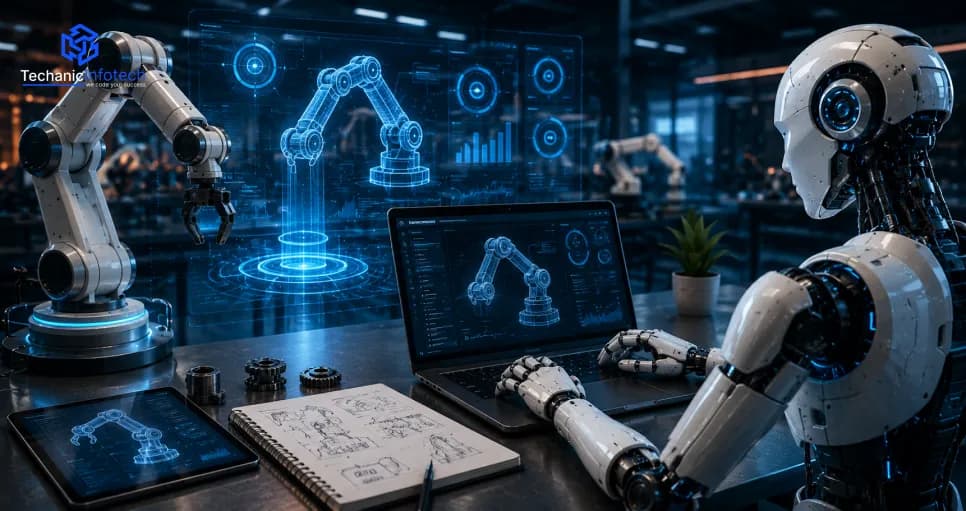
Key Takeaways:
Software has become the intelligence behind modern robotics, enabling automation, real-time decision-making, and seamless business integration.
The growing B2B robotics opportunity is creating new possibilities across manufacturing, healthcare, logistics, agriculture, retail, and other industries.
Successful robotics software integration depends on scalable software, AI capabilities, cloud connectivity, and enterprise system integration.
Businesses should begin with high-impact automation projects, build a scalable software foundation, and expand robotics adoption gradually.
As AI and robotics continue to evolve, organisations that invest in software-driven automation today will be better positioned to improve operational efficiency, reduce costs, and gain a long-term competitive advantage.
For decades, robotics was primarily associated with manufacturing plants, automotive assembly lines, and large industrial enterprises. Today, that perception is changing rapidly. Modern robots are no longer standalone machines performing repetitive tasks; they have become intelligent, connected systems powered by advanced software, artificial intelligence, cloud computing, and real-time data.
This convergence of robotics and software is creating a significant B2B robotics opportunity for businesses across industries. From healthcare and logistics to agriculture, retail, and smart manufacturing, organisations are investing in software-driven robotics to automate operations, improve productivity, reduce costs, and make faster business decisions.
As robotics continues to evolve, software has become the foundation that enables robots to communicate, learn, adapt, and integrate with existing business systems. In this guide, we'll explore how robotics and software are transforming the B2B landscape, the industries leading adoption, emerging business opportunities, and what organisations should consider before investing in robotics-powered digital solutions.
Modern robots are no longer designed to operate as isolated machines. Instead, they function as intelligent systems that collect data, communicate with other devices, make decisions, and continuously improve their performance through software. This shift has made robotics software integration one of the most important drivers of digital transformation across industries.
Unlike traditional industrial robots that followed fixed instructions, today's robotic systems rely on software to adapt to changing environments, automate complex workflows, and interact seamlessly with enterprise platforms. As a result, businesses are increasingly investing in software for robotics companies to improve operational efficiency, reduce downtime, and support long-term scalability.
Cloud platforms allow robots to exchange data in real time, receive software updates remotely, and access centralised management systems. This enables businesses to monitor robotic operations across multiple locations while improving performance through continuous optimisation.
Modern robotics platforms generate large volumes of operational data. Software analyses this information to identify performance trends, predict maintenance requirements, and optimise workflows, helping organisations make faster and more informed business decisions.
Robotic systems are now integrated with ERP, CRM, warehouse management, and production planning platforms. Businesses investing in enterprise software development are increasingly connecting robotics with existing enterprise systems to create automated, end-to-end operational workflows.
Every industry has unique operational requirements. Manufacturing, healthcare, agriculture, logistics, and retail each require specialised robotic capabilities that cannot be delivered through generic software alone. This growing demand has increased the need for custom software development, enabling businesses to build robotics solutions tailored to their specific processes and objectives.
As robotics technology becomes more intelligent and accessible, businesses are moving beyond simple automation to build connected, software-driven ecosystems. This evolution is creating significant robotics business opportunities in 2026, allowing organisations to improve productivity, reduce operational costs, and deliver better customer experiences.
Manufacturing continues to lead robotics adoption, but today's factories rely on software to coordinate robotic systems, monitor production lines, predict equipment failures, and optimise workflows in real time.
Modern robotic process software enables manufacturers to reduce downtime, improve product quality, and increase overall production efficiency.
Business Benefits
Automated production lines
Predictive equipment maintenance
Quality inspection
Real-time production monitoring
Warehouses are increasingly using autonomous robots for inventory movement, order picking, sorting, and packaging. Software coordinates these robotic fleets, ensuring efficient task allocation and route optimisation while minimising operational delays.
Business Benefits
Faster order fulfillment
Reduced labor costs
Improved inventory accuracy
Better warehouse utilization
Healthcare providers are adopting robotics to assist with surgery, pharmacy automation, laboratory testing, patient monitoring, and hospital logistics. Software enables these robotic systems to operate safely while integrating with hospital information systems and patient records.
Business Benefits
Improved patient safety
Faster clinical workflows
Reduced administrative workload
Higher operational efficiency
Agricultural businesses are using robotic systems for crop monitoring, precision spraying, harvesting, and soil analysis. Intelligent software analyses environmental data and controls robotic equipment to improve crop yields while reducing resource consumption.
Business Benefits
Precision farming
Lower operational costs
Better resource utilization
Increased productivity
Instead of purchasing expensive robotic equipment, many businesses now subscribe to robotics SaaS solutions through Robotics-as-a-Service (RaaS) models. This approach allows organisations to access advanced robotic technologies through flexible subscription plans while reducing upfront capital investment.
For small and medium-sized businesses, RaaS provides an affordable path to automation without the financial burden of purchasing and maintaining complex robotic systems.
Robots have evolved far beyond machines that simply follow pre-programmed instructions. Today, robotics and AI integration enable robotic systems to analyse data, adapt to changing environments, learn from experience, and make intelligent decisions with minimal human intervention. This combination is transforming robots into autonomous business assets capable of handling increasingly complex tasks.
Rather than replacing human workers, AI-powered robots are designed to improve productivity by automating repetitive activities while allowing employees to focus on strategic and creative responsibilities.
Traditional robots execute predefined commands, but AI-powered systems continuously analyse data and adjust their actions based on real-time conditions. This enables businesses to improve operational accuracy while responding more effectively to unexpected situations.
Examples include:
Dynamic route optimization
Quality inspection
Inventory management
Predictive maintenance
Production optimization
Modern robotic platforms increasingly rely on intelligent agents capable of planning tasks, coordinating workflows, and communicating with other business systems. Businesses investing in AI agent development are creating autonomous solutions that can perform multi-step operations with limited human supervision, improving efficiency across manufacturing, logistics, and service industries.
AI-powered computer vision allows robots to identify objects, inspect products, detect defects, recognise human movements, and navigate complex environments with greater accuracy.
Machine learning further improves robotic performance by enabling systems to learn from operational data and continuously optimise future decisions.
Instead of waiting for equipment failures, AI analyses sensor data to predict maintenance requirements before breakdowns occur. This proactive approach reduces downtime, extends equipment lifespan, and lowers maintenance costs.
As robotics projects become more advanced, businesses often collaborate with an experienced AI development company to integrate machine learning models, intelligent automation, and advanced analytics into robotic platforms. These capabilities help organisations build flexible, scalable solutions that continue to improve through real-world operational data.
Although robotics is creating exciting business opportunities, successful implementation requires more than purchasing advanced hardware. Businesses must overcome technical, operational, and organisational challenges to maximise the value of robotics investments. Addressing these challenges early helps reduce implementation risks while improving long-term returns.
Many organisations already use ERP, CRM, warehouse management, and production planning software. Ensuring robotic systems integrate seamlessly with these existing platforms is often one of the biggest implementation challenges. Poor integration can create data silos, duplicate processes, and reduce the overall effectiveness of automation initiatives.
While robotics can reduce operational costs over time, the initial investment in hardware, software, system integration, and employee training can be significant. Businesses should evaluate long-term ROI rather than focusing only on upfront expenses. Many organisations begin with pilot projects before expanding robotics across multiple departments.
Robotic systems are designed to support employees, not replace them. However, successful adoption depends on preparing teams to work alongside intelligent machines. Providing proper training, establishing clear workflows, and encouraging employee adoption are essential for maximising productivity and minimising resistance to change.
Connected robotic systems continuously exchange operational and business data across networks. Without strong security measures, these systems may become vulnerable to cyber threats, unauthorised access, and operational disruptions. Businesses should implement secure authentication, encrypted communication, regular software updates, and continuous monitoring to protect both robotic systems and sensitive business information.
As businesses expand, robotics platforms must support additional devices, higher workloads, and more complex workflows without affecting performance. Choosing scalable software architecture from the beginning reduces future redevelopment costs and ensures long-term flexibility.
Successfully adopting robotics requires careful planning rather than simply investing in new technology. Businesses that take a strategic approach are more likely to achieve long-term operational improvements, reduce implementation risks, and maximise return on investment.
Start by identifying repetitive, time-consuming, or error-prone processes that can benefit from automation. Prioritising high-impact workflows allows businesses to demonstrate measurable results before expanding robotics across other departments.
Typical starting points include the following:
Inventory management
Production monitoring
Quality inspection
Warehouse operations
Customer service automation
Robots perform best when connected to reliable software systems. Businesses should ensure their ERP, CRM, analytics platforms, and operational software are capable of supporting future robotic integrations while maintaining security and performance.
A scalable software ecosystem reduces future implementation challenges and simplifies expansion.
Successful robotics adoption involves more than hardware costs. Businesses should evaluate software licensing, cloud infrastructure, employee training, system integration, maintenance, and the overall AI product development cost when planning long-term investments.
A comprehensive budget helps organisations avoid unexpected expenses while creating a realistic implementation roadmap.
Implementing robotics requires expertise in software architecture, AI, cloud platforms, and system integration. Working with an experienced software development company helps businesses select the right technologies, integrate robotics with existing systems, and build solutions that remain scalable as operational requirements evolve.
Rather than automating every business process at once, many organisations begin with pilot projects to validate performance, measure ROI, and gather operational insights. Once the initial implementation proves successful, robotics can be expanded across additional departments and business functions with significantly lower risk.
The future of robotics will be defined by intelligent software rather than hardware alone. As artificial intelligence, cloud computing, edge computing, and connected devices continue to evolve, robotic systems will become more autonomous, collaborative, and capable of handling increasingly complex business operations.
One of the biggest trends shaping the industry is adaptive AI development, where robotic systems continuously learn from real-world data, adjust to changing environments, and improve their performance without requiring constant manual programming. This will enable businesses to build more flexible automation solutions that evolve alongside operational needs.
Mobile connectivity will also play an increasingly important role. Business owners and operations managers expect to monitor robotic systems, receive real-time alerts, and manage workflows remotely through mobile applications. Many organisations therefore collaborate with an experienced mobile app development company to build companion applications that provide centralised control, live monitoring, and actionable business insights.
The convergence of robotics and software is creating a new wave of innovation for B2B organisations. Businesses are no longer investing in robotics solely to automate repetitive tasks; they are using intelligent software to improve decision-making, optimise operations, and build more agile, data-driven enterprises. As AI, cloud computing, and connected technologies continue to evolve, software will remain the foundation that unlocks the full potential of modern robotics. Organisations that adopt scalable, software-driven robotics solutions today will be better positioned to improve efficiency, reduce costs, and capitalise on the growing business opportunities in the years ahead.
Robotics meets software' refers to the integration of intelligent software, AI, cloud technologies, and automation platforms with robotic systems, enabling them to perform more advanced, connected, and data-driven business operations.
The growing B2B robotics opportunity is driven by increasing demand for automation, operational efficiency, predictive maintenance, and intelligent decision-making across industries such as manufacturing, healthcare, logistics, agriculture, and retail.
Robotics software integration involves connecting robotic systems with enterprise applications, cloud platforms, IoT devices, analytics tools, and AI models to improve communication, workflow automation, and overall business performance.
Manufacturing, healthcare, logistics, agriculture, retail, construction, and warehouse management are among the industries experiencing the greatest benefits from software-driven robotics solutions.
AI enables robots to analyse data, recognise patterns, make intelligent decisions, learn from experience, predict maintenance needs, and adapt to changing environments, making robotic systems significantly more autonomous and efficient.
Robotics SaaS solutions allow businesses to access robotic software, monitoring platforms, and automation capabilities through subscription-based cloud services instead of investing in expensive on-premise infrastructure.
Organisations should evaluate system integration, cybersecurity, workforce training, software scalability, implementation costs, and long-term maintenance to ensure successful robotics adoption.
The future of robotics software lies in AI-powered automation, adaptive learning, cloud connectivity, Robotics-as-a-Service (RaaS), and intelligent enterprise integrations that enable businesses to automate increasingly complex operations while improving productivity and operational efficiency.


Bharat Sharma is the CTO of Techanic Infotech, bringing deep technical expertise in software architecture, mobile app development, and scalable system design. He leads the engineering team with a strong focus on innovation, performance, and security.