
Businesses often ask how much it costs to build software in 2026. The cost of custom software development varies depending on features, complexity, and development team location.
Understanding average software development rates can help companies plan their budgets and avoid unexpected expenses.
Selecting the right software development pricing model—whether it’s fixed-price, time and materials, or a dedicated development team model plays a key role in achieving accurate software project estimation and software development cost estimates.
To keep expenses under control, businesses should also adopt cost optimization in software development practices, such as defining clear project requirements, using agile development cost estimation, and leveraging open-source technologies where possible.
In this blog, we’ll explore how the cost of custom software development in 2026 is estimated today, the key factors that influence pricing, and how businesses can plan their budgets more effectively before starting a development project.
In most cases, software development costs vary depending on several core factors that influence the effort, development time, and overall project risk.
Understanding these factors allows businesses to plan realistic budgets and improve software development budget planning while avoiding unexpected expenses during development.
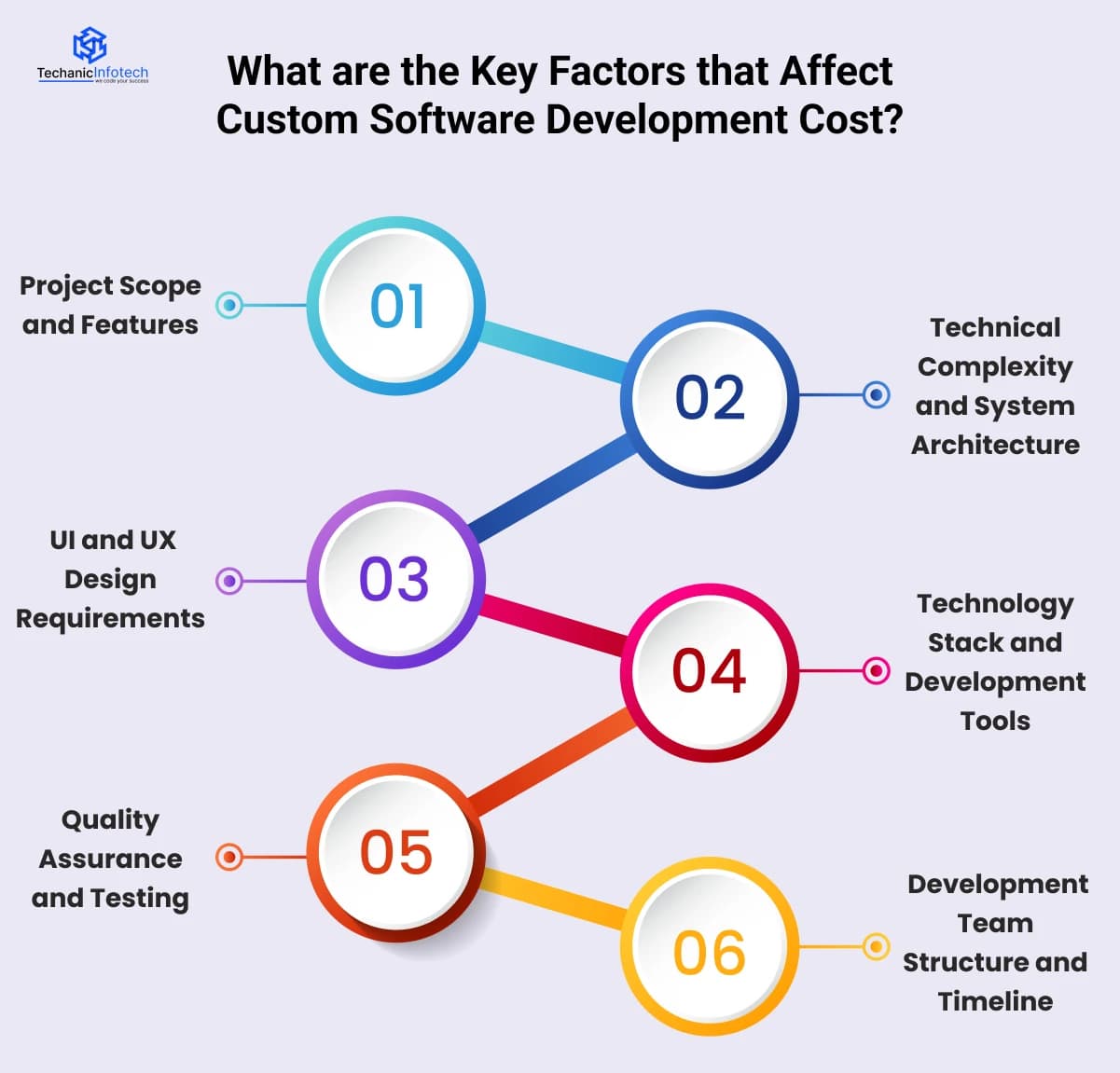
The project scope defines the amount of work required to build a software solution. It includes the number of features, system modules, integrations, and user roles involved in the project.
Clearly defining the technical project scope and minimum viable product development roadmap helps improve software project estimation and reduce the overall software development lifecycle cost.
Projects with a clear and limited feature set are easier to estimate and manage. However, when the scope expands to include complex workflows, multiple user roles, or advanced functionality, the level of software architecture complexity increases.
Technical decisions made during the planning stage play a critical role in determining the final cost of custom software development.
Applications that require scalable infrastructure, real-time data processing, microservices architecture, or third-party system integrations typically demand more development time and specialized expertise.
User Interface (UI) and User Experience (UX) design go far beyond visual aesthetics.
Modern applications require carefully designed interfaces, well-structured user journeys, and accessible layouts that meet usability standards.
These design processes also influence the overall custom application development cost.
The mobile app technology stack chosen for a project also influences web application development cost in 2026.
Programming languages, frameworks, cloud services, and third-party tools all affect how quickly software can be built and maintained.
Additionally, integrating external services such as payment gateways, analytics platforms, or AI tools can increase the AI software integration cost.
Quality assurance (QA) and testing are essential to ensure the software performs reliably in real-world conditions.
Testing includes several stages:
Manual testing
Automated testing
Performance testing
Security testing
Although testing may extend the development timeline, it improves software project cost estimation and prevents expensive fixes later.
The size, expertise, and geographic location of the dedicated software development team significantly affect software development hourly rates by region.
Highly experienced teams may charge higher development team hourly rates, but they often complete projects faster and with higher quality.
For businesses planning to build a web or mobile solution, the average custom software development cost typically ranges between $10,000 and $90,000+, depending on the scope of the project.
This includes web application development cost, mobile app development cost, and SaaS platform development, depending on the product type.
|
Aspect |
Simple Application |
Medium Complexity Application |
Complex Application |
|
Estimated Price |
$10,000 – $30,000 |
$30,000 – $60,000 |
$60,000 – $90,000+ |
|
Development Time |
1–2 months |
2–4 months |
4–6+ months |
|
What’s Included |
Basic functionality, simple UI, single platform |
Additional features, improved UI/UX, and integrations |
Advanced functionality, multi-platform support, custom UI |
Simple applications usually include basic functionality and minimal mobile app design requirements. These projects often focus on solving a single business problem and do not require advanced integrations.
Typical examples include:
Basic internal business tools
Simple booking systems
Small informational mobile apps
These projects usually cost between $10,000 and $30,000, making them ideal for companies planning an MVP development cost for startups.
Medium complexity applications involve more advanced features, better user interfaces, and third-party integrations.
These applications may include:
User authentication and dashboards
Payment gateway integration
API integrations
Advanced UI/UX components
Projects in this category usually cost between $30,000 and $60,000, depending on the startup software development cost estimate.
Complex software solutions require large-scale architecture, advanced features, and high-level customization. These projects often support multiple mobile app development services, such as web and mobile.
Examples include:
SaaS platforms
marketplace platforms
enterprise automation systems
advanced analytics platforms
The average cost of SaaS development or enterprise platforms usually ranges from $60,000 to $90,000+.
Artificial Intelligence (AI) is rapidly transforming custom software development in 2026. According to Gartner, global AI spending is expected to reach $2.5 trillion by 2026, showing how rapidly companies are investing in AI-powered systems.
While AI-powered features bring powerful benefits such as automation and predictive analytics, the AI software integration cost can increase the total development budget by 20% to 50%.
Businesses planning to build AI software should also consider the cost of building AI software infrastructure, including cloud computing, model training, and data pipelines.
Incorporating AI requires specialized skills in areas like machine learning, natural language processing, and computer vision. Developing these advanced mobile app features involves:
Hiring AI experts who typically command higher hourly rates
Spending extra time on preparing datasets, training models, and testing
Continuous iterations to improve AI accuracy and performance
Because of this complexity, projects that include AI features generally experience a 20% to 50% increase in development costs compared to traditional software.
AI systems rely heavily on large amounts of quality data. Managing this data entails:
Collecting, cleaning, and labeling datasets
Building and maintaining data pipelines
Investing in cloud infrastructure for AI training, deployment, and hosting
These data-related and infrastructure needs add roughly 10% to 30% extra cost to your project budget, covering both the initial setup and ongoing maintenance.
On the positive side, AI-powered development tools and automation platforms can speed up software creation by:
Accelerating prototyping and iteration
Reducing manual coding errors and bugs
Improving overall software quality
Utilizing AI-assisted tools during development can reduce certain costs by 10% to 20%, partially offsetting the increased expenses of AI feature development.
AI-driven software requires continuous updates and monitoring to stay effective. Maintenance activities include:
Regular retraining of AI models with new data
Addressing issues caused by data drift or evolving user behavior
Upgrading infrastructure to maintain scalability and performance
As a result, mobile app maintenance costs for AI software are typically 15% to 25% higher annually compared to traditional applications.
When estimating custom software development costs in 2026, where your development team is located plays a major role.
Hourly rates, project timelines, and quality standards can vary significantly depending on the region. Understanding these differences can help businesses optimize budgets without compromising quality.
|
Region |
Average Hourly Rate (USD) |
Typical Project Cost Range |
Notes |
|
United States |
$100 – $250 |
$30,000 – $150,000+ |
High cost, strong expertise, ideal for enterprise-level solutions |
|
Canada |
$80 – $200 |
$25,000 – $120,000 |
Slightly lower than the US, good for North American projects |
|
Western Europe |
$70 – $180 |
$25,000 – $120,000 |
Germany, the UK, and France offer quality and compliance-focused development |
|
Eastern Europe |
$35 – $80 |
$15,000 – $60,000 |
Poland, Ukraine, Romania: skilled developers at lower rates |
|
India |
$20 – $50 |
$10,000 – $40,000 |
Cost-effective, best for MVPs and startups |
|
Southeast Asia |
$15 – $45 |
$8,000 – $35,000 |
Vietnam, Philippines, Indonesia; competitive rates, growing talent pool |
US & Canada: Ideal for projects requiring high security, rapid communication, and enterprise-grade standards at a premium cost.
Eastern Europe: Offers a balance of quality and affordability, plus good overlap with European time zones.
India & Southeast Asia: Highly cost-effective; may require more detailed planning and management to ensure quality.
Pro Tip: Many companies adopt a hybrid approach combining onshore and offshore developers to balance cost, quality, and project speed.
Selecting the right software development pricing model can make or break your project budget.
Different models suit different project types, team structures, and timelines.
Understanding these options helps you plan effectively, minimize risks, and get the best value for your investment.
Here’s a breakdown of the most common pricing models, complete with real-world examples:
|
Pricing Model |
How It Works |
Pros |
Cons |
Best |
|
Fixed-Price |
Total cost agreed upfront; scope and timeline defined |
Predictable budget; low financial risk |
Less flexible; changes can increase costs |
Small to medium projects with clear requirements |
|
Time & Material (T&M) |
You pay for actual hours worked and resources used |
Flexible; adapts to changing requirements |
The budget can grow if the scope expands |
Projects with evolving requirements or R&D |
|
Dedicated Team |
A dedicated team works exclusively on your project, billed monthly |
Full control, scalable, efficient for long-term projects |
Requires management effort; less predictable if the team isn’t fully utilized |
Large projects, continuous development, or ongoing feature expansion |
|
Hybrid/Phased Approach |
Combines models (e.g., fixed-price for MVP, T&M for enhancements) |
Flexibility + cost predictability |
Can be complex to manage |
Complex projects with initial goals and evolving features |
Practical Examples:
Startup MVP (Fixed-Price): Imagine a small team building a booking app for local salons. Requirements are clear, and costs can be locked upfront.
Enterprise SaaS Platform (Dedicated Team): A company developing a cloud-based CRM for thousands of users, needing ongoing updates and custom integrations.
Hybrid Project: A marketplace app is initially launched as a fixed-price MVP. Later, AI recommendation features and advanced analytics are added using T&M billing.
Pro Tip: Always include a 10–20% contingency budget for unexpected changes, especially in T&M or hybrid models. This ensures smoother execution and avoids project delays.
Many businesses make the mistake of budgeting only for the initial build. However, in 2026, the Total Cost of Ownership (TCO) is influenced by ongoing operational needs. Failing to account for these can lead to a 20–30% budget shortfall in the first year alone.
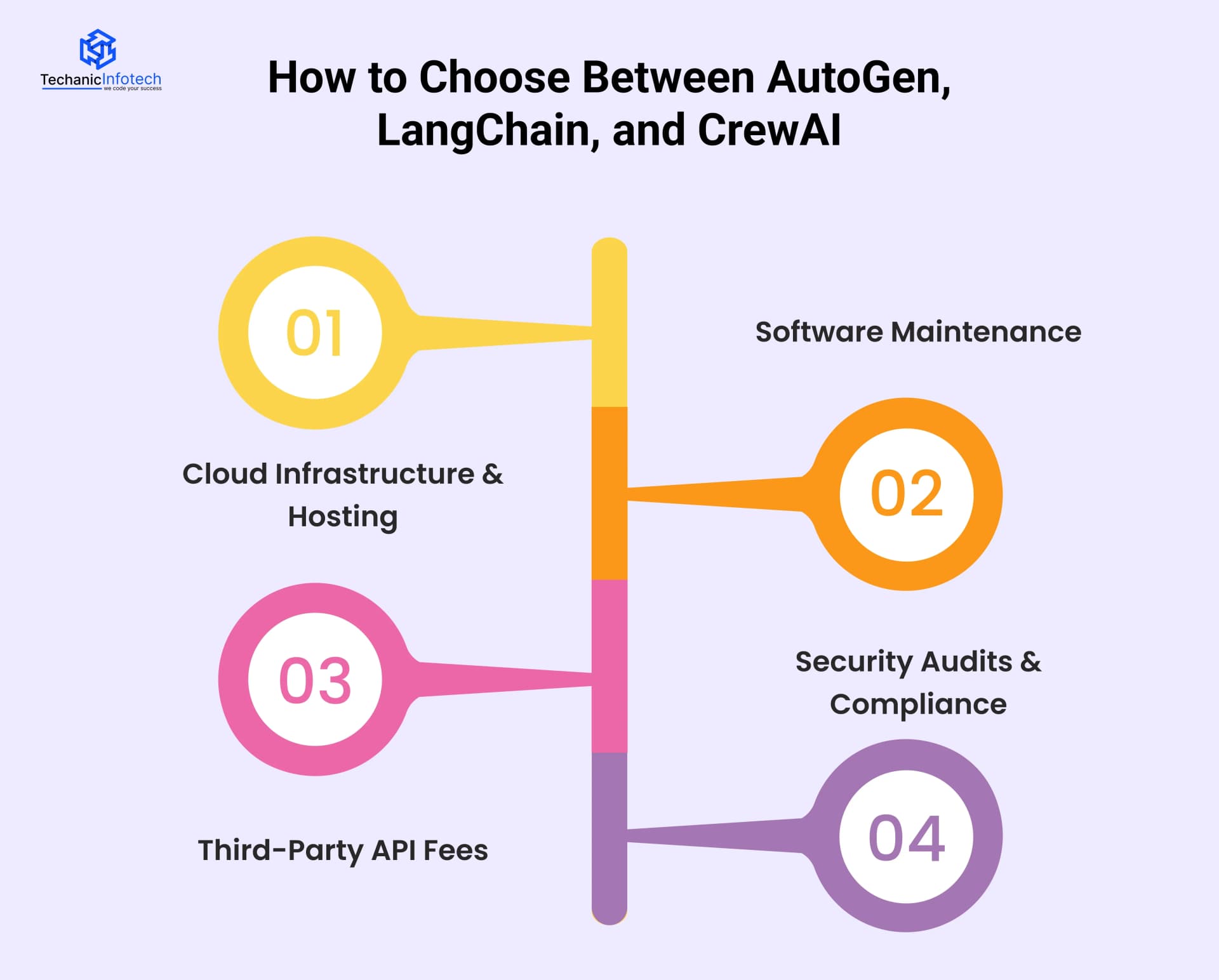
Software isn't a "set it and forget it" asset. You must budget for regular bug fixes, security patches, and updates to keep up with evolving operating systems (iOS/Android) and browser versions.
Depending on your user base, monthly cloud bills (AWS, Azure, or Google Cloud) can range from $500 to $10,000+. AI-heavy apps specifically consume more "compute power," which can spike these costs unexpectedly.
In 2026, data privacy is non-negotiable. If you handle healthcare data (HIPAA) or financial info (PCI-DSS), annual audits and penetration testing can add $5,000 to $20,000 to your yearly overhead.
Most modern apps rely on external services for maps, SMS, or AI (like OpenAI’s API). These are often "pay-as-you-go" and can scale rapidly with your user growth.
In 2026, the most effective way to lock in your budget and avoid "sticker shock" is through a Discovery Phase. Instead of jumping straight into coding, this 2-to-4-week planning stage acts as your financial insurance by defining exactly what will be built.
Eliminates Scope Creep: By mapping out every feature upfront, you prevent the "slow addition" of requirements that typically inflate budgets mid-project.
Identifies Technical Risks Early: Discovering that a specific AI integration or legacy database won't work is free during planning, but costs thousands to fix during the development phase.
Provides Budget Certainty: You move from a "ballpark guess" to a precise roadmap with 90%–95% cost accuracy.
Delivers Essential Blueprints: For an upfront investment of $3,000–$10,000, you receive clickable wireframes and a Software Requirements Specification (SRS) that you can use to get competitive, "apples-to-apples" quotes.
Expert Warning: Be wary of any agency that offers a "fixed price" for a complex project without a Discovery Phase; they are often overcharging to cover their own risks or will rely on expensive "Change Orders" later.
Navigating custom software development cost in 2026 requires balancing innovation with effective budget planning.
While the cost of custom software development typically ranges from $10,000 to $90,000+, businesses must also consider software maintenance and support fees, cloud infrastructure, and scaling costs.
Companies that invest in proper software development, pricing models, and accurate software project estimation can turn their development investment into a long-term competitive advantage.
Freelancers are usually 30–50% cheaper upfront but carry higher management risk. Agencies provide a full team (PM, QA, Designers), which often leads to a faster time-to-market and higher code quality, potentially saving money on long-term maintenance.
A "ballpark" estimate can take 24–48 hours, but a reliable, binding quote usually requires a 1–2 week deep dive into your business logic and technical needs.
Yes and no. AI coding assistants (like GitHub Copilot) can speed up development by 20%, but the cost of integrating AI features into your product often requires expensive, specialized talent, which can raise the overall project price.
In 2026, using cross-platform frameworks like Flutter or React Native allows you to build for both platforms using a single codebase, typically saving you 30–40% compared to building two separate native apps.


Abhishek Jangid is the CEO of Techanic Infotech, with extensive experience in mobile app and web development. He specializes in helping businesses turn innovative ideas into scalable digital solutions through strategic planning and modern technology.