Mobile App Development
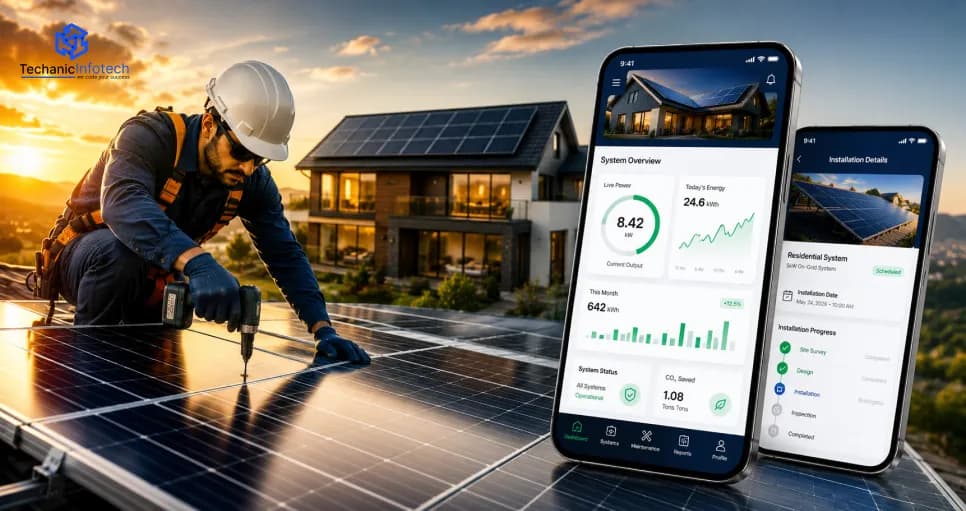
Solar Installation App Development: A Guide to Lead Tracking, Site Surveys & Project Management
August 6, 2026
August 6, 2026
Key Takeaways
Solar installation applications connect lead management, site surveys, project execution, and customer communication into one digital workflow.
Mobile-first platforms improve operational visibility while reducing manual coordination across installation teams.
AI and connected technologies are transforming how solar businesses manage projects, customers, and long-term maintenance.
Development investment typically ranges between $8,000 and $60,000+, depending on operational complexity and business requirements.
A scalable digital platform creates a strong foundation for long-term growth in the renewable energy industry.
The solar energy industry is expanding at an unprecedented pace as homeowners, commercial businesses, and governments invest in clean and sustainable power solutions. While demand continues to rise, solar installation companies face increasing pressure to manage leads efficiently, conduct accurate site surveys, coordinate installation teams, and complete projects on schedule. Relying on spreadsheets, paper forms, and disconnected software often creates delays, communication gaps, and operational inefficiencies.
To solve these challenges, businesses are investing in solar installation app development. Instead of managing every stage of a project through separate systems, modern applications bring lead management, site inspections, quotations, installation scheduling, customer communication, and project tracking together in one centralised platform.
Today's Solar App Development Guide focuses on much more than creating a mobile application. It helps businesses build connected digital ecosystems that improve productivity, reduce manual work, enhance customer experiences, and provide complete visibility throughout every stage of the solar installation lifecycle.
This guide explores how digital platforms are transforming solar operations, the essential capabilities every installer needs, the development journey behind modern solar software, estimated development costs, and the technologies shaping the future of renewable energy businesses.
The global solar industry continues to expand as governments, businesses, and homeowners accelerate investments in renewable energy. This rapid growth is increasing the demand for digital platforms that help solar companies manage leads, site surveys, installations, and long-term customer relationships more efficiently.
Solar Market Growth: According to Fortune Business Insights, the global solar energy market was valued at USD 273.81 billion in 2024 and is projected to reach USD 436.36 billion by 2032, growing at a CAGR of 6.1%.
Renewable Energy Expansion: The International Energy Agency (IEA) reports that solar PV remains the fastest-growing renewable electricity technology and is expected to account for the largest share of renewable capacity additions worldwide over the coming years.
Digital Transformation in Field Operations: Grand View Research highlights that the global field service management market is expanding rapidly as businesses adopt mobile workforce solutions, digital scheduling, GPS tracking, and workflow automation to improve operational efficiency.
AI Adoption in Renewable Energy: Deloitte reports that artificial intelligence is increasingly being used in renewable energy for predictive maintenance, energy forecasting, asset monitoring, and operational optimisation.
Selling and installing solar systems has become far more complex than scheduling an installation date. Every project moves through multiple stages, from capturing leads and conducting site inspections to preparing quotations, assigning technicians, tracking installation progress, and providing post-installation support. Managing these activities manually often slows growth and creates unnecessary operational challenges.
Digital platforms are helping solar companies replace disconnected processes with a streamlined workflow that keeps every department connected.
Potential customers can be captured instantly from websites, advertisements, referral campaigns, or sales representatives. Instead of manually following up with enquiries, businesses can automatically organise, assign, and monitor leads throughout the sales pipeline.
Technicians can record roof dimensions, installation requirements, photographs, GPS locations, and customer notes directly from mobile devices during on-site inspections. This eliminates paperwork while improving the accuracy of project planning.
Sales teams, survey engineers, project managers, installers, and customer support staff all work from the same system, ensuring every project progresses smoothly without communication gaps or duplicated work.
Business owners can monitor project status, installation schedules, pending approvals, equipment availability, and technician performance from a centralised dashboard, allowing faster decisions and improved operational control.
As renewable energy businesses continue expanding, many organisations partner with an experienced software development company to build scalable digital platforms that support higher project volumes, automate workflows, and prepare the business for long-term growth in the evolving solar market.
As solar installation businesses grow, the number of projects, customer enquiries, technicians, and site visits increases dramatically. What once worked with spreadsheets, phone calls, and paper documents quickly becomes difficult to manage at scale.
The table below highlights some of the most common operational challenges faced by growing solar businesses.
|
Challenge |
Operational Impact |
|
Scattered Lead Information |
Customer enquiries from multiple channels become difficult to track, resulting in missed sales opportunities. |
|
Manual Site Survey Reports |
Paper-based inspections slow proposal preparation and increase the risk of inaccurate measurements. |
|
Project Scheduling Conflicts |
Coordinating survey teams, installers, and customer availability manually often causes delays. |
|
Poor Team Communication |
Sales, engineering, and installation teams operate in silos, leading to duplicated work and project confusion. |
|
Limited Project Visibility |
Managers struggle to monitor installation progress across multiple ongoing projects. |
|
Document Management Issues |
Contracts, permits, quotations, and installation records become difficult to organise and retrieve. |
|
Delayed Customer Updates |
Customers receive limited visibility into installation timelines, reducing overall satisfaction. |
|
Inefficient Resource Planning |
Equipment, technicians, and vehicles are not always allocated efficiently, affecting productivity. |
|
Difficulty Measuring Performance |
Without centralised reporting, businesses cannot accurately evaluate sales conversion, project completion rates, or team performance. |
A successful solar installation platform doesn't treat sales, engineering, and project execution as separate processes. Instead, it creates a continuous workflow where information moves automatically from one stage to the next, reducing manual effort and improving collaboration across the business.
Every project begins with a potential customer inquiry. The platform captures leads from websites, social media campaigns, referral programmes, or sales representatives and organises them into a structured sales pipeline. Teams can prioritise opportunities, schedule follow-ups, and monitor conversion progress from a single dashboard.
Once a lead is qualified, field engineers perform on-site inspections using a mobile application. Roof measurements, photographs, shading analysis, GPS coordinates, and installation notes are recorded digitally, allowing office teams to begin project planning immediately after the survey is completed.
Based on the survey data, the system generates accurate quotations, estimated energy production, installation timelines, and project documents. This shortens the sales cycle while improving pricing consistency.
After customer approval, project managers schedule technicians, allocate equipment, assign installation dates, and monitor project milestones through a centralised dashboard. Businesses investing in custom software development often tailor these workflows to match their internal approval processes and operational requirements.
Throughout the project lifecycle, customer communication remains centralised. Many businesses integrate CRM development services to manage follow-ups, document sharing, payment tracking, support requests, and long-term customer relationships after installation is complete.
By connecting every operational stage into one platform, solar companies reduce administrative overhead, improve project visibility, and deliver a more consistent customer experience from the first inquiry to the final installation. Working with an experienced mobile app development company helps businesses design scalable workflows that support sales, site surveys, installation teams, and customer communication within a single connected platform.
A modern solar installation platform should support every department involved in delivering a project. Instead of focusing only on customer bookings or installation schedules, the software should help sales teams close more deals, engineers perform accurate surveys, project managers monitor execution, and business owners measure performance.
The platform should help businesses capture, organise, and convert leads efficiently.
Core capabilities include:
Lead capture from multiple channels
Sales pipeline management
Follow-up reminders
Customer profile management
Proposal generation
Digital quotations
Accurate site assessments are critical for successful solar installations. Mobile survey tools reduce paperwork while improving project planning.
Core capabilities include:
GPS-enabled surveys
Roof measurements
Photo documentation
Digital inspection forms
Shading analysis
Survey reports
Once a project is approved, managers need complete visibility over every installation stage.
Core capabilities include:
Technician scheduling
Installation timeline management
Task assignment
Progress tracking
Material allocation
Project status updates
Customers expect complete transparency throughout the installation process.
Core capabilities include:
Appointment scheduling
Project progress tracking
Document access
Payment history
Installation notifications
Support requests
Business owners require real-time insights to make informed decisions.
Core capabilities include:
Lead conversion reports
Revenue analytics
Installation performance
Team productivity
Project completion statistics
Customer satisfaction reports
Rather than operating as individual tools, these modules work together to create a connected platform that improves operational efficiency while supporting business growth.
Building a solar installation platform is an iterative process that combines business planning, field operations, and software engineering. Instead of trying to deliver every feature at once, successful businesses focus on creating a reliable foundation that can evolve as operations grow.
Identify the problems the application should solve. This may include improving lead management, simplifying site surveys, coordinating installation teams, or reducing project delays.
Document how information flows between sales representatives, survey engineers, project managers, installers, and customers. This ensures the software supports real business processes instead of creating additional work.
Create separate interfaces for customers, field technicians, project managers, and administrators. Each user should have quick access to the tools they use most frequently.
Develop lead management, customer accounts, digital surveys, project scheduling, notifications, reporting, and payment modules. Businesses entering the renewable energy market often begin with on-demand app development practices by launching essential functionality first and expanding the platform through continuous releases.
Connect mapping services, payment gateways, CRM platforms, cloud storage, document management, and communication tools to streamline day-to-day operations.
Verify the complete customer journey, from lead capture and survey submission to installation scheduling and project completion, while testing application performance, security, and reliability.
Deploy the platform, migrate business data, onboard employees, and monitor early customer feedback to ensure a smooth transition to digital operations.
Introduce automation, analytics, AI capabilities, and operational enhancements based on business growth and user feedback. Working with an experienced mobile app developer helps businesses maintain performance, introduce new features, and support future expansion without interrupting daily operations.
Behind every successful solar installation platform is a technology ecosystem that connects office teams, field engineers, installers, customers, and business systems in real time. Rather than focusing on programming languages alone, businesses should choose technologies that support scalability, mobility, and operational efficiency.
Cloud platforms provide centralised access to project information, customer records, site survey reports, installation schedules, and business analytics. This allows every department to work with the latest information regardless of location.
Artificial intelligence is becoming an important part of modern solar operations. Many businesses collaborate with an experienced AI development company to implement intelligent features such as lead scoring, project scheduling, predictive maintenance, energy production forecasting, and automated customer support.
Installation teams spend most of their time outside the office. Integrating field service management software allows businesses to assign jobs, optimise technician schedules, navigate installation sites, update work progress, and complete inspections directly from mobile devices.
Customer contracts, financial information, engineering drawings, and installation records require strong security. Secure authentication, encrypted communication, automated backups, and role-based permissions help protect sensitive business data while maintaining regulatory compliance.
Modern solar platforms increasingly leverage IoT-enabled devices to collect operational data from installed systems. Through renewable energy software development, businesses can monitor equipment performance, identify faults remotely, and generate maintenance alerts before system failures occur.
When businesses ask about the cost of a solar installation application, the answer depends less on the number of screens and more on the operational problems the software is expected to solve. A platform that only manages customer enquiries requires a much smaller investment than one that coordinates sales teams, survey engineers, installation crews, inventory, and post-installation support.
Instead of thinking about cost in terms of "basic" or "advanced" software, it's more useful to understand how the project budget is distributed across different parts of the platform.
|
Development Area |
Estimated Investment |
|
Customer Portal & Booking Experience |
$5,000–$10,000 |
|
Lead Tracking & CRM Workflow |
$4,000–$8,000 |
|
Digital Site Survey Module |
$5,000–$10,000 |
|
Installation & Project Management |
$8,000–$15,000 |
|
Analytics, Reporting & Admin Dashboard |
$5,000–$10,000 |
|
AI & Automation Features |
$5,000–$12,000 |
|
Third-Party Integrations & Cloud Infrastructure |
$6,000–$12,000 |
Most businesses launching their first digital platform don't build every module at once. They begin with customer management, digital surveys, and project scheduling, then gradually expand the system with AI capabilities, predictive analytics, inventory automation, and advanced reporting as operations grow.
The solar installation industry is becoming more competitive as customer expectations, project volumes, and operational complexity continue to grow. Businesses that rely on manual coordination often struggle to maintain efficiency, while companies embracing digital platforms gain greater visibility, faster project execution, and stronger customer relationships.
Whether you're building a solution for residential installers or large commercial solar providers, investing in a well-designed solar installation platform helps streamline operations today while preparing your business for the next generation of intelligent renewable energy solutions.
Solar installation app development involves building software that helps solar companies manage leads, conduct site surveys, schedule installations, monitor project progress, and improve customer communication through a centralised digital platform.
The overall investment typically ranges from $8,000 to $60,000+, depending on the project's complexity, required modules, AI capabilities, integrations, and customisation.
Essential features include lead management, digital site surveys, quotation generation, installation scheduling, technician management, customer communication, analytics dashboards, and project tracking.
Most projects require 2 to 10 months, depending on the number of features, integrations, business workflows, and level of customisation.
Yes. AI can automate lead qualification, improve project scheduling, forecast maintenance needs, optimise resource allocation, and provide predictive business insights
Yes. Modern solar installation platforms can integrate with CRM software, ERP systems, accounting platforms, payment gateways, mapping services, and monitoring tools.
Yes. A centralised platform can manage multiple survey teams, installation crews, service engineers, and regional offices while providing real-time project visibility.
Digital platforms improve operational efficiency, reduce paperwork, streamline communication, enhance customer experience, and provide real-time visibility across the entire installation lifecycle.


Bharat Sharma is the CTO of Techanic Infotech, bringing deep technical expertise in software architecture, mobile app development, and scalable system design. He leads the engineering team with a strong focus on innovation, performance, and security.