Mobile App Development
Sports Performance Analytics Software Development: Complete Guide to Features, Cost & Benefits
July 27, 2026
July 27, 2026
Key Takeaways
Sports performance analytics software helps organisations make data-driven decisions that improve athlete performance and coaching efficiency.
Modern analytics platforms combine AI, wearable integrations, and real-time data to optimise training, monitor health, and reduce injury risks.
Essential features include performance tracking, video analysis, reporting dashboards, wearable connectivity, and cloud-based data management.
Development costs typically range from $10,000 to $100,000+, depending on platform complexity, AI capabilities, and integrations.
Investing in a scalable analytics platform enables sports organisations to enhance player development, improve operational efficiency, and remain competitive in an increasingly data-driven sports industry.
Data has become one of the most valuable assets in modern sports. Professional teams, coaches, fitness organisations, and sports academies now rely on advanced analytics to measure athlete performance, reduce injury risks, optimise training programmes, and improve competitive outcomes. Instead of depending solely on observation, organisations use real-time data to make faster and more informed decisions.
This growing demand has accelerated investment in sports performance analytics software, enabling sports organisations to collect, analyse, and visualise performance data from multiple sources, including wearable devices, video analysis systems, GPS trackers, and biometric sensors.
Whether you're planning sports analytics software development for a professional team, a training academy, or a fitness organisation, building an intelligent analytics platform can help improve athlete development, coaching strategies, and overall operational efficiency. In this guide, we'll explore the essential features, business benefits, development process, technology stack, implementation costs, and future trends shaping the next generation of sports analytics platforms.
Sports performance analytics software is a digital platform that collects, processes, and analyses athlete and team performance data to help coaches, trainers, analysts, and sports organisations make informed decisions. Instead of relying solely on manual observations, these platforms transform performance metrics into actionable insights that improve training, strategy, and player development.
Modern sports performance tracking software integrates data from GPS devices, wearable sensors, heart-rate monitors, video analysis tools, and training equipment to provide a comprehensive view of an athlete's physical and tactical performance.
A typical sports data analytics platform can monitor the following:
Speed, distance, and acceleration
Heart rate and recovery metrics
Training workload
Injury risk indicators
Match and practice performance
Team and player comparisons
Historical performance trends
Whether used by professional sports teams, academies, fitness organisations, or rehabilitation centres, these platforms help optimise performance while supporting evidence-based coaching decisions.
The sports industry is rapidly embracing data-driven decision-making, making analytics software an essential investment for professional teams, leagues, training academies, and sports technology companies.
According to Grand View Research, the global sports analytics market was valued at approximately USD 4.3 billion in 2024 and is projected to grow at a strong compound annual growth rate (CAGR) through the next decade as organisations increase investment in data-driven performance analysis.
Fortune Business Insights projects significant growth in the sports analytics market, driven by the increasing adoption of AI, cloud computing, wearable technologies, and real-time performance monitoring across professional and amateur sports.
MarketsandMarkets reports that the growing use of wearable sensors, athlete monitoring systems, and predictive analytics is accelerating demand for advanced sports analytics platforms worldwide.
The effectiveness of athlete performance analytics software depends on its ability to collect accurate data, generate meaningful insights, and present information in a way that coaches, athletes, and sports organisations can easily understand. A well-designed platform should combine real-time monitoring, intelligent analytics, and intuitive reporting to improve both individual and team performance.
Below are the essential features of sports analytics software that every modern platform should include.
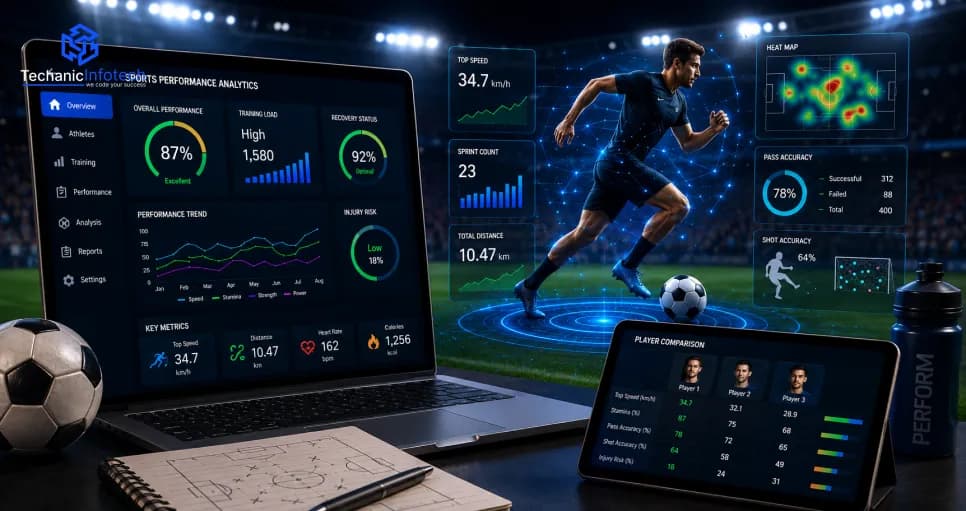
A centralised dashboard provides coaches and analysts with live performance metrics, training summaries, workload analysis, and athlete health indicators. Real-time visualisation enables faster decision-making during both training sessions and competitions.
One of the core capabilities of sports performance tracking software is monitoring an athlete's physical and technical performance over time. The platform should track key metrics such as speed, acceleration, endurance, heart rate, workload, recovery, and overall fitness progression. This allows coaches to evaluate performance trends and personalise training programmes based on objective data.
Modern sports organisations increasingly rely on smartwatches, GPS trackers, biometric sensors, and fitness bands to collect real-time performance data. Integrating these devices ensures continuous monitoring while reducing manual data collection. Organisations investing in wearable app development often connect wearable ecosystems with analytics platforms to provide coaches with more comprehensive athlete insights.
Video analytics allows coaches to review matches and training sessions frame by frame. Combined with performance data, it helps identify tactical improvements, player positioning, movement patterns, and technical weaknesses.
Monitoring workload, recovery, fatigue levels, and biometric indicators helps identify athletes who may be at greater risk of injury. Early detection enables coaching staff to adjust training intensity before performance declines or injuries occur.
Beyond individual performance, the platform should provide team-wide insights such as tactical efficiency, player comparisons, workload distribution, match statistics, and overall squad performance. These analytics help coaching staff make informed strategic decisions.
Comprehensive reporting tools allow coaches and management to generate performance summaries, training reports, historical comparisons, and custom analytics dashboards. Visual reports simplify complex datasets and support data-driven decision-making.
Different stakeholders require different levels of access. Athletes, coaches, fitness trainers, medical staff, and administrators should each have customised dashboards with role-based permissions while securely accessing data through cloud infrastructure.
A successful sports analytics platform depends on a technology stack that can process large volumes of real-time performance data while delivering fast, accurate, and actionable insights. The right technologies ensure scalability, security, seamless integrations, and high-performance analytics for athletes, coaches, and sports organisations.
|
Component |
Recommended Technologies |
|
Frontend |
Flutter, React Native, React.js |
|
Backend |
Node.js, Python, Java, .NET |
|
Database |
PostgreSQL, MongoDB, Firebase |
|
Cloud Platform |
AWS, Microsoft Azure, Google Cloud |
|
Data Visualization |
Power BI, Tableau, Grafana |
|
AI & Machine Learning |
TensorFlow, PyTorch, OpenAI APIs |
|
Real-Time Data Processing |
Apache Kafka, MQTT |
|
Wearable Integration |
Apple HealthKit, Google Health Connect, Fitbit APIs |
Building an enterprise-grade sports analytics platform requires expertise in AI, cloud computing, wearable integrations, and large-scale data processing. Many organisations partner with an experienced AI development company to develop intelligent analytics models and integrate predictive capabilities into their platforms.
Similarly, working with a trusted mobile app development company helps businesses build secure, scalable mobile applications that enable coaches, athletes, and analysts to access performance insights anytime, anywhere.
Building sports analytics software development requires more than collecting athlete data. A successful platform must combine performance tracking, AI-powered analytics, wearable integrations, and intuitive dashboards to deliver actionable insights for coaches, athletes, and sports organisations.
Below is a typical development roadmap followed by most sports technology projects.
The first step is identifying the platform's primary goals. Some organisations focus on athlete performance tracking, while others prioritise injury prevention, tactical analysis, or team management. Clearly defining objectives helps determine the required features and technology stack.
Create intuitive dashboards for coaches, athletes, medical staff, and administrators. The interface should simplify data visualisation while making complex performance metrics easy to understand and analyse.
Develop the platform's essential functionality, including athlete profiles, performance tracking, wearable integrations, AI-powered analytics, reporting dashboards, and role-based access management.
Connect the platform with wearable devices, GPS trackers, heart-rate monitors, video analysis systems, and third-party APIs to collect accurate real-time performance data from multiple sources.
Perform functional testing, performance testing, security validation, and integration testing to ensure the platform operates reliably across different devices and environments before deployment.
After launch, continuously monitor platform performance, gather user feedback, improve AI models, release feature updates, and expand integrations to support evolving business and athlete requirements.
The sports analytics software cost depends on several factors, including platform complexity, AI capabilities, wearable integrations, cloud infrastructure, data visualisation requirements, and third-party API integrations.
A basic analytics solution designed for local sports academies requires a smaller investment, while enterprise-grade platforms with real-time analytics and predictive AI involve significantly higher development costs.
|
Solution Type |
Estimated Cost |
Development Timeline |
|
Basic Sports Analytics Software |
$8,000–$20,000 |
2–3 Months |
|
Standard Performance Analytics Platform |
$20,000–$45,000 |
3–5 Months |
|
Advanced AI Sports Analytics Platform |
$45,000–$75,000 |
5–7 Months |
|
Enterprise Sports Data Analytics Platform |
$75,000–$100,000+ |
7–10 Months |
Before planning the project budget, organisations should also evaluate the overall software development cost, especially if the analytics platform will integrate with existing enterprise systems or additional digital products. Professional sports organisations developing companion mobile applications should also consider the complete investment required for mobile platforms alongside their analytics solution.
Sports analytics has become an essential part of modern athlete development and team management. By combining real-time performance tracking, AI-powered insights, wearable technology, and advanced reporting, organisations can make faster and more informed decisions that improve both individual and team performance. Whether you're developing a solution for a professional club, sports academy, or fitness organisation, investing in a scalable analytics platform creates long-term value by enhancing training, reducing injury risks, and supporting continuous performance improvement in an increasingly competitive sports landscape.
Sports performance analytics software is a digital platform that collects, analyses, and visualises athlete and team performance data to help coaches, trainers, and sports organisations improve training, strategy, and decision-making.
The sports analytics software cost generally ranges from $10,000 to $100,000+, depending on platform complexity, AI features, wearable integrations, cloud infrastructure, and customisation requirements.
Essential sports analytics software features include athlete performance tracking, wearable integration, video analysis, injury risk monitoring, reporting dashboards, team analytics, and cloud-based data management.
Professional sports teams, academies, fitness organisations, sports scientists, coaches, rehabilitation centres, and athletic training facilities all use athlete performance analytics software to improve performance and monitor player development.
Yes. AI helps analyse performance trends, predict injury risks, automate match analysis, personalise training plans, and provide intelligent recommendations for coaches and athletes.
Wearable devices provide real-time biometric and movement data, enabling coaches to monitor athlete workload, recovery, heart rate, speed, and overall performance more accurately.
Development typically takes 2 to 10 months, depending on the number of features, AI capabilities, integrations, and overall platform complexity.
Yes. Modern analytics platforms can integrate with wearable devices, GPS trackers, video analysis tools, ERP systems, cloud platforms, and other sports management solutions to create a centralised performance ecosystem.


Bharat Sharma is the CTO of Techanic Infotech, bringing deep technical expertise in software architecture, mobile app development, and scalable system design. He leads the engineering team with a strong focus on innovation, performance, and security.