Cloud App Development
What Is Edge Computing, and Why Does It Matter for Enterprises?
September 24, 2026
September 24, 2026
Key Takeaways:
Edge computing solves a real latency problem: processing data near its source eliminates the delay of round-tripping to distant cloud servers.
The market is growing explosively, driven by IoT, 5G, and AI workloads that demand real-time processing at scale.
Edge complements cloud; it doesn't replace it: most enterprises use both strategically for different types of workloads.
Real tradeoffs exist: higher upfront costs and management complexity require honest evaluation before committing to adoption.
Starting small reduces risk: a focused pilot project validates real-world value before scaling deployment across the organization.
Every second a self-driving car spends waiting for a cloud server to respond is a second too long. Same goes for a factory sensor flagging a malfunctioning machine, or a hospital monitor tracking a patient's vitals in real time.
When milliseconds matter, sending data on a round trip to a distant data center and back just doesn't cut it anymore.
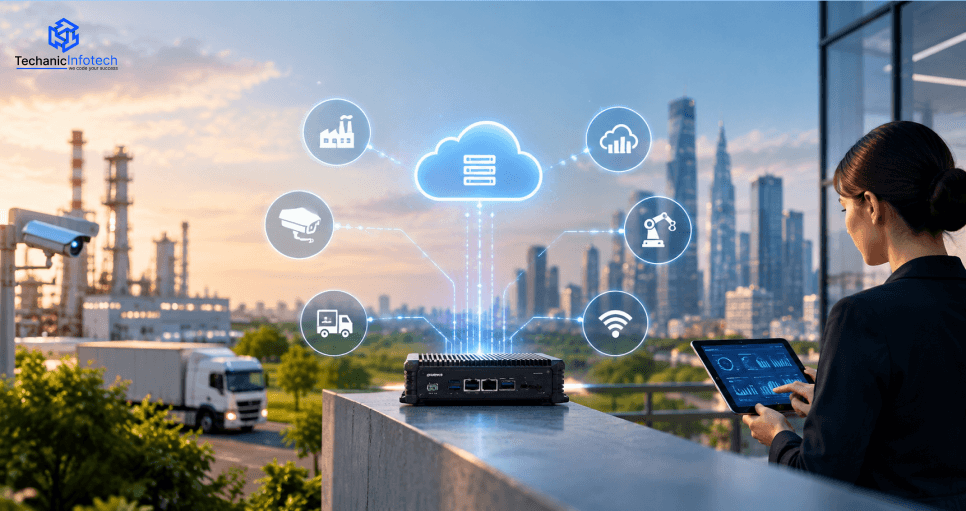
That's the exact problem edge computing solves. Instead of processing data far away in centralized cloud servers, edge computing brings computation closer to where data actually gets created, cutting latency dramatically and reducing strain on network bandwidth.
For enterprises managing IoT devices, real-time analytics, or mission-critical operations, this shift isn't just a technical upgrade; it's becoming a genuine competitive necessity.
This guide breaks down what edge computing actually is and why it matters.
If you've ever wondered what edge computing is and why it's suddenly everywhere in enterprise tech conversations, the short answer is this: it processes data closer to where it's actually generated, rather than sending everything to a distant cloud server first.
Instead of every sensor, camera, or device sending raw data across the internet to a centralized data center, edge computing processes that data locally or at a nearby "edge" node.
This proximity dramatically cuts the time between data creation and actionable insight.
This isn't a fringe technology anymore.
Edge computing for enterprises is expanding rapidly, with the global market projected to grow from $111.34 billion in 2026 to $317.39 billion by 2031, at a CAGR of 23.3%, driven by IoT, 5G, and real-time AI workloads.
Big organizations aren't waiting on the sidelines.
Large enterprises are expected to hold a dominant 55.79% share of the edge computing market in 2026, driven largely by the explosive growth of IoT-connected devices requiring faster, localized data processing than centralized cloud infrastructure can reliably deliver.
By handling data locally instead of shipping it back and forth to the cloud, edge computing cuts response times significantly while also reducing the sheer volume of data that needs to travel across the network, lowering bandwidth costs in the process.
Understanding edge computing architecture helps businesses evaluate whether and how to adopt this technology intelligently.
These six components work together to move processing closer to data sources while still connecting back to centralized systems when needed.
These are the physical devices generating raw data, sensors, cameras, industrial equipment, smartphones, or IoT devices.
They sit at the very edge of the network, closest to where real-world activity actually happens, forming the starting point for every data stream the system processes.
Enterprise edge computing relies on local servers or gateways positioned near edge devices to process data before it travels further.
These nodes handle immediate computation, filtering, and basic analysis, reducing the amount of raw data that needs to reach centralized cloud infrastructure.
This layer performs real-time analysis directly at the edge, running algorithms and AI models locally rather than waiting for a round trip to a distant server.
This local processing is what actually delivers the low-latency response edge computing is known for.
Edge nodes still need reliable connectivity to communicate with each other and with centralized systems when necessary.
Technologies like 5G play a significant role here, providing the fast, low-latency connections that make distributed edge architectures practical at meaningful enterprise scale.
Rather than replacing the cloud entirely, most edge computing solutions work alongside centralized infrastructure, sending only summarized or critical data upward for deeper analysis, long-term storage, or cross-location insights that don't require the same real-time urgency as edge-level processing.
With data processing distributed across potentially thousands of edge locations, this layer handles monitoring, updates, and coordination across the entire network.
Strong orchestration ensures consistency and security across every edge node, even as the deployment scales to hundreds or thousands of sites.
Beyond the technical mechanics, edge computing for enterprises delivers real, measurable business advantages.
These six reasons explain why adoption keeps accelerating across manufacturing, healthcare, retail, and nearly every data-intensive industry today.
For applications where milliseconds genuinely matter, autonomous vehicles, industrial automation, real-time fraud detection, edge computing eliminates the delay caused by sending data to a distant server and waiting for a response.
This speed advantage directly translates into safer, more responsive systems.
Processing data locally means only relevant, summarized information needs to travel across the network, rather than raw data from every single sensor or device.
This significantly reduces bandwidth consumption and the associated costs, especially for enterprises managing thousands of connected devices simultaneously.
Since edge devices can process data locally without depending on a constant cloud connection, operations continue functioning even during network outages or poor connectivity.
This resilience matters enormously for remote facilities or mission-critical systems that can't afford downtime.
Keeping sensitive data local, rather than transmitting everything to centralized servers, reduces exposure to interception and helps businesses meet data sovereignty requirements in regulated industries.
This localized approach gives enterprises more direct control over how sensitive information gets handled.
Businesses investing in custom software development increasingly build AI models designed to run directly at the edge, enabling real-time decision-making for tasks like quality inspection or predictive maintenance without depending on constant cloud connectivity for every single inference.
Enterprises that adopt edge computing gain the ability to act on data immediately rather than waiting for centralized processing.
This speed advantage compounds over time, letting businesses respond to operational issues, customer behavior, or market conditions faster than competitors still relying solely on centralized cloud infrastructure.
Understanding edge computing vs. cloud computing isn't about choosing one over the other; most enterprises use both together strategically.
Knowing exactly where they differ helps businesses decide which workloads belong where within their broader infrastructure strategy.
|
Factor |
Cloud Computing |
Edge Computing |
|
Data Processing Location |
Centralized data centers, often far from the data source |
Near or at the source where data is generated |
|
Latency |
Higher, due to data travel time to and from central servers |
Significantly lower, since processing happens locally |
|
Bandwidth Usage |
Higher, since raw data travels across the network constantly |
Lower, since only relevant, summarized data gets transmitted |
|
Reliability During Outages |
Dependent on stable internet connectivity |
Can continue operating locally during connectivity disruptions |
|
Scalability |
Highly scalable with virtually unlimited centralized resources |
Scalable but distributed, requiring management across many nodes |
|
Data Privacy |
Data travels to and resides in centralized, often third-party servers |
Sensitive data can stay local, supporting data sovereignty needs |
|
Best Suited For |
Large-scale data storage, batch processing, and complex analytics |
Real-time applications requiring immediate response and action |
|
Infrastructure Cost |
Lower upfront cost, pay-as-you-go cloud pricing models |
Higher upfront investment in distributed hardware and nodes |
|
Maintenance Complexity |
Centralized, generally simpler to manage and update |
More complex, requiring coordination across many distributed locations |
|
Common Use Cases |
Enterprise applications, data warehousing, and web hosting |
IoT devices, autonomous systems, and industrial automation |
Abstract benefits become clearer once you see how businesses actually apply this technology.
These real-world edge computing use cases show exactly where speed, reliability, and local processing deliver genuine operational value across different industries.
Factories use edge computing benefits to monitor equipment in real time, detecting vibration patterns or temperature anomalies that signal impending failure.
Processing this data locally means machines get flagged for maintenance within seconds, rather than waiting for delayed cloud analysis to catch the problem.
Self-driving cars can't afford the latency of sending sensor data to a distant server and waiting for a response before reacting to a pedestrian or obstacle.
Edge computing processes this data directly onboard, enabling split-second decisions that keep passengers and pedestrians safe.
Wearable and bedside patient monitors rely on enterprise software development built around edge processing to analyze vital signs instantly, alerting medical staff to critical changes immediately rather than after a delay caused by routing data through centralized cloud infrastructure first.
Understanding how edge computing works becomes clear in retail settings, where cameras and sensors analyze foot traffic, inventory levels, and checkout patterns locally, letting stores adjust staffing or restock shelves in real time without waiting on cloud-based processing delays.
Cities use edge-connected sensors to monitor traffic flow, adjusting signal timing in real time to reduce congestion.
This localized processing responds to actual road conditions instantly, something centralized cloud systems simply can't match given the inherent delay in round-trip data transmission.
Remote facilities like oil rigs or mining sites often have limited, unreliable internet connectivity, making edge computing essential for continuous monitoring and safety systems that need to function reliably regardless of whether a stable cloud connection is available at any given moment.
Edge computing isn't a universal upgrade; it comes with real trade-offs businesses need to weigh honestly.
Whether you're working with an internal team or a software development company, here are eight challenges worth understanding before committing to adoption.
Deploying distributed hardware across multiple edge locations costs significantly more initially than relying entirely on centralized cloud infrastructure.
Businesses sometimes underestimate this investment, since edge nodes, gateways, and local processing hardware all add real capital expense before any benefits materialize.
Solution: Start with a focused pilot deployment at one or two high-impact locations to validate ROI before committing to a full-scale rollout across the entire organization.
Coordinating updates, security patches, and monitoring across potentially hundreds or thousands of distributed edge nodes is far more complex than managing centralized cloud infrastructure from one location, creating real operational overhead that grows with deployment scale.
Solution: Invest in strong orchestration and management platforms specifically built for distributed edge environments, rather than trying to manage each node manually.
Every additional edge node represents a potential attack surface, and securing hundreds of distributed locations is inherently harder than securing one centralized data center with unified security policies and monitoring.
Solution: Apply consistent security policies across every edge node through centralized management tools, and conduct regular security audits specifically designed for distributed architectures.
Edge devices typically have less computational power than centralized cloud servers, limiting the complexity of models or analysis that can run locally without performance degradation or unacceptable delays.
Solution: Design edge workloads specifically for lightweight, optimized processing, reserving more computationally intensive tasks for centralized cloud resources when real-time response isn't required.
When data gets processed locally at multiple edge sites, ensuring consistency and synchronization with centralized systems becomes genuinely challenging, especially when connectivity between locations is intermittent or unreliable.
Solution: Implement robust data synchronization protocols and conflict-resolution logic that reconcile local and centralized data automatically once connectivity is restored.
Building and maintaining edge computing architecture requires specialized skills in distributed systems that many internal teams simply don't have readily available, creating a real hiring or training challenge.
Solution: Partner with experienced vendors or consultants during initial deployment while simultaneously investing in training to build internal expertise over time.
Since many edge computing benefits, reduced latency and improved reliability, show up gradually rather than immediately, some stakeholders struggle to justify the upfront investment before seeing measurable results.
Solution: Track specific performance metrics before and after deployment, response time, downtime reduction, bandwidth savings, to demonstrate concrete ROI to stakeholders over time.
The edge computing market includes numerous vendors and competing standards, making it genuinely difficult to choose compatible technologies that will work well together and remain supported long-term.
Solution: Prioritize vendors with strong interoperability standards and established track records, rather than chasing the newest, least-proven technology options available.
Moving from curiosity to actual implementation requires a structured approach.
Whether you're exploring edge computing alongside 5G app development or as a standalone infrastructure investment, these eight steps help you get started without unnecessary risk or wasted spend.
Rather than adopting edge computing broadly across the organization immediately, identify specific processes where latency, bandwidth, or reliability genuinely limit current operations.
Starting with a clear, high-value use case makes it easier to measure success and justify further investment later.
Before deploying anything new, evaluate your existing network, connectivity, and data flows to understand what's already in place and where gaps exist.
This assessment reveals whether current infrastructure can support edge deployment or requires meaningful upgrades first.
Rather than committing to a full-scale rollout immediately, launch a focused pilot at one location or use case.
This lets you validate real-world performance, measure actual benefits, and identify unexpected challenges before scaling the investment across the broader organization.
Selecting vendors and platforms with strong interoperability, proven reliability, and genuine edge computing experience matters significantly.
Avoid choosing based solely on cost or marketing claims, since the wrong technology foundation creates problems that compound as deployment scales.
Rather than treating security as an afterthought, build strong authentication, encryption, and monitoring into your edge architecture from day one.
Retrofitting security into an already-deployed distributed system is significantly harder than designing it in from the beginning.
Whether hiring specialized talent or training existing staff, ensure your team understands distributed systems management before scaling deployment.
Teams without this expertise often struggle with the operational complexity that comes with managing infrastructure across many locations.
Define specific, measurable goals before deployment- reduced latency, improved uptime, bandwidth savings- so you can objectively evaluate whether the pilot actually delivered value before committing further resources to broader rollout.
Once the pilot demonstrates clear value, expand deployment incrementally rather than all at once, applying lessons learned from the initial rollout to avoid repeating the same mistakes across additional locations or use cases.
Edge computing has moved from an emerging concept to a genuine enterprise necessity, driven by the explosive growth of IoT devices, 5G networks, and real-time AI workloads that simply can't tolerate the latency of round-tripping data to a distant cloud server.
For enterprises operating in manufacturing, healthcare, retail, or any latency-sensitive environment, the business case keeps getting stronger.
Success, though, depends on approaching adoption deliberately, starting with focused pilots, understanding the real tradeoffs around cost and complexity, and building the right expertise before scaling broadly.
Edge computing isn't about replacing the cloud; it's about complementing it with the speed and reliability that centralized infrastructure alone can't deliver.
The roadmap covered here gives you a practical, honest foundation for deciding if and how your enterprise should make the move.
Edge computing processes data close to where it's generated, sensors, devices, local servers, rather than sending everything to a distant, centralized cloud server first, dramatically reducing response time.
No. Most enterprises use both together, relying on cloud computing for large-scale storage and complex analytics while using edge computing for real-time, latency-sensitive processing needs.
Manufacturing, healthcare, retail, transportation, and energy see significant benefits, particularly for applications like predictive maintenance, autonomous systems, and real-time monitoring that require immediate response.
5G provides the fast, low-latency connectivity that makes distributed edge architectures practical at scale, enabling edge nodes to communicate reliably even across large, geographically spread deployments.
It requires higher upfront infrastructure investment compared to cloud-only approaches, though starting with a focused pilot project helps validate ROI before committing to broader deployment.
Managing complexity across distributed locations, security, updates, and monitoring, ranks among the most significant challenges, requiring strong orchestration tools and specialized technical expertise.
Yes, to an extent. Edge devices can process data locally and continue functioning during connectivity disruptions, syncing with centralized systems once the connection is restored.
If your operations involve real-time decision-making, IoT devices, or latency-sensitive processes where delays cause real problems, edge computing likely offers measurable, meaningful benefits.
Fog computing is often considered a layer between edge devices and centralized cloud infrastructure, coordinating multiple edge nodes, while edge computing refers more broadly to processing at or near the data source.
Focused pilot projects can show measurable results, reduced latency, improved reliability within weeks to a few months, though full enterprise-wide adoption typically takes longer to scale properly.


Abhishek Jangid is the CEO of Techanic Infotech, with extensive experience in mobile app and web development. He specializes in helping businesses turn innovative ideas into scalable digital solutions through strategic planning and modern technology.