AI Agent Development
AI Agent Marketplace Development: Cost, Features, and Business Model
October 17, 2026
October 17, 2026
Key Takeaways:
AI agent marketplaces connect users with specialised AI agents for automation and business tasks.
Essential features include agent discovery, secure execution, payments, integrations, and monitoring.
A scalable architecture supports model integrations and multi-agent workflows.
Development costs typically range from $9,000 to $100,000+, depending on complexity.
Subscriptions, usage-based pricing, commissions, and enterprise licensing offer monetisation opportunities.
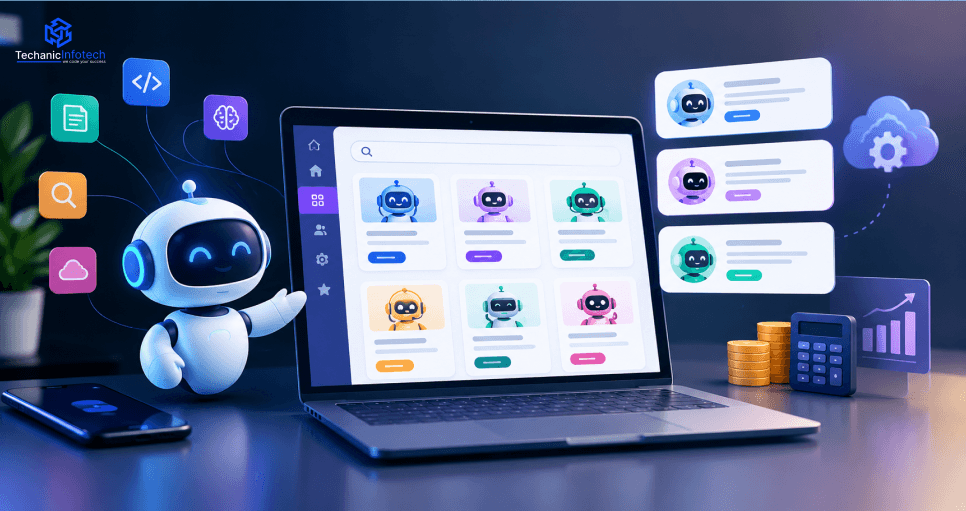
AI agent marketplaces allow businesses and individuals to discover, purchase, deploy, and manage AI agents designed for specific tasks. These platforms can offer agents for customer support, workflow automation, research, sales, data analysis, and other business operations.
AI agent marketplace development involves building a platform where developers can publish agents and users can access them through subscriptions, usage-based payments, or licensing. Essential components include agent discovery, secure execution, integrations, user management, and performance monitoring.
Businesses can also use an AI development company to build customised marketplace solutions that connect AI models, tools, and business applications within a scalable platform.
The global AI agents market size was valued at USD 8.03 billion in 2025. The market is projected to grow from USD 11.78 billion in 2026 to USD 251.38 billion by 2034, exhibiting a CAGR of 46.61% during the forecast period.
The global AI agents market size is expected to reach USD 182.97 billion by 2033, registering a CAGR of 49.6% from 2026 to 2033
The agentic AI development platform market size is expected to grow from USD 10.75 billion in 2025 to USD 14.62 billion in 2026 and is forecast to reach USD 66.38 billion by 2031 at 35.34% CAGR over 2026-2031.
AI agent marketplaces help businesses access specialised AI capabilities without building every agent from scratch. They can also create new opportunities for developers to distribute and monetise their solutions.
Workflow automation: Agents can handle repetitive tasks across business applications.
Faster adoption: Ready-made agents can reduce implementation time for common use cases.
Scalability: Businesses can add agents as operational needs grow.
New revenue opportunities: Developers can monetise agents through subscriptions, licensing, or usage-based pricing.
System integration: Agents can connect with APIs, databases, and enterprise tools to support end-to-end workflows.
Demand for these platforms also creates opportunities for AI development services providers to build secure marketplaces tailored to specific industries and business requirements.
An AI agent marketplace connects agent creators with users who need specialised AI capabilities. It manages agent discovery, access, execution, payments, and ongoing performance.
Agent publishing: Developers submit agents with descriptions, capabilities, requirements, and pricing.
Review and verification: The platform checks agent functionality, permissions, and security.
Discovery and selection: Users browse categories, compare agents, and select suitable solutions.
Deployment and configuration: Users connect required tools, provide authorised credentials, and configure settings.
Agent execution: The platform runs agents using approved models, tools, and workflows.
Billing and monitoring: Usage is tracked for payments, performance analysis, and troubleshooting.
For complex workflows, marketplace operators may also apply principles from How to Build Multi-Agent Systems to coordinate specialised agents, manage task handoffs, and control execution across multiple steps.
A successful marketplace needs features that help users discover, evaluate, purchase, and manage AI agents while giving developers tools to publish and maintain their products.
|
Feature |
Purpose |
|
Agent Discovery and Search |
Helps users find agents by category, task, and capability. |
|
Agent Profiles and Reviews |
Displays descriptions, ratings, pricing, and performance details. |
|
Developer Dashboard |
Supports agent publishing, version updates, and usage tracking. |
|
Secure Agent Execution |
Runs agents with controlled permissions and resource limits. |
|
Payments and Subscriptions |
Supports purchases, recurring plans, and usage-based billing. |
|
API and Tool Integrations |
Connects agents with approved business applications and services. |
|
User and Access Management |
Manages accounts, roles, permissions, and workspace access. |
|
Monitoring and Analytics |
Tracks usage, errors, execution time, and operating costs. |
|
Agent Memory Management |
Maintains relevant context or preferences when required and authorised. |
|
Admin and Moderation Tools |
Supports listing reviews, policy enforcement, and dispute handling. |
A well-designed AI agent memory architecture can help agents retain relevant context across interactions while applying appropriate data-retention, access-control, and privacy policies.
A scalable marketplace needs an architecture that supports agent discovery, execution, integrations, billing, and security without exposing the underlying infrastructure to unrestricted access.
Frontend layer: Provides search, agent listings, reviews, dashboards, and account management.
Marketplace backend: Manages listings, user accounts, subscriptions, permissions, and transactions.
Agent orchestration layer: Coordinates agent execution, tool calls, task routing, and multi-agent workflows.
Model and integration layer: Connects language models, external APIs, databases, and business applications.
Execution environment: Runs agents in isolated environments with defined resource and permission limits.
Data and memory layer: Stores approved agent configurations, conversation context, usage records, and relevant memory.
Security and monitoring layer: Enforces authentication, access policies, audit logging, and performance monitoring.
When a user selects an agent, the backend validates access and billing permissions. The orchestration layer then executes the agent using approved models and tools. Monitoring services record execution results, errors, and resource usage.
This architecture supports modular upgrades, controlled agent deployment, and future expansion as the marketplace grows.
The AI agent marketplace tech stack should support reliable agent execution, secure integrations, scalable infrastructure, and efficient payment processing. The final selection depends on the platform's workload, supported models, and business requirements.
|
Technology Layer |
Common Options |
Purpose |
|
Purpose |
React, Next.js, Vue.js |
Marketplace interface and dashboards |
|
Backend |
Python, Node.js, Java |
APIs, user management, and business logic |
|
AI Frameworks |
LangGraph, CrewAI, OpenAI Agents SDK |
Agent orchestration and workflow management |
|
AI Models |
OpenAI models, Anthropic models, and open-source models |
Reasoning, generation, and task execution |
|
Databases |
PostgreSQL, MongoDB, Redis |
Marketplace data, configurations, and caching |
|
Vector Search |
pgvector, Pinecone, Weaviate |
Semantic retrieval and knowledge search |
|
Cloud Infrastructure |
AWS, Microsoft Azure, Google Cloud |
Hosting, deployment, and scaling |
|
Containers |
Docker, Kubernetes |
Isolated execution and workload management |
|
Payments |
Stripe, Paddle, and regional payment providers |
Subscriptions, billing, and transactions |
|
Monitoring |
OpenTelemetry, Prometheus, Grafana |
Performance tracking and troubleshooting |
A modular stack allows developers to add new models and integrations without redesigning the entire platform. Teams should also evaluate AI agent app development cost when estimating the expense of building custom agents alongside the marketplace itself.
The AI agent marketplace development cost typically ranges from $9,000 to $100,000+, depending on the platform's features, agent orchestration requirements, security controls, integrations, and expected user traffic.
|
Marketplace Type |
Estimated Cost |
Development Timeline |
|
Basic Marketplace MVP |
9,000–20,000 |
2–3 months |
|
Mid-Level Marketplace |
20,000–45,000 |
3–5 months |
|
Advanced AI Agent Marketplace |
45,000–75,000 |
5–7 months |
|
Enterprise Marketplace |
75,000–100,000+ |
7–10+ months |
Feature requirements: Agent listings, reviews, subscriptions, analytics, and developer dashboards affect implementation effort.
Agent orchestration: Multi-agent coordination, tool calling, and workflow automation increase complexity.
Third-party integrations: Model APIs, payment gateways, and external business systems may require additional development.
Security and governance: Agent isolation, access controls, audit logs, and usage limits add engineering and testing requirements.
Scalability: High execution volumes and resource-intensive agents require additional infrastructure planning.
Businesses can work with an Agentic development lifecycle approach to plan requirements, build incrementally, test agent behaviour, and monitor performance after launch.
The final budget depends on the marketplace's technical requirements, business model, and expected scale. Understanding these factors helps businesses prioritise features and allocate resources effectively.
|
Cost Factor |
Impact on Budget |
|
Feature Complexity |
Advanced search, subscriptions, ratings, and analytics require additional development. |
|
Agent Execution |
Multi-agent workflows and complex tool integrations increase engineering effort. |
|
AI Model Usage |
Model selection and request volume affect ongoing operating costs. |
|
Security Requirements |
Agent isolation, permissions, audits, and security testing add implementation work. |
|
Third-Party Integrations |
External APIs, payment providers, and enterprise systems can increase costs. |
|
Infrastructure and Scale |
Higher traffic and execution volumes may require additional computing resources. |
|
Testing and Maintenance |
Quality assurance, updates, monitoring, and bug fixes add ongoing expenses. |
Start with a focused MVP, use managed services where appropriate, and add advanced orchestration only when users need it. Reusable components and clear architecture can also reduce duplicated work.
The best approach is to balance initial development spending with reliability, security, and long-term operating costs rather than choosing the lowest-cost implementation alone.
Building an AI agent marketplace requires structured planning, technical design, secure development, and continuous evaluation. Following an agentic development lifecycle helps teams validate the business idea, manage implementation risks, and prepare the platform for growth.
Identify target users, existing marketplace competitors, industry demand, and potential revenue streams. Define user roles, agent categories, core features, and measurable business goals before development begins.
Separate essential MVP features from future enhancements. Prioritise agent discovery, listings, user accounts, payments, secure execution, and basic administration.
Design intuitive interfaces for buyers, developers, and administrators. Create wireframes and prototypes for agent search, listing details, checkout, deployment, and management dashboards.
Define the marketplace backend, agent orchestration layer, database, execution environment, and integration strategy. Select the AI models, frameworks, and infrastructure that fit the expected workload.
Build authentication, user profiles, agent listings, search, subscriptions, billing, and developer dashboards. Establish APIs and database structures to support marketplace operations.
Integrate approved models, tools, and agent workflows. Implement execution controls, permission boundaries, usage limits, and appropriate isolation for agents accessing external systems.
Test core workflows, agent outputs, payment handling, API integrations, access controls, and failure scenarios. Evaluate accuracy, latency, resource usage, and resistance to unauthorised actions before release.
Deploy the marketplace, monitor errors and usage, collect feedback, and improve agent listings and execution workflows. Plan regular security updates, model evaluations, and infrastructure scaling.
A disciplined development process helps businesses launch a functional marketplace first, validate demand, and expand its agent ecosystem without introducing unnecessary complexity too early.
An AI agent marketplace needs reliable integrations so agents can perform tasks across different models, APIs, and business applications. A flexible integration layer also allows the platform to support new tools without rebuilding its core architecture.
Connect suitable hosted or open-source models based on task complexity, latency, cost, and data-handling requirements. Model abstraction can make it easier to switch providers when business needs change.
Agents may need access to approved tools such as search services, databases, CRM systems, and productivity applications. Each integration should use validated inputs, scoped permissions, and secure credential management.
Some tasks require several specialised agents to collaborate. Applying principles for building multi-agent systems can help coordinate task delegation, shared context, handoffs, and failure handling.
Payment integrations support subscriptions, usage-based billing, refunds, and developer payouts. The marketplace should also track agent execution and apply pricing rules transparently.
Monitor API failures, execution time, model usage, and resource consumption. Retry policies, fallback models, and clear error messages can help improve reliability.
A well-designed integration layer enables the marketplace to expand its capabilities while maintaining control over security, performance, and operating costs.
AI agent marketplaces must protect user data, control agent permissions, and ensure that published agents behave as expected. Strong governance is essential because agents may access external tools, process sensitive information, or trigger business actions.
|
Challenge |
Recommended Approach |
|
Data Privacy |
Apply encryption, data minimisation, and clear retention policies. |
|
Unauthorised Actions |
Use scoped permissions, execution limits, and approval for sensitive operations. |
|
Malicious Agents |
Review listings, validate behaviour, and isolate agent execution. |
|
Unreliable Outputs |
Test agents against defined scenarios and monitor results. |
|
Prompt Injection |
Validate external inputs and restrict access to tools and confidential data. |
|
Rising Operating Costs |
Track model usage, set spending limits, and optimise execution. |
|
Regulatory Requirements |
Assess applicable privacy, consumer, and industry obligations. |
|
Version Changes |
Maintain versioning, regression testing, and rollback procedures. |
A marketplace should define clear publishing standards, developer responsibilities, incident-response procedures, and user reporting mechanisms. Audit logs should record important actions without unnecessarily exposing sensitive information.
A robust AI agent memory architecture should also control what information agents retain, who can access it, and when it must be deleted.
Regular security reviews and ongoing performance evaluations help maintain user trust as the marketplace and its agent ecosystem expand.
An AI agent marketplace can generate revenue by connecting agent developers with businesses and individuals seeking ready-to-use AI capabilities. The right business model depends on the target audience, pricing structure, and platform operating costs.
Charge users monthly or annually for premium agents, advanced features, higher usage limits, or team access.
Bill customers according to agent executions, API calls, processing time, or other measurable consumption units.
Collect a percentage of transactions when users purchase agents or subscribe to developer-created solutions.
Offer private marketplaces, custom integrations, access controls, and dedicated support to enterprise customers through licensing agreements.
Provide basic agents for free while charging for advanced capabilities, increased usage, or premium integrations.
Offer paid listing promotion or enhanced analytics for developers, provided that sponsored placements and pricing are clearly disclosed.
Businesses should compare expected revenue with model API charges, hosting, support, payment processing, and security costs. Transparent pricing and reliable agent performance are essential for long-term customer retention.
A combination of subscriptions, usage-based billing, and enterprise licensing can help a marketplace serve different customer segments while diversifying revenue.
An AI agent marketplace can create value for users, developers, and businesses by making specialised AI capabilities easier to access, distribute, and manage.
Faster AI adoption: Businesses can use ready-made agents instead of developing every solution from scratch.
New revenue opportunities: Developers can monetise agents through subscriptions, licensing, and usage-based pricing.
Improved productivity: Specialised agents can automate repetitive tasks and support complex workflows.
Scalable capabilities: Businesses can add agents as their operational requirements evolve.
Centralised management: A unified platform can simplify agent discovery, access control, billing, and monitoring.
Greater innovation: Developers can publish new agents and reach customers across different industries.
Flexible integrations: Connections with approved tools and business systems expand what agents can accomplish.
A successful marketplace combines these benefits with reliable execution, transparent pricing, strong security, and continuous quality evaluation.
AI agent marketplaces are creating new opportunities to distribute, manage, and monetise specialised AI capabilities. A successful platform combines agent discovery, secure execution, flexible integrations, transparent billing, and effective monitoring.
Businesses planning AI agent marketplace development should begin with market research, prioritise essential features, and select an architecture that supports future growth. Security, agent governance, and operating costs should be considered throughout development.
With a clear business model and a structured implementation strategy, organisations can build marketplaces that help users access useful AI agents while creating sustainable opportunities for developers and platform operators.
It is a platform where users discover, access, purchase, and manage AI agents for different tasks.
Development may cost 9,000–100,000+, depending on features and complexity.
A typical project may take 2–10 months or longer, depending on scope.
Core features include agent discovery, listings, payments, developer dashboards, secure execution, and monitoring.
Common options include React, Python, Node.js, PostgreSQL, cloud platforms, and AI orchestration frameworks.
They can earn through subscriptions, usage-based billing, sales commissions, and enterprise licensing.
Use agent isolation, scoped permissions, encryption, authentication, monitoring, and regular security testing.
Yes. Orchestration frameworks can coordinate specialised agents, manage handoffs, and execute multi-step workflows.


Bharat Sharma is the CTO of Techanic Infotech, bringing deep technical expertise in software architecture, mobile app development, and scalable system design. He leads the engineering team with a strong focus on innovation, performance, and security.