AI Development
AI Agent Memory Architecture: Building Long Term Context for Enterprise AI
September 28, 2026
September 28, 2026
Key Takeaways:
Memory is a missing layer, not a model limitation. Context windows don't substitute for persistence across sessions and real long-term recall.
Not all memory is equal. Short-term, long-term, episodic, and semantic memory each serve distinct purposes within a well-designed architecture.
Selective retention beats total recall. Deciding what's worth remembering keeps memory useful instead of an unmanageable, ever-growing store.
Security must be built in, not added later. Encryption, tenant isolation, and audit logging are core requirements, not optional extras.
Users deserve visibility and control. Transparent memory settings and deletion rights are both an ethical and regulatory necessity.
An enterprise AI agent handles a customer's request perfectly on Monday, then asks the same qualifying questions all over again on Thursday, as if the conversation never happened.
That gap isn't a model limitation; it's a missing architecture layer. AI agent memory architecture is what turns a stateless chatbot into a system that actually remembers context, preferences, and past interactions across sessions, not just within a single conversation window.
For enterprise use cases, this matters even more, since memory needs to persist reliably, respect data governance rules, and scale across thousands of users without becoming a security liability.
This guide breaks down how to design memory architecture that actually holds up in production, from short-term context through long-term, persistent recall.
Most enterprise AI deployments focus heavily on model selection and prompt engineering, while memory gets treated as an afterthought.
This gap explains why so many agents feel impressively capable in a demo but frustratingly forgetful once deployed against real, ongoing work.
Teams often assume a larger context window solves the memory problem, but AI agent memory requires persistence across sessions, not just a bigger buffer within one conversation.
Once a session ends, everything inside that context window disappears, regardless of how large it was.
Without memory, an agent re-asks qualifying questions, re-explains context, and re-derives conclusions it already reached in a previous interaction.
This isn't just an annoyance; it wastes real compute and creates a genuinely frustrating experience for users who expect the system to remember prior context.
Business processes rarely complete in a single conversation; a support case, a sales negotiation, or an onboarding workflow often spans days or weeks across multiple touchpoints.
An agent without persistent memory can't meaningfully participate in workflows that unfold over this kind of extended timeline.
Genuinely personalized responses depend on remembering a specific user's preferences, history, and past decisions, not just reasoning well in the moment.
Without memory, every interaction starts from zero, making real personalization structurally impossible regardless of how capable the underlying model actually is.
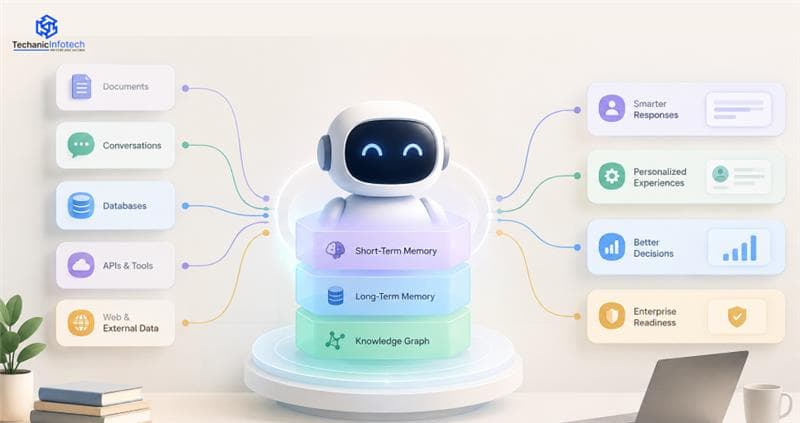
Not all memory serves the same purpose. Understanding the distinct types, and specifically long-term memory for AI agents, helps teams design systems that remember the right things, for the right duration, without treating every piece of context as equally important.
Short-term memory holds the immediate conversation, what was just said, and what task is currently in progress.
This memory typically clears once a session ends, and it forms the foundation every conversation builds on before information graduates into genuine AI agent long-term memory, if it's relevant enough to keep.
Long-term memory retains information across sessions entirely: user preferences, past decisions, established facts about a specific account or relationship.
This is the core of enterprise AI memory architecture, since business relationships and workflows genuinely span far more than a single conversation or interaction.
Episodic memory captures specific past interactions as discrete events, what happened during a particular support call, or what was decided in a specific meeting, rather than just distilled facts.
Good AI memory architecture treats episodic memory as its own category, since exact context sometimes matters more than a summary.
Semantic memory stores generalized facts and knowledge the agent has learned or been given, separate from any specific conversation or event.
Reliable AI development services typically implement this as structured, queryable knowledge, distinct from raw conversation history, so facts stay accurate and consistent.
Working memory holds the specific information needed to complete a task currently in progress, distinct from the broader conversation history around it.
This narrower scope is what makes persistent memory for AI agents efficient, pulling in only what's relevant to the immediate task rather than everything ever stored.
Procedural memory captures how the agent should behave based on past patterns, a user's preferred communication style, or a workflow's typical steps, without necessarily storing the specific events that taught it.
Effective AI agent context management uses this memory type to shape behavior consistently across future interactions automatically.
A working memory system depends on three connected layers functioning together reliably. Adaptive AI development services typically design these components as a coordinated pipeline, not isolated pieces, since a failure in any single layer breaks the agent's ability to recall context accurately.
|
Component |
What It Does |
Common Technologies |
Key Design Consideration |
|
Memory Storage Layer |
Persists memory data (facts, events, preferences) in a durable, queryable format across sessions |
PostgreSQL, MongoDB, vector databases (Pinecone, Weaviate) |
Choosing between structured storage for facts and vector storage for semantic search based on retrieval needs |
|
Embedding and Indexing |
Converts memory content into searchable vector representations for semantic retrieval later |
OpenAI/Cohere embeddings, sentence-transformers |
Embedding quality directly affects retrieval accuracy; poor embeddings surface irrelevant memories |
|
Retrieval Engine |
Searches stored memory for content relevant to the current conversation or task |
Vector similarity search, hybrid keyword + semantic search |
Balancing retrieval speed against relevance, especially as stored memory volume grows significantly over time |
|
Relevance Ranking |
Scores and ranks retrieved memories by relevance, recency, and importance to the current context |
Custom scoring algorithms, recency-weighted ranking |
Preventing outdated or low-relevance memories from crowding out genuinely useful, current context |
|
Context Injection Layer |
Formats and inserts retrieved memory into the model's prompt or context window before generation |
Prompt templating, structured context formatting |
Managing token budget carefully, since injected memory competes with conversation history for limited context space |
|
Memory Summarization |
Condenses older or lower-priority memories into compact summaries rather than storing full detail indefinitely |
LLM-based summarization pipelines |
Balancing detail retention against storage and retrieval efficiency as memory volume accumulates over months or years |
|
Access Control Layer |
Enforces permissions on which memories a specific user, agent, or process can retrieve |
Role-based access control, tenant isolation logic |
Ensuring one user's or tenant's memory never surfaces in another's context, especially in multi-tenant systems |
|
Memory Lifecycle Management |
Governs how long memories persist, when they expire, and how updates or corrections get handled |
TTL policies, versioning, audit logging |
Defining retention rules that balance genuine long-term usefulness against data privacy and storage cost obligations |
Getting long-term memory right requires more than storing every conversation indefinitely.
Any AI agent development company building production systems relies on specific, proven patterns to keep memory genuinely useful rather than an ever-growing, unmanageable pile of stored context.
Rather than storing every message verbatim, effective enterprise AI agents decide what's actually worth remembering: a stated preference, a key decision, a resolved issue, versus routine small talk that adds no lasting value. This selectivity keeps stored memory relevant instead of bloated with noise.
Well-designed AI agent memory systems periodically consolidate related memories into summaries, rather than letting individual interactions pile up indefinitely without structure.
This consolidation keeps retrieval fast and relevant, even as the total volume of historical interactions grows substantially over months or years.
Good conversational AI memory doesn't just retrieve the most recent information; it balances recency against genuine relevance to the current context.
A highly relevant memory from months ago often matters more than a recent but tangential one, and ranking logic needs to reflect that distinction.
A responsible generative AI development company builds in ways for users to view, correct, or delete what the system remembers about them, rather than treating memory as an invisible black box.
This transparency matters both for trust and for genuine data privacy compliance obligations.
Strong AI agent context retention distinguishes between facts the user explicitly stated and inferences the system drew from behavior or patterns.
Treating inferred information with the same confidence as stated facts risks the agent acting on assumptions that were never actually confirmed as true.
Before deploying a system relying on AI agent memory architecture, teams should test scenarios like conflicting information across sessions, outdated preferences, and memory retrieval under high volume.
These edge cases reveal design flaws that a simple, clean demo conversation would never actually surface.
Memory that persists across sessions creates real security and compliance obligations that stateless systems never had to address.
Any LLM development company building enterprise agents needs to treat governance as core architecture, not a policy document written after the system is already live.
Every layer of AI agent memory architecture handling sensitive data needs encryption both at rest and in transit, since stored memories often contain personal details, business context, or confidential decisions.
Treating memory storage with the same security rigor as any other sensitive database is essential, not optional.
For any system serving multiple organizations, AI agent memory needs strict isolation, ensuring one customer's stored context never surfaces in another's retrieval results, even accidentally.
This typically means separate storage namespaces per tenant, not just a shared store filtered by a tenant identifier field alone.
Users should understand, and ideally control, what AI agent long-term memory actually retains about them, rather than discovering months later that a casual comment became permanent stored context.
Clear consent flows and visible memory settings build the trust genuine long-term adoption depends on.
Enterprise AI memory architecture should store only what's genuinely necessary for the system's purpose, not everything technically possible to capture.
Excessive retention increases both security exposure and compliance risk without adding proportional value, making data minimization a security practice, not just a cost-saving measure.
Sound AI memory architecture includes defined retention periods, with older or lower-value memories automatically expiring or getting summarized rather than persisting indefinitely by default.
This prevents an ever-growing liability of stored personal data the organization has no genuine ongoing need to retain.
Regulations like GDPR require honoring user requests to delete or correct stored personal data, which means AI agent memory architecture needs built-in mechanisms for finding and removing specific memories on request, not just a general database wipe that can't target individual users precisely.
Every read, write, and deletion within AI agent memory systems should be logged, creating a traceable record of what was remembered, accessed, or removed, and when.
This logging becomes essential during compliance reviews or when investigating whether a memory-related incident actually occurred as suspected.
Malicious or mistaken input shouldn't be able to permanently corrupt conversational AI memory with false information that then influences future interactions.
Validation before committing information to long-term storage, and the ability to review or roll back specific memories, protects against this genuine emerging risk.
Choosing the right components for memory infrastructure requires balancing retrieval performance against genuine data governance needs.
Reliable software development services build these systems around proven, auditable technology, not experimental tools deployed directly onto sensitive enterprise data.
Pinecone, Weaviate, Milvus, or PostgreSQL with a vector extension each handle semantic memory retrieval differently, with trade-offs between managed convenience and infrastructure control.
The right choice often depends on whether data residency requirements push toward self-hosted options versus a fully managed cloud service.
Alongside vector storage, a relational database (PostgreSQL, MySQL) typically holds structured facts, user preferences, and permission metadata that benefit from precise querying rather than semantic similarity search.
Combining both storage types lets the system retrieve the right kind of memory for each specific situation.
Choosing between hosted embedding APIs and self-hosted open-source models affects both cost and data privacy, since self-hosted embeddings keep raw content from leaving company infrastructure entirely.
This decision matters more in enterprise memory systems than in typical applications, given the sensitivity of stored context.
Frameworks like LangChain or LlamaIndex provide built-in memory management patterns, though many enterprise teams build custom orchestration layers instead, prioritizing tighter control over retrieval logic, ranking, and access enforcement than a general-purpose framework typically offers out of the box.
Redis or a similar in-memory cache stores frequently accessed memory results, reducing repeated vector search costs for common queries.
This caching layer matters particularly for high-traffic enterprise deployments, where the same context gets retrieved repeatedly across many concurrent user sessions throughout the day.
An enterprise software development company typically connects memory systems directly to existing identity infrastructure, Okta, Azure AD, ensuring memory access permissions stay synchronized automatically with the organization's broader access control policies, rather than being maintained as a separate, disconnected permission system.
Tools like Datadog, OpenTelemetry, or custom logging infrastructure track memory retrieval accuracy, latency, and access patterns continuously in production.
This observability becomes essential for debugging unexpected agent behavior and demonstrating compliance during audits or security reviews of the memory system itself.
Cloud, on-premises, or hybrid deployment each carry different implications for data residency, cost, and operational control over sensitive stored memory.
Regulated industries often push toward on-premises or private cloud deployment specifically, even accepting some operational complexity to maintain stricter control over data location.
Building AI agent memory architecture for enterprise use means treating memory as core infrastructure, not a feature bolted onto an already-deployed agent.
The systems that actually work well aren't the ones storing everything indefinitely; they're the ones that selectively remember what matters, consolidate context over time, and enforce security and governance at every layer, from encryption to tenant isolation to the right to deletion.
Short-term, long-term, episodic, and semantic memory each serve different purposes, and a well-designed architecture uses all of them deliberately rather than treating memory as one undifferentiated store.
Whether you're building for a single product or a multi-tenant enterprise platform, the same principle holds: design for what should be remembered, protected, and eventually forgotten, right from the start.
A context window holds information within one active session; long-term memory persists across sessions, letting an agent recall past interactions entirely.
No. Simple, single-session tasks don't require it. Memory matters most for workflows spanning multiple interactions over time.
Through strict tenant isolation, typically separate storage namespaces per customer, ensuring one organization's memory never surfaces in another's context.
They should be able to. Transparent memory settings and deletion controls are both a trust and compliance requirement.
Well-designed systems include correction and deletion mechanisms, allowing specific memories to be updated or removed without wiping everything.
For semantic retrieval, yes. Structured facts can live in a relational database, but similarity-based recall depends on vector search.
It depends on purpose and regulation. Defined retention limits with automatic expiration prevent indefinite, unnecessary data accumulation.
Potentially, without safeguards. Validating information before it's committed to long-term storage helps prevent memory poisoning attacks.
Often both. Recent or high-value interactions may stay detailed, while older ones get consolidated into concise summaries over time.
It directly enables it. Deletion rights, data minimization, and audit logging all depend on memory being architected with governance in mind.


Bharat Sharma is the CTO of Techanic Infotech, bringing deep technical expertise in software architecture, mobile app development, and scalable system design. He leads the engineering team with a strong focus on innovation, performance, and security.