On Demand App Development
How to Build an AI Powered Super App: Features, Architecture, Cost and Business Model
September 8, 2026
September 8, 2026
Mobile users increasingly expect convenience. They do not want to switch between several applications to make a payment, order food, book travel, shop online, talk to customer support, or manage everyday services.
That demand has helped create the super app model.
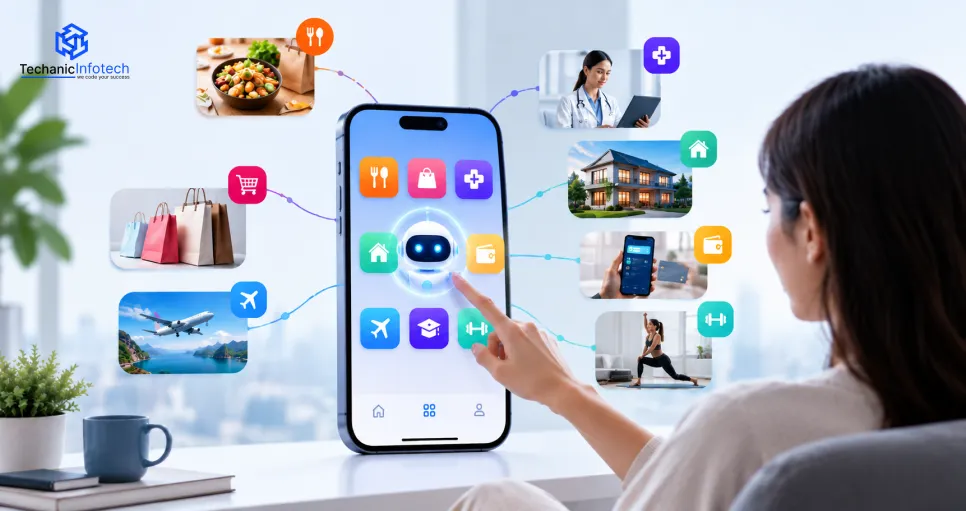
A super app brings multiple services together inside one mobile ecosystem. Artificial intelligence can make that ecosystem much more useful by helping users discover services, receive personalized recommendations, automate tasks, search through natural language, and move between different parts of the platform more easily.
For businesses, an AI powered super app can create several revenue opportunities while increasing the number of reasons customers return to the application.
Building one, however, is considerably more complex than developing a conventional mobile app. It requires scalable architecture, secure payments, multiple service modules, APIs, user management, data infrastructure, and carefully selected AI capabilities.
Businesses planning this type of product need more than a collection of features. They need a platform that can grow as new services are introduced. Professional mobile app development services can help create the technical foundation required for that scale.
An AI powered super app is a mobile platform that combines several services inside one application and uses artificial intelligence to connect those services into a more intelligent user experience.
A conventional app normally focuses on one primary function.
A food delivery app handles food orders.
A travel app manages bookings.
A digital wallet processes payments.
A marketplace connects buyers and sellers.
A super app can bring several of these functions together.
The AI layer then helps users navigate the larger ecosystem.
Imagine opening one application and asking:
Plan a weekend trip within my budget, book a hotel, suggest nearby restaurants, and show me how much I will spend.
A well designed AI powered super app could potentially connect travel search, accommodation, restaurant discovery, payment services, user preferences, and recommendations within the same experience.
The value comes from combining services rather than forcing the customer to repeat the same process across several separate apps.
Techanic Infotech has already explored how this model applies to digital payments in its guide to super apps in eWallets, where payments can become one part of a wider ecosystem of financial and lifestyle services.
The super app model gives businesses access to something that is difficult to achieve with a single purpose application: repeated engagement across different customer needs.
A customer may only book a hotel a few times each year.
That same customer may make payments, order food, shop, use transportation, or access other services much more frequently.
Bringing these activities together can increase the number of interactions a business has with each user.
It can also create more opportunities to understand customer preferences.
With proper consent and data controls, the application can learn which services a user prefers, how often they use them, and what types of recommendations are likely to be useful.
AI can then make the experience easier to navigate.
Instead of presenting every service equally, the application can prioritize what matters to the individual user.
Artificial intelligence should not be added to every part of a super app. The strongest features are the ones that reduce complexity for users.
A super app may contain dozens of services.
Showing all of them on the home screen can quickly create clutter.
AI personalization can help determine which services, offers, shortcuts, and recommendations should appear first.
For example, one user may regularly order food and make digital payments.
Another may use travel booking and shopping features more frequently.
Their home experiences do not need to look identical.
AI can analyze previous activity and adjust the interface according to the services each person actually uses.
This turns personalization into a navigation tool rather than simply a marketing feature.
Search becomes more difficult as the number of services inside an application increases.
A conventional search bar may return results from one category at a time.
AI powered search can understand broader intent.
A user might search:
Find me a hotel near the airport and somewhere good to eat nearby.
Instead of forcing the customer to search travel and restaurant modules separately, the system can understand that the request involves multiple services.
Natural language search can make the entire super app easier to use because customers do not need to know where each function is located.
An AI assistant can become the common interface connecting different parts of a super app.
Users can ask questions, discover services, compare options, manage bookings, or request support through one conversational experience.
The important point is that the assistant should connect with the platform itself.
A generic chatbot that only generates text provides limited value.
A useful assistant needs access to the appropriate APIs, user permissions, service modules, and business data.
Techanic Infotech provides AI development services for businesses that want intelligent systems connected with real applications and workflows rather than isolated AI features.
Super apps generate data across several types of customer interaction.
AI can use that information to predict what may be relevant next.
A user who frequently travels for work may receive hotel suggestions near locations they visit regularly.
Someone who orders food at similar times each week may see useful restaurant recommendations during those periods.
A payment user may receive relevant reminders based on previous behavior.
The objective should be usefulness rather than constant promotion.
Poor recommendations can make the application feel intrusive, while relevant ones can reduce the effort required to find a service.
One of the biggest opportunities is using AI across multiple modules rather than limiting it to one feature.
Consider a user who books a flight inside the app.
That booking creates useful context.
The platform may then suggest hotel options, local transportation, relevant activities, or payment services connected to the same trip.
A travel focused service inside a super app can be designed with this wider ecosystem in mind. Techanic Infotech provides travel app development services for platforms involving booking, itinerary management, travel APIs, payment integration, and related travel workflows.
The same principle can work across ecommerce, finance, delivery, mobility, entertainment, and other modules.
The more services communicate properly, the more useful the super app becomes.
Payments often sit at the center of successful super app models.
If users can purchase products, book services, transfer money, pay bills, and manage transactions through the same system, the payment layer connects the rest of the platform.
AI can support this environment through fraud detection, transaction insights, personalized financial recommendations, and intelligent support.
A super app may also include digital wallets, lending services, insurance products, subscriptions, or other financial capabilities depending on the business model and regulatory requirements.
Businesses planning these systems can use specialized fintech app development services to build secure financial modules that integrate with the wider mobile ecosystem.
A super app should not be designed as one enormous block of software.
The platform needs an architecture that allows individual services to evolve without disrupting everything else.
Each major service should operate as a clearly defined module.
For example, the platform may contain separate modules for payments, ecommerce, travel, food delivery, messaging, or customer support.
This allows teams to update one area without rebuilding the entire application.
It also makes future expansion easier.
A company may launch with payments, shopping, and delivery, then add travel or insurance later.
APIs connect the different services.
They allow modules to exchange information and connect with external platforms.
A travel module may require airline and hotel APIs.
A payment module may connect with banking services.
A delivery module may communicate with mapping, restaurant, and logistics systems.
The quality of these integrations has a direct effect on the user experience.
The AI layer can sit across several parts of the ecosystem.
It may power search, recommendations, conversational assistance, fraud detection, personalization, or automation.
This layer needs carefully controlled access to user data and business systems.
The AI should only receive the information required to perform a particular task.
Users should not need separate accounts for every service inside the super app.
A shared identity system allows customers to move between modules with one account while permissions and sensitive data remain properly controlled.
This also creates a more consistent experience across the platform.
A common payment layer can simplify transactions across different services.
Instead of entering payment information repeatedly, users can manage payments through one secure system.
This can also support rewards, loyalty programs, subscriptions, and other monetization strategies.
One of the biggest mistakes businesses can make is attempting to launch every possible service at once.
A super app does not need to begin as a super app.
Many successful platforms grow from one strong core service.
A business might begin with payments and gradually add commerce.
Another might begin with delivery and later introduce transportation, shopping, or financial services.
The first version should focus on a clear customer problem and a small number of connected services.
Once the platform establishes user activity and operational stability, additional modules can be introduced.
This approach reduces initial complexity and allows businesses to learn which services customers actually want.
Techanic Infotech's guide to profitable on demand app ideas also discusses how mobile first service ecosystems and super app models are becoming relevant for businesses that want to expand beyond a single service.
AI powered super app development requires several technical areas to work together.
The mobile application needs strong frontend development, backend architecture, APIs, databases, payments, security, cloud infrastructure, and AI integration.
Techanic Infotech can support businesses from early product planning through development and launch.
The team can help define which services belong in the first version, how different modules should communicate, where AI can create practical value, and how the architecture can support future expansion.
The objective should not be to build the largest possible application from day one.
It should be to create a strong core platform that can gradually become a larger ecosystem as the business grows.
Once the product vision and service ecosystem are clear, development can begin.
A super app should usually be built in stages rather than attempting to launch every service at once.
The development process needs to cover product planning, interface design, backend architecture, service integrations, payments, AI systems, testing, and deployment.
For a complex platform, the quality of the underlying architecture matters just as much as the number of features.
The first decision is identifying the service that gives users a reason to install the app.
That service may be:
Payments
Ecommerce
Transportation
Food delivery
Travel
Messaging
Local services
Once users begin relying on the core service, additional modules can be introduced gradually.
This approach helps businesses test demand while avoiding unnecessary development complexity during the first release.
A super app that launches with too many disconnected features can become difficult to navigate and expensive to maintain.
The interface should make multiple services feel like parts of one product.
Users should not feel as if they are switching between several unrelated applications.
Navigation, search, payments, user profiles, rewards, and AI assistance should remain consistent across modules.
This becomes particularly important when a platform grows.
A strong design system allows new services to be added without making the app increasingly confusing.
The backend manages the service modules, user information, transactions, APIs, AI requests, notifications, and business logic.
Super apps can generate large amounts of activity because several services operate through the same platform.
The backend therefore needs to support increasing traffic without affecting performance.
Businesses should also avoid tightly connecting every service to every other service. A modular architecture makes it easier to update individual components as the platform grows.
There is no single technology stack that works for every super app.
The right combination depends on the services being offered, expected traffic, platform requirements, integrations, and AI capabilities.
For the mobile application, businesses may choose native Android and iOS development or use a cross platform framework.
Backend technologies such as NodeJS, Python, Java, or similar modern technologies can support APIs, business logic, and service orchestration.
Databases may include both relational and non relational systems depending on the information being managed.
Cloud infrastructure supports hosting, storage, scaling, monitoring, and deployment.
AI models may be integrated through APIs or deployed using dedicated infrastructure depending on privacy and performance requirements.
Businesses evaluating technology options can refer to Techanic Infotech's mobile app technology stack guide, which explains how frontend, backend, database, cloud, and platform choices affect mobile product development.
There is no fixed development cost for a super app because the scope can vary significantly.
A platform combining a digital wallet, ecommerce marketplace, travel booking, delivery, AI assistant, and loyalty system will naturally require more investment than an MVP containing two connected services.
The biggest cost factors include the number of modules, platforms supported, backend complexity, third party APIs, AI features, payment infrastructure, design requirements, and security.
A basic MVP may begin with one or two core services.
A more advanced platform can include several service categories, complex admin systems, AI driven personalization, advanced analytics, and large scale infrastructure.
The most practical approach is to estimate development based on the first release rather than trying to price the entire long term super app vision.
Techanic Infotech's broader guide to mobile app development cost explains how features, platform selection, backend architecture, integrations, and maintenance influence overall development budgets.
Super apps become expensive mainly because multiple complex systems must work together.
Every new service adds development requirements.
An ecommerce module needs product catalogs, orders, inventory, and payments.
A travel module requires booking systems and external APIs.
A delivery module may require location tracking and logistics workflows.
Adding services should therefore be based on business demand rather than simply increasing the size of the platform.
Simple recommendation systems may require less development than an advanced AI assistant that interacts with several services.
AI costs can include model usage, cloud resources, vector databases, data processing, and monitoring.
The more autonomy the AI receives, the more development and testing may be required.
Super apps often depend heavily on external platforms.
These may include maps, payment gateways, banking systems, travel providers, communication services, and analytics platforms.
Every integration requires development, testing, and ongoing maintenance.
A platform processing payments and personal information needs stronger security than a simple content application.
Encryption, authentication, fraud prevention, access control, monitoring, and compliance can all add to development complexity.
A super app can support several revenue streams because multiple services operate inside the same ecosystem.
The strongest business model depends on what the platform offers and which participants create the most value.
The platform can charge a commission whenever a transaction takes place.
This model is common in marketplaces, travel booking, delivery services, and other platforms that connect users with service providers.
Businesses can offer paid membership tiers with benefits such as premium features, exclusive discounts, faster delivery, additional AI capabilities, or enhanced services.
Merchants and service providers may pay for better visibility within search results or recommendation areas.
These placements should be clearly identified and should not damage the relevance of the user experience.
Wallets, payments, insurance, credit products, or other financial services can create additional revenue opportunities where regulations allow them.
Businesses operating inside the platform can pay fees for access to customers, software tools, analytics, logistics, or other platform capabilities.
A diversified model can reduce dependence on one revenue source.
Super apps can become attractive targets because they combine multiple services and large amounts of user data within one environment.
A compromised account may provide access to more than one type of service.
Security therefore needs to be considered throughout the architecture.
Strong authentication, encrypted communication, controlled API access, secure payments, fraud monitoring, and role based permissions should be part of the platform from the beginning.
AI also introduces additional considerations.
An AI assistant should not automatically receive unrestricted access to every service and dataset simply because it operates across the platform.
Its permissions should depend on the task being performed.
For example, an assistant may need access to travel booking information when helping with a trip, but that does not mean it requires unrestricted access to every financial record.
Security becomes especially important as AI systems begin taking actions rather than only providing recommendations.
The biggest challenge is complexity.
A super app combines several businesses into one digital product.
Each module may have different technical requirements, regulations, user journeys, and external dependencies.
Performance is another concern.
Adding more services can make applications slower if the architecture is not designed properly.
Businesses must also avoid turning the interface into an overcrowded collection of features.
Another challenge is user adoption.
A company may technically be capable of adding several services, but users may not want all of them.
This is why gradual expansion is usually more practical than trying to launch a complete ecosystem immediately.
Super apps usually need to reach a large mobile audience.
Businesses therefore need to decide whether to build native applications or use a cross platform development approach.
Android can provide access to a broad device ecosystem and allows businesses to build sophisticated mobile experiences around payments, location, notifications, AI, and service integrations.
Techanic Infotech provides Android app development services for businesses that need scalable Android products with advanced functionality.
Platform decisions should be made according to target users, expected performance, development budget, and the types of device capabilities the super app requires.
Developing a super app requires a team that can work across multiple technical areas.
The project may involve mobile development, backend engineering, API integration, AI implementation, payment systems, databases, cloud architecture, security, and testing.
Techanic Infotech can help businesses move from an initial super app idea to a scalable digital platform.
The development process can begin with a focused MVP built around the strongest service opportunity.
Additional modules can then be introduced according to user demand and business growth.
Rather than treating every service as a separate application, the architecture can be planned around shared user accounts, payments, AI capabilities, and backend infrastructure.
Businesses with unusual combinations of services can also explore Techanic Infotech's broader custom solutions portfolio, which covers web, mobile, software, and on demand products across multiple industries.
The goal is to create a platform that can expand without becoming harder to use or maintain.
AI powered super apps combine two major shifts in mobile technology.
The first is the move toward platforms that provide several services through one ecosystem.
The second is the use of AI to make those larger ecosystems easier to navigate and more personalized.
Artificial intelligence can help users discover services, receive recommendations, search naturally, automate tasks, and move between different modules with less effort.
But AI alone does not make a successful super app.
The product still needs a strong core service, reliable architecture, secure payments, well designed integrations, a clear revenue model, and a realistic expansion strategy.
Businesses considering this model should start with the service users need most, build the technical foundation correctly, and introduce new capabilities as the platform proves its value.
That approach creates a much stronger path toward a genuine super app than trying to build every possible service from the first release.
An AI powered super app combines several digital services inside one mobile application and uses artificial intelligence for features such as personalization, recommendations, intelligent search, assistance, and automation.
The exact features depend on the business model, but common capabilities include payments, user accounts, multiple service modules, intelligent search, AI assistance, recommendations, notifications, loyalty programs, and secure integrations.
The cost depends on the number of services, AI complexity, platforms, integrations, payment systems, backend requirements, security, and expected scale. An MVP with a limited number of modules will cost less than a mature multi service ecosystem.
No. A better approach is usually to begin with one strong core service and a limited number of connected features. Additional services can be added after the platform gains users and validates demand.
AI can simplify navigation, personalize recommendations, improve search, automate support, predict user needs, and connect different services through a common intelligent interface.
Yes. Techanic Infotech can help businesses plan and develop AI powered super apps with mobile interfaces, backend systems, service integrations, payments, AI features, scalable architecture, testing, and ongoing product expansion.


Abhishek Jangid is the CEO of Techanic Infotech, with extensive experience in mobile app and web development. He specializes in helping businesses turn innovative ideas into scalable digital solutions through strategic planning and modern technology.