Key Takeaways
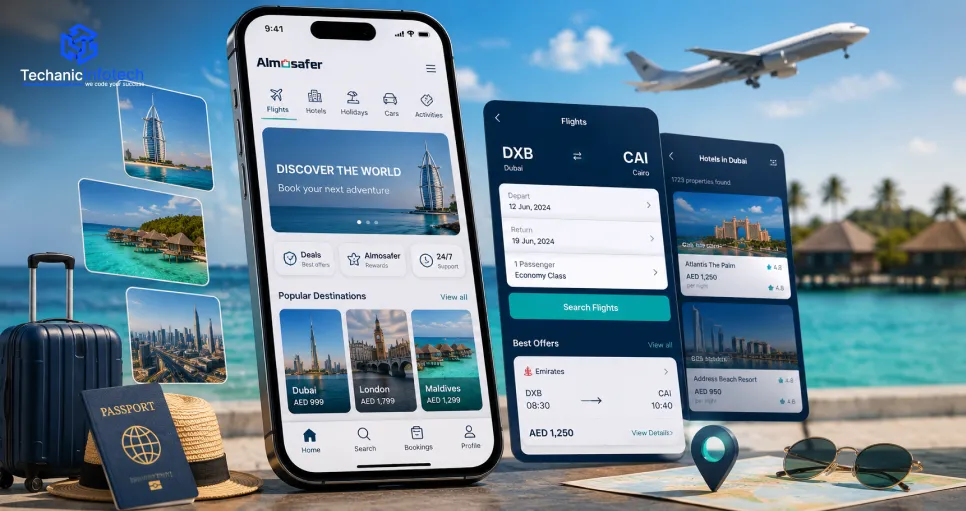
Almosafer-like applications combine flight, hotel, and travel services into one seamless platform.
Building an MVP helps businesses validate their travel app before full-scale development.
AI-powered features improve personalisation, customer engagement, and operational efficiency.
Development costs generally range from $10,000 to $100,000+, depending on complexity and integrations.
Choosing a scalable technology stack ensures long-term growth and reliable platform performance.
The online travel industry continues to experience remarkable growth as travellers increasingly rely on digital platforms to book flights, hotels, holiday packages, and travel experiences. Modern travel applications simplify trip planning by offering real-time availability, secure payments, personalised recommendations, and seamless booking experiences through a single platform.
This growing demand has encouraged businesses and entrepreneurs to invest in Almosafer clone app development to build feature-rich travel booking platforms that cater to today's digitally connected travellers. Whether you're planning Almosafer-like app development, a comprehensive travel booking app development solution, or a complete online travel agency app development platform, building a scalable and user-friendly application can help you establish a strong presence in the competitive travel market.
With the right development strategy, businesses can integrate flight bookings, hotel reservations, holiday packages, payment gateways, customer support, and AI-powered personalisation into one seamless ecosystem, delivering exceptional travel experiences while maximising revenue opportunities.
Travellers today expect fast, secure, and personalised booking experiences across mobile and web platforms. Building an app similar to Almosafer enables travel businesses to offer multiple travel services through a single platform while improving customer engagement and operational efficiency.
The increasing popularity of digital travel platforms has created significant opportunities for startups and travel agencies. Businesses that invest in travel marketplace app development can connect travellers with airlines, hotels, tour operators, and other service providers through a centralised booking platform.
An Almosafer-like application can generate revenue through flight commissions, hotel bookings, holiday packages, travel insurance, premium memberships, advertising, and affiliate partnerships, creating multiple income streams.
Providing flight reservations, hotel bookings, package comparisons, secure payments, and real-time booking updates within a single application improves convenience and increases customer satisfaction.
Modern travel platforms are designed to support multiple vendors, thousands of listings, and growing customer bases. Businesses exploring Airbnb clone app development or other travel marketplace models often adopt scalable architectures that accommodate future expansion and additional services.
Studying solutions offered by top travel app development companies helps businesses understand emerging travel technologies, customer expectations, and industry best practices, making it easier to build a competitive travel booking platform.
A successful Almosafer clone app development project should provide travellers with a seamless booking experience while helping travel businesses efficiently manage reservations, payments, and customer interactions. Below are the essential Almosafer clone app features every modern travel platform should include.
Allow users to sign up using email, phone numbers, or social media accounts. Travellers should be able to manage personal information, save payment methods, access booking history, and receive personalised travel recommendations.
An advanced flight booking app development module should enable users to search flights using filters such as destination, airline, travel dates, cabin class, and budget. Real-time availability, fare comparisons, and instant booking confirmations enhance the user experience.
A comprehensive hotel booking app development feature allows users to browse hotels, compare room prices, view amenities, read customer reviews, and make secure reservations. Flexible filters simplify the search process and help travellers find the best accommodation.
Offer curated holiday packages, seasonal promotions, tour packages, and exclusive travel discounts. Personalised travel offers encourage higher booking conversions and improve customer engagement.
Support multiple payment options, including credit cards, digital wallets, net banking, and international payment gateways. Secure transactions and automated invoice generation help build customer trust.
Users should be able to view, modify, cancel, or reschedule bookings directly from the application. Real-time booking status updates, e-tickets, and travel itineraries improve convenience.
Modern travel platforms increasingly leverage AI integration in mobile apps to recommend destinations, hotels, flights, and travel packages based on user preferences, booking history, and browsing behaviour. AI can also power intelligent chatbots, dynamic pricing, and personalised travel experiences.
Developing a successful travel booking platform requires more than replicating existing features. A well-planned development process ensures your application delivers an outstanding user experience while remaining scalable, secure, and ready for future growth.
Begin by identifying your business model, target market, and core services. Decide whether your platform will focus on flight bookings, hotel reservations, holiday packages, or a complete travel marketplace. Understanding user expectations helps define the product roadmap and feature priorities.
Analyse competitors, customer preferences, pricing strategies, and industry trends to identify opportunities for differentiation. Research also helps determine which features provide the greatest value and improve customer engagement.
Instead of developing every feature at once, many startups choose to build a minimum viable product that includes essential functionalities such as user registration, flight search, hotel booking, secure payments, and booking management. Launching an MVP allows businesses to validate their concept, collect user feedback, and refine the platform before investing in advanced capabilities.
Create a clean and user-friendly interface that simplifies searching, booking, and managing travel plans. Easy navigation, fast search filters, responsive layouts, and streamlined booking flows improve customer satisfaction and increase booking conversions.
Build the application using scalable technologies that support real-time bookings, payment processing, customer management, notifications, and third-party travel APIs. A reliable backend ensures smooth performance even during periods of high user activity.
Integrate airline APIs, hotel booking systems, payment gateways, maps, notifications, customer support tools, and analytics platforms to create a complete travel ecosystem. These integrations enhance functionality while delivering a seamless booking experience.
Perform comprehensive testing to verify security, performance, compatibility, usability, and payment functionality. Once the application meets quality standards, deploy it to production and continuously monitor performance after launch.
Working with an experienced mobile app development company helps businesses accelerate development while ensuring high-quality architecture, security, and long-term scalability. Professional development teams also provide ongoing maintenance, feature enhancements, and technical support to keep the platform competitive as market demands evolve.
Selecting the right technology stack is essential for building a high-performance travel booking platform that can handle real-time reservations, secure transactions, and thousands of concurrent users. A scalable architecture ensures your application remains reliable as your business grows and new features are introduced.
|
Component |
Recommended Technologies |
|
Frontend |
Flutter, React Native, Swift, Kotlin |
|
Backend |
Node.js, Python, Java, .NET |
|
Database |
PostgreSQL, MongoDB, MySQL |
|
Cloud Platform |
AWS, Microsoft Azure, Google Cloud |
|
Payment Integration |
Stripe, PayPal, Razorpay |
|
Travel APIs |
Amadeus, Skyscanner, Booking.com APIs |
|
Maps & Location |
Google Maps API, Mapbox |
|
Notifications |
Firebase Cloud Messaging (FCM), OneSignal |
|
Analytics |
Google Analytics, Firebase Analytics |
Modern travel platforms increasingly leverage AI integration in mobile apps to deliver personalised recommendations, intelligent itinerary planning, dynamic pricing, chatbot support, fraud detection, and predictive travel insights. These AI-driven capabilities improve customer engagement while enhancing operational efficiency.
Since travel booking platforms connect multiple service providers, including airlines, hotels, and tour operators, they require a scalable marketplace architecture. Businesses planning marketplace app development should prioritise flexible APIs, vendor management capabilities, secure payment processing, and real-time inventory synchronisation.
The Almosafer Clone App Development Cost generally ranges from $10,000 to $100,000+, depending on the application's complexity, supported booking modules, third-party integrations, AI capabilities, cloud infrastructure, and customisation requirements. A basic travel booking solution requires a lower investment, while a feature-rich online travel platform with advanced automation and marketplace functionality demands a larger development budget.
Estimated Development Cost:
|
App Type |
Estimated Cost |
Development Timeline |
|
Basic Travel Booking App |
$10,000–$20,000 |
2–3 Months |
|
Standard Online Travel Platform |
$20,000–$45,000 |
3–5 Months |
|
Advanced Travel Marketplace App |
$45,000–$75,000 |
5–7 Months |
|
Enterprise Travel Booking Solution |
$75,000–$100,000+ |
7–10 Months |
Before finalising the project budget, businesses should also evaluate the overall mobile app development cost, particularly if they plan to launch native Android and iOS applications alongside the web platform. Startups and growing travel agencies can also benefit from custom software development for SMBs to build scalable travel solutions while optimising development expenses.
Building an Almosafer-like platform is an excellent opportunity for businesses looking to enter the rapidly growing online travel industry. A well-designed travel application can simplify flight and hotel bookings, improve customer experiences, streamline operations, and create multiple revenue streams through a single digital platform.
Whether you're developing a travel marketplace for a startup or expanding an existing travel business, investing in a scalable architecture, user-friendly design, and modern technologies will help you deliver a competitive travel booking solution that supports long-term business growth.
Almosafer Clone App Development involves building a travel booking platform with features such as flight reservations, hotel bookings, holiday packages, secure payments, booking management, and customer support, similar to the Almosafer platform.
The Almosafer Clone App Development Cost typically ranges from $10,000 to $100,000+, depending on features, integrations, platform complexity, and customisation requirements.
Essential features include user registration, flight and hotel search, booking management, secure payments, itinerary management, notifications, customer support, AI-powered recommendations, and analytics dashboards.
Development usually takes 2 to 10 months, depending on the project's scope, supported modules, integrations, and level of customisation.
Yes. AI can be used to deliver personalised travel recommendations, dynamic pricing, intelligent chatbots, fraud detection, itinerary planning, and predictive analytics to enhance the overall user experience.
Yes. A modern travel booking platform can integrate multiple airlines, hotels, tour operators, and payment providers, allowing users to compare and book services through a single application.
Yes. Launching an MVP with core booking features allows businesses to validate the product idea, gather user feedback, and gradually expand the platform with advanced functionalities.
Travel agencies, tour operators, online travel agencies (OTAs), hotel chains, airline aggregators, and travel startups can all benefit from investing in an Almosafer-like application.


Bharat Sharma is the CTO of Techanic Infotech, bringing deep technical expertise in software architecture, mobile app development, and scalable system design. He leads the engineering team with a strong focus on innovation, performance, and security.