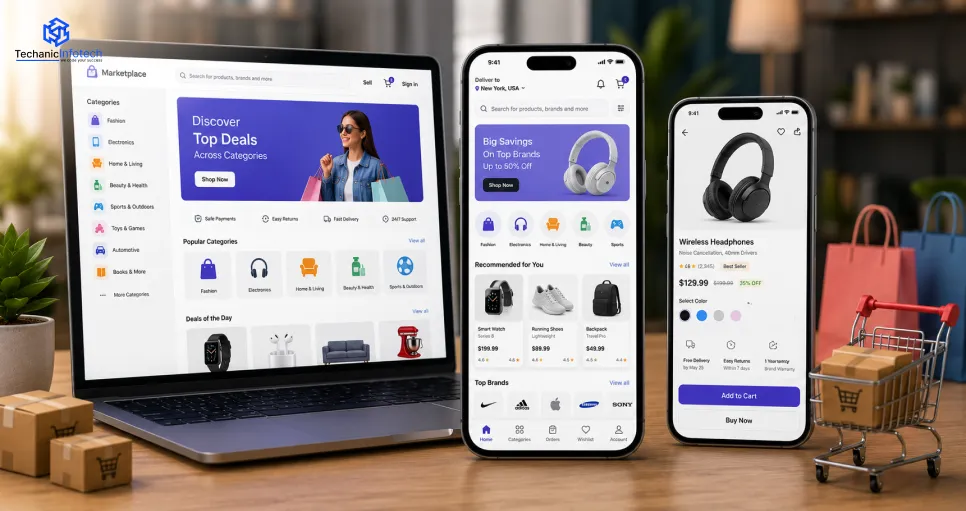
Ecommerce App Development
Marketplace App Development: Features, Costs, and Revenue Models
June 23, 2026
June 23, 2026
The digital marketplace industry continues to transform how businesses connect buyers and sellers. From Amazon and Etsy to Uber and Airbnb, marketplace platforms have become some of the most profitable digital business models worldwide.
As consumer expectations evolve, businesses are increasingly investing in marketplace app development to create seamless buying and selling experiences. Whether you're building a niche platform, a B2B exchange, or a large-scale e-commerce marketplace, understanding the development process, costs, features, and monetisation strategies is essential.
This guide explores everything you need to know about developing a successful marketplace application in 2026.
Marketplace app development involves creating a digital platform where multiple sellers can offer products or services to buyers through a centralised application.
Unlike traditional e-commerce websites, marketplace platforms facilitate transactions between third parties while earning revenue through commissions, subscriptions, advertising, or premium services.
Businesses often choose custom marketplace app solutions to create platforms tailored to their industry requirements, customer expectations, and long-term growth goals.
Examples:
E-commerce marketplaces
Service marketplaces
Rental marketplaces
Freelance marketplaces
Wholesale marketplaces
Healthcare marketplaces
Marketplace applications can be structured in different ways depending on their target audience and business model.
Businesses sell directly to consumers through a digital platform. This model is widely used in e-commerce and helps businesses reach a larger customer base efficiently.
Examples:
Amazon
Flipkart
Consumers sell products or services to other consumers. This model enables peer-to-peer transactions and creates opportunities for individuals to earn income through digital platforms.
Examples:
eBay
OLX
B2B marketplaces connect businesses with suppliers, wholesalers, manufacturers, and distributors. These platforms streamline procurement processes, improve supply chain efficiency, and enable companies to access a wider network of trusted business partners while reducing operational costs.
Examples:
Alibaba
IndiaMART
Platforms connecting service providers with customers, enabling users to easily find, compare, book, and pay for a wide range of professional or on-demand services through a centralised digital platform.
Examples:
Uber
Upwork
Ecommerce marketplace development remains one of the fastest-growing segments, enabling businesses to connect multiple vendors and customers through a single digital platform.
Examples:
Amazon Marketplace
Etsy
Successful marketplace mobile app development requires a feature-rich platform that delivers seamless experiences for buyers, sellers, and administrators. The right feature set not only improves user satisfaction but also supports scalability, security, and long-term business growth.
User Registration and Profile Management: Users should be able to sign up quickly through email, phone number, or social media accounts. Personalised profiles help customers manage orders, payment methods, and preferences.
Advanced Search and Filters: Powerful search functionality allows buyers to quickly find products or services using categories, keywords, pricing, ratings, location, and other filters.
Product Listings Detailed Descriptions: Comprehensive product pages with images, videos, specifications, reviews, and seller information help users make informed purchasing decisions.
Wishlist and Favourites: Customers can save products or services for future purchases, increasing engagement and improving conversion rates.
Secure Payment Processing: Integration with multiple payment gateways ensures safe and convenient transactions through credit cards, digital wallets, UPI, and other payment methods.
Order Tracking: Real-time order tracking keeps customers informed throughout the purchasing and delivery process.
Ratings and Reviews: User-generated reviews build trust and help buyers evaluate products, services, and sellers before making a purchase.
Vendor Registration and Verification: A streamlined onboarding process enables sellers to join the platform while maintaining quality through verification procedures.
Product and Inventory Management: Sellers can easily add, edit, categorise, and manage product listings while tracking inventory levels in real time.
Order Management Dashboard: A centralised dashboard allows vendors to manage orders, shipping updates, cancellations, and returns efficiently.
Sales Analytics and Reporting: Detailed reports provide insights into sales performance, customer behaviour, revenue trends, and inventory management.
Payment Settlement Management: Automated payout systems simplify commission calculations and ensure timely payments to sellers.
User and Vendor Management: Administrators can monitor users, approve vendors, manage permissions, and resolve disputes from a centralised control panel.
Commission and Revenue Management: The platform should support flexible commission structures and automated revenue tracking.
Content Moderation: Admins need tools to review listings, remove inappropriate content, and maintain platform quality.
Reports and Business Analytics: Comprehensive analytics help track platform performance, user growth, transactions, and revenue generation.
Marketing and Promotional Tools: Built-in tools for discounts, coupons, featured listings, referral programmes, and email campaigns help drive engagement and sales.
AI-Powered Product Recommendations: Artificial intelligence analyses user behaviour and purchase history to provide personalised product suggestions.
In-App Chat and Messaging: Direct communication between buyers and sellers improves customer support and increases transaction confidence.
Smart Search with AI: AI-driven search capabilities deliver more accurate and relevant search results based on user intent.
Dynamic Pricing: Automated pricing adjustments based on demand, competition, and market trends help maximise revenue.
Fraud Detection and Security: Advanced security mechanisms identify suspicious activities and protect both buyers and sellers from fraudulent transactions.
Multi-Language and Multi-Currency Support: Global marketplaces benefit from localised experiences that support different languages, currencies, and regional preferences.
Loyalty and Rewards Programmes: Reward systems encourage repeat purchases and strengthen customer retention.
AI is enhancing online marketplace app development by improving user experience, operational efficiency, and business growth.
Personalised Recommendations: Suggests relevant products and services based on user behaviour and preferences.
Smart Search: Delivers faster and more accurate search results using AI-powered algorithms.
Dynamic Pricing: Automatically adjusts prices based on demand, competition, and market conditions.
Fraud Detection: Identifies suspicious activities and helps prevent fraudulent transactions.
AI Chatbots: Provide instant customer support and improve response times. Learn more about implementing artificial intelligence in mobile applications in our guide on AI Integration in Mobile Apps.
Building a successful marketplace application requires a strategic approach that balances business goals, user experience, technology, and scalability. Whether you're investing in marketplace app development, online marketplace app development, or multi-vendor marketplace app development, following a structured development process can significantly improve your chances of success.
The first step is understanding your target market, audience needs, competitors, and industry trends. Businesses should identify market gaps, define their unique value proposition, and validate demand before investing in development.
Key activities include:
Competitor analysis
Customer research
Market opportunity assessment
Business model validation
Revenue strategy planning
Choosing the right marketplace model is critical for long-term success. Businesses should determine whether the platform will operate as follows:
B2B Marketplace
B2C Marketplace
C2C Marketplace
Service Marketplace
Rental Marketplace
Hybrid Marketplace
For companies focusing on B2B marketplace app development, additional features such as bulk ordering, supplier management, and enterprise pricing may be required.
A detailed roadmap helps define project scope, features, timelines, and development priorities. This stage outlines both short- and long-term objectives and aligns business goals with technical requirements.
Important considerations include:
User roles and permissions
Core marketplace functionality
Third-party integrations
Monetization strategy
Scalability requirements
Developing an MVP allows businesses to validate demand through a minimal viable product development approach before investing in advanced functionality.
Typical MVP features include the following:
User registration
Product listings
Search functionality
Shopping cart
Payment gateway integration
Order management
An intuitive user experience is essential for marketplace success. Designers create wireframes, user flows, and interactive prototypes that ensure seamless navigation for buyers, sellers, and administrators.
The design phase focuses on:
User-friendly navigation
Responsive interfaces
Mobile-first experiences
Brand consistency
Conversion optimization
This is the core development stage where developers build frontend interfaces, backend systems, APIs, databases, and administrative panels.
A typical marketplace platform development project includes the following:
Frontend Development:
Mobile applications
Web interfaces
User dashboards
Seller portals
Backend Development:
User management
Product management
Order processing
Payment systems
Notification services
Third-Party Integrations:
Payment gateways
Shipping providers
CRM systems
Analytics tools
Marketing platforms
For a multi-vendor marketplace app, vendor-specific features must be implemented.
These include:
Seller onboarding
Vendor dashboards
Commission management
Inventory management
Performance tracking
Automated payouts
This functionality enables multiple sellers to operate independently while maintaining centralised platform control.
Following modern mobile app development trends helps marketplace businesses stay competitive and continuously improve user experiences.
Post-launch activities include:
Feature enhancements
Bug fixes
Security updates
User feedback analysis
Performance optimization
Scalability improvements
Regular updates help businesses stay ahead of changing customer expectations and market trends.
The marketplace app development cost typically ranges between $10,000 and $90,000, depending on the platform's complexity, features, integrations, and scalability requirements.
|
Marketplace Type |
Estimated Cost |
|
Basic MVP Marketplace App |
$10,000 – $20,000 |
|
Standard Multi-Vendor Marketplace |
$20,000 – $40,000 |
|
Advanced Marketplace App |
$40,000 – $65,000 |
|
Enterprise Marketplace Platform |
$65,000 – $90,000 |
|
Feature |
Estimated Cost Impact |
|
User Registration & Profiles |
$1,000 – $3,000 |
|
Product Listings & Search |
$2,000 – $5,000 |
|
Vendor Management System |
$3,000 – $8,000 |
|
Payment Gateway Integration |
$2,000 – $5,000 |
|
Ratings & Reviews |
$1,000 – $3,000 |
|
Real-Time Chat |
$2,000 – $6,000 |
|
AI Recommendations |
$3,000 – $10,000 |
|
Analytics Dashboard |
$2,000 – $5,000 |
Factors Affecting Marketplace App Development Cost
Number of buyer, seller, and admin features
Complexity of the vendor management system
Third-party integrations and APIs
AI-powered features and automation
Android, iOS, or cross-platform development
Security and compliance requirements
Scalability and cloud infrastructure
Businesses looking to launch quickly often start with an MVP costing around $10,000–$20,000 and gradually add advanced features as their marketplace grows.
Choosing the right monetisation strategy is critical for long-term profitability, as it directly impacts revenue generation, platform sustainability, vendor participation, and the overall growth potential of your marketplace business.
In this model, the marketplace charges a percentage of each successful transaction made on the platform. The commission can be fixed or vary based on product categories, seller tiers, or order value.
Sellers pay a monthly or annual subscription fee to access marketplace features, list products, or reach customers. Different subscription plans can offer varying levels of visibility and functionality.
The platform charges sellers a fee every time they publish a product or service listing. This model helps maintain listing quality while generating revenue regardless of sales performance.
Sellers can pay to promote their products or services at the top of search results or within featured sections of the marketplace. This increases visibility and can lead to higher conversion rates.
Marketplace owners can monetise traffic by allowing brands, sellers, or third-party businesses to display sponsored advertisements within the platform.
Instead of charging a percentage, the platform collects a fixed fee for every completed transaction. This provides predictable revenue and is often used alongside commission-based pricing.
These are among the most effective marketplace app revenue models used by successful global platforms.
A successful marketplace platform requires a mobile app tech stack guide that supports scalability, security, performance, and future growth.
Frontend Technologies:
React.js
Next.js
Flutter
React Native
Backend Technologies:
Node.js
Laravel
.NET
Django
Databases:
PostgreSQL
MongoDB
MySQL
Cloud Infrastructure:
AWS
Microsoft Azure
Google Cloud Platform
Payment Integrations:
Stripe
PayPal
Razorpay
Choosing the right mobile app tech stack guide helps businesses build scalable marketplace platforms capable of handling increasing users, transactions, and vendor operations.
Digital marketplaces have become one of the most scalable and profitable business models across industries. Whether you're pursuing multi-vendor marketplace app development, launching a niche service platform, or investing in B2B marketplace app development, success depends on strategic planning, user-focused design, scalable technology, and sustainable monetisation.
By investing in professional marketplace mobile app development and leveraging the right marketplace app revenue models, businesses can build platforms that attract users, generate revenue, and scale efficiently in today's competitive digital economy.
The cost typically ranges from $10,000 to $150,000+, depending on features, complexity, integrations, and platform requirements.
The cost typically ranges from $10,000 to $150,000+, depending on features, complexity, integrations, and platform requirements.
It involves creating a marketplace where multiple sellers can manage products, orders, inventory, and payments through a centralised platform.
It involves creating a marketplace where multiple sellers can manage products, orders, inventory, and payments through a centralised platform.
A basic MVP may take 3–6 months, while a full-featured marketplace platform can require 6–12 months or more.
A basic MVP may take 3–6 months, while a full-featured marketplace platform can require 6–12 months or more.
Popular monetisation strategies include commissions, subscriptions, listing fees, featured listings, advertising, and transaction fees.
Popular monetisation strategies include commissions, subscriptions, listing fees, featured listings, advertising, and transaction fees.
Custom solutions provide greater flexibility, scalability, branding control, and feature customisation tailored to unique business requirements.
Custom solutions provide greater flexibility, scalability, branding control, and feature customisation tailored to unique business requirements.
Retail, healthcare, logistics, real estate, education, travel, and professional services are among the industries that benefit significantly from marketplace platforms.
Retail, healthcare, logistics, real estate, education, travel, and professional services are among the industries that benefit significantly from marketplace platforms.
AI enhances personalisation, smart search, fraud prevention, dynamic pricing, and customer support, improving both user experience and business efficiency.
AI enhances personalisation, smart search, fraud prevention, dynamic pricing, and customer support, improving both user experience and business efficiency.


Abhishek Jangid is the CEO of Techanic Infotech, with extensive experience in mobile app and web development. He specializes in helping businesses turn innovative ideas into scalable digital solutions through strategic planning and modern technology.