Mobile App Development
Auto Repair Shop Software Development: An Ultimate Business Guide
August 4, 2026
August 4, 2026
Key Takeaways
Auto repair shop software centralises appointments, repairs, inventory, billing, and customer management.
Digital automation improves technician productivity while reducing administrative work.
Essential modules include work order management, CRM, inventory tracking, billing, and business analytics.
Development costs typically range from $10,000 to $100,000+, depending on software complexity and business requirements.
AI, connected vehicles, predictive maintenance, and cloud technologies will continue shaping the future of automotive repair software.
Running an auto repair shop today involves much more than fixing vehicles. Service centres must manage appointments, customer records, repair estimates, technician assignments, inventory, invoices, and follow-up communication while delivering fast and reliable service. Relying on spreadsheets or manual paperwork often leads to scheduling conflicts, misplaced records, delayed repairs, and reduced customer satisfaction.
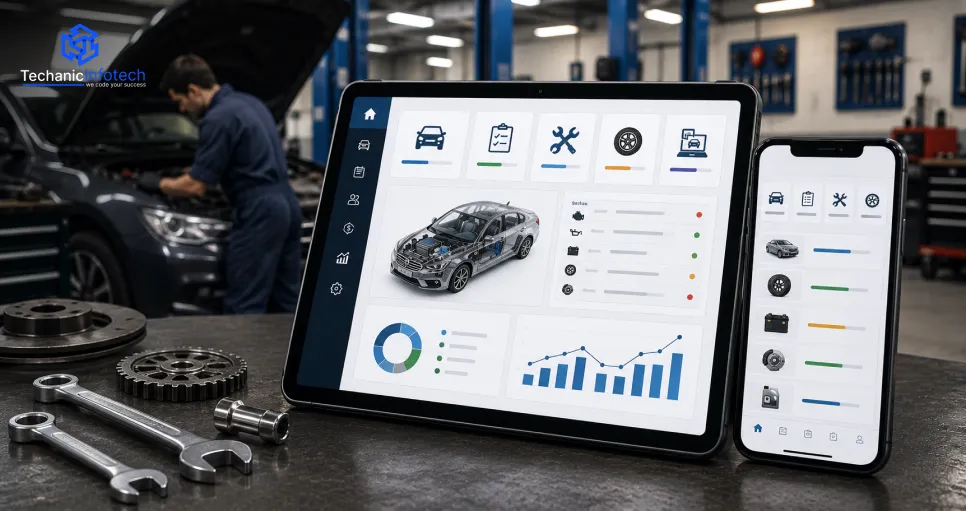
This is why businesses are increasingly investing in auto repair shop software development. A modern software solution centralises daily operations into a single platform, allowing repair shops to automate workflows, improve technician productivity, track service history, and deliver a better customer experience.
Whether you operate an independent garage, a multi-location repair business, or a large automotive service centre, the right software can streamline operations, reduce administrative work, and support long-term business growth.
The automotive service industry is rapidly adopting digital solutions to improve efficiency, reduce operational costs, and provide better customer experiences. Modern repair shops require intelligent software that simplifies day-to-day management while supporting future business expansion.
Digital platforms automate appointment scheduling, repair orders, customer communication, billing, and inventory tracking, helping repair shops complete more jobs with fewer delays.
Customers benefit from online appointment booking, digital estimates, service updates, repair history, and transparent billing, creating a smoother service journey and improving customer loyalty.
Technicians can access repair orders, vehicle history, inspection reports, and work assignments digitally, reducing paperwork and allowing them to focus on servicing vehicles.
Owners gain access to real-time dashboards, financial reports, inventory status, and technician performance metrics, enabling data-driven business decisions.
Repair shops are increasingly adopting AI-driven technologies to automate routine operations such as appointment scheduling, customer communication, predictive maintenance, and inventory planning. Many businesses partner with an experienced AI development company to implement intelligent automation that improves operational efficiency, enhances customer experiences, and supports long-term business growth.
The demand for digital management solutions in the automotive service industry continues to rise as repair shops invest in automation, cloud-based operations, and customer relationship management tools. The following statistics highlight the growth of the market and the increasing adoption of repair shop software.
Global Market Size: According to LP Information, the global auto repair software market was valued at approximately USD 397.2 million in 2023 and is projected to reach USD 703.3 million by 2030, growing at a CAGR of 8.5% during the forecast period.
Cloud-Based Adoption: According to Research and Markets, repair businesses are rapidly adopting cloud-based management platforms to streamline work orders, inventory management, customer communication, billing, and vehicle diagnostics, contributing to steady market expansion.
Growing Digital Transformation: According to Research and Markets, increasing adoption of electric vehicles (EVs), connected vehicles, and Advanced Driver Assistance Systems (ADAS) is driving repair shops to invest in modern software solutions capable of handling more complex service workflows.
Auto Repair Shop Software is a digital business management solution that helps automotive service centres manage repair operations, customer relationships, technician workflows, inventory, invoicing, and business reporting from a centralised platform. Instead of handling multiple operational tasks manually, repair businesses can automate daily processes and improve overall efficiency.
Modern auto repair shop management software supports the complete service lifecycle, from appointment scheduling and vehicle inspections to repair tracking, billing, and customer follow-ups. By keeping all business information in one place, repair shops can reduce paperwork, improve communication, and deliver faster service.
As businesses expand, many partner with an experienced software development company to build customised solutions that match their workflows, integrate with existing systems, and support long-term scalability.
An effective repair shop management platform should include dedicated modules that simplify operations for customers, service advisors, technicians, and business owners.
Customers should be able to schedule appointments, receive booking confirmations, view repair status, and access vehicle service history through an intuitive interface.
Repair orders should be created digitally, allowing service advisors and technicians to track diagnostics, labour, parts, repair progress, and completion status efficiently.
The software should monitor spare parts inventory, supplier information, stock availability, purchase orders, and low-stock alerts to avoid service delays.
Integrated invoicing simplifies estimate creation, tax calculations, payment collection, receipts, and financial reporting while reducing manual accounting tasks.
A built-in CRM helps businesses maintain customer records, service history, reminders, follow-up communication, promotional campaigns, and loyalty programmes. Many repair businesses also integrate advanced CRM development services to strengthen customer engagement and improve long-term retention.
Business dashboards provide insights into revenue, repair volume, technician productivity, inventory performance, customer retention, and overall operational efficiency, helping owners make informed decisions.
Investing in auto repair shop software development delivers measurable advantages for repair businesses by improving operational efficiency, enhancing customer service, and supporting long-term growth.
Automating appointments, repair orders, inventory, invoicing, and technician scheduling reduces administrative work and allows staff to focus on delivering quality vehicle repairs.
Digital service reminders, repair updates, transparent estimates, and personalised follow-ups encourage repeat business while building long-term customer trust.
Managers can efficiently allocate technicians, monitor service bays, track spare parts, and optimise daily workloads to maximise productivity.
Real-time dashboards provide insights into revenue, completed repairs, inventory usage, customer trends, and technician performance, helping businesses make smarter operational decisions.
As the number of customers and service locations increases, businesses often invest in custom software development to build flexible solutions that adapt to changing operational requirements without relying on generic software.
Many repair businesses also offer roadside assistance, pickup and drop-off services, or mobile repair solutions. Integrating field service management software helps dispatch technicians efficiently, optimise service routes, and improve response times for customers.
Developing a reliable repair shop management system requires careful planning, the right technology stack, and a structured development approach.
Identify business goals, operational workflows, target users, required modules, and future scalability requirements.
Define essential features such as appointment scheduling, repair management, CRM, billing, inventory, reporting, and technician dashboards.
Design intuitive interfaces for customers, service advisors, technicians, and administrators to simplify daily operations.
Create wireframes, interactive prototypes, and intuitive interfaces for customers, technicians, and administrators. A well-designed UI improves productivity and reduces the learning curve for employees.
Choose scalable frontend, backend, database, and cloud technologies that support high performance, security, third-party integrations, and future expansion.
Build the customer portal, technician dashboard, admin panel, APIs, payment integrations, inventory system, notification services, and cloud infrastructure. Partnering with an experienced mobile app development company helps ensure reliable architecture and long-term maintainability.
Connect payment gateways, accounting software, SMS/email notification systems, vehicle databases, supplier systems, and other external tools to create a unified business ecosystem.
Perform functional testing, security audits, performance optimisation, API validation, compatibility testing, and user acceptance testing to ensure the software performs reliably under real-world conditions.
Launch the software in a production environment, migrate existing business data, configure user roles, and train employees to ensure a smooth transition from manual processes.
Continuously monitor system performance, collect customer feedback, release feature updates, strengthen security, and introduce AI-powered automation as business requirements evolve.
Selecting the right technology stack is essential for building reliable, scalable, and high-performance auto repair shop software. The technologies below provide a strong foundation for managing customers, repair workflows, inventory, billing, analytics, and cloud-based operations.
|
Component |
Recommended Technologies |
|
Frontend |
Flutter, React Native, React.js |
|
Backend |
Node.js, Python, .NET, Java |
|
Database |
PostgreSQL, MongoDB, MySQL |
|
Cloud Platform |
AWS, Microsoft Azure, Google Cloud |
|
Authentication |
OAuth 2.0, JWT |
|
Notifications |
Firebase Cloud Messaging, OneSignal |
|
Payments |
Stripe, Razorpay, PayPal |
|
Analytics |
Power BI, Google Analytics |
Many repair businesses extend their software with customer-facing mobile applications that support appointment booking, repair tracking, digital invoices, and payment processing. Businesses investing in automotive app development can provide customers with a seamless digital experience while improving service accessibility.
Artificial intelligence is transforming repair shop management by automating appointment scheduling, predicting maintenance requirements, analysing customer behaviour, and improving inventory forecasting. Working with an experienced AI development company enables businesses to integrate intelligent automation that improves operational efficiency and customer satisfaction.
Repair businesses that manage commercial vehicles or corporate clients often integrate fleet management app development capabilities to monitor vehicle maintenance schedules, service history, inspections, and repair workflows across multiple vehicles from a centralised platform.
The cost of auto repair software depends on the number of modules, customisation level, cloud infrastructure, third-party integrations, AI capabilities, and business requirements. A basic management solution requires a smaller investment, while enterprise-grade software with advanced automation and analytics demands a larger budget.
|
Software Type |
Estimated Cost |
Development Timeline |
|
Basic Auto Repair Management Software |
$10,000–$20,000 |
2–3 Months |
|
Standard Repair Shop Management Platform |
$20,000–$40,000 |
3–5 Months |
|
Advanced Automotive Service Platform |
$40,000–$70,000 |
5–7 Months |
|
Enterprise Auto Repair Software |
$70,000–$100,000+ |
7–10 Months |
Auto repair shop software has become an essential investment for businesses looking to modernise operations and improve customer satisfaction. By digitising repair workflows, automating routine tasks and providing real-time business insights, repair shops can operate more efficiently while delivering a better service experience.
Whether you're developing software for a single garage or a multi-location automotive service business, investing in a scalable and future-ready platform creates a strong foundation for sustainable business growth and long-term success.
Auto repair shop software development involves creating customised software that helps automotive businesses manage appointments, repairs, inventory, billing, customer records, and day-to-day workshop operations.
The development cost generally ranges from $10,000 to $100,000+, depending on the required features, integrations, customisation, and software complexity.
Core features include appointment scheduling, work order management, inventory tracking, technician management, invoicing, CRM, reporting dashboards, and customer notifications.
Development typically takes 2 to 10 months, depending on the project scope, number of modules, and customisation requirements.
Yes. AI can enhance diagnostics, maintenance predictions, appointment scheduling, inventory forecasting, and customer engagement while improving overall operational efficiency.
Cloud-based software offers better scalability, remote accessibility, automatic backups, easier maintenance, and centralised management, making it the preferred choice for most modern repair businesses.


Bharat Sharma is the CTO of Techanic Infotech, bringing deep technical expertise in software architecture, mobile app development, and scalable system design. He leads the engineering team with a strong focus on innovation, performance, and security.