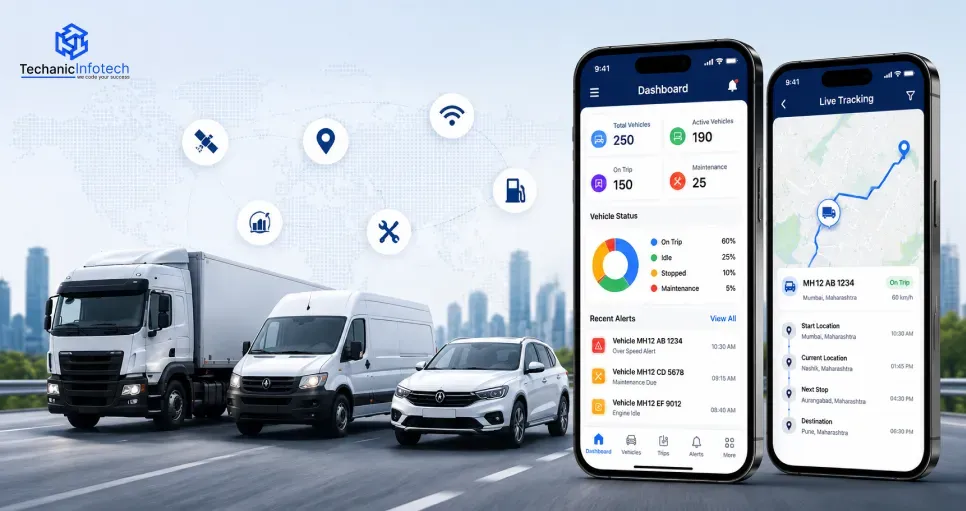
Managing a fleet of vehicles has become increasingly complex as businesses strive to reduce operational costs, improve driver safety, and ensure timely deliveries. Whether it's a logistics company, transportation provider, rental service, or field service business, manual fleet management is no longer enough to meet today's operational demands.
This is where fleet management app development comes into play. A modern fleet management application enables businesses to monitor vehicles in real time, optimise routes, schedule preventive maintenance, track fuel consumption, and manage drivers from a single platform. By combining GPS technology, cloud computing, AI, and IoT, companies can gain complete visibility into their fleet operations while improving efficiency and reducing expenses.
As digital transformation continues to reshape the transportation industry, investing in fleet management software development has become a strategic move rather than just a technological upgrade. Businesses are increasingly adopting intelligent fleet solutions to enhance productivity, improve customer satisfaction, and stay competitive in a rapidly evolving market.
In this comprehensive guide, we'll explore everything you need to know about fleet management app development, including its essential features, market growth, development process, technology stack, estimated costs, and the future of smart fleet management solutions.
Fleet management app development is the process of designing and building software that helps businesses monitor, manage, and optimise their fleet operations through web and mobile applications. These applications enable fleet managers to track vehicle locations, monitor driver behaviour, schedule maintenance, manage fuel consumption, generate reports, and improve overall operational efficiency.
A modern vehicle fleet management app integrates multiple technologies, including GPS tracking, cloud computing, IoT sensors, AI-powered analytics, and real-time notifications, to provide comprehensive visibility into fleet performance. Instead of relying on spreadsheets or manual tracking, businesses can automate routine tasks and make data-driven decisions.
Depending on business requirements, fleet management solutions can be developed for industries such as the following:
Logistics and supply chain
Transportation companies
Trucking businesses
Delivery services
Construction companies
Car rental businesses
Public transportation
Field service organizations
Today's GPS fleet management software goes beyond location tracking. It provides predictive maintenance alerts, driver performance analysis, route optimisation, fuel monitoring, geofencing, electronic proof of delivery (ePOD), and compliance management. These capabilities help organisations reduce operational costs while improving fleet utilisation and customer service.
Whether you're building a logistics fleet management app for last-mile deliveries or a comprehensive transportation fleet management software platform for enterprise operations, the right solution can significantly improve business performance.
The demand for digital fleet management solutions continues to grow as businesses prioritise operational efficiency, sustainability, and real-time visibility. Increasing adoption of connected vehicles, IoT devices, AI-powered analytics, and cloud-based platforms is driving the expansion of the global fleet management market.
Here are some notable industry statistics:
The global fleet management market was valued at over USD 30 billion in 2024 and is expected to surpass USD 70 billion by 2032, growing at a healthy CAGR over the forecast period.
GPS-based fleet tracking has become one of the fastest-growing segments within commercial transportation, with businesses increasingly investing in real-time vehicle monitoring and route optimisation technologies.
Fleet operators implementing AI-powered predictive maintenance solutions have reported significant reductions in vehicle downtime, maintenance costs, and unexpected breakdowns.
Rising fuel prices and increasing demand for delivery services are encouraging businesses to adopt intelligent fleet management software that improves route planning and fuel efficiency.
Cloud-based fleet management platforms continue to dominate new deployments due to their scalability, remote accessibility, and lower infrastructure costs compared to traditional on-premise systems.
As organisations continue their digital transformation journey, investment in commercial fleet management solutions is expected to accelerate across logistics, transportation, construction, healthcare, and field service industries.
The success of a fleet management application depends on the features it offers. A well-designed platform should simplify fleet operations while providing valuable insights that improve efficiency, safety, and profitability.
|
Feature |
Business Benefit |
|
Real-Time GPS Tracking |
Monitor vehicle locations, optimise routes, and improve dispatch accuracy. |
|
Driver Management |
Track driver performance, monitor driving behaviour, and encourage safe driving practices. |
|
Fleet Maintenance Scheduling |
Automate maintenance reminders to minimise vehicle downtime and repair costs. |
|
Fuel Management |
Analyse fuel consumption, identify wastage, and reduce operational expenses. |
|
Route Optimisation |
Suggest the fastest and most fuel-efficient routes using real-time traffic data. |
|
Geofencing |
Receive alerts when vehicles enter or leave designated areas. |
|
Trip History |
Access historical trip data for audits, reporting, and performance analysis. |
|
Push Notifications |
Notify drivers and managers about maintenance, delays, or emergencies instantly. |
|
Document Management |
Store insurance, permits, registrations, and compliance documents securely. |
|
Reports & Analytics |
Generate actionable insights into fleet utilisation, fuel efficiency, maintenance, and driver performance. |
Investing in fleet management app development offers long-term benefits for organisations that rely on commercial vehicles. Beyond improving day-to-day operations, these applications provide valuable insights that support strategic business decisions.
Managers can monitor every vehicle in real time through GPS tracking, enabling faster decision-making and better coordination across the fleet.
Route optimisation, fuel monitoring, and preventive maintenance help businesses reduce unnecessary expenses and improve overall profitability.
By tracking harsh braking, speeding, and idle time, fleet managers can encourage safer driving habits and reduce accident risks.
Fleet analytics help identify underutilised vehicles, allowing businesses to maximise asset usage and improve return on investment.
Automated maintenance schedules ensure vehicles receive timely servicing, preventing expensive repairs and minimising downtime.
Real-time tracking and accurate delivery estimates improve transparency, helping businesses provide better customer experiences.
Fleet management software simplifies compliance by storing digital records, tracking inspections, and generating reports required by transportation authorities.
Comprehensive dashboards and analytics provide insights into fleet performance, driver productivity, maintenance trends, and operational efficiency, enabling businesses to make informed decisions.
Developing a successful fleet management application requires more than just coding. It involves careful planning, selecting the right technologies, and creating an intuitive user experience that meets business goals. Below is a step-by-step overview of the development process.
The first step is to understand your target audience, business objectives, and competitors. Identify the challenges your fleet management solution aims to solve, such as reducing fuel costs, improving vehicle utilisation, or enhancing driver safety.
Many businesses begin with a minimum viable product (MVP) to validate their idea before investing in a full-scale solution. If you're unfamiliar with this approach, our guide on minimum viable product development explains how an MVP helps gather user feedback, minimise risks, and reduce development costs before building a full-featured application.
A user-friendly interface is essential for fleet managers and drivers who rely on the app daily. The design should focus on easy navigation, clear dashboards, and quick access to important information like vehicle locations, maintenance schedules, and alerts.
A well-designed interface improves user adoption and overall productivity. Following app UI/UX design best practices ensures your fleet management application delivers a seamless and intuitive user experience across all devices.
Once the design is finalised, developers begin building the application. This phase includes front-end development, back-end architecture, API integration, cloud infrastructure, GPS functionality, and database management.
Common modules developed during this stage include:
Vehicle tracking
Driver management
Route optimization
Fuel monitoring
Maintenance scheduling
Reports and analytics
Notifications
Admin dashboard
Developers also integrate third-party services such as GPS providers, mapping APIs, payment gateways (if required), and cloud storage solutions.
Before deployment, the application undergoes rigorous testing to ensure it performs reliably across different devices and operating systems.
Testing typically includes:
Functional testing
Performance testing
Security testing
GPS accuracy testing
Compatibility testing
User acceptance testing (UAT)
Conducting comprehensive testing on an application helps identify bugs, improve performance, strengthen security, and deliver a reliable user experience before launch.
After successful testing, the application is deployed to cloud servers and published on the Apple App Store and Google Play Store, depending on the project's requirements.
Businesses should also ensure proper server configuration, security monitoring, and backup systems before launch. Following the right process to publish an app to the App Store/Play Store helps ensure a smooth approval process and successful app launch.
Launching the application is only the beginning. Regular maintenance ensures the software remains secure, compatible with new operating system updates, and equipped with the latest features.
Typical post-launch services include the following:
Bug fixes
Performance optimization
Feature enhancements
Security updates
API upgrades
Server monitoring
Regularly maintain a mobile app to improve performance, enhance security, fix issues, and introduce new features that keep your fleet management solution efficient and competitive over the long term.
Choosing the right technology stack is critical for building a secure, scalable, and high-performing fleet management solution. The technologies used depend on factors such as project complexity, scalability requirements, and integration needs. If you're unsure which technologies best suit your project, our mobile app tech stack guide can help you make informed decisions based on your business goals and scalability needs.
|
Component |
Recommended Technologies |
|
Frontend |
Flutter, React Native, Swift, Kotlin |
|
Backend |
Node.js, .NET, Python (Django), Java (Spring Boot) |
|
Database |
PostgreSQL, MySQL, MongoDB |
|
Cloud Platform |
AWS, Microsoft Azure, Google Cloud |
|
Maps & Navigation |
Google Maps API, Mapbox |
|
GPS Integration |
GPS APIs, Geofencing Services |
|
IoT Integration |
MQTT, AWS IoT Core |
|
AI & Analytics |
TensorFlow, OpenAI APIs, Azure AI |
|
Notifications |
Firebase Cloud Messaging (FCM), OneSignal |
|
Authentication |
OAuth 2.0, Firebase Authentication |
Modern Fleet Management Software development increasingly incorporates AI and IoT to provide predictive maintenance, intelligent route optimisation, and advanced analytics. Businesses looking to enhance automation can also explore AI integration in mobile apps to implement features such as predictive maintenance, driver behaviour analysis, smart route planning, and real-time fleet insights.
The Fleet Management App Development Cost typically ranges from $8,000 to $90,000, depending on factors such as app complexity, the number of features, platform selection (iOS, Android, or cross-platform), third-party integrations, UI/UX design, and the location of the development team. If you're planning your budget, you can also refer to our detailed guide on mobile app development costs to understand the pricing factors involved in mobile app projects.
Estimated Development Cost & Timeline
|
App Complexity |
Ideal For |
Key Features |
Estimated Timeline |
Estimated Cost (USD) |
|
Basic Fleet Management App |
Startups & Small Businesses |
GPS tracking, vehicle registration, driver profiles, trip history, basic reports, notifications |
2–3 Months |
$8,000 - $20,000 |
|
Medium Complexity App |
Growing Logistics Companies |
Everything in the basic app, plus route optimisation, fuel management, maintenance scheduling, geofencing, analytics dashboard, role-based access |
4–6 Months |
$20,000 - $50,000 |
|
Advance Fleet Management App |
Enterprises & Large Fleet Operators |
AI-powered route optimisation, IoT integration, predictive maintenance, real-time analytics, ERP/CRM integration, multi-admin panel, advanced reporting, custom dashboards |
6–9 Months |
$50,000 - $90,000 |
As businesses continue to embrace digital transformation, investing in fleet management app development has become a strategic decision rather than an operational upgrade. A feature-rich fleet management solution helps organisations streamline daily operations, improve vehicle utilisation, reduce fuel and maintenance costs, enhance driver safety, and deliver better customer experiences through real-time tracking and data-driven insights.
Whether you're developing a basic fleet tracking application or an enterprise-grade fleet management software development solution, success depends on choosing the right features, technology stack, and development approach.
For startups and growing businesses, staying informed about the latest mobile app development trends and investing in SMB software development strategies can provide a competitive advantage while ensuring long-term scalability. With technologies like AI, IoT, cloud computing, and predictive analytics reshaping fleet operations, now is the ideal time to invest in a smart fleet management solution that drives efficiency and business growth.
The cost typically ranges from $8,000 to $90,000, depending on the app's complexity, features, integrations, and development requirements.
A basic app can take 2–3 months, while advanced solutions with custom features may require 6–9 months.
Core features include GPS tracking, route optimization, fleet maintenance, fuel management, driver monitoring, notifications, and analytics dashboards.
Logistics, transportation, delivery services, construction, car rental, healthcare, and field service businesses commonly use fleet management solutions.
Yes. AI can be used for predictive maintenance, route optimisation, driver behaviour analysis, and real-time fleet analytics.
Popular technologies include Flutter or React Native for the frontend, Node.js or Python for the backend, PostgreSQL or MongoDB for databases, and AWS or Google Cloud for hosting.
Fleet management software helps reduce operational costs, improve vehicle utilisation, enhance driver safety, and increase overall fleet efficiency.


Bharat Sharma is the CTO of Techanic Infotech, bringing deep technical expertise in software architecture, mobile app development, and scalable system design. He leads the engineering team with a strong focus on innovation, performance, and security.