AI Development
Event-Driven Architecture for AI Native Enterprise Applications: Design, Scaling, and Real Time Workflows
October 6, 2026
October 6, 2026
Key Takeaways:
Event-driven architecture lets AI native apps react to data the moment it changes, replacing slow batch jobs with real-time decisions for customers and teams.
Four building blocks do the work: producers, brokers, consumers, and AI models. Clear schemas and shared contracts keep all four connected and dependable over time.
Design for failure from day one. Idempotent consumers, retries, dead-letter queues, and fallback rules stop one bad event or slow model from stalling everything else.
Scale each layer on its own. Partition topics, autoscale consumers on lag, and run model inference as a separate service to protect speed and reliability.
Start small and add governance early. Pick one high-value use case, track results, assign clear owners, and keep humans involved in every high-risk AI decision.
AI native applications don't wait around. They read signals, make decisions, and act in seconds. Traditional request-response systems struggle to keep up with that pace.
Event-driven architecture (EDA) solves the problem by treating every change, like a payment, a sensor reading, or a customer click, as an event that triggers action right away.
For enterprise teams, this shift changes how software gets designed, scaled, and trusted. Models need fresh data. Workflows need to run in real time. Services need to grow without breaking each other.
This guide walks through how event-driven architecture supports AI native enterprise applications. You will see exactly how to design it, scale it, and build real-time workflows that deliver faster, smarter results for your business.
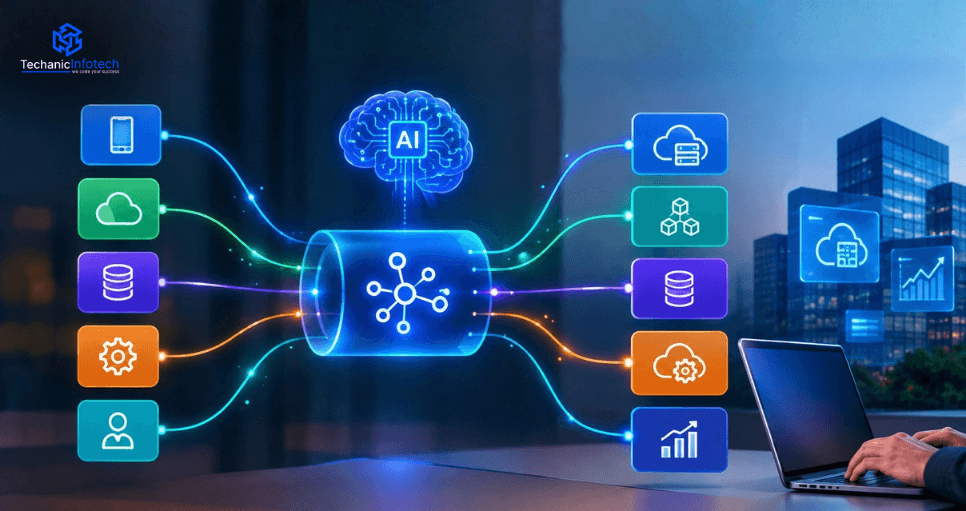
Event-driven architecture (EDA) lets software react the moment something happens. Every order, alert, or user action becomes an event that services can act on instantly. That flow of data is what keeps AI native enterprise apps fast, current, and responsive.
Prod
ucers publish an event, a broker routes it, and an AI model consumes it within moments. Nothing waits for a scheduled batch job, so fraud checks, recommendations, and alerts run on fresh information instead of yesterday's data, every single time.
Agents subscribe to the events they care about and act on their own. Gartner expects 40% of enterprise applications to include task-specific AI agents by the end of 2026, up from under 5% in 2025. Loose coupling keeps growth manageable.
A broker sits between producers and consumers, so teams can add or update services without rewiring everything. When traffic spikes, you scale only the consumers under pressure, which keeps costs lower and the whole system steady, even during peak demand.
Every event is stored in order, creating a clear audit trail for each AI decision. That matters because Gartner predicts over 40% of agentic AI projects will be canceled by the end of 2027, citing cost, unclear value, or risk.
Every event-driven system rests on a few core parts. Producers create events, brokers route them, consumers act on them, and AI models turn them into decisions. Understanding how these pieces fit makes enterprise AI apps easier to design and scale.
Producers are any source that emits an event: payment systems, IoT sensors, web forms, or internal services. Each event should carry clear, consistent details like a timestamp, an ID, and a payload, so downstream systems can trust and process it.
Strong mobile app architecture turns every tap, scan, and location update into a clean event. Lightweight SDKs queue events offline, then sync them when the connection returns, so AI models still see accurate, complete activity from customers and field teams.
The broker is the traffic controller. Tools like Apache Kafka, RabbitMQ, and AWS EventBridge receive events, store them in order, and deliver them to the right consumers. They also buffer sudden spikes, so one slow service never blocks the rest.
Consumers listen for specific events and react. One might update inventory, another might send a notification, and another might call an AI model. Each runs on its own, so teams can change or replace a consumer without touching other services.
AI models sit inside consumers or behind inference services. They score each event, classify it, or predict what happens next. Keep models stateless and versioned, so you can update safely and trace each output back to its exact source model.
Shared event schemas keep every team speaking the same language, while monitoring shows lag, failures, and model drift. Together they catch broken data early, protect AI accuracy, and give engineers the visibility they need to fix problems before customers notice.
Good design starts before any code. In enterprise web application development, event-driven systems need clear event definitions, smart routing, and room for AI models to grow. These choices keep your AI native application fast, reliable, and easy to change later.
Map the moments that matter to your business first, such as order placed, claim filed, or payment failed. Name events in the past tense and keep each one focused, so every team understands what happened without guessing or digging through code.
Write each event as a versioned schema with required fields, data types, and owners. Store schemas in a shared registry, so producers cannot break consumers with surprise changes and AI models always receive clean, predictable input, even as systems evolve.
Pick a broker based on volume, ordering needs, and team skills. Use pub/sub when many services need the same event, and queues for single-task work. Decide early between at-least-once and exactly-once delivery, because it affects cost, speed, and error recovery.
Decide which events need a model and which need simple rules. Run fast models inline for instant decisions, and heavier ones asynchronously. Always add a safe fallback path, so the system keeps working if a model slows down or fails.
Assume events will arrive late, twice, or out of order. Make consumers idempotent, add retry limits, and route stubborn failures to a dead-letter queue. That way, one bad message never stalls your whole pipeline or silently corrupts downstream AI results.
Encrypt events in transit and at rest, and limit who can publish or read each topic. Track lag, errors, and model accuracy on one dashboard. Log every AI decision, so audits and debugging stay fast and simple for your team.
In AI native software development, speed shapes value. A real-time workflow turns a stream of events into a decision within seconds, often without human input. This section shows how data moves from the first signal to the final action.
Start by collecting events from apps, sensors, databases, and partner systems into one stream. Use change data capture for databases, so every update flows out instantly. Consistent formats at this stage save hours of cleanup later and prevent confusing errors.
Raw events are rarely ready for models. Stream processors like Apache Flink or Kafka Streams filter noise, remove duplicates, and join each event with customer or product context while it moves, so models receive complete, useful input every single time.
Models need fresh signals, like purchases in the last ten minutes or login attempts today. A feature store serves these values with low delay and keeps training data and live data consistent, which prevents quiet, hard-to-spot accuracy problems.
Inference should return answers in milliseconds. Host models close to the stream, use smaller or optimized versions where possible, and cache common results. For heavier models, run asynchronous scoring, so slow predictions never hold up urgent, time-sensitive customer events.
AI output needs boundaries. Add business rules, confidence thresholds, and policy checks after every prediction. If a score looks uncertain or breaks a rule, the workflow routes it elsewhere, protecting customers and your brand from confident but wrong automated decisions.
Once a decision is made, the system acts. It might block a payment, reroute a delivery, open a support ticket, or send an alert. Publishing the result as a new event lets other services respond right away, without extra coordination.
Some decisions carry too much risk to automate fully. Send high value or low confidence cases to a person for review, with the model's reasoning attached. Reviewers approve quickly, and their choices become useful training signals for future model versions.
Every outcome teaches the system something. Capture what the model predicted and what actually happened, then stream that result back for evaluation. Regular retraining on fresh outcomes keeps accuracy high as customer behavior, markets, and fraud tactics change over time.
Traffic never arrives evenly. Use backpressure, autoscaling consumers, and partitioning to absorb sudden bursts. Set time limits on each step, and define fallback answers, so a slow component never freezes the entire workflow during your busiest hours of the day.
Track end-to-end latency, from the original event to the final action. Watch consumer lag, error rates, and model accuracy together. Clear targets, such as decisions in under one second, help teams spot problems and prove real business value.
Growth tests every system. As event volume climbs, delays, duplicates, and failures become more likely, especially when AI models sit in the path. Scaling well means adding capacity without giving up accuracy, speed, or trust. Here's how to do it.
Split each topic into partitions so multiple consumers can read in parallel. Choose partition keys carefully, such as customer ID, to keep related events in order. Add partitions before traffic peaks, because changing them later can disrupt ordering and throughput.
Scale consumers based on lag, the gap between published and processed events. CPU alone can hide a growing backlog. Set minimum and maximum limits, and test scaling with realistic traffic, so new instances join without overwhelming databases or model endpoints.
Serverless architecture cloud app development suits bursty event traffic, because functions scale up on demand and drop to zero when idle. Use it for lightweight consumers, and keep long-running or GPU-heavy inference on dedicated services, avoiding cold starts and timeouts.
At scale, duplicates are normal. Brokers may redeliver events after failures or rebalances. Give every event a unique ID and track what you have processed, so repeating a message never charges a card twice or triggers the same AI action.
Retry temporary errors with exponential backoff, and cap the number of attempts. Send messages that keep failing to a dead-letter queue for review. This stops one poisoned event from blocking a partition and keeps healthy traffic flowing normally for customers.
Run AI inference as its own service, so you can scale models apart from event consumers. Use batching, caching, and model versions to raise throughput. Add circuit breakers and fallback rules, so a slow model degrades instead of stalling everything.
Run brokers across multiple availability zones, with replicated data, so one outage does not erase events. Define recovery time and data loss targets, back up schemas and offsets, and rehearse failovers, because untested recovery plans often fail when needed most.
Track consumer lag, error rates, latency, and model accuracy on one dashboard. Load test before big launches, and set alerts that fire early. Review retention, storage, and inference costs monthly, so rapid growth does not quietly erase your profit margins.
Many teams stumble not on technology, but on planning. Poor event design, rushed rollouts, and weak ownership can sink an otherwise strong project. Here are the most common pitfalls, paired with practical ways to adopt event-driven AI safely and steadily.
Not every action deserves an event. Too many tiny events flood brokers, inflate costs, and confuse teams. Start with business moments that matter, like orders, claims, or alerts, and add more only when a real use case demands it.
Unmanaged event formats cause quiet, expensive breakage. One renamed field can crash consumers or corrupt model input. Adopt a schema registry from day one, require versioning, and test compatibility before every release, so teams can change events without surprising anyone downstream.
Avoid a company-wide rewrite. Pick one workflow with clear pain and measurable results, such as fraud alerts or delayed shipments. Deliver it in a few months, share the wins, and use that proof to earn support for the next project.
Event flows are harder to trace than simple requests. Without proper tooling, a missing event can take days to find. Add correlation IDs, distributed tracing, and lag dashboards early, so engineers can follow any event from source to final AI decision.
Cloud computing for businesses removes much of the heavy lifting. Managed brokers, serverless functions, and hosted model endpoints cut setup time and maintenance. Choose services that fit your compliance needs, and avoid heavy lock-in by keeping event formats open and portable.
Fast pipelines can spread bad data just as fast. Models also lose accuracy as customer behavior shifts. Validate events at the door, monitor prediction quality continuously, and schedule retraining, so your AI keeps making sound decisions months after launch.
When nobody owns an event, nobody fixes it. Assign a clear owner to every topic and schema, document who consumes what, and set access rules. Add human review for high-risk AI decisions, so accountability never gets lost between teams.
Event-driven thinking takes practice. Train developers, data scientists, and operations teams together, and share simple design guidelines. Build a small platform team that offers templates and support, so every new project starts faster and avoids repeating old mistakes.
Event-driven architecture gives AI native enterprise applications the speed and flexibility they need to compete.
Producers create events, brokers route them, consumers react, and models turn fresh data into decisions within seconds.
When you design clear schemas, plan for failure, and scale each part on its own, the system stays reliable as demand grows.
Success rarely comes from a big rewrite. Start with one valuable use case, measure the results, and build from there. Pair strong governance with the right cloud tools, and keep humans involved in high-risk decisions.
Teams that take this path ship faster, adapt sooner, and earn lasting trust from customers. The best time to start is now, with one well-chosen event and a clear business goal.
Event-driven architecture is a design style where software reacts to events, like a payment, a click, or a sensor reading. Producers publish events, a broker routes them, and consumers act on them independently, without waiting on requests or each other.
An AI native application is built around AI from the start, not added later. Models drive core features like decisions, predictions, and automation, and they depend on fresh data, which is why event streams fit so naturally into the design.
Request-response systems wait for a caller to ask, then reply. Event-driven systems react the moment something changes. This removes polling and batch delays, lets services work in parallel, and gives AI models fresher data for faster and smarter decisions overall.
Common choices include Apache Kafka, RabbitMQ, AWS EventBridge, Google Pub/Sub, and Azure Event Hubs for brokers, plus Apache Flink or Kafka Streams for processing. Pick one based on expected volume, ordering needs, cloud provider, budget, and your team's existing skills.
Use real time when the value of a decision fades fast, like fraud detection, dynamic pricing, or delivery alerts. Batch works for reports and model training on datasets. Enterprises combine both, streaming for instant actions and batch for deeper analysis.
Make consumers idempotent by giving each event a unique ID and tracking what has been processed. Use partition keys to keep related events in order, and add timestamps so late arrivals can be handled correctly without corrupting AI results downstream.
Add guardrails after every prediction, like confidence thresholds and policy checks. Log each decision for audits, limit who can access events, encrypt data at rest, and send high-risk or uncertain cases to a human reviewer before any automated action happens.
A focused first use case, like fraud alerts or delivery tracking, often takes two to four months to reach production. Full enterprise adoption takes longer and happens in stages. Timelines depend on team skills, data quality, and your existing systems.
Yes, for lightweight consumers and bursty traffic. Serverless functions scale on demand and cost nothing when idle. For heavy or GPU-based inference, dedicated model services usually work better, since cold starts and time limits can slow urgent real time predictions.
The biggest mistakes include making everything an event, skipping schema versioning, ignoring observability, and launching without clear ownership. Avoid them by starting small, using a schema registry, adding tracing early, and assigning a clear owner to every topic and schema.


Bharat Sharma is the CTO of Techanic Infotech, bringing deep technical expertise in software architecture, mobile app development, and scalable system design. He leads the engineering team with a strong focus on innovation, performance, and security.