Mobile App Development
How to Build a Gift Delivery App: Benefits, Features, Cost, & More
August 31, 2026
August 31, 2026
Key Takeaways:
Gift delivery apps can connect customers with florists, bakeries, gift shops, and other retailers through a convenient digital platform.
Essential features include product catalogues, search, personalization, scheduled delivery, payments, order tracking, notifications, and customer support.
Advanced features such as AI recommendations, smart search, gift reminders, loyalty programs, and real-time tracking can improve engagement.
Businesses can generate revenue through commissions, delivery fees, subscriptions, featured listings, corporate gifting, and hybrid models.
A structured development process helps businesses validate the idea, launch an MVP, and introduce advanced functionality in phases.
The estimated gift delivery app development cost can range from $8,000 to $70,000+, depending on complexity and scope.
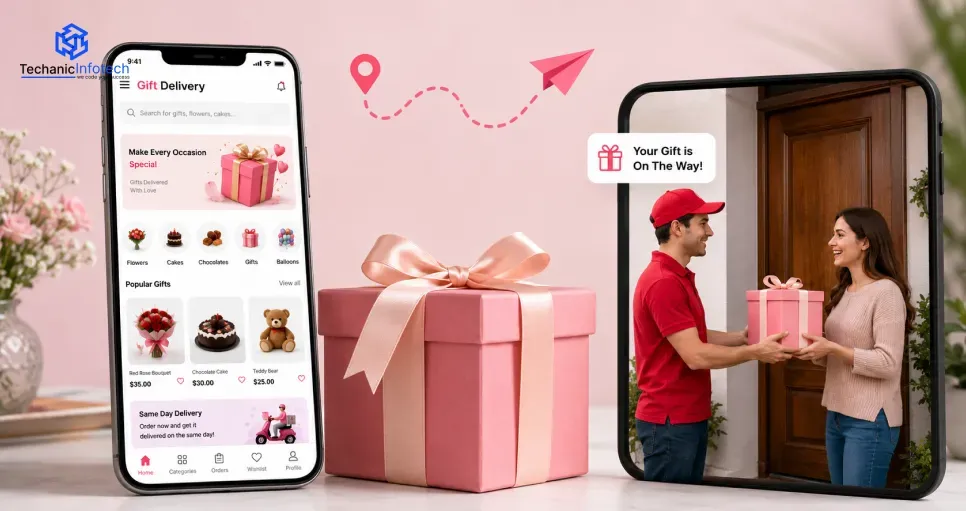
Gift delivery apps have made it easier for customers to send flowers, cakes, personalized gifts, chocolates, and other products to friends and family. With on-demand ordering, scheduled deliveries, digital payments, and real-time tracking, these platforms provide a convenient way to make special occasions more memorable.
For businesses, launching a gift delivery platform can create opportunities to serve customers across multiple locations while partnering with local stores, florists, bakeries, and gift retailers. A successful gift delivery app development strategy should therefore focus on a smooth customer experience, efficient order management, reliable delivery, and scalable technology.
This guide explains how to build a gift delivery app, covering its essential features, business models, development process, technology stack, AI capabilities, integrations, development cost, and factors to consider when choosing a development partner.
The Indian online gifting market size was valued at USD 309.60 million in 2025 and is projected to reach USD 406.51 million by 2034, growing at a compound annual growth rate of 3.07% from 2026 to 2034.
According to iMarcGroup, the Indian market is being supported by increasing internet penetration; eCommerce adoption; digital payments such as UPI; and demand for personalized and convenient gifting experiences.
According to Fortune Business Insights, the growth rate (CAGR) is 3.64% over the forecast period. Europe dominated the gift retailing market with a market share of 37.76% in 2025.
The way people purchase and send gifts has changed with the growth of eCommerce and on-demand delivery services. Gift delivery apps allow customers to choose products, personalize orders, select delivery dates, and send gifts without visiting a physical store.
Customers can browse and order gifts from their smartphones at any time. This makes last-minute and scheduled gifting easier, particularly for birthdays, anniversaries, festivals, and other occasions.
Many customers expect gifts to arrive quickly. Same-day and scheduled delivery options allow businesses to serve urgent gifting needs while creating additional revenue opportunities.
Apps can recommend gifts based on occasions, budgets, previous purchases, and recipient preferences. Personalization can make the shopping experience more relevant and engaging.
A single platform can offer flowers, cakes, chocolates, greeting cards, personalized gifts, hampers, and other products. This gives customers more choices while helping businesses increase average order value.
Integrated payment options allow customers to complete purchases quickly using cards, digital wallets, UPI, or other supported payment methods.
Customers can receive updates about order confirmation, preparation, dispatch, and delivery. Real-time tracking also improves transparency and reduces delivery-related support requests.
Gift businesses can expand beyond local stores by partnering with multiple vendors and delivery partners. This marketplace approach can help platforms increase product variety and reach more customers.
Businesses planning an on-demand app development solution can also use the same delivery infrastructure for other time-sensitive services, depending on their target market and business model.
Choosing the right business model is one of the first decisions to make when planning a gift delivery app. It determines how the platform earns revenue, who manages products and deliveries, and what features are required for customers, vendors, and administrators.
In this model, a single gift retailer, florist, bakery, or gifting brand operates the application and manages its own products, inventory, orders, and deliveries.
Customers can browse the catalogue, personalize gifts, select delivery slots, make payments, and track their orders through the app.
Best suited for:
Local gift shops
Florists
Bakeries
Specialty gifting brands
Regional retailers
This model is relatively straightforward and can be a practical starting point for businesses launching their first digital gifting platform.
A multi-vendor platform connects customers with multiple florists, bakeries, gift shops, and other retailers through one application. Each vendor can manage its own products, pricing, inventory, promotions, and orders.
The platform owner can earn revenue through commissions charged on completed orders.
Best suited for:
Gift marketplaces
Local delivery platforms
Multi-brand gifting businesses
City-wide gifting services
Although this model provides a wider product selection, it requires additional functionality such as vendor dashboards, commission management, inventory synchronization, and vendor onboarding.
The platform earns a percentage of every successful order placed through the application. Vendors receive the remaining amount after the platform's commission is deducted.
For example, if a customer places a $100 order and the platform charges a 15% commission, the platform earns $15 from that transaction.
This model can work particularly well for multi-vendor gift delivery platforms because revenue grows alongside order volume.
Businesses can charge customers a separate delivery fee based on distance, delivery speed, location, or order value. For example, standard delivery can have a lower fee, while same-day or express delivery can carry a premium charge.
This model can generate additional revenue while helping businesses cover delivery and logistics expenses.
A gift delivery platform can offer customers a paid membership that provides benefits such as free delivery, exclusive discounts, priority delivery slots, loyalty rewards, or special offers.
This model can be particularly useful for customers who frequently send gifts throughout the year.
Businesses can provide gifting solutions for companies that regularly send gifts to employees, clients, partners, or customers.
The platform can support bulk orders, scheduled deliveries, personalized messages, corporate accounts, and centralized billing. This model can create higher-value orders and recurring business relationships.
A gift delivery platform does not necessarily need to rely on one revenue source. Businesses can combine commissions, delivery fees, subscriptions, featured listings, and corporate gifting to create multiple revenue streams.
Choosing the right business model early helps determine the platform's required features, revenue strategy, vendor structure, and overall development scope. Businesses can also consult an experienced software app development company to evaluate the technical requirements of their chosen model and create a scalable roadmap for future expansion.
A gift delivery app connects customers, gift vendors, delivery partners, and administrators through a single platform. The workflow is designed to make product discovery, ordering, personalization, payment, and delivery simple.
Customers create an account and browse categories such as flowers, cakes, chocolates, hampers, and personalized gifts. Search and filters help them quickly find suitable products.
Customers select a gift, choose available variants, add personalized messages, and provide recipient details. They can also select a preferred delivery date or time slot.
After reviewing the order, customers proceed to checkout and pay through the available payment methods. The system generates an order confirmation once the transaction is successful.
The selected vendor receives the order through the vendor dashboard. They confirm availability, prepare the gift, and update its status through the platform.
Once the gift is ready, the platform assigns the order to an available delivery partner. Location and delivery data can be used to support efficient dispatching.
Customers can track their order and receive notifications as it moves from preparation to dispatch and final delivery.
The delivery partner completes the order and can provide proof of delivery where required. The customer receives a final notification and can leave a rating or review.
A well-planned workflow ensures that customers, vendors, and delivery partners can interact smoothly throughout the order journey. Businesses can work with an experienced gift delivery app development company to build these connected workflows and create a scalable platform that supports future features and growing order volumes.
A successful gift delivery platform needs features that make shopping simple for customers while helping vendors and delivery partners manage orders efficiently.
|
Feature |
Purpose |
|
User Registration & Login |
Secure account creation and access |
|
Gift Catalog |
Display products, prices, images, and availability |
|
Search & Filters |
Help users find suitable gifts quickly |
|
Gift Categories |
Organize flowers, cakes, chocolates, hampers, and more |
|
Personalization |
Add messages, names, photos, or customization options |
|
Recipient Details |
Store the recipient's name, address, and contact information |
|
Scheduled Delivery |
Allow customers to select a preferred delivery date and time |
|
Shopping Cart |
Review and manage selected products |
|
Secure Payments |
Support cards, wallets, UPI, and other payment methods |
|
Order Tracking |
Show order preparation, dispatch, and delivery statuses. |
|
Push Notifications |
Send order and delivery updates |
|
Ratings & Reviews |
Collect feedback from customers |
|
Offers & Coupons |
Provide discounts and promotional deals |
|
Order History |
Allow customers to view previous purchases |
|
Wishlist |
Save gifts for future purchases |
|
Customer Support |
Help customers resolve order-related issues |
For a first release, businesses can prioritize essential mobile app features such as product browsing, personalization, checkout, payments, scheduled delivery, notifications, and order tracking. Advanced functionality can be introduced as the platform gains users.
A well-planned feature set also makes it easier to scale the platform into related services such as flower delivery app development or cake delivery app development without redesigning the entire customer experience.
A structured development process helps businesses turn a gift delivery idea into a reliable and scalable platform. Each stage should be planned around the target audience, business model, required features, and delivery operations.
Identify the target customers, competitors, product categories, delivery locations, and revenue model. Define the core requirements and decide whether the platform will operate as a single-store service or multi-vendor marketplace.
Prioritize essential functionality such as registration, product browsing, personalization, cart, payments, order management, scheduled delivery, and notifications. This helps launch the platform faster and validate the business concept.
Create wireframes, user flows, prototypes, and final interfaces for customers, vendors, delivery partners, and administrators. The design should keep product discovery and checkout simple.
Choose the appropriate frontend, backend, database, cloud infrastructure, APIs, and development framework based on the expected scale and feature requirements. A suitable mobile app tech stack can improve performance and make future expansion easier.
Develop APIs, authentication, product management, order processing, payments, notifications, vendor management, delivery workflows, and admin functionality.
Build the customer and delivery applications and connect them with the backend. Vendor and admin dashboards can be developed as web-based interfaces where appropriate.
Integrate payment gateways, maps, GPS tracking, notifications, analytics, inventory systems, and other third-party services required by the business model.
Test functionality, payments, security, performance, device compatibility, notifications, order workflows, and delivery tracking before launch.
Prepare production infrastructure, configure monitoring, publish the applications to the required app stores, and launch the platform.
Monitor user behavior, reviews, technical performance, and business metrics. Use these insights to fix issues and introduce new features in future releases.
Following a phased gift delivery app development process allows businesses to control the initial scope while creating a foundation for long-term growth.
The technology stack affects an app's performance, scalability, security, and development effort. The right combination should be selected based on the platform's features, expected traffic, integrations, and future expansion plans.
|
Technology Layer |
Recommended Technologies |
Purpose |
|
Mobile App |
Flutter, React Native, Swift, Kotlin |
Customer and delivery apps |
|
Frontend |
React.js, Angular, Vue.js |
Vendor and admin dashboards |
|
Backend |
Node.js, Python, Java, .NET |
APIs and business logic |
|
Database |
PostgreSQL, MySQL, MongoDB |
Users, products, orders, and inventory |
|
Cloud |
AWS, Azure, Google Cloud |
Hosting, storage, and scalability |
|
Maps & GPS |
Google Maps API, Mapbox |
Location and delivery tracking |
|
Payments |
Stripe, PayPal, Razorpay |
Secure online transactions |
|
Notifications |
Firebase, Twilio |
Push notifications, SMS, and alerts |
|
Analytics |
Firebase Analytics, Google Analytics |
Customer and business insights |
|
AI/ML |
Python, TensorFlow, OpenAI APIs |
Recommendations and personalization |
For startups, cross-platform frameworks such as Flutter or React Native can reduce development effort when launching on multiple platforms. Larger businesses may choose native technologies when they require highly customized performance or device-specific functionality.
A well-planned mobile app tech stack should not only support the initial release but also make it easier to add advanced features, new integrations, and additional delivery regions later.
AI can help gift delivery platforms create more personalized shopping experiences while improving operational efficiency. From recommending products to forecasting demand, AI can be applied across multiple parts of the platform.
AI can analyze customer preferences, previous purchases, browsing behavior, occasion types, and budgets to suggest relevant gifts.
Natural-language search can help customers find products using conversational queries such as “gifts for a birthday under $50” or “romantic anniversary gifts".
AI can recommend suitable gifts based on occasions such as birthdays, anniversaries, weddings, festivals, and corporate events.
AI models can analyze historical orders and seasonal trends to help businesses forecast demand and plan inventory more efficiently.
AI can analyze traffic, distance, delivery locations, and order priorities to suggest more efficient routes for delivery partners.
AI-powered chatbots can answer common questions about products, order status, delivery times, cancellations, and refunds, reducing the workload for support teams.
Machine learning models can identify unusual transaction patterns and help businesses detect potentially fraudulent orders or payment activity.
AI can help personalize notifications, offers, and recommendations based on customer behavior, increasing engagement and repeat purchases.
Businesses that want advanced AI capabilities can work with an AI development company to develop customized recommendation engines, predictive analytics, automation workflows, and intelligent customer-support solutions.
Third-party integrations help a gift delivery app handle payments, location services, notifications, inventory, and deliveries more efficiently. The required integrations depend on the platform's business model and operational scope.
|
Integration |
Purpose |
|
Payment Gateway |
Process online payments, refunds, and transactions |
|
Maps & GPS |
Location search, navigation, and delivery tracking |
|
SMS & Email |
OTPs, order confirmations, and delivery updates |
|
Push Notifications |
Real-time order and promotional alerts |
|
Inventory APIs |
Synchronize product availability and stock |
|
POS/ERP Systems |
Connect vendor operations with the platform |
|
Logistics APIs |
Driver assignment, dispatch, and delivery tracking |
|
Analytics Tools |
Monitor customer behavior and business performance |
|
Social Login |
Simplify account registration and login |
|
AI APIs |
Recommendations, search, and automation |
The cost of developing a gift delivery app generally ranges from $8,000 to $70,000+, depending on the platform's complexity, features, number of applications, integrations, technology, and development team.
|
App Type |
Estimated Cost |
Timeline |
Suitable For |
|
Basic MVP |
8,000–18,000 |
2–3 months |
Startups and small gift businesses |
|
Standard App |
18,000–35,000 |
3–5 months |
Growing local and regional businesses |
|
Advanced Platform |
35,000–50,000 |
5–7 months |
Multi-vendor gift marketplaces |
|
Enterprise Platform |
50,000–70,000+ |
7–10+ months |
Large-scale gifting and delivery networks |
The budget may cover:
Customer mobile application
Delivery partner application
Vendor dashboard
Admin panel
UI/UX design
Backend development
Product and inventory management
Payment integration
Order management
GPS and delivery tracking
Push notifications
Third-party API integrations
Testing and deployment
The final mobile app development cost can increase when businesses require advanced AI recommendations, multi-vendor functionality, real-time tracking, custom integrations, multilingual support, or complex admin workflows.
Businesses can start with an MVP containing essential features and gradually invest in advanced capabilities as the platform gains customers and revenue.
The final development budget depends on more than the number of features. Several technical and business decisions can significantly influence the overall investment.
A simple single-vendor application requires fewer resources than a multi-vendor marketplace with separate customer, vendor, delivery, and admin interfaces.
Features such as personalization, scheduled delivery, real-time tracking, loyalty programmes, AI recommendations, and advanced analytics require additional development effort.
Building for Android, iOS, and web simultaneously can increase the budget compared with launching on a single platform. Cross-platform frameworks can help reduce development effort.
A highly customized interface with advanced animations, personalized product experiences, and multiple user journeys requires more design and development resources.
Payment gateways, maps, inventory systems, POS platforms, logistics APIs, SMS providers, and AI services can add both integration and recurring usage costs.
A scalable backend designed to support thousands or millions of users requires more planning and infrastructure than a small local delivery application.
Developer rates vary based on geographic location, experience, technical specialization, and project requirements.
Payment security, authentication, data protection, performance testing, and device compatibility testing add to development effort but are essential for a reliable platform.
Businesses should also consider ongoing expenses for bug fixes, operating-system updates, API changes, cloud infrastructure, security patches, and new features.
For businesses comparing vendors, the courier delivery app development cost can also provide a useful reference when estimating the delivery-management portion of a gift delivery platform, particularly when the business operates its own fleet.
Building a gift delivery app can help businesses meet the growing demand for convenient, personalized, and time-sensitive gifting. A successful platform should combine an intuitive shopping experience with reliable order management, secure payments, vendor coordination, and efficient delivery operations.
Businesses can start with an MVP that includes essential features and gradually introduce advanced capabilities such as AI-powered recommendations, personalized gifting, loyalty programmes, real-time tracking, and analytics.
The overall development investment depends on the platform's business model, feature set, technology stack, integrations, and development approach. Careful planning and phased development can help control the initial budget while creating a scalable foundation for future growth.
The estimated gift delivery app development cost can range from $8,000 to $70,000+, depending on features, platforms, integrations, technology, and overall complexity.
A basic MVP can take around 2–3 months, while a feature-rich multi-vendor platform may require 5–10+ months, depending on its scope.
Key features include product catalogues, search and filters, personalization, a shopping cart, secure payments, scheduled delivery, order tracking, push notifications, ratings, and customer support.
Yes. A multi-vendor platform can allow florists, bakeries, gift shops, and other retailers to manage their products, inventory, orders, and deliveries through dedicated dashboards.
Yes. AI can support personalized gift recommendations, smart search, demand forecasting, customer support, marketing automation, and delivery route optimization.
Common technologies include Flutter, React Native, Swift, Kotlin, Node.js, Python, PostgreSQL, MongoDB, AWS, Google Maps APIs, payment gateways, and notification services.


Bharat Sharma is the CTO of Techanic Infotech, bringing deep technical expertise in software architecture, mobile app development, and scalable system design. He leads the engineering team with a strong focus on innovation, performance, and security.