Courier Delivery App Development
Courier Delivery App Development Cost in 2026: Features, Pricing & Hidden Expenses
December 11, 2025
December 11, 2025
The courier delivery industry is undergoing a rapid transformation as businesses increasingly rely on mobile applications to manage deliveries, optimize routes, and meet rising customer expectations for speed and transparency. From local logistics startups to enterprise-scale delivery networks, courier apps have become a critical operational tool rather than a competitive luxury.
For businesses planning to enter this market, one of the first and most important questions is courier delivery app development cost in 2026. The answer depends on the app’s feature set, complexity, platform choice, and scalability requirements.
On average, the cost to develop a courier delivery app ranges from $5,000–$20,000 for a basic MVP, $25,000–$45,000 for a mid-level solution, and $50,000–$90,000+ for an advanced, fully featured courier platform.
In this guide, we break down how much it costs to develop a courier delivery app by examining key cost-driving factors, app complexity levels, and hidden expenses while also sharing practical strategies to reduce development costs without compromising quality or scalability.
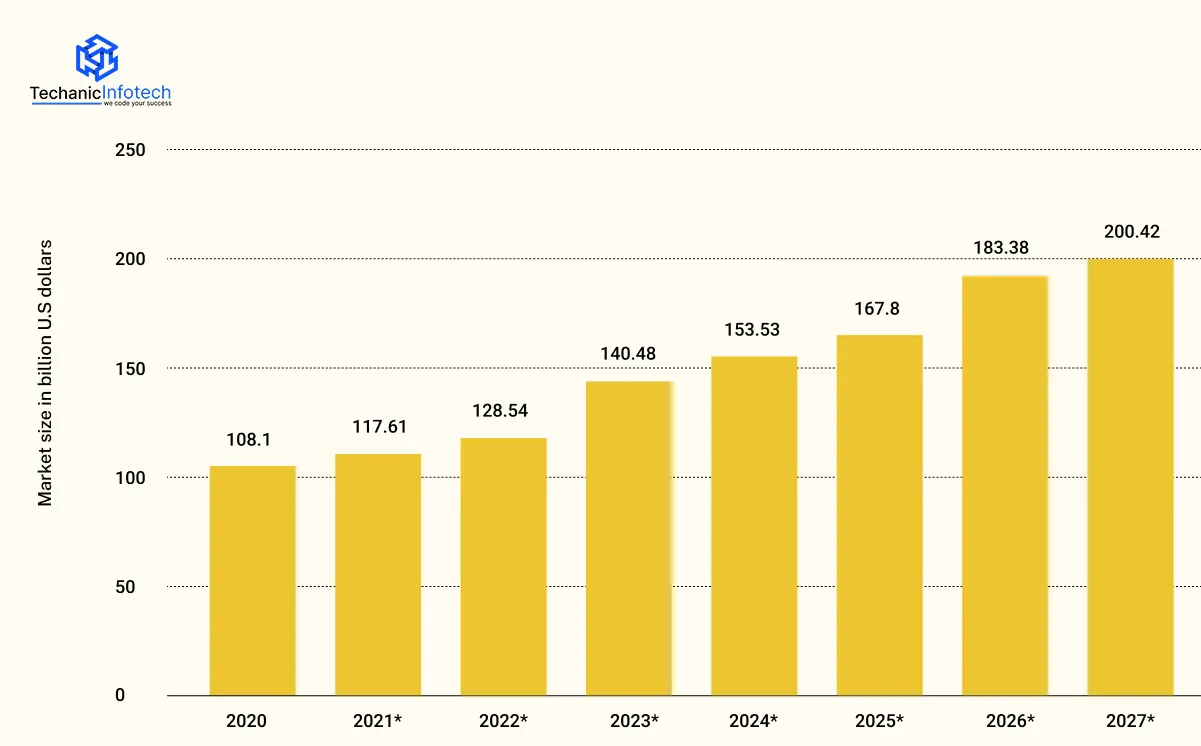
Most consumers today are demanding faster, more efficient delivery services, with 74% of U.S. consumers expecting same-day or next-day delivery.
Courier delivery applications are now enabling businesses to offer real-time tracking, allowing seamless communication between drivers and customers, as well as automated delivery systems.
Furthermore, the e-commerce sector, which has experienced a growth rate of 15% annually since 2020, is fueling the rise in demand for advanced delivery apps.
In 2021, the global on-demand delivery market was valued at $75 billion and is projected to reach $220 billion by 2027, growing at a CAGR (Compound Annual Growth Rate) of 15%.
As competition intensifies in the delivery sector, businesses must continuously innovate to stay ahead. Research shows that companies investing in UX/UI improvements and app functionality upgrades experience a 30% higher customer retention rate and a 25% increase in repeat purchases.
These factors have made it essential for companies to innovate constantly and remain graceful in responding to evolving consumer demands.
The mobile app development cost usually depends on multiple features, complexity, technology stack, and the team’s location. On average, the cost to create a courier delivery app can range from $20,000 to $120,000+, depending on the complexity level.
| App Level | Suitable For | Core Features | Estimated Development |
| Basic Courier Delivery App | Early-stage startups & small businesses | Basic tracking, order placement, notifications, simple admin panel | $5000 – $20,000 |
| Mid-Level Courier Delivery App | Growing courier businesses | Real-time tracking, advanced admin dashboard, payment integration, route optimization | $25,000 – $45,000 |
| Advanced Level Courier Delivery App | Enterprises & large logistics companies | Automation, advanced analytics, geo-fencing, multi-hub management, API ecosystem | $50,000 – $90,000+ |
The following are the three levels at which the delivery app development cost is divided, from basic feature integration to the advanced one.
A basic courier delivery app usually contains some essential features such as user registration, parcel booking, basic delivery status, simple GPS tracking, and a driver module.
This type of app is ideal for startups or small businesses wanting to test the market with a minimum viable product (MVP).
A mid-level courier delivery application comes with more refined features like real-time tracking, multiple payment gateways, route navigation, driver performance monitoring, order scheduling, and customer support integration.
This level of app usually delivers a more polished user experience and is perfect for businesses ready to scale.
An advanced courier delivery app usually contains highly sophisticated features like AI-based route optimization, automated dispatching, multi-driver management, delivery analytics, fleet monitoring, APIs for 3rd-party integrations, multi-language support, and enterprise-level security.
These applications are built for businesses with high delivery volume and complex logistics operations.
Due to the demand for these types of courier delivery applications, most businesses are looking to create more efficient or scalable courier delivery applications in terms of meeting the requirements of their customers.
From app features and design to platform choice and security considerations where understanding these factors plays an important role in enhancing the cost to build a courier delivery app and making a proper plan for a successful launch.
The number of features directly influences the mobile app development efforts, time, and cost for the overall process. Basic apps usually come with simple navigation, static content, and limited interaction that are easier to build and require less time.
Adding the real-time chat, geolocation, push notifications, payment processing, and also offline capabilities increases the complexity for developing an app.
Advanced features for developing the app include AI-powered recommendations, augmented reality, and multi-tenant user roles with custom animations that usually require specialized development and testing, consuming lots of time
Meanwhile, the complex workflows and integrations usually contain extra APIs, custom backend logic, and microservices.
Every single feature added in the app increases the requirement of UI refinement, performance optimization, and quality assurance by influencing the overall project's scope, with an increasing cost to build a courier delivery app.
Choosing the right platform also affects the development cost, tech stack, and timeline. Building for a single platform, whether it's iOS or Android, is typically a more easier process.
Proper selection of a platform that allows you to test the product with a targeted user base. iOS development often costs slightly more to create a courier delivery application, but it can be faster due to fewer device variations, while Android offers a wider market reach with more device fragmentation.
Developing for both platforms ensures maximum user coverage but requires additional resources, larger teams, and extended testing.
Early-stage startups often begin with one platform and expand to both after validating product-market fit, which makes the development process more time-consuming.
Meanwhile, the app design and user experience (UX) play a critical role in attracting and retaining users. A well-designed interface should be more intuitive, visually appealing, and tailored to the needs of the users.
High-quality UX involves in-depth or careful user research, journey mapping, and iterative prototyping to minimise friction and enhance usability. Investing in professional mobile app UI/UX design reduces user confusion, support costs, and churn.
Custom animations, microinteractions, brand-consistent visuals, and accessibility features improve engagement but require additional design and development time.
Ultimately, great UX differentiates your app from competitors and strongly influences user satisfaction, conversion rates, and long-term retention.
Most modern apps rely on third-party services for functionality such as payments, maps, authentication, analytics, notifications, and social logins.
These integrations speed up development by leveraging existing technologies instead of building everything from scratch. However, each integration introduces additional work for API setup, testing, security considerations, and maintenance.
Some services charge usage fees, which can influence long-term costs. The complexity of integrations varies widely, including payment gateways and real-time communication tools that require more effort than basic analytics.
Choosing reliable, well-documented providers ensures smoother development and reduces potential downtime or compatibility issues as your app scales.
A strong backend supports data storage, user authentication, real-time features, and overall app performance. The complexity of the backend infrastructure depends on app requirements.
Simple apps may use lightweight cloud services, whereas large-scale products need custom servers, databases, APIs, and load balancing.
Cloud providers such as AWS, Google Cloud, and Azure offer scalability, monitoring tools, and automated security features. Costs increase with traffic, storage, and advanced services like AI, streaming, or geolocation.
A well-designed backend ensures reliability, fast response times, and smooth app functionality, especially during peak usage or rapid user growth.
The quality and speed of app development depend heavily on the team’s experience and skill set. A typical team may include mobile developers, backend engineers, UI/UX designers, QA testers, and project managers.
Highly experienced developers can deliver cleaner code, faster performance, and better architectural decisions, reducing long-term technical debt. However, they typically come at a higher cost.
Outsourcing, freelancing, and in-house development each have trade-offs related to communication, scalability, and budget.
Selecting a team that understands your industry and product vision ensures smoother workflows, fewer revisions, and a more reliable, high-quality final product.
App development doesn’t end at launch. Continuous maintenance is required to fix bugs, improve performance, update third-party libraries, and adapt to new OS versions.
Regular updates keep the app secure, compatible, and aligned with changing user expectations. Adding new features or refining existing ones involves ongoing development costs.
Monitoring tools, crash reporting, and usage analytics help identify areas for improvement. As the user base grows, infrastructure scaling may also be necessary.
Proper maintenance ensures long-term stability, higher user satisfaction, and improved retention, ultimately protecting your investment and keeping the app competitive in the market.
Security and compliance requirements significantly influence the cost of courier app development because they involve implementing essential safeguards that protect user data, financial information, and business operations.
Since courier applications handle sensitive details such as customer addresses, contact information, live location tracking, and online payments, ensuring strong security measures becomes a major priority.
Meeting these standards requires advanced development efforts, specialized tools, and ongoing monitoring, enhancing the overall project budget.
This factor not only enhances user trust and protects the business from legal risks but also significantly influences both development and long-term cost to make a courier delivery app.
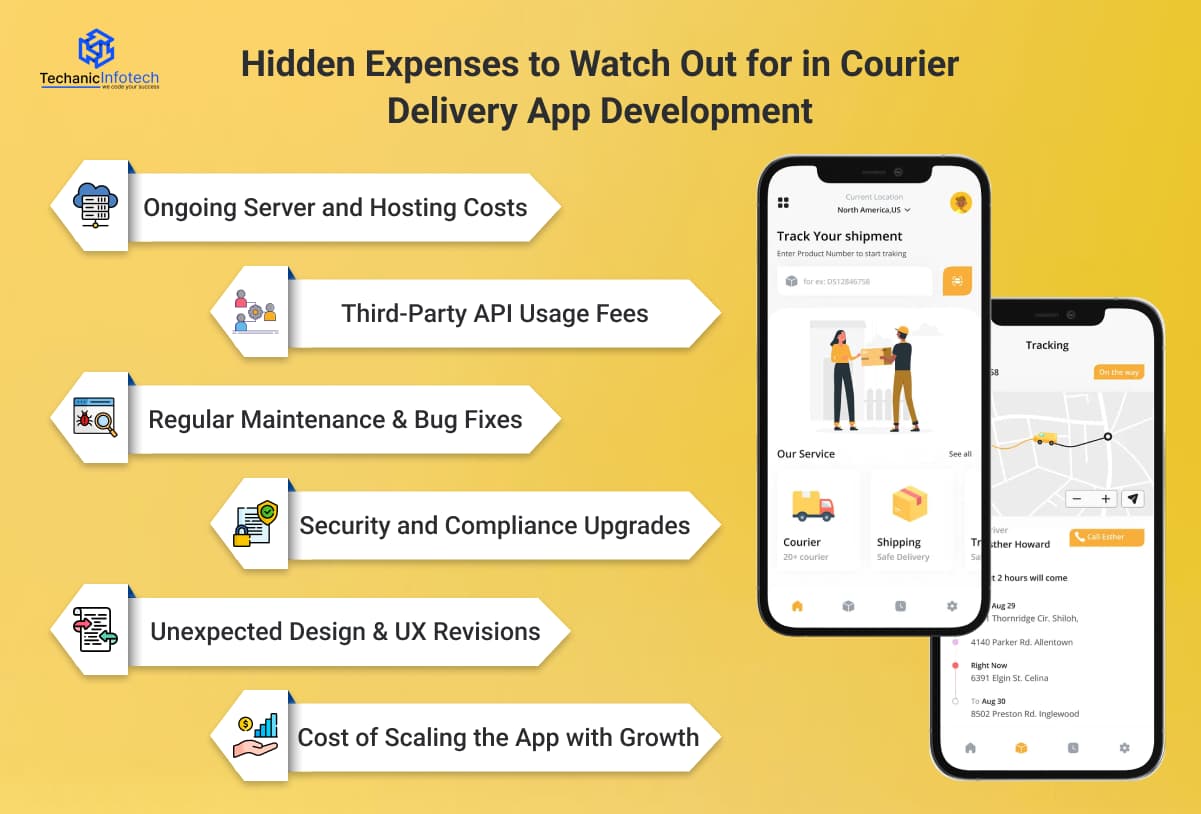
While planning to develop a courier delivery app, many businesses usually focus on visible development costs, but several hidden expenses often arise throughout the project lifecycle.
Whether it's about real-time tracking, push notifications, or high-volume data storage or getting answers for queries like “ How much does it cost to build a courier delivery app?”, it requires robust servers and monthly cloud expenses that significantly increase the delivery app development cost if not carefully monitored.
Courier delivery applications rely on real-time processing, live tracking, and notifications that usually require powerful servers and hosting.
These services involve recurring monthly or annual costs depending on traffic, storage needs, and usage spikes.
Cloud platforms like AWS, Google Cloud, or Azure charge based on bandwidth, database size, CPU usage, and additional services. Without proper monitoring, these expenses can rise unexpectedly.
Courier delivery apps depend on multiple third-party APIs for essential features like GPS tracking, map routing, payment processing, SMS verification, and analytics.
Payment gateways may charge per transaction, and map services often bill based on API calls. These recurring fees can accumulate over time, impacting operational budgets if not monitored closely.
Choosing cost-efficient providers, optimizing API calls, and tracking usage patterns help reduce expenses while ensuring your courier delivery app maintains the accuracy, speed, and functionality that users expect.
Developing a courier delivery app is not a one-time task; ongoing maintenance is essential to keep the app functional, secure, and updated.
Regular updates are required to fix bugs, optimize performance, and ensure compatibility with new operating system versions or device changes.
Although maintenance costs are recurring, they protect the app from disruptions, improve user satisfaction, and extend its lifespan. Neglecting maintenance can lead to poor performance, security risks, and revenue loss.
Courier apps handle sensitive data such as customer addresses, contact numbers, courier delivery details, and payment information.
To protect this data, regular security upgrades are necessary, including encryption updates, penetration testing, secure API audits, and multi-factor authentication enhancements.
Compliance with regulations like GDPR, CCPA, or PCI-DSS may require additional policy changes, documentation, and technical adjustments.
These upgrades come with ongoing costs to develop a courier delivery app, but are crucial for maintaining trust, avoiding legal penalties, and ensuring safe app operations. Investing in strong security reduces long-term risks and supports sustainable business growth.
During development, user testing or stakeholder feedback may reveal issues in navigation, layout, or visual flow, resulting in unexpected design revisions.
Improving user experience often requires redesigning screens, refining animations, or simplifying complex processes to ensure smooth usability
A polished UX reduces user frustration, boosts engagement, and strengthens brand credibility, ultimately improving retention and customer satisfaction.
As your courier delivery app gains users, businesses, and delivery partners, the infrastructure must scale to handle increased demand.
Scaling includes upgrading servers, optimizing databases, enhancing real-time tracking capabilities, and supporting more simultaneous users.
Additional features may be required to accommodate enterprise clients or complex logistics workflows. More users also mean higher API usage fees, increased cloud storage needs, and advanced load-balancing systems.
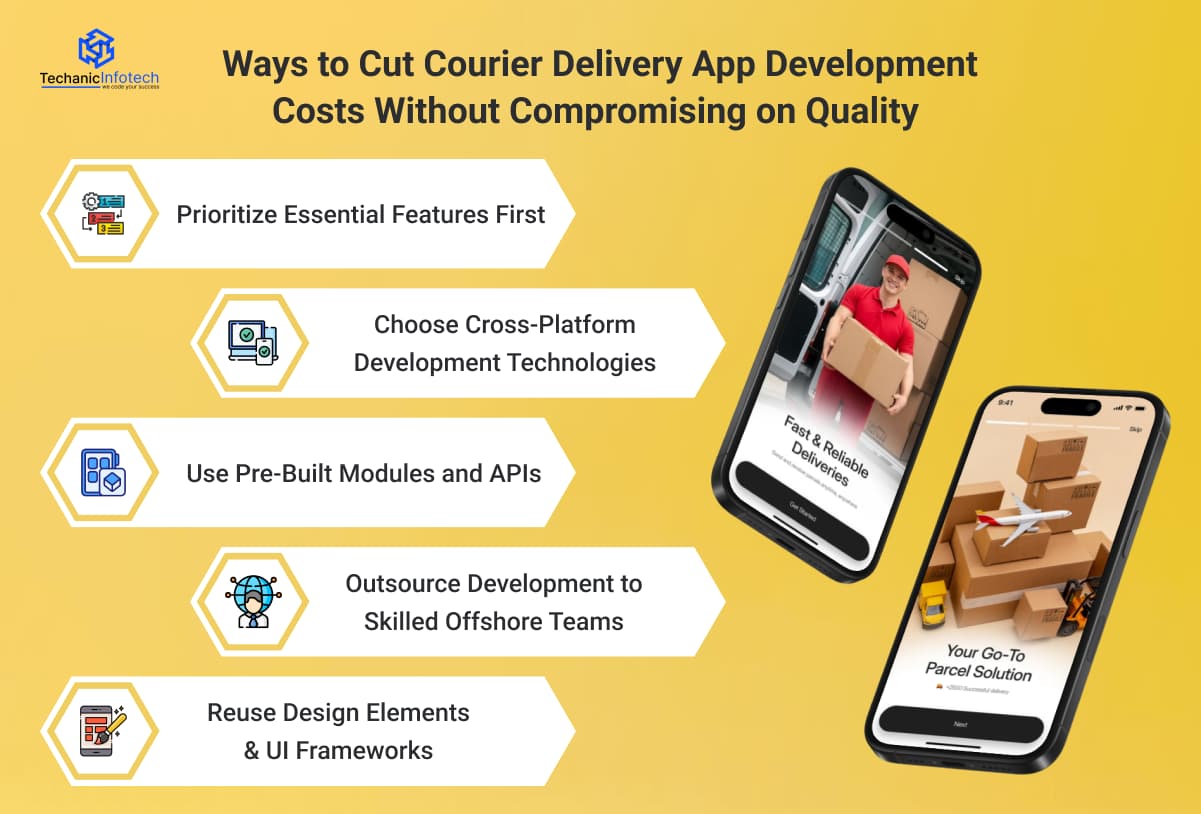
Developing a courier delivery app can be expensive, especially when aiming for high performance, modern features, and a seamless user experience.
Prioritizing essential features, using cross-platform technologies, leveraging pre-built integrations, and adopting efficient development practices, companies can streamline the process and optimize budgets.
The following are the key ways to minimize delivery app development cost while still building a reliable, scalable, and user-friendly courier delivery application.
Focusing on core features at the start helps reduce development time and cost. By identifying the most valuable functionalities, teams avoid unnecessary complexity and ensure early delivery.
This approach allows faster testing, quicker user feedback, and the ability to expand later based on real needs.
Using cross-platform tools like Flutter, React Native, or Ionic allows developers to build one codebase for multiple platforms. This significantly cuts the cost to develop a courier delivery app, reduces development time, and simplifies maintenance.
It also ensures consistent user experiences across devices while enabling faster updates and broader market reach.
Leveraging ready-made modules, libraries, and APIs speeds up development by eliminating the need to build everything from scratch. These components provide reliable, tested functionality, reducing bugs and improving efficiency.
Developers can focus on unique features instead of reinventing common elements like payments, authentication, or maps.
Hiring offshore developers can greatly reduce labour costs while providing access to experienced talent. Offshore teams often deliver high-quality work at competitive rates.
This approach allows businesses to scale quickly, maintain flexibility, and focus internal resources on strategy while external experts handle technical development.Adopt Agile Development for Efficiency
Agile methodology enhances productivity through iterative planning, continuous feedback, and regular improvements. It breaks projects into manageable sprints, ensuring faster delivery and the ability to adapt quickly to changes.
This reduces project risks, improves collaboration, and results in a product that better aligns with user expectations.
Reusing design components, templates, and UI frameworks speeds up the visual development process. It ensures consistency across screens, reduces design and coding time, and minimizes errors.
Frameworks like Material Design or Bootstrap provide tested, scalable components that help teams deliver polished interfaces more efficiently.
Considering the example of SwiftDeliver, a new courier startup, needed to build a high-quality app within a limited budget while ensuring scalability and user satisfaction reduce their development costs with Techanic Infotech without compromising on quality.
By applying these ways help most platforms can build cost-efficient apps that meet user expectations.
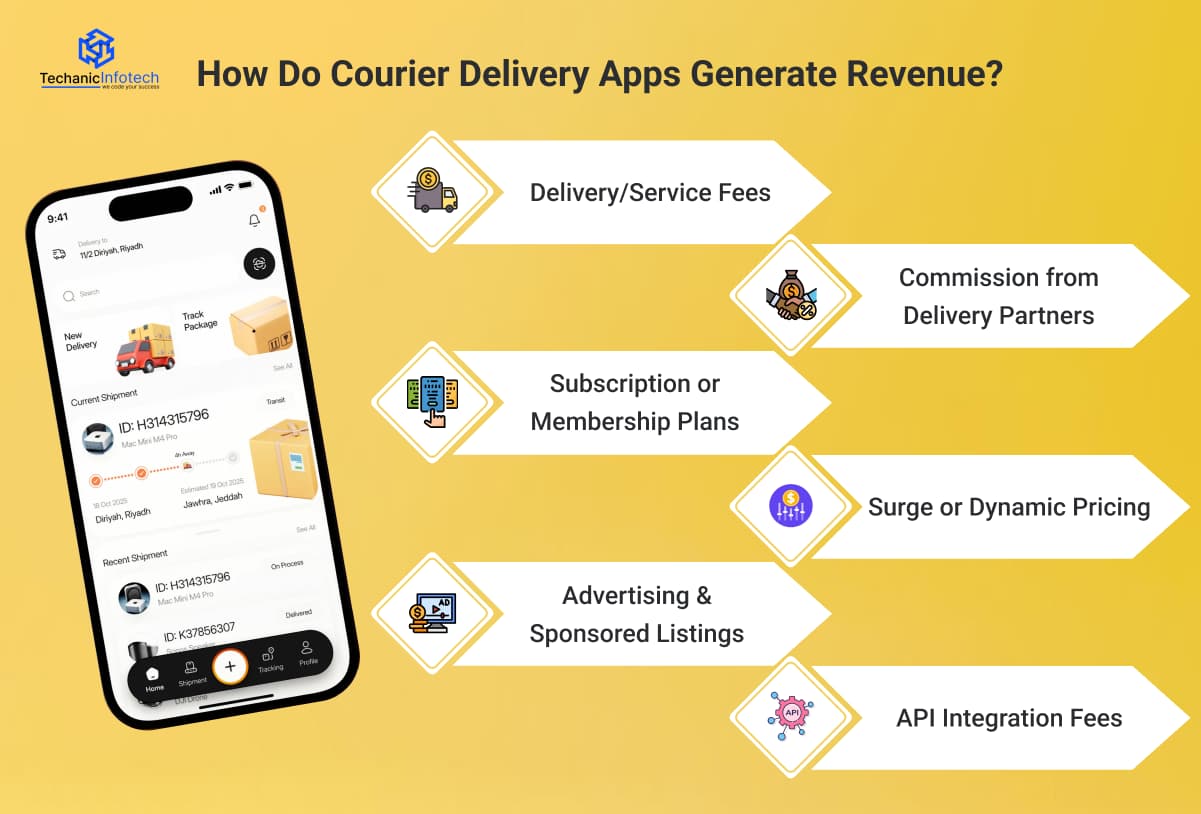
Courier delivery apps usually generate revenue from multiple sources, whether it's about partnering with local businesses like restaurants and hotels or adding some delivery fees for customers.
Following is the list of where courier delivery apps generate revenue by making the app more successful.
These are charges added to the total order cost, typically paid by customers, to cover the cost of delivery, packaging, or other service-related expenses. They vary by platform, location, and order size.
Delivery platforms charge restaurants a commission fee (usually 15-30%) on each order made through their service. This covers platform usage, customer access, and logistics.
Considering the case study of DoorDash that takes a commission ranging between 15-30% on each order processed through its platform.
DoorDash takes a commission ranging between 15-30% on each order processed through its platform.
DoorDash's revenue from commissions was a significant portion of its overall earnings, reflecting the scale of its platform.
Customers can subscribe to premium services for a fixed monthly or annual fee. This provides them with cost savings and enhances platform loyalty.
For instance, Grubhub introduced Grubhub+, a subscription service that allows customers to pay $9.99 per month for free delivery on orders over a certain amount.
Grubhub+ generates steady revenue from its subscribers, even during times when orders are not being placed.
Prices for delivery services fluctuate based on demand, time, or location. During busy periods, delivery fees increase to encourage more drivers and balance supply with demand.
Just like Uber Eats, during lunch or dinner rush hours, Postmates introduced surge pricing. If there’s a shortage of available drivers, the delivery budget could increase by 1.5x or 2x.
This system ensures that customers can still get deliveries during busy times and that drivers are compensated fairly for their time.
Restaurants can pay for premium placement on delivery platforms, ensuring their listings appear at the top of search results or in special promotional sections. This boosts visibility, driving more traffic and potentially more orders.
For example, Uber Eats allows restaurants to pay for placement in specific categories or search results. Likewise, a fast-food chain might pay to be listed at the top of a “burgers” category, giving them more exposure to customers.
Uber Eats charges restaurants a fee for these sponsored listings, which can vary based on the location, category, and popularity of the restaurant.
These are fees charged to businesses for connecting their systems (like POS or order management) with third-party platforms via an API. It enables seamless data exchange, but the platform typically charges for technical support and system maintenance.
Considering scenarios like Square offers a POS system that integrates with multiple delivery platforms like Uber Eats, DoorDash, and Grubhub.
Square charges a monthly fee for API access and system maintenance by offering a commission on every transaction that is processed through its API.
This approach is helpful for them in creating a recurring revenue stream from businesses that rely on seamless order management.
Techanic Infotech is one of the best courier delivery app development company in developing feature-rich, budget-friendly apps tailored to your business needs.
By leveraging cross-platform technologies like Flutter and React Native, the team builds apps that work seamlessly on both Android and iOS with a single codebase, significantly reducing development costs and time.
They integrate pre-built modules such as payment gateways, tracking systems, and user authentication to accelerate delivery while maintaining high performance.
Techanic Infotech also offers UI/UX frameworks and reusable design components to cut unnecessary expenses while delivering a modern, intuitive interface.
From planning and prototyping to deployment and ongoing support, they provide end-to-end services that make launching your courier delivery app not only affordable but highly efficient.
Courier delivery delivery apps offer diverse revenue opportunities, making them a strong business model in today’s on-demand economy.
By leveraging service fees, commissions, subscriptions, dynamic pricing, advertising, and API integrations, these platforms can achieve sustainable profitability and scalability.
Building an app with the right strategy and technology partner is crucial for success. Techanic Infotech helps businesses reduce courier delivery app development cost while ensuring top-quality features, cross-platform compatibility, and fast delivery.
With expert guidance and efficient processes, it's become easier to get answers related to concerns like “ How much does it cost to develop a courier delivery app?“Launching a competitive courier delivery app becomes both achievable and cost-effective.
Developing a courier delivery app typically takes 3–6 months, depending on features and complexity. Advanced apps requiring real-time tracking, automation, and integrations may take longer due to design revisions, testing cycles, and backend architecture setup.
Yes, most businesses start with an MVP to reduce initial costs. As your user base grows, you can easily add advanced features like route optimization, analytics dashboards, and automated dispatching through phased development.
Maintenance usually costs 15–20% of the original development price annually. This covers bug fixes, security patches, server monitoring, feature updates, and performance improvements required to ensure smooth long-term operation.
Yes, courier delivery apps require third-party APIs for maps, payments, SMS alerts, push notifications, and real-time tracking. These services improve functionality but may include monthly or usage-based fees.
Absolutely. Cross-platform development saves time and cost by allowing one codebase to run on both iOS and Android. It’s an ideal choice for startups wanting a faster launch and broader reach without heavy investment.


Abhishek Jangid is the CEO of Techanic Infotech, with extensive experience in mobile app and web development. He specializes in helping businesses turn innovative ideas into scalable digital solutions through strategic planning and modern technology.