Healthcare App Development
Health Insurance App Development: Cost, Features & Complete Development Guide
July 22, 2026
July 22, 2026
Key Takeaways
Health insurance apps simplify policy management, claims processing, and customer engagement through a single digital platform.
Role-based features for policyholders, agents, hospitals, and administrators improve operational efficiency and user experience.
A secure and scalable technology foundation is essential for handling sensitive healthcare and insurance data.
Development costs typically range from $8,000 to $80,000+, depending on business requirements, integrations, and platform complexity.
AI, automation, and digital healthcare integrations are shaping the future of modern health insurance applications.
The health insurance industry is undergoing a major digital transformation. Customers no longer want to visit branch offices, submit paper documents, or wait weeks for policy approvals and claim settlements. Instead, they expect instant policy access, digital claims processing, cashless hospital services, premium payments, and real-time support directly from their smartphones.
To meet these changing expectations, insurers are increasingly investing in health insurance app development to simplify policy management, improve customer engagement, and automate complex insurance workflows.
This guide explores everything you need to know about health insurance mobile app development, including how these applications work, the different types available, essential features, technology recommendations, development challenges, investment planning, and future opportunities.
The global healthcare insurance market was valued at USD 2.9 trillion in 2025 and is projected to reach USD 4.4 trillion by 2033, growing at a 5.1% CAGR.
The healthcare insurance mobile application market generated USD 5.87 billion in 2024 and is expected to reach USD 55.71 billion by 2030, expanding at a remarkable 45.4% CAGR.
North America accounted for 36.5% of the global healthcare mobile application market in 2024, making it the largest regional market.
The broader healthcare mobile application market is forecast to reach USD 1.07 trillion by 2030, driven by increasing adoption of digital health services and mobile technologies.
A health insurance application is a digital platform that allows policyholders, insurance providers, hospitals, and administrators to manage insurance services through a single ecosystem. It simplifies policy management, premium payments, claims processing, document verification, and customer communication while reducing manual paperwork.
Customers create an account, verify their identity, and securely upload personal information required for purchasing or managing insurance policies.
Users compare insurance plans, review coverage details, calculate premiums, and purchase suitable policies directly through the application.
The platform verifies submitted documents such as identity proof, medical reports, and supporting records before activating the insurance policy.
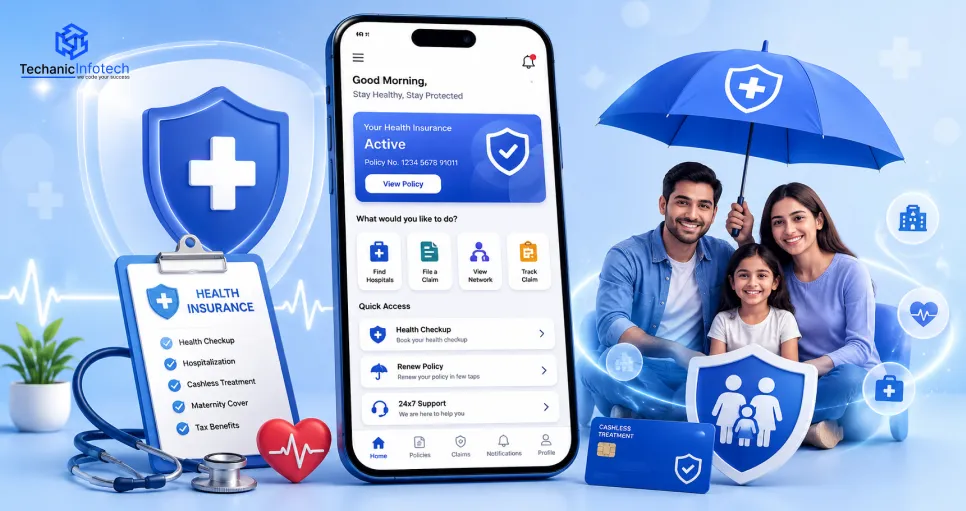
Once approved, users can access digital policy documents, monitor coverage, download insurance cards, pay premiums, renew policies, and receive automated reminders from a centralised dashboard.
When medical treatment is required, policyholders can submit claims by uploading invoices, prescriptions, and supporting documents through the application instead of relying on manual paperwork.
Insurance teams verify submitted claims, communicate with hospitals if required, approve eligible requests, and update claim status in real time until settlement is completed.
Healthcare consumers are becoming increasingly digital-first, and insurance providers must evolve to meet these expectations. Mobile applications are no longer just an added convenience; they have become an essential channel for managing policies, processing claims, and delivering faster customer support. As digital healthcare adoption continues to grow, many insurers evaluate the top healthcare app development companies to find experienced partners capable of delivering secure, scalable, and compliant insurance solutions.
Policyholders want to purchase insurance, download policy documents, pay premiums, submit claims, and receive updates without visiting branch offices or making lengthy customer support calls. A digital platform makes these services available anytime and anywhere.
Traditional claim settlements often involve paperwork, manual verification, and extended processing times. Modern insurance claims app development solutions automate document submission, verification, claim tracking, and notifications, significantly improving operational efficiency.
Today's customers prefer managing their own policies through intuitive mobile applications. Features such as digital ID cards, premium reminders, policy renewals, hospital locators, and claim status tracking reduce dependency on customer support teams while improving user satisfaction.
Modern insurers are increasingly adopting AI integration in mobile apps to automate routine tasks, personalise insurance recommendations, detect fraudulent claims, and improve customer service through intelligent virtual assistants.
Building a health insurance app requires careful planning, strong security measures, and seamless healthcare integrations. Following a structured development process helps insurers create a secure, scalable, and user-friendly platform.
Start by identifying the purpose of the application and its target users, such as policyholders, insurance agents, hospitals, or administrators. Clearly define the core features, compliance requirements, and business objectives before development begins.
Create wireframes and user-friendly interface designs that simplify policy purchases, claims submission, premium payments, and policy management. A well-designed user experience improves customer engagement and reduces operational complexity.
Along with selecting the right technologies, partnering with an experienced telecom software development company helps insurers build secure, scalable, and future-ready health insurance platforms. Consider cross-platform frameworks, cloud infrastructure, secure databases, payment gateways, and authentication solutions to build a reliable application.
Develop essential functionalities such as user registration, policy management, premium payments, digital insurance cards, claims processing, document uploads, notifications, and role-based dashboards for different users. The number and complexity of these features directly influence the overall healthcare app development cost, making feature prioritisation an important part of the planning process.
Connect the application with payment gateways, hospital management systems, identity verification services, notification platforms, AI tools, and analytics solutions to create a seamless digital insurance ecosystem.
Perform comprehensive testing to identify bugs, validate workflows, ensure data security, and optimise performance. Verify that the application complies with healthcare and insurance regulations before launch.
Launch the application on Android, iOS, and web platforms after successful testing. Configure cloud infrastructure, monitor system performance, and ensure a smooth rollout for all users.
Regularly monitor the application, release security updates, improve performance, add new features, and adapt to changing healthcare regulations and customer expectations to ensure long-term success.
Health insurance is no longer limited to a single mobile application. Depending on business objectives and target users, insurers often develop multiple digital solutions that work together as an integrated ecosystem.
This is the customer-facing application that allows users to purchase insurance plans, manage policies, pay premiums, download policy documents, submit claims, and monitor claim status from a single dashboard.
Typical capabilities include the following:
User registration and profile management
Policy comparison
Premium payment
Digital insurance cards
Claim tracking
Policy renewal reminders
Customer support
This application focuses on improving customer convenience while reducing dependency on traditional customer service channels.
Insurance advisors and field agents require dedicated tools to manage customers, recommend policies, and monitor sales performance. A separate agent application improves productivity while enabling faster customer onboarding.
Common features include:
Lead management
Customer onboarding
Policy recommendations
Appointment scheduling
Sales tracking
Digital document collection
Commission monitoring
Claims processing is one of the most critical components of medical insurance app development. Dedicated claims applications help insurers automate document verification, reduce manual processing, and improve settlement speed.
Key capabilities include:
Claim submission
Medical document upload
Real-time claim status
Fraud detection
Approval workflow
Settlement tracking
Efficient insurance claims app development not only enhances customer satisfaction but also reduces operational costs for insurance providers.
Hospitals require secure access to verify patient insurance eligibility, request approvals, upload treatment documents, and monitor reimbursement status. A dedicated hospital portal simplifies communication between healthcare providers and insurance companies while accelerating cashless treatment processes.
Typical features include the following:
Patient eligibility verification
Cashless authorization requests
Medical record submission
Claim status monitoring
Hospital reimbursement management
The administrator dashboard serves as the operational control centre of the entire insurance ecosystem. It enables insurance companies to manage users, policies, claims, healthcare partners, and business analytics through a centralised interface.
Administrative capabilities usually include:
User management
Policy administration
Claims monitoring
Hospital management
Reporting dashboards
Compliance monitoring
Security controls
By integrating these applications into a unified ecosystem, insurers create a seamless digital experience that benefits customers, agents, hospitals, and internal teams alike.
The success of a health insurance mobile app development project depends on delivering the right experience to every stakeholder. Rather than offering identical functionality to all users, modern insurance platforms provide dedicated features based on specific roles, ensuring greater efficiency and improved customer satisfaction.
The customer application should simplify every stage of the insurance journey, from purchasing a policy to receiving claim settlements.
Smart Policy Search: Users should be able to compare multiple insurance plans based on premium, coverage, network hospitals, waiting periods, and additional benefits before making a decision.
Digital Policy Wallet: Customers can securely access policy documents, insurance cards, payment receipts, and renewal history from a single dashboard.
Online Premium Payments: Integrated payment gateways allow users to pay premiums securely while receiving automated payment confirmations and renewal reminders.
Digital Claims Submission: Policyholders can upload prescriptions, invoices, discharge summaries, and supporting documents directly through the application, eliminating paperwork and reducing claim processing time.
Real-Time Claim Tracking: Users receive live updates throughout the claims process, from document verification to final settlement, improving transparency and reducing customer anxiety.
Agents require tools that help them serve customers efficiently while managing multiple policies simultaneously.
Lead & Customer Management: Agents can organise customer profiles, manage leads, recommend insurance plans, and monitor policy status from a centralised dashboard.
Appointment Scheduling: Integrated calendars simplify consultation bookings and follow-up meetings with prospective customers.
Performance Dashboard: Sales reports, commission tracking, and policy conversion metrics help agents monitor individual performance and improve productivity.
Hospitals play an essential role in delivering seamless cashless healthcare services.
Patient Eligibility Verification: Hospitals can instantly verify insurance coverage before initiating treatment.
Digital Authorisation Requests: Healthcare providers can submit cashless approval requests and receive faster authorisation decisions through the application.
Claim Documentation: Medical reports, invoices, treatment summaries, and discharge documents can be uploaded securely for claim processing.
Administrators require complete visibility into platform operations while ensuring compliance and security.
Policy & User Management: Manage customers, insurance plans, hospitals, agents, and policy approvals through a centralised dashboard.
Claims Monitoring: Track every claim from submission to settlement while identifying delays, fraudulent activities, and operational bottlenecks.
Business Intelligence Dashboard: Comprehensive analytics provide insights into policy sales, claim approvals, customer engagement, operational efficiency, and revenue performance.
AI-Powered Customer Support: Many insurers now integrate intelligent chatbots and virtual assistants through AI integration in mobile apps to automate customer queries, provide policy recommendations and improve support availability without increasing operational costs.
The success of health insurance software development depends on selecting technologies that deliver security, scalability, and seamless integration. Many businesses also evaluate the top healthcare app development companies to find a technology partner with proven expertise in building secure, compliant, and scalable insurance solutions.
|
Technology Layer |
Recommended Technologies |
|
Mobile Development |
Flutter, React Native, Swift, Kotlin |
|
Backend Development |
Node.js, Java, Python, .NET |
|
Database |
PostgreSQL, MongoDB, MySQL |
|
Cloud Infrastructure |
AWS, Microsoft Azure, Google Cloud |
|
Authentication & Security |
OAuth 2.0, JWT, Firebase Authentication |
|
Payment Integration |
Stripe, Razorpay, PayPal |
|
Push Notifications |
Firebase Cloud Messaging, OneSignal |
|
Video Consultation |
Twilio, Agora, WebRTC |
|
AI & Analytics |
OpenAI APIs, TensorFlow, Google Vertex AI |
|
Data Security |
SSL/TLS, AES-256 Encryption |
Choosing the right technology stack and partnering with an experienced one are essential for building a secure, scalable, and future-ready health insurance platform. Reviewing a comprehensive mobile app tech stack guide helps organisations select technologies that align with both current business goals and future expansion plans.
A mid-sized health insurance provider was struggling with slow claim approvals, high volumes of customer support requests, and manual document verification. Policyholders often waited several days for claim updates, while internal teams spent significant time reviewing paperwork and coordinating with hospitals. To modernise its operations, the company invested in health insurance app development with the goal of digitising the complete insurance lifecycle, from policy purchase to claim settlement.
Before launching the platform, the insurer faced several operational issues:
Manual claim submission through physical documents and emails.
Delayed communication between hospitals and insurance teams.
High customer support workload for policy and claim-related enquiries.
Limited visibility into claim status for policyholders.
Slow approval workflows due to fragmented internal systems.
The insurer implemented a comprehensive digital health insurance app featuring the following:
Digital policy management
Online premium payments
Real-time claim tracking
Secure document uploads
Automated claim routing
Push notifications
AI-assisted customer support
Integrated hospital portal
The platform also explored AI symptom checker app development capabilities to help policyholders understand basic health concerns before connecting with healthcare providers, creating a more comprehensive digital healthcare experience.
There isn't a fixed price for building a health insurance application because every insurer has different business goals, operational workflows, and compliance requirements. The right investment depends on whether you're validating a new insurance product, digitising existing operations, or building an enterprise-grade insurance ecosystem.
Evaluating the overall cost helps insurers plan realistic budgets based on compliance requirements, integrations, security standards, and long-term business goals.
Instead of investing in every advanced feature from day one, many organisations start with a focused solution and expand it as customer adoption grows.
A starter application is designed to digitise the essential insurance journey, allowing customers to register, purchase policies, pay premiums, access digital insurance cards, and submit claims through a mobile application.
Estimated Investment: $8,000–$25,000
Recommended for:
Insurance startups
Small insurance agencies
MVP launches
Regional insurance providers
As the business grows, insurers typically add advanced capabilities such as hospital integrations, automated claims processing, policy renewal automation, analytics dashboards, customer engagement tools, and AI-powered support to improve operational efficiency.
Estimated Investment: $25,000–$45,000
Recommended for:
Growing insurance companies
Digital-first healthcare providers
Expanding insurance businesses
Growing insurers and regional providers often benefit from custom software development for SMBs, enabling them to build tailored insurance platforms that align with their operational workflows and customer needs.
Large insurers often require a highly scalable platform capable of managing multiple insurance products, thousands of policyholders, extensive hospital networks, advanced reporting, fraud detection, regulatory compliance, and intelligent automation.
Estimated Investment: $45,000–$80,000+
Recommended for:
Enterprise insurance organizations
National health insurance providers
Multi-location healthcare groups
Large-scale digital insurance ecosystems
The insurance industry is rapidly moving toward digital-first experiences, making health insurance app development a strategic investment for insurers looking to improve customer satisfaction, streamline operations, and remain competitive. From digital policy management and automated claims processing to AI-powered assistance and secure healthcare integrations, modern insurance applications are transforming the way insurers interact with policyholders.
Whether you're launching a startup insurance platform or modernising an existing business, investing in a scalable and secure solution helps improve operational efficiency while preparing your organisation for future growth.
Health insurance app development is the process of creating digital platforms that allow users to purchase insurance policies, manage coverage, submit claims, pay premiums, and access healthcare services through mobile or web applications.
The health insurance app development cost generally ranges from $8,000 to $80,000+, depending on application complexity, features, integrations, compliance requirements, and business objectives.
Core features include policy management, premium payments, digital insurance cards, claims submission, claim tracking, hospital locator, secure document management, notifications, and customer support.
Popular technologies include Flutter, React Native, Node.js, Java, Python, PostgreSQL, MongoDB, AWS, Microsoft Azure, Google Cloud, and AI-powered analytics solutions.
Yes. Through AI integration in mobile apps, insurers can automate claims processing, detect fraudulent activities, provide intelligent customer support, personalise policy recommendations, and improve operational efficiency.
The development timeline generally ranges from 2 to 8 months, depending on the platform's complexity, integrations, compliance requirements, and customisation needs.


Neha Sharma is a tech expert at heart who loves exploring new technologies and turning complex ideas into easy-to-understand content. With a passion for learning and writing, she enjoys sharing insights on emerging tech, digital products, and innovation that help businesses stay ahead.