Key Takeaways
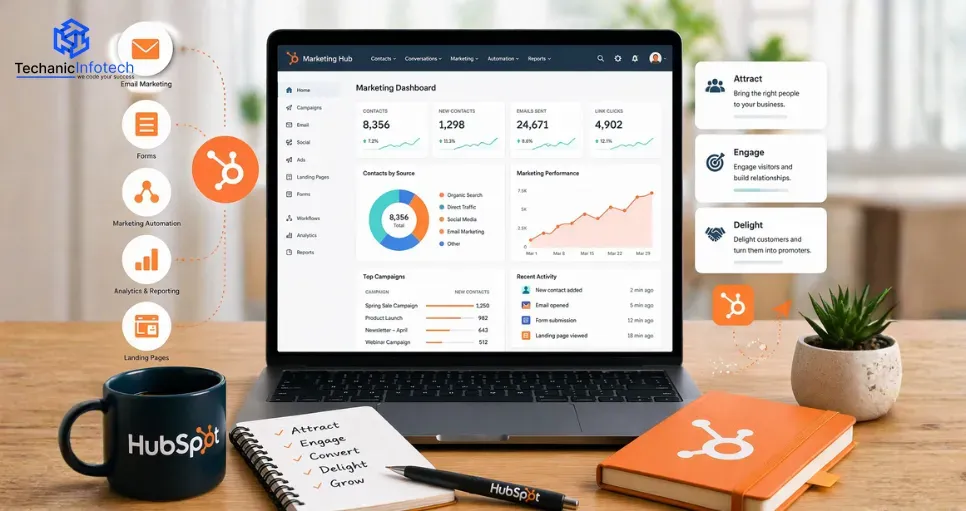
HubSpot Marketing Hub is an all-in-one platform combining email marketing, automation, CRM, analytics, and content tools to streamline marketing processes and improve overall campaign efficiency.
Built for scalability, the platform supports startups, mid-sized companies, and enterprises by offering flexible tools that grow alongside business needs and marketing complexity.
Key features include email marketing, automation workflows, lead generation tools, CRM integration, analytics dashboards, and social media management within a unified ecosystem.
Automation reduces manual work by triggering actions based on user behavior, ensuring timely follow-ups and improving efficiency in lead nurturing and campaign execution.
Data-driven insights from analytics dashboards help businesses measure ROI, optimize campaigns, and make informed decisions to enhance long-term marketing performance and growth strategies.
In today’s competitive digital landscape, businesses need powerful marketing tools to attract, engage, and convert customers effectively.
From email campaigns and automation to analytics and CRM integration, it provides everything marketers need under one roof.
The platform is built to support businesses of all sizes, helping them generate leads, nurture prospects, and drive measurable growth.
Whether you are a startup or an enterprise, it simplifies complex marketing processes and enhances overall campaign performance.
HubSpot Marketing Hub is a comprehensive marketing automation platform developed by HubSpot to help businesses attract visitors, convert leads, and close customers.
It combines tools for email marketing, content management, SEO, social media, landing pages, and analytics into one centralized system.
Businesses can automate repetitive tasks, personalize customer communication, and track performance in real time.
Designed for scalability, HubSpot Marketing Hub supports small businesses, mid-sized HubSpot consulting companies in USA, and large enterprises looking to optimize their inbound marketing strategies and improve return on investment.
HubSpot Marketing Hub is a powerful all-in-one platform designed to help businesses attract, engage, and convert customers through automation, email marketing, lead management, analytics, and personalized campaigns.
Following are the list of key features of the HubSpot Marketing Hub that one should consider while making the HubSpot Marketing Hub successful.
HubSpot marketing hub guide offers advanced email marketing tools that allow businesses to design, personalize, and automate email campaigns.
Users can segment contacts, create A/B tests, and analyze open and click-through rates. The drag-and-drop editor makes email creation simple while ensuring professional, responsive designs.
The platform enables powerful workflow automation to nurture leads automatically.
Businesses can set triggers based on user behavior, send follow-up emails, and assign leads to sales teams.
Automation reduces manual work, improves efficiency, and ensures timely engagement with prospects.
HubSpot provides forms, pop-ups, landing pages, and live chat tools to capture leads effectively.
Users can create customized calls-to-action and optimize conversion rates. These tools help attract qualified prospects while tracking their interactions for better targeting and engagement.
HubSpot Marketing Hub seamlessly integrates with HubSpot CRM, allowing marketing and sales teams to share data in real time.
This integration ensures better lead tracking, personalized communication, and smoother handoffs between teams, ultimately improving customer relationship management.
The platform provides detailed analytics dashboards to measure campaign performance. Users can track traffic, conversions, revenue attribution, and customer journeys.
Customizable reports help businesses make data-driven decisions and continuously improve marketing strategies.
HubSpot allows users to schedule, publish, and monitor social media posts from a single dashboard.
It tracks engagement metrics and integrates social interactions into the CRM. This centralized management helps businesses maintain consistent branding and analyze social campaign effectiveness.
Developing a solution similar to HubSpot Marketing Hub depends on complexity, features, integrations, and scalability requirements, with costs varying significantly based on development scope and customization levels.
A basic version includes simple email marketing, contact forms, and limited analytics, where the development cost falls between $8000 to $15,000.
Suitable for startups, it offers minimal automation and basic UI, focusing on essential marketing functionalities without advanced integrations or scalability features.
This level includes marketing automation, CRM integration, landing pages, and reporting dashboards, where the creation process budget falls between $15,000 to $35000.
It supports moderate customization and improved UI/UX, making it ideal for growing businesses seeking better lead management and campaign tracking capabilities.
Advanced platforms include AI-driven analytics, multi-channel automation, predictive lead scoring, and deep integrations.
Built for enterprises, the overall development budget falls between $35,000 to $70,000+, where they support high scalability, complex workflows, and large databases requiring robust infrastructure and security.
Ongoing website or mobile app maintenance costs fall around $2,000 to $10,000 includes updates, bug fixes, server management, and feature enhancements.
Regular optimization ensures platform performance, security, and compatibility with evolving marketing tools and third-party integrations.
Additional costs may include $3000 to $15,000+, containing API integrations, premium tools, cloud hosting, third-party services, and onboarding.
These expenses often arise during scaling, customization, or adding advanced marketing functionalities.
HubSpot Marketing Hub provides a wide range of integrated tools designed to simplify marketing operations, improve automation, and enhance customer engagement across multiple digital channels.
Allows users to create, personalize, and automate email campaigns with drag-and-drop editors, segmentation, and A/B testing, helping improve engagement, open rates, and conversion performance across targeted audiences.
Enables automated workflows triggered by user behavior, such as email sequences and lead nurturing, reducing manual effort while maintaining personalized communication throughout the customer journey.
Includes forms, pop-ups, landing pages, and live chat features to capture and convert leads efficiently while tracking user interactions for better targeting and engagement strategies.
Seamlessly connects with CRM to centralize customer data, enabling marketing and sales alignment, personalized communication, and efficient lead tracking across the entire customer lifecycle.
Provides real-time dashboards, campaign tracking, and revenue attribution insights, helping businesses measure performance, optimize strategies, and make data-driven marketing decisions.
Allows scheduling, publishing, and monitoring of social media posts from a single dashboard while tracking engagement metrics and integrating social data into marketing campaigns.
HubSpot Marketing Hub is a powerful all-in-one platform designed to help businesses attract, engage, and convert customers more effectively.
It streamlines marketing efforts through automation, advanced analytics, personalized campaigns, and seamless CRM integration.
HubSpot brings together essential marketing tools within a single, unified platform.
This eliminates reliance on multiple third-party platforms and enables seamless data synchronization across campaigns.
Teams can efficiently manage email marketing, automation, social media scheduling, landing pages, and analytics without switching between disconnected systems.
Automated workflows and highly personalized messaging empower businesses to nurture leads more strategically.
By delivering timely, relevant content tailored to each prospect’s behavior and interests, companies can strengthen engagement, build trust, and guide potential customers smoothly through the buyer’s journey toward higher conversion rates.
Integrated CRM functionality ensures that sales and marketing teams access the same real-time contact data and activity history.
This shared visibility enhances collaboration, minimizes communication gaps, streamlines follow-ups, and shortens the sales cycle by enabling both teams to act on consistent, accurate information.
Robust analytics and reporting dashboards provide clear insights into campaign effectiveness, customer behavior, and return on investment.
With accurate performance metrics readily available, businesses can optimize strategies, allocate budgets wisely, identify growth opportunities, and make informed decisions grounded in measurable results rather than assumptions.
HubSpot Marketing Hub is designed to grow alongside businesses of all sizes.
Companies can begin with essential marketing features and progressively unlock advanced automation, reporting, and customization tools as their operational complexity and strategic marketing needs evolve over time.
Personalization tools and intelligent automation enable businesses to deliver tailored, meaningful interactions across multiple touchpoints.
Customers receive content aligned with their preferences, behaviors, and stage in the buying journey, resulting in improved satisfaction, stronger brand loyalty, and long-term relationships built on relevance and value.
HubSpot Marketing Hub offers flexible pricing plans to suit businesses of all sizes, from startups to enterprises.
Its tiered structure provides scalable features starting with essential tools and expanding to advanced automation, analytics, and customization options.
The Free plan offers essential marketing tools like email marketing, forms, landing pages, live chat, and basic CRM integration.
It is ideal for startups testing inbound marketing strategies without financial commitment while accessing core automation and contact management features.
The Starter plan adds removal of HubSpot branding, simple marketing automation, email health reporting, and ad management tools.
It is designed for small businesses that want more professional marketing capabilities and improved analytics without the higher investment required for advanced features.
The Professional plan introduces advanced marketing automation workflows, A/B testing, custom reporting, social media management, and lead scoring.
It suits growing businesses seeking scalable inbound marketing strategies, deeper performance insights, and stronger campaign personalization capabilities to improve conversions.
The Enterprise plan includes advanced features like predictive lead scoring, custom behavioral events, advanced analytics, partitioning, and team management.
It is built for large organizations needing complex automation, multi-team collaboration, detailed reporting structures, and greater control over the marketing operations hub.
HubSpot offers optional add-ons such as advanced reporting, API limits, and additional contacts.
Pricing scales based on contact database size and feature requirements, allowing businesses to customize their marketing infrastructure according to operational needs and growth stage.
HubSpot Marketing Hub centralizes marketing tools to attract, engage, and convert leads.
It supports content creation, automation, email campaigns, analytics, and CRM integration, helping businesses streamline marketing efforts and improve customer experiences.
HubSpot Marketing Hub integrates seamlessly with HubSpot CRM, storing all contact data in one centralized database.
This unified system enables marketers to track interactions, manage leads, personalize campaigns, and align sales and marketing teams effectively for better conversion outcomes.
The platform allows users to create automated workflows triggered by user actions such as email opens, form submissions, or website visits.
Automation nurtures leads through personalized email sequences, saving time while maintaining consistent communication across the customer journey.
Users can build landing pages, blogs, and email campaigns within the platform.
SEO recommendations, A/B testing, and performance analytics help optimize content for higher search rankings, improved engagement, and increased lead generation results.
HubSpot tracks visitor behavior, including page views, clicks, and conversions.
Detailed dashboards and custom reports provide insights into campaign performance, helping marketers refine strategies based on measurable data and ROI metrics.
The system supports email marketing, social media scheduling, paid ad tracking, and website chat tools.
This integrated multi-channel approach ensures consistent brand messaging and coordinated campaigns across various digital marketing platforms.
HubSpot Marketing Hub is ideal for small, medium, and large businesses looking to streamline marketing efforts and improve lead generation.
It is especially beneficial for growing HubSpot consulting companies that want to automate campaigns, enhance customer engagement, and align marketing with sales.
Startups benefit from the free and starter plans, enabling them to manage leads, automate emails, and track marketing performance without large budgets.
The HubSpot consulting services simplify inbound marketing, helping small teams compete effectively in digital markets.
Mid-sized companies seeking scalable marketing automation and detailed reporting will benefit from Professional features.
Advanced workflows and campaign tracking help optimize lead nurturing, improve conversion rates, and support expanding sales teams efficiently.
Large enterprises requiring complex automation, predictive analytics, and multi-team collaboration tools should consider the Enterprise plan.
It supports high-volume contact databases, detailed segmentation, and governance controls needed for large-scale marketing operations.
B2B organizations benefit from lead scoring, account-based marketing capabilities, and CRM alignment.
These features enhance long sales cycles by nurturing prospects through targeted content and personalized automation strategies.
Agencies managing multiple client campaigns can leverage automation, analytics, and reporting tools.
The platform enables efficient campaign execution, performance tracking, and client reporting from a single centralized marketing dashboard.
HubSpot Marketing Hub is a comprehensive platform that streamlines marketing, automates campaigns, and boosts customer engagement.
Here, we explore the pros and cons to help businesses evaluate their benefits and limitations.
HubSpot Marketing Hub offers a comprehensive suite of marketing tools that streamline campaigns, automate workflows, and provide analytics, helping businesses attract, engage, and convert leads efficiently.
The platform offers an intuitive dashboard with drag-and-drop editors and guided setup tools.
Even users with minimal technical expertise can create campaigns, manage contacts, and analyze performance without needing complex coding skills.
Native integration with HubSpot CRM setup ensures seamless data sharing between marketing and sales teams.
This alignment improves lead management, enhances personalization, and streamlines communication throughout the customer lifecycle.
Advanced workflows allow businesses to automate email nurturing, segmentation, and behavioral triggers.
Automation reduces manual effort while maintaining personalized communication, increasing efficiency and engagement rates.
Detailed reporting dashboards provide actionable insights into marketing performance.
Businesses can measure ROI, identify campaign strengths, and adjust strategies using real-time data and customizable reports.
Flexible plans and add-ons allow businesses to scale as they grow.
From startups to enterprises, organizations can upgrade features and contact limits according to evolving marketing needs.
While HubSpot Marketing Hub is powerful, considering the HubSpot consulting cost for small businesses.
Advanced features may require higher-tier plans, sometimes limiting customization compared with specialized marketing tools.
Professional and Enterprise tiers can be expensive, especially for small businesses with limited budgets. Pricing increases based on contact volume, which may become costly as databases grow.
While basic tools are simple, advanced automation workflows and analytics require training. New users may need the HubSpot implementation and onboarding guide to fully utilize complex features effectively.
Costs scale with the number of marketing contacts stored in the database. Businesses with large lists may face significant expenses compared to flat-rate marketing platforms.
Some advanced customization and reporting features are restricted to higher-tier plans. Starter users may find limitations when trying to implement sophisticated marketing strategies.
Full functionality often works best within the broader HubSpot ecosystem. Businesses using external tools may require integrations, which can add complexity and additional costs.
HubSpot Marketing Hub stands out as a comprehensive inbound marketing solution designed to support businesses at every growth stage.
Its integrated CRM, automation capabilities, and detailed analytics empower teams to execute data-driven campaigns effectively.
Organizations seeking streamlined marketing processes, improved lead nurturing, and measurable ROI will find it highly beneficial.
Proper onboarding and strategic implementation are essential to unlock its full potential and ensure long-term success.
Yes, the platform offers a Free plan and user-friendly tools ideal for beginners. Drag-and-drop editors, templates, and guided onboarding make it accessible.
HubSpot Marketing Hub integrates natively with HubSpot CRM, providing centralized contact management, interaction tracking, and seamless collaboration between marketing and sales teams without requiring separate CRM software.
Yes, the platform allows users to create automated email workflows triggered by user behavior, segmentation rules, or time-based actions, ensuring personalized and timely communication with leads and customers.
Yes, the Enterprise plan offers advanced analytics, predictive lead scoring, and team management tools designed to handle complex marketing operations and large contact databases efficiently.
Yes, the Enterprise plan offers advanced analytics, predictive lead scoring, and team management tools designed to handle complex marketing operations and large contact databases efficiently.
Yes, HubSpot uses a contact-based pricing model. As your marketing contact database grows, subscription costs may increase depending on your selected plan and additional feature requirements.
Yes, HubSpot uses a contact-based pricing model. As your marketing contact database grows, subscription costs may increase depending on your selected plan and additional feature requirements.
Yes, it supports integrations with tools like Salesforce, Slack, Google Analytics, and more, allowing businesses to extend functionality and connect existing systems seamlessly.
Yes, it supports integrations with tools like Salesforce, Slack, Google Analytics, and more, allowing businesses to extend functionality and connect existing systems seamlessly.
Yes, it includes blogging tools, SEO recommendations, and content management features to help businesses create, optimize, and distribute content effectively for better visibility and engagement.
Yes, it includes blogging tools, SEO recommendations, and content management features to help businesses create, optimize, and distribute content effectively for better visibility and engagement.
Yes, it supports eCommerce integrations, enabling personalized campaigns, abandoned cart emails, and customer segmentation to improve sales and retention.
Yes, it supports eCommerce integrations, enabling personalized campaigns, abandoned cart emails, and customer segmentation to improve sales and retention.
HubSpot provides enterprise-grade security, including data encryption, user permissions, and compliance with global standards, ensuring safe handling of customer and business data.
HubSpot provides enterprise-grade security, including data encryption, user permissions, and compliance with global standards, ensuring safe handling of customer and business data.
Yes, it supports email, social media, ads, and website campaigns within one platform, ensuring consistent messaging and centralized campaign management across multiple channels.
Yes, it supports email, social media, ads, and website campaigns within one platform, ensuring consistent messaging and centralized campaign management across multiple channels.


Abhishek Jangid is the CEO of Techanic Infotech, with extensive experience in mobile app and web development. He specializes in helping businesses turn innovative ideas into scalable digital solutions through strategic planning and modern technology.