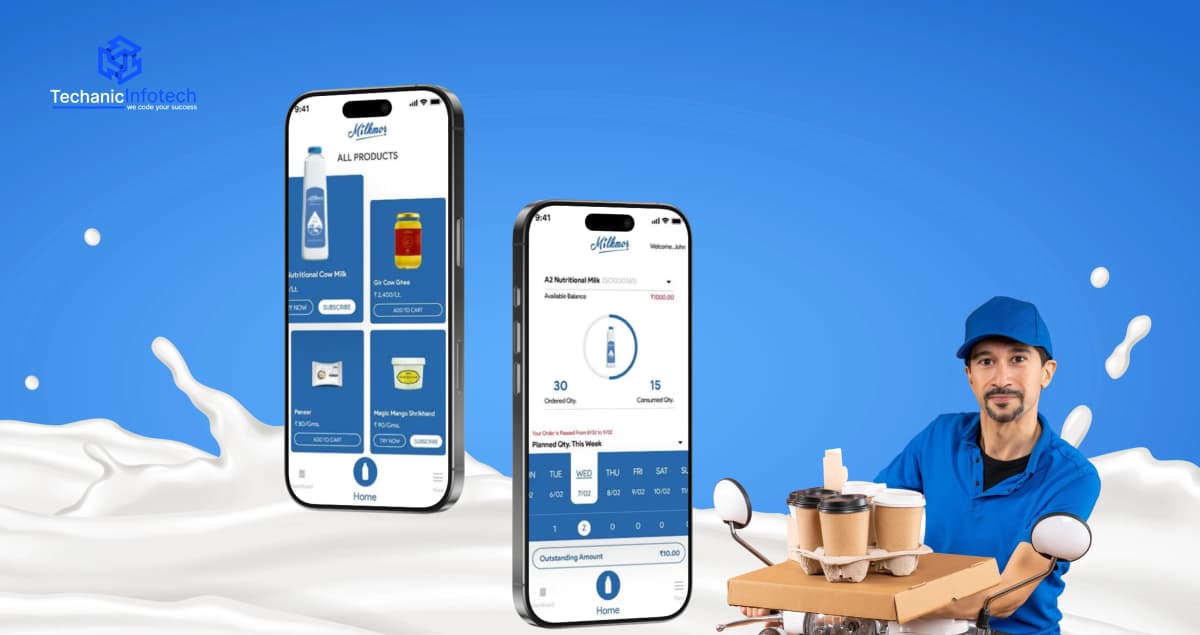
Milk delivery apps are transforming the traditional dairy supply chain by bringing convenience, automation, and efficiency to everyday milk purchases.
With the rise of smartphones and digital payment systems, customers now prefer managing their daily milk and grocery needs through mobile applications.
A milk delivery app allows users to schedule deliveries, manage subscriptions, make secure payments, and track orders in real time.
By combining smart technology with subscription-based services, milk delivery apps provide a reliable and scalable solution for modern dairy businesses.
Modern consumers prefer quick and hassle-free services, where they are looking for getting help from a reliable milk delivery app development company. Milk delivery apps allow customers to schedule daily deliveries, modify orders instantly, and receive products at their doorstep.
This convenience significantly increases customer satisfaction and retention.
Milk delivery apps enable automated subscription management where customers can schedule recurring orders.
Businesses benefit from predictable demand and stable revenue while customers enjoy uninterrupted daily deliveries without placing repeated orders.
Mobile apps provide direct communication with customers through notifications, offers, and reminders.
Businesses can inform users about delivery updates, discounts, or new products, helping build stronger relationships and brand loyalty.
Managing multiple daily orders manually can be challenging.
Milk delivery apps automate order tracking, scheduling, and delivery management, helping businesses streamline operations and reduce human errors.
With a mobile app, dairy businesses can reach a larger audience beyond their local area.
Online platforms allow businesses to attract new customers, increasing brand visibility and overall sales.
Milk delivery apps provide valuable insights such as customer preferences, order patterns, and sales reports.
Businesses can analyze this data to improve services, optimize inventory, and create better marketing strategies.
A successful milk delivery app must include mobile app features that simplify ordering, subscription management, delivery tracking, and business operations.
These features ensure smooth communication between customers, admins, and delivery partners while providing a seamless user experience.
Customer App Features deliver a smooth and convenient experience, allowing users to browse products, place orders, track deliveries, manage payments, and access personalized services anytime through a simple and user-friendly interface.
A simple registration process allows users to quickly create accounts using email, phone numbers, or social media logins.
Secure authentication ensures safe access while enabling customers to manage subscriptions and orders conveniently.
Customers can explore different types of milk and dairy products through an organized catalog.
Product descriptions, images, and pricing help users easily compare items and choose the right products.
The subscription feature allows customers to schedule recurring milk deliveries daily or weekly.
Users can pause, skip, or modify deliveries anytime, making the system flexible and convenient for regular dairy consumption.
Customers can select preferred delivery times according to their daily routines. This feature ensures timely deliveries while allowing users to adjust schedules based on their availability.
Milk delivery apps integrate secure payment gateways that support credit cards, digital wallets, and online banking. This ensures safe transactions while providing multiple payment options for customer convenience.
Real-time tracking allows customers to monitor the status of their deliveries. Users can see when the order is processed, dispatched, and delivered, providing transparency throughout the process.
Push notifications keep customers informed about order confirmations, delivery updates, payment reminders, and promotional offers, helping businesses maintain consistent engagement with users.
Admin Panel Features enable administrators to efficiently manage users, products, orders, payments, and reports, while monitoring system activities and maintaining overall platform control through a secure and easy-to-use dashboard.
The admin dashboard provides a complete overview of orders, deliveries, customer activity, and revenue statistics. Businesses can analyze performance metrics to make informed operational and marketing decisions.
Admins can easily add, update, or remove products from the catalog while managing stock levels. This ensures accurate inventory tracking and prevents product shortages.Order Management
The order management system helps admins monitor incoming orders, assign deliveries, and track order status. This centralized control simplifies daily operations and improves efficiency.
Admins can manage customer profiles, subscription plans, and support requests from a single interface. This helps businesses maintain strong relationships with their customers.
This feature tracks all transactions, generates invoices, and manages payment records. It ensures financial transparency and simplifies accounting processes for the business.
Delivery Partner App Features help delivery partners manage assigned orders, view pickup and drop locations, track routes, update delivery status, and communicate with customers while ensuring fast, accurate, and efficient deliveries.
Delivery partners receive instant notifications when new orders are assigned. This helps them quickly accept delivery tasks and prepare for efficient order fulfillment.
Route optimization tools suggest the fastest delivery paths based on location and traffic conditions. This reduces delivery time and improves overall operational efficiency.
Delivery partners can update the status of orders during pickup, transit, and delivery. These updates help customers and admins track progress in real time.
Delivery partners can view completed deliveries, earnings summaries, and payment history within the app. This transparency helps them track their performance and income.
Developing a milk delivery app involves several stages, from planning and design to deployment and maintenance.
Following a structured mobile app development process ensures the app is functional, scalable, and ready to meet market demands.
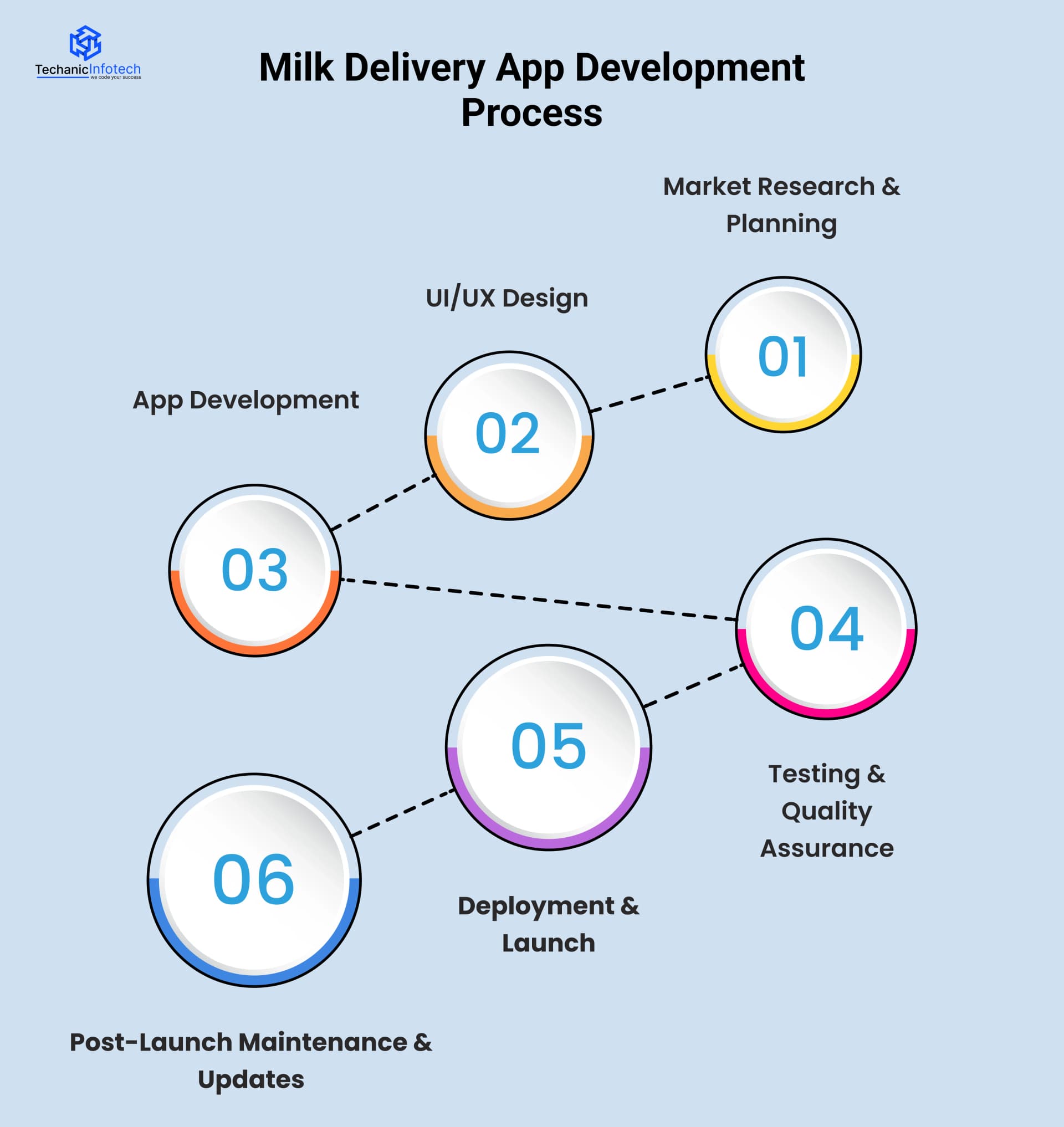
This stage involves analyzing market trends, competitor apps, and target audiences. Businesses define app goals, features, and business models to create a clear development roadmap.
Designers create intuitive interfaces that make the app easy to use. Wireframes, prototypes, and visual designs are developed to ensure smooth navigation and a positive user experience.
Developers build the app using selected technologies. This phase includes coding the frontend, backend, and integrations such as payment gateways and location services.
Before launch, the app undergoes extensive testing to identify bugs, security issues, and performance problems. Quality assurance ensures the app runs smoothly across different devices.
Once testing is complete, the app is published on app stores or deployed on servers. Businesses prepare marketing strategies to attract users and promote the new platform.
After launch, regular updates and mobile app maintenance ensure the app remains secure, functional, and compatible with new devices or operating systems.
The cost depends on factors such as app complexity, features, development team location, and mobile app tech stack.
Businesses can build basic apps or invest in advanced platforms with smart automation and analytics.
A basic milk delivery app includes essential features such as user registration, product browsing, subscriptions, order management, and payment integration.
This type of application is suitable for small dairy businesses that want to start their digital journey and manage daily deliveries more efficiently.
The development cost for this level of app generally ranges between $10,000 and $25,000, depending on the platform, design complexity, and development team.
A mid-level milk delivery app provides a more enhanced experience by including additional features like real-time delivery tracking, push notifications, analytics dashboards, and a separate app or panel for delivery partners.
These features help businesses scale operations, track performance, and improve customer engagement.
The mobile app development cost for this type of app typically falls between $25,000 and $50,000, depending on customization and technology requirements.
An advanced milk delivery platform is designed for large dairy businesses and delivery networks that require powerful automation and data-driven operations.
These platforms may include AI-powered analytics, demand forecasting, route optimization, multi-language support, loyalty programs, and integrations with other business systems.
Building such a comprehensive platform can cost $50,000 to $90,000 or more, depending on the level of complexity and scalability.
After minimal viable product development, ongoing maintenance is required to keep the app running smoothly.
This includes bug fixes, server management, security updates, and technical support.
Maintenance costs are typically around 15–20% of the total development cost per year, depending on the size and complexity of the application.
Mobile applications require regular updates to add new features, enhance performance, and remain compatible with operating system updates.
Continuous improvements help ensure long-term functionality, better security, and a satisfying user experience for customers and business owners.
Building a milk delivery app involves operational and technical challenges. Businesses must address issues like recurring orders, delivery logistics, payments, and inventory to ensure smooth operations.
Challenge:
Milk delivery businesses handle thousands of recurring orders daily. Manual tracking or poorly designed systems can cause missed deliveries, incorrect quantities, and customer dissatisfaction.
Solution:
Implement an automated subscription management system that allows customers to schedule, modify, or pause deliveries. Smart order scheduling combined with database automation ensures accurate recurring orders and minimizes operational errors.
Challenge:
Without real-time tracking and route optimization, delivery partners may face delays, inefficient routes, and higher fuel costs. This affects delivery accuracy and overall customer satisfaction.
Slution:
Integrate GPS tracking and route optimization tools to help delivery partners follow the most efficient routes. Real-time updates allow customers and admins to monitor delivery progress and ensure timely service.
Challenge:
Customers expect secure and flexible payment options. Lack of reliable payment gateways or limited payment methods can reduce user trust and lead to abandoned transactions.
Solution:
Integrate trusted payment gateways supporting credit cards, UPI, wallets, and net banking. Strong encryption, secure authentication, and compliance with payment security standards ensure safe and smooth transactions.
Challenge:
Milk and dairy products have limited shelf life, making inventory management challenging. Overstocking leads to waste, while understocking causes delivery delays and lost sales.
Solution:
Use real-time inventory tracking and demand forecasting tools to manage stock efficiently. Automated alerts for low inventory and integration with supplier systems help maintain a consistent supply chain.
Challenge:
Even with a well-built app, businesses may struggle to keep customers engaged and loyal in a competitive market with multiple dairy delivery services.
Solution:
Use push notifications, loyalty programs, personalized offers, and subscription reminders to improve engagement. Data analytics helps understand user behavior and create targeted promotions that increase customer retention.
Milk delivery apps are revolutionizing the dairy industry by combining traditional milk distribution with modern digital technology.
These apps make it easier for customers to schedule daily deliveries, manage subscriptions, and pay securely from their smartphones.
For dairy businesses, mobile applications simplify operations by automating order management, improving inventory tracking, and optimizing delivery routes.
As consumer demand for convenience continues to grow, milk delivery apps provide a scalable solution for expanding market reach and increasing revenue.
By integrating advanced technologies such as AI-based demand prediction and real-time tracking, businesses can enhance efficiency and customer satisfaction.
Developing a milk delivery app typically takes 3 to 6 months, depending on the complexity, features, and development team. Advanced apps with AI features, delivery tracking, and analytics may require longer development timelines.
Developing a milk delivery app typically takes 3 to 6 months, depending on the complexity, features, and development team. Advanced apps with AI features, delivery tracking, and analytics may require longer development timelines.
The development cost generally ranges between $10,000 and $90,000+, depending on features, app complexity, technology stack, and development team location.
The development cost generally ranges between $10,000 and $90,000+, depending on features, app complexity, technology stack, and development team location.
Essential features include user registration, subscription management, product browsing, payment integration, order tracking, delivery partner management, and an admin dashboard for managing orders and inventory.
Essential features include user registration, subscription management, product browsing, payment integration, order tracking, delivery partner management, and an admin dashboard for managing orders and inventory.
Yes, subscription-based ordering is one of the core features of milk delivery apps. Customers can schedule recurring deliveries and modify or pause subscriptions whenever needed.
Yes, subscription-based ordering is one of the core features of milk delivery apps. Customers can schedule recurring deliveries and modify or pause subscriptions whenever needed.
A delivery partner app helps manage delivery operations efficiently. It allows drivers to receive orders, optimize routes, update delivery status, and track earnings directly from their mobile devices.
A delivery partner app helps manage delivery operations efficiently. It allows drivers to receive orders, optimize routes, update delivery status, and track earnings directly from their mobile devices.


Abhishek Jangid is the CEO of Techanic Infotech, with extensive experience in mobile app and web development. He specializes in helping businesses turn innovative ideas into scalable digital solutions through strategic planning and modern technology.