
Mobile App Development
How to Build a Minimal Viable Product (MVP) and Secure Funding in 2026
February 5, 2026
February 5, 2026
Building an MVP in 2026 is one of the smartest ways to turn an idea into a real business. Instead of spending months building a full product, startups now focus on creating something small that solves a real problem and gets early users involved. This approach helps founders test ideas faster, learn from feedback, and make better decisions.
An MVP is also a powerful tool when it comes to funding. Investors want to see progress, not just plans. A well-built MVP shows how your idea works, how users respond, and why it has potential to grow.
In this guide, we’ll walk you through how to build an MVP the right way and use it to move confidently toward funding in 2026.
Building an MVP is no longer optional for startups aiming to raise money. In 2026, investors expect founders to show real progress, not just ideas. Here’s why building an MVP plays a critical role in securing funding.
Below are the key reasons why an MVP plays a critical role in securing startup funding.
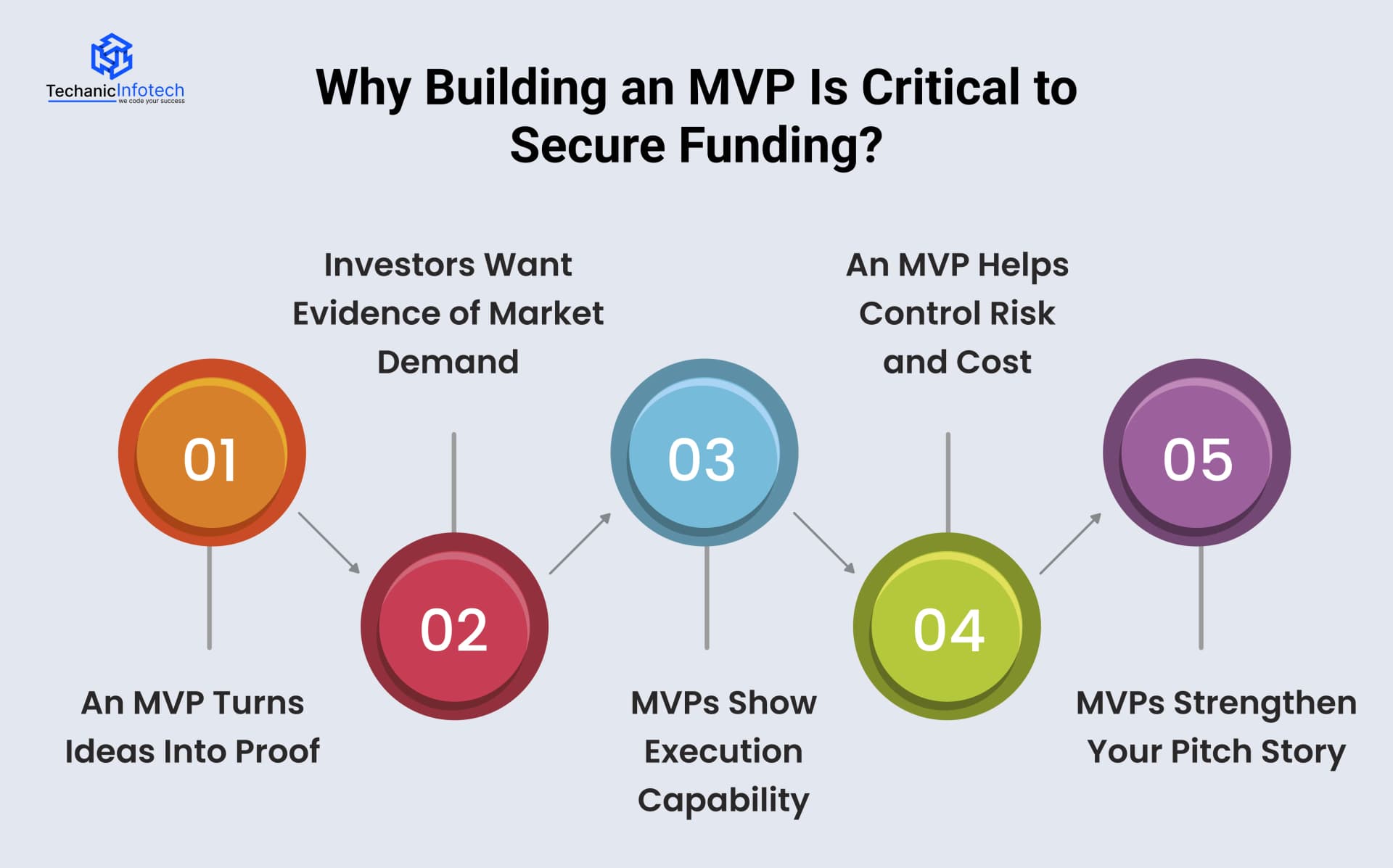
Investors see hundreds of ideas, but only a few products. When you build an MVP, you move from theory to execution.
A working product shows that your idea can be built, used, and improved. This is why minimal viable product development is often the first thing investors look for. It reduces uncertainty and proves that your startup is more than just a concept.
A strong MVP helps validate whether people actually want your product. Even small traction, like early users, sign-ups, or feedback, matters.
For MVP development for investors, real user response is far more convincing than assumptions. This validation increases trust and makes it easier to secure funding with an MVP.
Anyone can explain an idea, but not everyone can build one. When you develop an MVP, you prove your ability to execute. Investors want founders who can move fast, make decisions, and deliver results. A well-executed MVP app development effort signals discipline, focus, and leadership, qualities investors value.
From an investor’s point of view, risk matters. An MVP shows that you understand priorities and can manage cost wisely.
Instead of overbuilding, you focus on core features. This approach reassures investors that future funding will be used carefully and strategically.
A working MVP makes your pitch more powerful. You’re not just talking, you’re showing. For MVP for startup funding, demos, metrics, and early insights help investors imagine scale. It turns your pitch into a story backed by real progress.
In 2026, knowing how to build a minimal viable product is directly linked to knowing how to secure funding using an MVP. A strong MVP builds confidence, reduces risk, and opens doors to investors faster.
In 2026, building a minimal viable product (MVP) is no longer just about launching fast, it’s about launching smart. Startup founders must follow the latest trends to stay competitive, prove market value, and attract funding.
Below are key MVP trends shaping today’s product landscape.
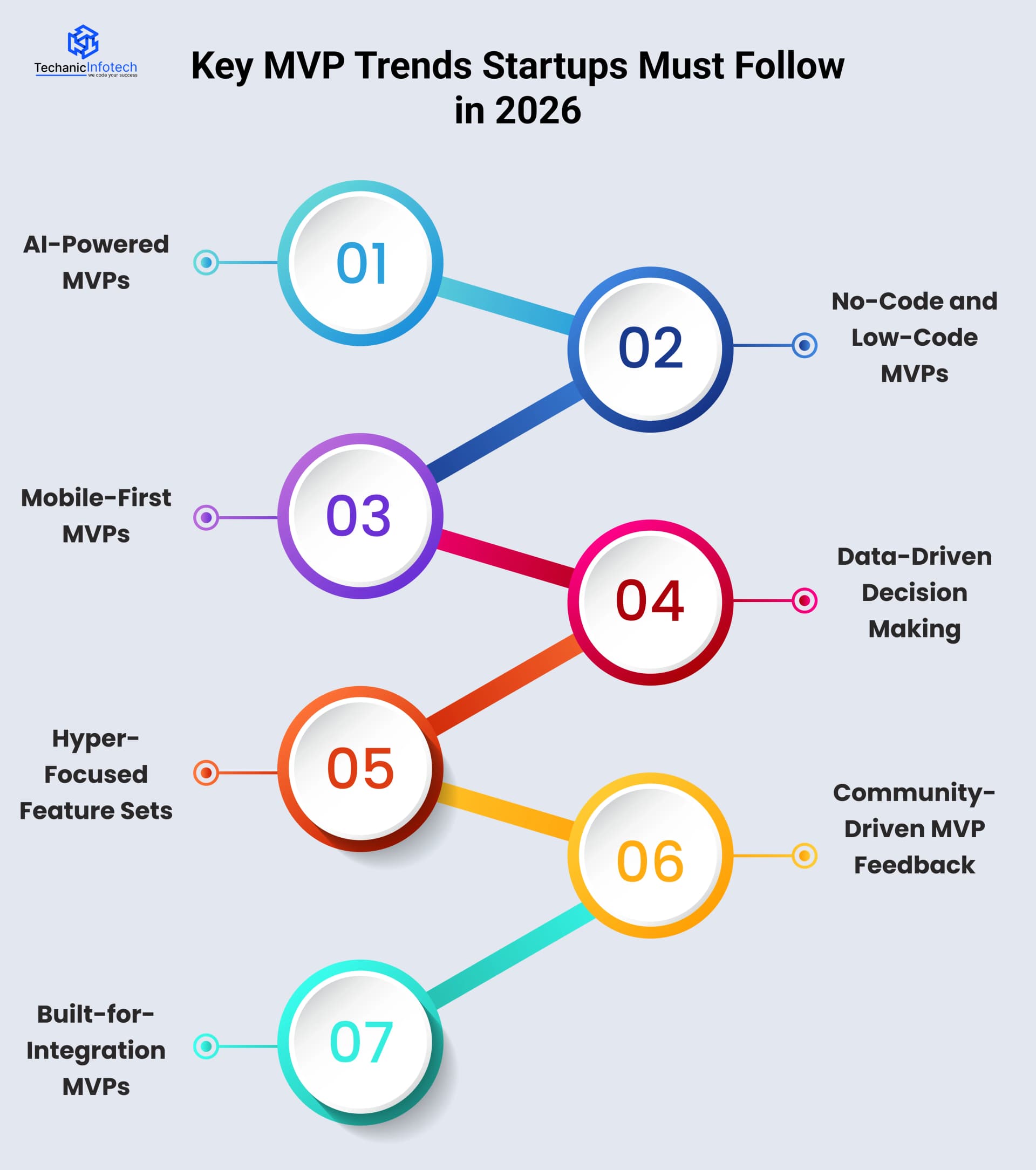
Artificial intelligence has become a core part of many digital products. From personalized recommendations to automated workflows, AI makes apps smarter and more valuable.
Startups now include basic AI features, like chatbots or predictive analytics, even in early MVP versions. These capabilities show investors that your product can adapt, learn, and offer real value beyond static features.
No-code and low-code platforms let startups create working MVPs without full engineering teams. These tools are ideal for validating ideas quickly and inexpensively.
With drag-and-drop builders, you can design workflows, integrate APIs, and launch interactive prototypes in days instead of months. This trend helps reduce cost and lets founders focus on feedback and iteration.
Today’s users expect mobile-ready products. Even if your final product includes web and desktop versions, launching an MVP with a mobile focus helps you gather early user insights faster.
A mobile-first MVP also appeals to investors looking for products that engage users in real time, no matter where they are.
Data matters more than ever. Startups now build MVPs with analytics that track how users interact with key features. These insights help you understand what works, what doesn’t, and what to prioritize next.
Investors pay close attention to real data, usage patterns, retention rates, and conversion funnels when evaluating an MVP.
Instead of building many features at once, startups in 2026 focus on one core value proposition and perfect it. This hyper-focused approach improves product clarity and speeds up feedback loops. It also helps reduce distractions, making your MVP easier to understand and evaluate.
Engaging early adopters or niche communities during MVP testing helps gather honest feedback before scaling.
Founders now use online communities, beta groups, or social platforms to refine their products. This trend not only improves product relevance but also builds a ready audience, something investors value highly.
Modern products rarely stand alone. MVPs that integrate with other tools, platforms, or services show forward thinking. Whether it’s connecting with CRM systems, payment gateways, or messaging apps, integration capabilities improve usability and expand your product’s ecosystem.
Building an MVP in 2026 is all about speed, clarity, and smart decisions. You don’t need a perfect product. You need a product that solves one real problem and proves people care.
Below is a practical MVP development process that startups can actually follow.
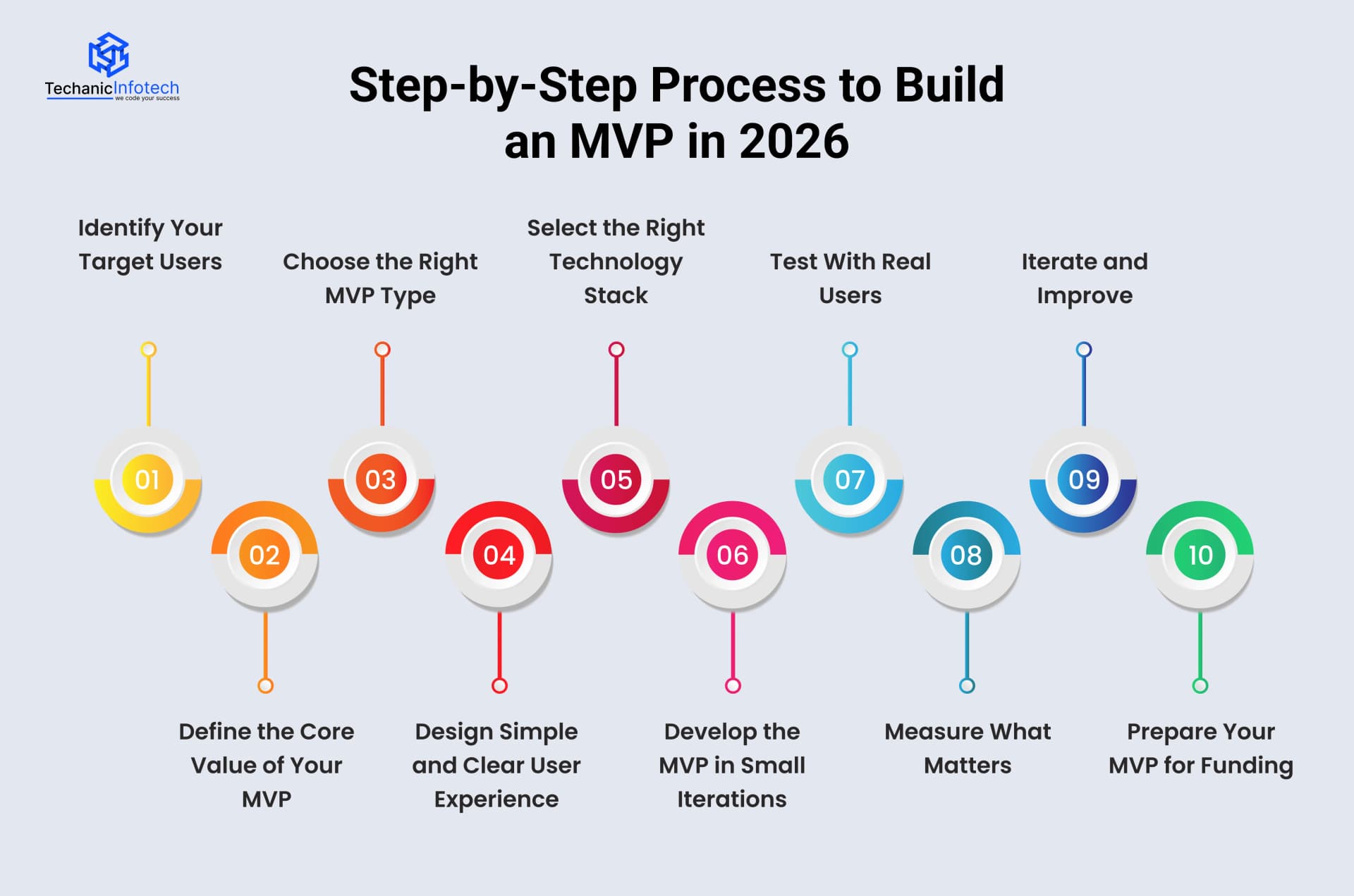
Before you create an MVP, get very clear about the problem. Ask yourself: Who is facing this problem? and Why does it matter?
Investors and users don’t fund ideas, they fund solutions. A clear problem statement sets the foundation for minimal viable product development and helps avoid building unnecessary features.
Not everyone is your user. In 2026, successful startups focus on a specific group with a clear pain point.
Define your ideal user based on behavior, needs, and context. This clarity helps you build an MVP that feels relevant and useful from day one.
Your MVP should do one main thing really well. List all possible features, then remove everything that is not essential.This step is critical to control cost and timelines. A focused MVP is easier to build, easier to explain, and easier to improve based on feedback.
Not all MVPs are full apps. In 2026, startups use different MVP formats:
Clickable prototypes
Landing pages
Basic functional apps
No-code or low-code MVPs
Choose the type that helps you validate your idea fastest. The goal is learning, not perfection.
Good app design does not mean complex design. Your MVP should be easy to use and easy to understand.
Focus on clear flows, simple screens, and obvious actions. A clean experience makes MVP app development more effective and improves early adoption.
Choose right tech stack that allow fast development and future scalability. Avoid overengineering.Many startups work with an MVP development company to make smart tech decisions early. This reduces rework and helps attract investors later.
Now it’s time to develop the MVP. Build in small steps instead of one big release.Test features as you build them. This approach reduces risk, improves quality, and keeps the team aligned with real goals.
Once your MVP is ready, put it in front of real users. Observe how they use it. Listen to feedback carefully.
Testing is crucial for MVP development for startups because it reveals what works and what doesn’t, early and cheaply.
Track simple metrics like user sign-ups, engagement, retention, or usage frequency. These insights are extremely important for MVP for startup funding, as investors want data, not guesses.
Use feedback and data to improve your MVP. Add features only if they support your core value.Iteration shows maturity and helps when pitching MVP development for investors.
Once you see early traction, prepare to pitch. Show the problem, the solution, user response, and growth potential.
This is where understanding how to secure funding using an MVP becomes critical. A working product with real users builds confidence faster than slides.

Understanding the cost and time required to develop an MVP helps startups plan better and avoid surprises. A well-defined MVP focuses on essential features, which keeps both development cost and development timeline under control.
The cost of MVP development depends on what you build, how complex it is, and how fast you want to launch. In 2026, most startups spend between $15,000 and $45,000 to build a solid MVP.
A simple MVP with basic features, limited screens, and standard functionality stays on the lower end. If your product needs custom features, integrations, or advanced logic, the cost increases.
Other factors that affect app development cost include design quality, technology stack, development location, and testing effort. Choosing only must-have features and building in small iterations helps keep costs under control.
The goal of an MVP is not perfection, it’s validation. Spending smart on a focused MVP helps you test your idea, attract early users, and move confidently toward funding without overspending.
The time it takes to build an MVP depends on the scope, features, and complexity of the product. In most cases, an MVP can be built within 8 to 16 weeks. A simple MVP with basic functionality and a clear user flow can be ready in about 8–10 weeks. If the product includes custom features, integrations, or more detailed design work, the timeline may extend to 12–16 weeks.
A realistic timeline helps you launch sooner, gather user feedback early, and improve your product step by step without unnecessary delays.
|
MVP Development Stage |
What Happens in This Stage |
Average Cost (USD) |
Time Required |
|
Idea Validation & Research |
Problem analysis, user research, competitor study |
$1,000 – $3,000 |
1–2 weeks |
|
Feature Planning & Scope |
Defining core features only (no extras) |
$1,000 – $2,500 |
1 week |
|
UI/UX Design |
Wireframes, basic design, user flow |
$2,000 – $5,000 |
2–3 weeks |
|
MVP App Development |
Core functionality, backend & frontend |
$8,000 – $25,000 |
6–10 weeks |
|
Testing & QA |
Bug fixing, usability testing |
$1,500 – $4,000 |
1–2 weeks |
|
Deployment & Launch |
App deployment, basic setup |
$500 – $2,000 |
1 week |
|
Initial Iteration (Post-Launch) |
Minor improvements based on feedback |
$1,000 – $3,000 |
Ongoing |
In 2026, investors don’t just fund ideas, they fund evidence. This is why a well-built MVP plays a huge role in helping startups raise money.
When done right, your MVP becomes proof that your idea works, users care, and the business can grow.
The investor mindset has changed significantly. Today, investors look for clarity, speed, and execution. They want to see that founders understand the problem deeply and can move fast without wasting resources.
A strong MVP shows that you can build an MVP, test assumptions, and learn quickly. For MVP development for investors, execution matters more than long business plans.
From an investor’s point of view, risk is everything. A raw idea carries high uncertainty, but a working MVP reduces that risk. When you develop an MVP, you prove technical feasibility and market interest at the same time.
This makes investors more confident that their money will be used wisely. That’s why minimal viable product development is often the first step before serious funding conversations begin.
Metrics turn your MVP into a funding tool. Investors want to see numbers that show real usage and interest. This may include user sign-ups, active users, retention, engagement, or conversion rates.
Even small but consistent metrics can help secure funding with an MVP. These data points show progress and make your startup easier to evaluate.
Traction builds trust. When users are actively using your MVP, giving feedback, or recommending it to others, it adds credibility to your pitch. This is especially important for MVP for startup funding, where early signals matter more than scale.
Traction shows that the problem is real and your solution resonates.
At the pre-seed stage, investors usually expect a basic MVP or prototype that validates the core idea. At the seed stage, they expect a more refined MVP with early traction and clear metrics. Knowing how to build a minimal viable product in 2026 helps you align your MVP with the right funding stage and avoid pitching too early or too late.
Many of today’s biggest companies started with a very simple MVP. These early versions focused on solving one clear problem, testing demand, and learning fast.
Below are popular real-life MVP examples that show how starting small can lead to massive success.
Airbnb began with a very basic idea: renting out air mattresses in an apartment to people attending a conference. The first MVP was just a simple website with photos of the space and a way to contact the hosts. There were no advanced features, no complex booking system, and no mobile app.
This MVP helped the founders validate one key thing people were willing to pay to stay in someone else’s home. Early user feedback helped them improve trust, pricing, and usability. By solving a real problem with a simple MVP, Airbnb proved demand and later raised funding to scale globally.
Dropbox’s MVP is a classic example of validating an idea without building a full product. Instead of developing the complete file-sync system upfront, the founders created a short demo video showing how the product would work.
This video explained the problem and solution clearly. It generated massive interest and sign-ups overnight. The response proved strong demand and helped Dropbox secure investor interest. This MVP saved time, reduced development risk, and showed that sometimes an MVP doesn’t even need to be a working app.
Uber’s first MVP was a very basic app that allowed users in one city to request a ride from a limited number of drivers. It was not available everywhere and had minimal features. The goal was simple: test whether people would use an app to book rides instead of taxis.
The MVP proved that users valued convenience and real-time tracking. Early traction helped Uber refine pricing, expand features, and scale city by city. This focused MVP approach helped Uber grow into a global transportation platform.
Building an MVP is meant to increase investor confidence but when done wrong, it can do the opposite. Many startups lose investor interest not because the idea is bad, but because the MVP sends the wrong signals.
Below are common MVP mistakes that scare investors away, along with practical solutions.
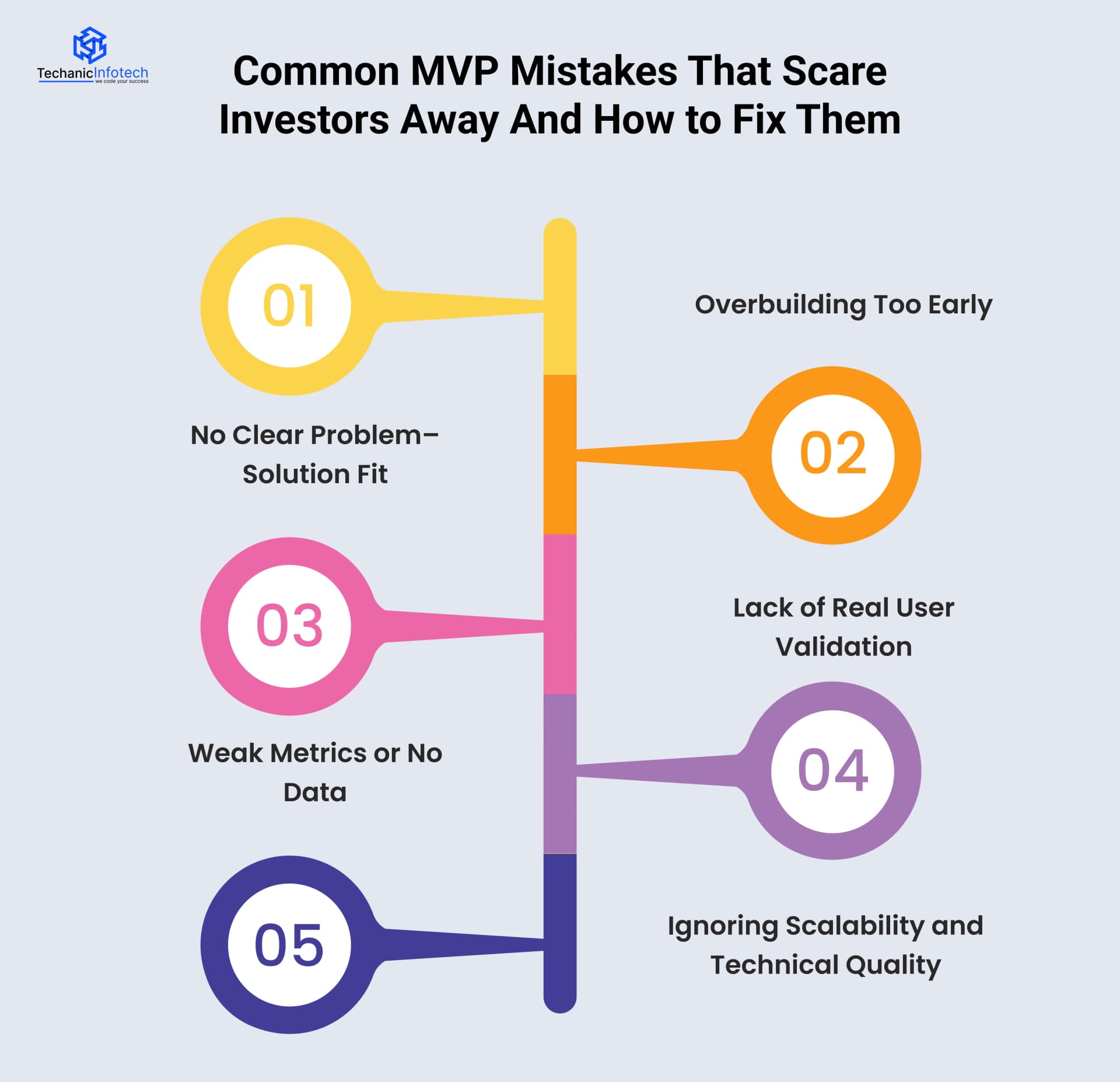
Many founders try to build a “perfect” product instead of a minimal one. They add too many features, complex flows, and unnecessary integrations before validating demand. This increases MVP development cost and delays launch.
Solution: Focus only on the core problem and one key solution. Build features that prove value, not features that look impressive. Investors prefer focused execution over complexity.
An MVP that doesn’t clearly solve a real problem confuses investors. If they can’t quickly understand who it’s for and why it matters, they lose interest.
Solution: Clearly define the problem and show how your MVP solves it. Use simple language and real user examples to demonstrate relevance.
Presenting an MVP with no users, feedback, or traction makes investors doubt demand. Assumptions without proof are risky.
Solution: Test your MVP with real users. Even small traction, sign-ups, usage, or feedback, adds credibility and shows market interest.
Some founders show an MVP but can’t explain what the data means. This makes investors question decision-making skills.
Solution: Track basic metrics like user engagement, retention, or conversions. Explain what you learned and how data influenced product decisions.
An MVP that looks unstable, slow, or poorly built raises concerns about future growth.
Solution: Your MVP doesn’t need to scale massively but it should be clean, stable, and built with future growth in mind. Investors look for smart technical foundations.
Pitching your MVP in 2026 is not about having the flashiest slides. It’s about clarity, proof, and confidence. Investors want to quickly understand the problem, see how your MVP solves it, and know why this solution can grow.
Below is a practical guide to help you pitch the right way.
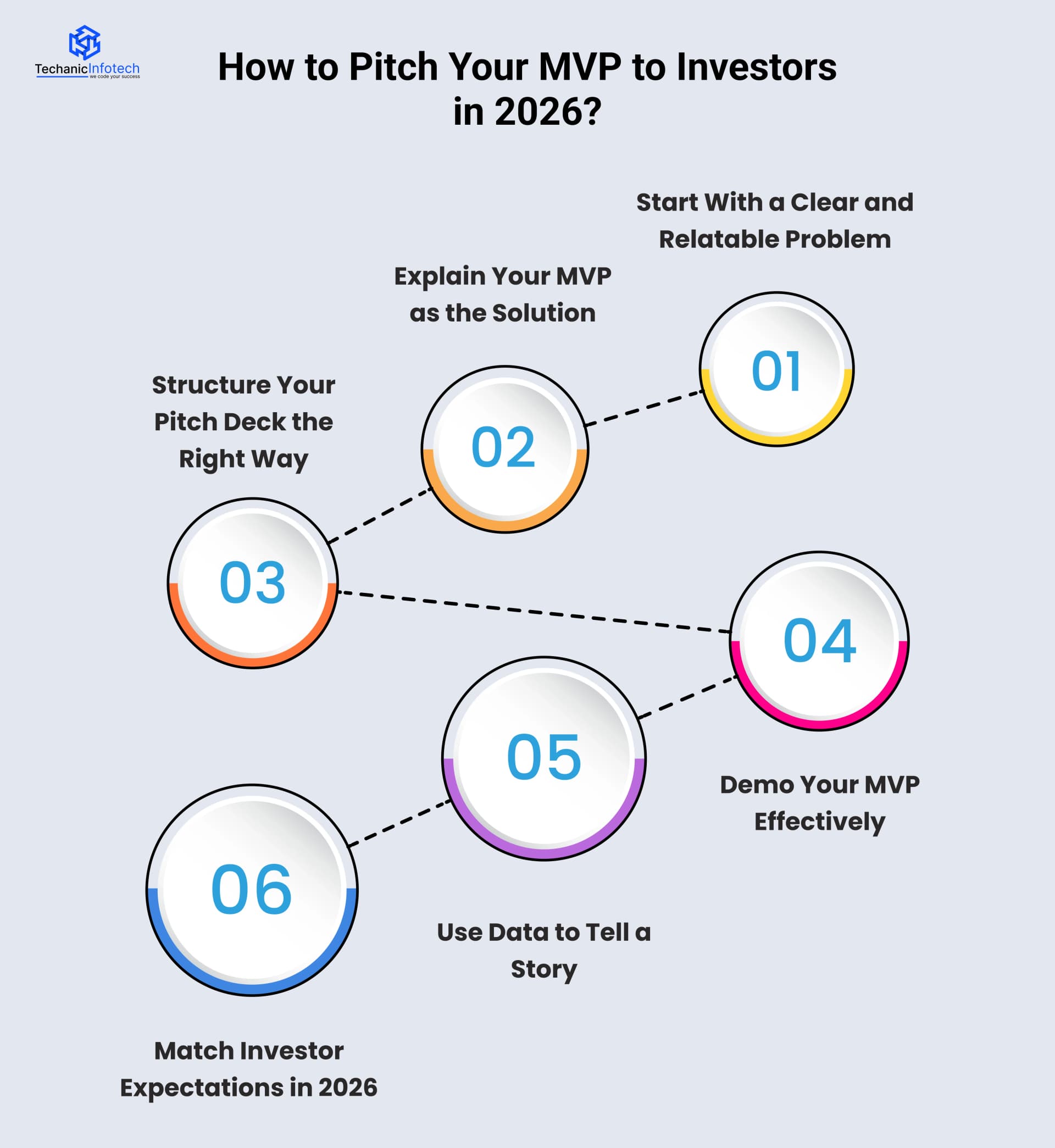
Begin your pitch by explaining the problem in simple terms. Investors should instantly understand who faces this problem and why it matters. Avoid buzzwords and long explanations. A clear problem statement shows that you truly understand the market you are building for.
Tip: If investors don’t relate to the problem within the first few minutes, they will lose interest.
Once the problem is clear, introduce your MVP. Explain what your product does and how it solves the problem better or faster than existing options.
Focus on the core value, not every feature. This is where MVP app development pays off, your product should be simple, focused, and easy to understand.
Your pitch deck should follow a logical flow:
Problem
Solution (your MVP)
Target users
Traction and early results
Business model
Market opportunity
Roadmap
Team
Keep the deck short and clean. Investors in 2026 prefer clarity over long presentations.
A live MVP demo is powerful but only if done right. Show one or two key workflows that highlight your core value. Don’t click through everything. Make sure the demo is stable and rehearsed.
Tip: If the demo fails, explain confidently what you intended to show and move on. Calm handling matters.
Numbers make your story believable. Use simple metrics like user sign-ups, engagement, or retention to show progress. Don’t overload slides with data. Instead, explain what the numbers mean and what you learned from them. This storytelling approach helps secure funding with an MVP.
Common mistakes include overpromising, ignoring competition, and talking too much about future features. Investors want honesty and focus. Overbuilding or exaggerating signals risk.
Investors today expect founders to move fast, learn from users, and manage costs wisely. Show that you understand cost, user feedback, and next steps. Confidence combined with realism builds trust.
Turning an idea into a successful MVP requires the right balance of speed, quality, and strategy and that’s where Techanic Infotech comes in. We help startups and founders plan, design, and build MVPs that are focused, scalable, and investor-ready.
From validating ideas and defining core features to managing MVP development cost and timelines, our mobile app development company follows a practical, startup-first approach. Whether you are building your first product or refining an idea for funding, we work closely with you at every step.
With real startup experience and a clear development process, Techanic Infotech helps you launch faster, learn quicker, and move confidently toward growth and funding.

At Techanic Infotech, we’ve helped startups turn raw ideas into working MVPs under tight timelines and budgets.
In one recent project, our client wanted to validate their idea quickly but struggled with unclear feature priorities and limited technical direction. The biggest challenge was avoiding overbuilding while still delivering something investors could trust.
We solved this by narrowing the MVP to one core use case, simplifying the user flow, and launching in small iterations. Early user feedback helped us refine features without increasing cost. As a result, the client launched faster, gained early traction, and used the MVP confidently in investor discussions.
Building an MVP in 2026 is not about creating a perfect product, it’s about creating the right product. A focused and well-planned minimal viable product development approach helps startups test ideas quickly, manage MVP development cost, and learn from real users.
More importantly, a strong MVP makes it easier to gain investor trust and secure funding with an MVP. By understanding how to build an MVP, following the right process, and avoiding common mistakes, founders can move faster with confidence.
Whether you are just starting out or preparing for your first pitch, a smart MVP lays the foundation for long-term growth. In today’s startup ecosystem, knowing how to build and present an MVP can make all the difference.
A Minimal Viable Product (MVP) is the simplest version of a product that solves a core problem and can be used by real users. It helps startups validate ideas quickly without building a full product.
In 2026, MVP development cost typically ranges between $15,000 and $45,000, depending on features, design complexity, technology stack, and development approach.
Most MVPs can be built within 8 to 16 weeks. A basic MVP takes less time, while more complex MVPs with integrations or custom logic may take longer.
Investors prefer startups with an MVP because it reduces risk. A working MVP shows execution ability, market demand, and early user validation instead of just ideas.
Yes. Many startups secure pre-seed or seed funding using an MVP, especially if it shows traction, user engagement, or clear problem–solution fit.
Investors usually look for metrics like user sign-ups, active users, engagement, retention, feedback, and early revenue signals.


Bharat Sharma is the CTO of Techanic Infotech, bringing deep technical expertise in software architecture, mobile app development, and scalable system design. He leads the engineering team with a strong focus on innovation, performance, and security.