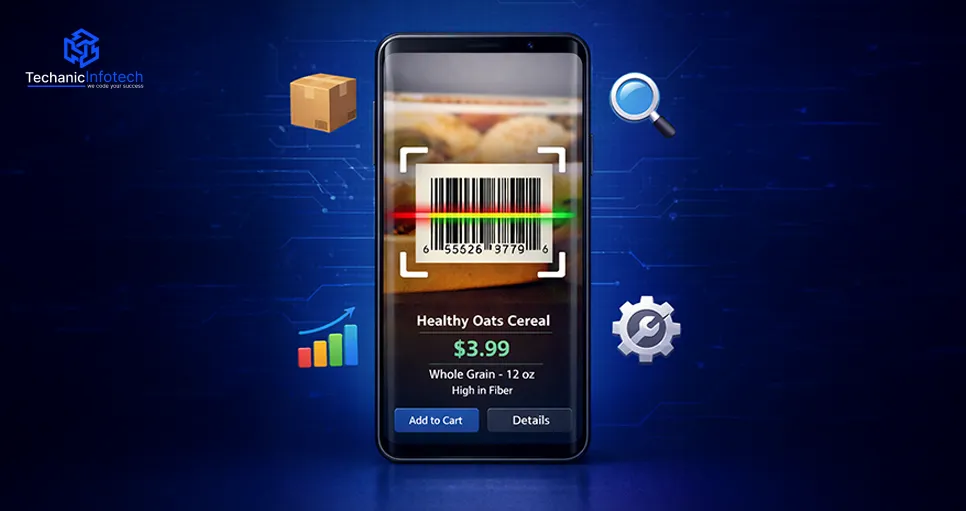
Product scanner apps let users scan barcodes or QR codes with their smartphone camera to instantly access product information.
These apps are widely used in retail, e-commerce, inventory management, and price comparison platforms.
By scanning a code, users can view details such as product name, price, ingredients, reviews, availability, and seller information.
Businesses also use these apps to track stock, manage warehouses, and streamline checkout processes.
With the growth of mobile commerce and smart retail systems, product scanner apps have become essential tools for both consumers and businesses.
The user opens the app and scans a barcode or QR code using the smartphone camera. The scanning technology detects patterns and converts the visual code into a readable digital product identifier.
Once scanned, the app decodes the barcode or QR code. It converts the encoded pattern into numeric or character values that uniquely identify a product in a database system.
After decoding, the app sends the product code to an online database or API. This request retrieves product details, including name, manufacturer, description, and pricing information.
The server processes the request and searches for the matching product record. If found, it sends back information including product specifications, images, reviews, and availability across stores.
Product scanner apps offer multiple functionalities that enhance shopping convenience and inventory management.
These mobile app features help users quickly identify products, compare prices, and track product details efficiently.
This feature enables users to scan barcodes or QR codes using the smartphone camera. Advanced scanning technology ensures quick recognition, even in low-light conditions or partially damaged codes, improving user experience.
After scanning a product, the app retrieves detailed information from databases or APIs. Users can access product descriptions, ingredients, specifications, manufacturer details, images, and sometimes customer reviews or ratings.
The app compares product prices across different online stores or nearby retailers. This helps users identify the best deals and make cost-effective purchasing decisions without manually searching multiple websites.
Businesses use scanner apps to track product quantities, update stock levels, and manage warehouse inventory efficiently. This feature reduces manual data entry and helps prevent stock shortages or overstocking.
The app records previously scanned products and purchase history. Users can revisit past scans, check product details again, or analyze their buying patterns for better budgeting and decision-making.
Product scanner apps serve different purposes depending on user needs, industries, and functionality. Various types of apps focus on shopping assistance, inventory control, or product verification.
These apps help consumers scan products while shopping in stores. Users can quickly check product details, reviews, and price comparisons to ensure they are getting the best value.
Businesses use these apps for warehouse and stock management. Employees scan products to update inventory levels, monitor stock movement, and manage supply chains efficiently.
These apps focus primarily on comparing product prices across different retailers and e-commerce platforms. They help shoppers identify discounts, deals, and the most affordable purchasing options.
These apps verify whether a product is genuine or counterfeit. By scanning the product code, users can confirm authenticity using manufacturer databases or blockchain-based verification systems.
Some apps scan food product barcodes to provide detailed nutritional information. Users can view calorie counts, ingredient lists, allergens, and dietary recommendations to make healthier food choices.
Product scanner apps provide numerous advantages for both consumers and businesses by simplifying product identification and improving operational efficiency.
Users can instantly identify products by scanning a barcode or QR code instead of manually searching for details. This saves mobile app development time and enhances convenience while shopping or managing inventory.
Customers can access product reviews, ingredients, and price comparisons in seconds. This transparency helps them make informed purchasing decisions and improves overall customer satisfaction.
Businesses can track stock levels accurately using scanning technology. Real-time inventory updates reduce human errors, streamline warehouse management, and ensure products remain available for customers.
Price comparison features help users find the most affordable option across different retailers. This allows shoppers to save money and identify discounts or promotions easily.
Companies can collect valuable data on customer behavior, product popularity, and purchase trends. These insights help businesses optimize marketing strategies and improve product offerings.
Automated barcode scanning eliminates manual data entry mistakes. This ensures accurate product information, efficient stock management, and reliable tracking across supply chains.
Building a product scanner app by getting help from a reliable mobile app development company requires a combination of frontend technologies, backend systems, scanning libraries, and cloud services to ensure smooth performance and accurate product data retrieval.
Frontend frameworks such as React Native, Flutter, or Swift are used to design the user interface. These technologies ensure responsive layouts, smooth navigation, and seamless camera integration for scanning functionality.
Backend systems handle data processing, API communication, and authentication. Popular technologies include Node.js, Django, Ruby on Rails, and Java Spring Boot for building scalable and secure server infrastructures.
Libraries like ZXing, ML Kit, and OpenCV help detect and decode barcodes efficiently. These libraries allow developers to implement high-speed scanning with accurate recognition capabilities.
Cloud platforms such as AWS, Google Cloud, or Azure provide storage, computing power, and database management. Databases like Firebase, MongoDB, or PostgreSQL store product information and user data securely.
Product information APIs allow the app to retrieve details such as descriptions, images, prices, and reviews. Popular sources include retail databases, e-commerce APIs, and product catalog services.
Mobile app development process usually involves several stages, from planning and design to deployment and continuous improvement.
Developers analyze market demand, target users, and competitors before building the app. This step defines the app’s core features, functionality, and business objectives.
Designers create intuitive interfaces that simplify scanning and navigation. Wireframes and prototypes help visualize user interactions and ensure a seamless user experience.
Selecting appropriate programming languages, frameworks, and cloud services ensures the app runs efficiently. The mobile app tech stack must support scanning features, database integration, and scalable performance.
Developers build the app’s frontend and backend components. This stage includes implementing scanning features, user authentication, database integration, and overall application logic.
Scanning libraries and camera APIs are integrated into the app. Developers optimize the system to ensure accurate code detection even in challenging lighting or scanning conditions.
Product information APIs are connected to retrieve data such as descriptions, images, and pricing. This integration ensures users receive accurate and updated product details.
Quality assurance teams test the app for bugs, performance issues, and scanning accuracy. Security, usability, and compatibility across devices are also verified before launch.
After testing, the app is deployed on app stores such as Google Play and Apple App Store. Marketing strategies and user feedback help improve the app after launch.
The mobile app development cost depends on features, technology stack, development team location, and project complexity.
A basic app usually costs between $10,000- $25,000 includes barcode scanning, product information retrieval, and a simple user interface. It usually supports limited database integration and basic functionality suitable for small businesses.
A mid-level app costs between $25,000- $50,000 includes advanced scanning features, user accounts, price comparison, and improved UI/UX design. It also supports API integrations and cloud database management.
Complex apps cost between $50,000- $90,000 include AI-powered scanning, inventory management systems, analytics dashboards, and real-time product updates. These apps are suitable for enterprise-level retail or logistics companies.
Post-launch mobile app maintenance typically costs 15–20% of the total development cost annually. Updates ensure compatibility with new devices, security improvements, and feature enhancements.
Costs may increase depending on external APIs, cloud services, or data providers. Licensing fees for product databases or scanning libraries may also affect overall minimum viable product development expenses.
Developing a product scanner app involves several technical and operational challenges that developers must address to ensure reliability and performance.
Ensuring accurate scanning in various lighting conditions and angles can be challenging. Developers must optimize camera performance and scanning algorithms to maintain high accuracy.
Maintaining a large and constantly updated product database is complex. Apps must connect to reliable APIs or data providers to ensure users receive correct product information.
Scanning and data retrieval must occur quickly to maintain user satisfaction. Poor optimization can lead to slow loading times and reduced app usability.
Apps must protect user data and prevent unauthorized access. Implementing strong authentication systems and secure data storage is essential.
Ensuring smooth performance across different devices and operating systems requires extensive testing and optimization during development.
Product scanner apps have transformed the way consumers and businesses interact with products.
By enabling instant barcode or QR code scanning, these apps provide quick access to product information, pricing, reviews, and availability.
For businesses, they streamline inventory management, asset tracking, and supply chain operations.
With the growing demand for smart retail solutions and mobile commerce, the popularity of product scanner apps continues to increase.
When designed effectively, a product scanner app can enhance operational efficiency, improve customer satisfaction, and create new business opportunities in retail, logistics, and e-commerce industries.
A product scanner app allows users to scan barcodes or QR codes using their smartphone camera to instantly access product details such as price, ingredients, reviews, and availability.
Yes, most product scanner apps are highly accurate when connected to reliable product databases. Accuracy depends on scanning technology, camera quality, and the availability of updated product information.
Some apps support offline scanning by storing scanned codes temporarily. Once the device reconnects to the internet, the app retrieves product details from its database.
Retail, logistics, warehousing, healthcare, and manufacturing industries commonly use product scanner apps for inventory tracking, product identification, and supply chain management.
Developing a basic product scanner app usually takes 2–4 months, while advanced apps with complex features and integrations may require 6–9 months or longer.


Bharat Sharma is the CTO of Techanic Infotech, bringing deep technical expertise in software architecture, mobile app development, and scalable system design. He leads the engineering team with a strong focus on innovation, performance, and security.